Tuesday, 12 April 2011

Penang - Past and Present 1786-1963

from: Inter Library. Loan, PHT
to: faridah
date: Mon, Apr 4, 2011 at 1:22 PM
subject: Buku (ruj. 10114)

salam
Buku yang dimohon seperti berikut telah diproses.

Title: Penang past and present, 1786-1963 : a historical account of the City of George Town since 1786
Call No: DS598.P39 P397
Publisher: City Council of George Town, Penang, 1966.
Accession: 00000162414


Penang Past and Present 1786-1963. A Historical account of the city of George Town since 1786. Published by the City Council of George Town, Penang. 1966.

Just an old book...

This 1966 book contains the 177-year history of Penang from 1786 to 1963. This period covers 3 phases - (i) 70 years before the British under Francis Light acquired Penang, (ii) 101-year colonial rule by the British  and (iii) 6 years post-Merdeka. There are important photos and dates which can be added to the Milestones of TEMD. The book that I received is an old photocopied version and the photos are not clear.

Useful information, landmarks & pics:

Ayer Itam Dam - Plaque at the Ayer Itam Dam

Plaque at the Ayer Itam Dam, Penang. This dam was constructed in 1958-1962.

Pengkalan Tun Uda (P.P.C. Ferry Terminal) - Gateway to the City
P.P.C. = Penang Port Commission

Pengkalan Tun Uda (P.P.C. Ferry Terminal)
With my family at Pengkalan Raja Tun Uda, circa 1960s. I'm the little girl at left facing the camera.

Chapter IX - Reconstruction of The Broken Past
- has Dr K. Mohd Ariff listed among the names

Unveiling of the Statue of Captain Francis Light, 1939
- from the collection of Captain Mohd Nor bin Mohamed, PJK, ED, JP

A black statue of Francis Light unveiled in Penang
Statue of Sir Francis Light in Penang. Photo by Penang Museum

Trade depression, 1922
Author's note:
According to Kamaruddin bin Captain Md Nor, Dr Che Lah’s grandfather, Shaik Ahmad was from Hyderabad near Darjeeling, Deccan in India. In 1800s, Shaik Ahmad came to Malaya with the British Army. Shaik Ahmad was either a dhobi or tailor in the British Army. In Malaya, Shaik Ahmad married Puan Hajar and they had six children (three sons and three daughters) – Hamidah Bee, Jan Bee, Mohd Joonos, Mohd Ali, Mariam and Captain Md Nor. Captain Md Nor bin Shaik Ahmad has sons named Kamarudin and Samsudin, by his third wife. A contributor to this research mentioned that there was possibly another man in Penang who was also named Captain Md Nor. This other man was Master Mohamed Nor bin Mohamed, a schoolteacher and brother of Dr Abdul Ghani bin Mohamed.
Source: The Early Malay Doctors: Dr Che Lah bin Md Joonos. 3 April 2012, 11:54:40 PM, 22nd draft     

page 72
Illicit manufacture of ice-cream was a source of typhoid in 1940, and ice-cream was confiscated. Ice-cream was stamped out in 1948.

Latest census (1957)
Malays 26,757
Chinese 171,245
Indians 32,029
Others 4,872
Total: 234,903

page 71
Census of 1931 during Dr Glass' period:

Race
Male
Female
Total
%
European
703
471
1,174
1
Eurasian
910
1,066
1,976
1
Chinese
58,519
42,723
101,242
68
Malay
9,618
9,518
19,136
13
Indian
18,314
5,806
24,120
16
Others
986
774
1,760
1

Dr GW Park
- organised a Health Dept (undated)
- opened a Maternity Hospital in 1915
- retired in 1917

Dr Rose
- succeeded Dr GW Park till 1927 
- died in 1927
- dealt with epidemics of 1918-19 (after WWI)

WWI
- the aftermath of WWI was influenza, smallpox and plague
- first case of influenza in July 1918 & another in Oct 1918 (3 mo apart, same year)
- others: bubonic plague, smallpox and malaria

Chapter VII - The Problem of Health

Mr W Peel
- WWI Municipal President, 1913

page 57
Modes of transportation
private carriage - most numerous in 1906, last registered 1954
Hackney carriage - nil of note
gharry - used for various periods beginning 1895-1917; 1920; 1931; 1932; 1934; last used 1935

page 53
Electricity and the electric tram
- the Commissioners made the first journey on the electric tram on 23 December 1905

page 52
Kerr Stuart's Penang Steam Tramways Ltd
- was put up for sale by auction in May 1900 but there were no bidders
- its assets were then bought by the govt (not by the Municipality in 1901
- tram service was resumed but at a loss
- the govt gave notice to discontinue tram service in July 1903
- Author's note: Prof Kerr of the English Dept, University of Hong Kong, is looking for his relatives

Mr JW Hallifax
- came to be regarded as the town's guiding spirit
- was part of a 3-member Municipal Commission (other 2 were LH Clayton & AR Adams)

Mr LH Clayton
- he, JW Hallifax and AR Adams were part of a 3-member MC
- Mr Clayton left the Colony in June (1906?)
- Author's note: Muzium Kelantan is looking for a "Clayton" wrt 2 photo albums that were donated to the Kelantan Sultan after the 1914/15 annual flood after which he returned to England. The 2 albums are now with Muzium Kelantan.

Trams started in Penang in 1906

page 46
Electricity supply in Penang
- first electricity supply to Penang on 14 July 1904 (41 arc lamps in public streets, 15 private homes, supplied at night only)
- continuous electricity supply by 1 January 1905
- continuous electricity supply was channelled to 188 (Dec 1905) and 336 (Dec 1908) private users
- policy of replacement - issued in 1909 to replace oil lamps with electricity
- ceiling fans were first used in 1907 through 1924; and then 1925-1928 fans were ubiquitous (everywhere)
- punkah
- punkah puller ended 1925

Captain Master Mohd Nor bin Mohamed PJK, ED, JP
- President of Penang Historical Society
- Re-convened (1961)
- Re-organised (Nov 1961)
- Re-convened (Sept 1963)
- Committee 1964/1965
- Editorial Board (1963- 1965)
- Unveiling of the Statue of Captain Francis Light, 1939
- Author's note: There seems to be 2 people named Captain Mohd Nor who lived in Penang. One is related to me, the other is not. The Capt Mohd Nor bin Shaik Ahmad that I know married 3 wives and had 19 children. The last 2 wives were sisters but he married them one after the other after the elder sister died (salin tikar). Capt Mohd Nor's son, Kamaruddin bin Mohd Nor (in PJ), I was told, has a large collection of old family photos. Master Mohd Nor bin Mohamed was a JP and was not involved in the army. His daughter is ex-nurse Fadzilah in Melbourne, Australia.

Introduction by Captain Master Mohd Nor bin Mohamed.

Tuan Haji Shamsuddin bin Mohd Joonos (bin Raboo), JP
- 1957 Committee

There were 2 men named Shamsuddin bin Mohd Joonos in Penang. Tuan Haji Shamsuddin bin Mohd Joonos bin Raboo (Mas Raboo) was a postmater and was connected to the Brunei royal house.  

Malay School
- Map XVII (grid C5, D5, and E4)
- Malay School is in Jalan Kampong Melayo, Penang
- Jalan Kampong Melayo links 2 roads - Ayer Itam Road and Jalan Kampong Pisang
- the Agriculture Dept is also in the same road but nearer to Jalan Kampong Pisang
- Ayer Itam Road becomes Penang Hill Railway Road which leads to Penang Hill

Penang Free School (PFS)
- Map VII (grid A1, B1)
- The more recent PFS is in Green Lane. The older PFS was in George Town (it is now the Penang Museum).
- The road behind the Green Lane school ground is Free School Road (grid B1-4)

Old Penang Free School in George Town, before the more recent one was built in Green Lane (below).
PFS in Green Lane
PFS in Green Lane during heavy traffic

Penang Hill
- Map XVII (grid A1, B1-3)

With my siblings at Penang Hill ground station, early 1960s. I'm 2nd from right, facing the camera.

Penang Chinese Girls' High School 
- Map X (grid F5)
- Penang Chinese Girls' High School is in Gottlieb Road

St John Ambulance, PCGHS, 1980s. My mother Tulip Che Lah is seated 4th from left.

Ludin's House (Kudin's house? Is Ludin, Kudin?)
- Map VIII (grid D4)

Marine Depot & Jetty
- Map VIII (grid E3-5)
- Marine Depot was in Calthrope Road (grid E3-4)
- Author's note: They had Akuarium Negara here once but that had closed down. It is now the TLD (Tentera Laut DiRaja) base in Penang.

With my family at Akuarium Negara, Penang, 1974/75. I'm 4th from right.

Malayan Teachers College (MTC)
- Map VIII (grid D3)
- MTC is in Glugor Road (now renamed Jalan Sultan Azlan Shah)
- MTC is sited on Coombe Hill. MTC is still there. 
- Author's note: RECSAM is also there.


Radio Malaya Transmission Station
- Map VIII (grid E2) 
Photo  from Penang Museum
Photo from Penang Museum

Telecoms Transmission Station
- Map VIII (grid E2) 

Dr Che Lah's bungalows
- Map VIII (grid E2-3, F2)
- his 3 bungalows would in this area on the side of the 2 transmission towers
- his first bungalow was a small house in Glugor Road (house is still there)
- his second bungalow (219 Bukit Glugor/219 Solok Pemancar) was on a hillside overlooking Glugor Road
- his third bungalow (355A Lengkok Pemancar, was demolished around 1976) would be in Jalan Buah Manggis, with a large rambutan farm between this road and Jalan Rambutan 

At Dr Che Lah's second bungalow (219 Bukit Glugor) in Glugor Road, 1963. I'm standing at right most.
Dr Che Lah's third bungalow near the rambutan plantation in Glugor, later demolished after 1976.
.
Kampong Dodol
- Map VII (grid A5)
- the mosque in grid 4A is Masjid Wanchee Ariffin
- Kampong Dodol is in Perak Road (now Jalan Perak) 

Masjid Wanchee Ariffin
- Map VII (grid 4A)
- Masjid Wanchee Ariffin is in Jalan Perak in Kampong Dodol 

Masjid Haji Hashim Yahaya
- Map VI (grid 4G)
- Masjid Haji Hashim Yahaya is in Jalan Perak and is surrounded by a large Muslim burial ground, roughly broken into 3 sections - the largest section has the Pejabat Pengurusan Perkuburan and Makam Dato' Keramat. The other 2 sections are across the road from the mosque and are divided into 2 by a small lane. 


Masjid Haji Hashim Yahaya, Jalan Perak, Penang

Methodist Boys' School (MBS)
- Map VI (grid F1)
- MBS is in Ayer Itam Road. The MBS was previously the Anglo-Chinese School, Penang (ACSP).
- Author's note: Among those who attended the ACSP were Dr Che Lah bin Md Joonos and Tok Chu.

MBS from my car window

Penang General Hospital
- Map VI (grid D3)
- Penang GH is bordered by Hospital Road, Residency Road, Western Road and Gaol Road 
Penang GH with cenotaph in the parking lot between Block A (the big building) and the director's complex  (pink building, not shown in this pic)

Nurses Quarters
- Map VI (grid C3, D3)
- Nurses Quarters bldg is bordered by Residency Road, Hospital Road, Tull Road and Barrack Road 

Nurses Hostel
- Map VI (grid C3)
- Nurses Hostel is in Residency Road and across the road from Penang GH. It is near the Maternity Hospital.


Nurses Hostel, Penang

St Georges Girls' School (SGGS)
- Map VI (grid B2)
- SGGS is in Macalister Road and nearest Residency Road Girls' School and the Maternity Hospital 

Residency Road Girls' School (RRGS)
- Map VI (grid B3, C3)
- RRGS is in Residency Road and nearest the Maternity Hospital and Nurses Hostel 


Residency Road Girls' School, Penang

Maternity Hospital, Penang. Closed down in 1991?

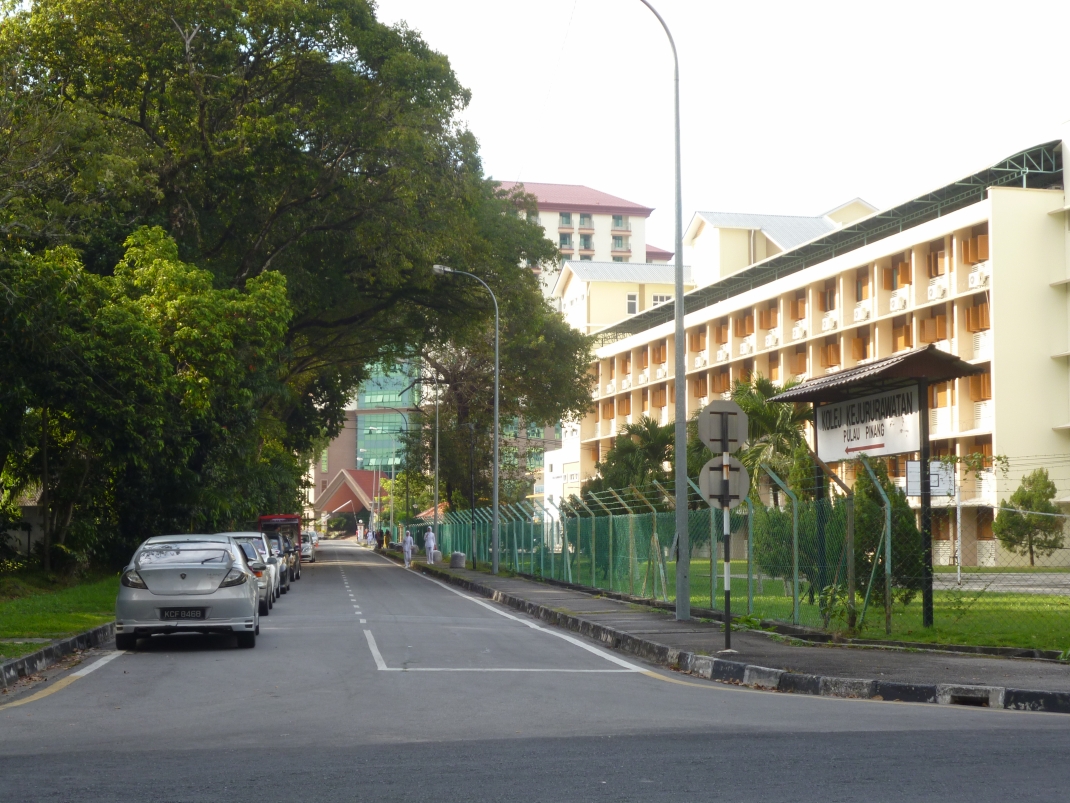
Signboard to the Nursing College, Penang (the college is straight ahead down the road)

Polo Grounds 
- Map VI (grid C1-2, D1-2)
- Polo Grounds is bordered by Sepoy Lines Road on 2 sides, Western Road and Residency Road 


Padang Polo, Penang

The Residency
- Map VI (grid D1-2)
- The Residency is the residence of the head of state or Penang Governors
- The Residence is in Western Road

External link

Wednesday, 6 April 2011

Johor Malays

Johor Malays are civilised in their manners and speech. They are often very pretty but they tend to also wear talisman (tangkal) to make them pretty for a lifetime. They are already pretty without tangkal but I would like to think it's just following on with family customs. As the Malays say, "Biar mati anak, jangan mati adat!" But if they are Muslims, then tangkal is benda terlarang and of course haram. But since adat is a stronger push factor, there's no way to stop adat from being passed on to issues. I have only seen the so-called tangkal once, belonging to a sweet Johor lady. In KL, the Malay ladies who are second wives also wear tangkal to keep their husbands to stay on with them rather than return to their senior wives. In Kelantan, most married ladies prefer tiny susuk metal implants which show up on x-ray films! These are often gold or silver implants. And that is why, many young boys are doing posting in x-ray so they can see these implants. Well, if ladies want to look pretty, men too have done their fair bit to be at par. I found out from reliable men, our hospital also offers a better alternative to Viagra! What can that be? Yes, vitamin E injection into the penis that gives erection that lasts at least the whole night! It costs RM500 per dose and it is big business. I really don't understand why people want to be super males when the genes can do everything for them! Don't try Viagra + vitamin E though; it will certainly give the best shot and best thrill but it can definitely kill!

Tuesday, 5 April 2011

KL Malays

KL Malays are a mixed kettle. There are many types and they cross-breed and inbreed so much so that the family trees are so entangled and some with missing links.

One type is the pure Malays who inbreed and don't out-marry, to keep wealth within controllable loops (my term is guni perang or tempayan tutup). There are three types who fall into this category and it is hard to infiltrate these sub-groups.

One Malay group is a mix of Chinese-Malay and Indonesian ladies. These Malays are filthy rich and do good business. They have good networks that support their businesses. Another type is Indian-Malay and Indonesian ladies. Their sons are dark but their daughters are fair and mistaken for Arab ladies which is misleading. There are others but it is hard to tell as after many generations, they all look the same, neither Malay, Chinese nor Indian. Nak panggil apa pun tak tau! Let me just refer to them as the 'homogeneous Malay features', senang cerita!

The only reason we call them all Malay is they pronounce the Malay words properly and their sentence structure is acceptable to pass them as Malay. Otherwise I too don't know that they are indeed Malays.

Migration and immigration, transfers etc etc etc, they all result in people mobility and families are constantly on the move, some more frequent than others. The more frequent movers are usually the mixed breeds and they tend to out-marry, resulting in a further complicated mix that nobody wants to try classify their issues. What to do? The world seems so mixed. Lesson learned, if we want to try categorise people and classify them into rigid classes, it is not worth the effort. Natural tendency will always result in more and more complex mixes and we too have to keep creating more classes to fit everyone. So the word Malay should be able to take all those who THINK and WANT to be accepted as Malays. 

Dressing style is a difficult issue to tackle as Malaysian women go all the way out to get what beautiful dress they need and very often, dress to kill! Yes, they dress to kill! If your eyes don't pop out and your hearts don't quiver when you see these beautiful scantily dressed torsos, I think you might as well be dead! Just wait at any LRT station if you don't believe me. If it's not the top cleavage that's showing, then it's the other one that they try to show off. But that's being very Malay and Malay women in KL are best at it! There are no rules governing Malay dress when Malay females go public. But that shouldn't mean that Malay women in KL who wear revealing clothes are all prostitutes, often they are not. It's just their natural tendency for preferred way to dress in hot weather. Let's just assume that. Well, go ask them! No wonder ustaz and ustazah nowadays always say "Yang kakak pakai baju adik, yang adik telanjang bulat! Tarik atas nampak bawah, tarik bawah nampak atas!" What to do? Now even the navels are showing and these women decorate their navels with pierced rings and gemstones! Well, you doctors can collect the gemstones when they die but leave in the pierced ones. Better still, when you tie the umbilical cord in newborns, make sure you  also clip it to the abdominal wall so it doesn't invert and create a hole for them to stick in gemstones. Of course their families will curse you for such an innovation and the MMA will retract your APC! Well if you do nothing about Malay dress today, then I think soon you will see naked patients walk in to your clinics! Then your eyes will pop out like mata ikan tongkol.

Malacca Malays

Malacca Malays fall into a few distinct types. Most are mixes and they live in towns (urbanised). The pure Malays are usually of Bugis descent and often of dark complexion.  They live is far out villages and some are farmers. Their counterparts are Bugis of fair complexion and can be found in the far reaches of rivers of Terengganu, Pahang and Selangor (most are sea-farers and they travel by sea or river). The mixed Malays are distinct but can be confusing trying to discern where they actually belong. The Indian-Portuguese mixes are dark and they can be found in the Portuguese Settlement. I've found some who even migrated as far as Sabah, Borneo island. The Chinese-Portuguese mixes are often tan and they may also live in the Settlement. The Malay-Portuguese are very rare because they cannot marry on religious grounds. The Chinese can be pure bred and they inbreed to keep wealth within limits. However, some do marry outside the clan, and they give rise to the Malay Nyonya & Malay Baba. These people look Chinese and often have fair complexion. They speak Malay and dress like Malay kampung folks. They speak Nyonya-Baba Malay which is very distinct and only they speak this type of Malay. When they speak, they also joke, and when it's really a big joke, they laugh so loud (boleh pecah rumah). Another type of mixed Malays are the Arab-Malays. They are usually dark but after many generations of marrying to the Chinese, they can become fair but not as fair as the pure bred Chinese. They do have slant eyes but they speak very good Malay. They can be called Baba-Nyonya but often they are regarded as orang atas (big people) and given some high status in society. Thus, they go by salutation and when you hear the salutation, you know their status within their community. The most noticeable salutation is Inche which became Enchik for males and now Encik. When the salutation is used, the maiden name is automatically dropped and never asked, and usually nobody knows the real names of such women. There are many women in Malacca who are known by a single syllable and nothing else! There is another group of Malays who are very dark and their nose and cheeks very prominent. These are the Chetty people. Their women dress in tight small kebaya. Another group of Malays is the Malay mixes with Chinese and who may have slant eyes or normal eyes but they dress in long loose kebaya panjang. These elegant women are from the higher class and usually their fathers or relatives work for the Malay Sultans in nearby Malay states. These ladies have Chinese call names and Malay full names. Often the full Malay names are unknown and they go by just the call names. They usually work/exist in a group of related individuals of three (don't ask me why three). There is a group of Malays in Malacca who have natural tight curly orange hair and blue irises. These are Malays from Cocos Keeling island of Australia. They are Malay and speak Malay but sometimes they can't understand what we say in Malay. They are the result of inbreeding which went on on Cocos Keeling island long ago. I can't recall the inbreeding anymore. You may be able to dig up old history books for that. The White man who owned the Malay slaves needed manual labour to farm the island so inbreeding was done (don't ask me how but there's only one way). The Malay slaves were paid shells. I have seen them and they have rosy cheeks and freckles. If only one Malay was there and the White man was master, and the slave raped, of course every child will bear the features of the White master. That's history.

Overall, I think the Malacca Malays are most complicated but most fascinating of all the Malays in this big Malay Archipelago.  I'm not from Cocos Keeling island. I'm from the Malacca Malays and have been mistaken for a Portuguese or Eurasian and such weird mixes.

Kelantan Malays & SKMK

The pure Kelantan Malays are tan to dark. But with the influx of refugees and other racial groups, today's Kelantan Malays vary in appearance and complexion. The Malay-Chinese mixes are generally fair, sometimes pale white or rosy. The Malay-Indian mixes are either fair or tan, sometimes quite dark, and some can resemble Blacks. 

Inbreeding is popular to keep wealth within the families and relatives. Quite a number of conditions are seen as a result of cousin marriages. The most obvious is the one without a normal skin, just a transparent hard/tough scaly skin that is both itchy and purulent from ceaseless scratching. I will refer to the skin condition as dragon skin without pigment. I've seen two cases myself, one at KB Mall and another on campus. Since ladies here cover themselves, the skin is not seen. Therefore, such conditions go undetected unless one takes a close look at the hands and feet. Most shy away from going to hospital and prefer conservative treatment for the itchiness. No amount of cooling cream can take away the itchiness. 

Otherwise Kelantan ladies are a delight. As the Kelantan people usually say to visitors, "Sampai Kelantan mesti kahwin!" or SKMK (literally, you must marry when you reach Kelantan). This charm has worked for most Kelantan beauties. I think most men who marry to Kelantan beauties have no regrets. There may be a few unfortunate cases but that's life.

Will photoshoot later.

Izrin Muaz bin Md Adnan

Izrin Muaz is a researcher at CenPRIS in USM.


IZRIN MUAZ BIN MD ADNAN
LL.B (UiTM) MA (Strategy and Diplomacy) (UKM),
Ext     : 4538 / 5013
Email : izrinmuaz@usm.myThis e-mail address is being protected from spambots. You need JavaScript enabled to view it
International Relations, Separatist Conflicts, Regional Security, Diplomacy, Foreign Policy, Islam in Southeast Asia
Link to Izrin Muaz

CENTRE FOR POLICY RESEARCH
AND INTERNATIONAL STUDIES (CenPRIS)
UNIVERSITI SAINS MALAYSIA
Georgetown
Penang
11800

Telephone: 04 - 6532047
Fax: 04 - 6591624
http://www.usm.my/cenpris/

Penang Malays

This is USM research about Penang Malays and who discovered Penang. It covers the Masjid Melayu (Jamek) Lebuh Aceh. There are many useful links for archeologists and for those who are interested in what Tanah Melayu/Malaya was like before Sir Francis Light came  to Penang.

Penang Malays

Here are some photos related to Penang Malays or Malays found in Penang, their homes and mosques.

Malay girl at Masjid Kapitan Keling, Penang
A renovated old wooden house in the compound of Masjid Melayu (Jamek) Lebuh Aceh. This type of Malay house does not use nails and contains no nails. The doors use long wooden poles as locks.
Modern, beautifully-designed Malay townhouses in the grounds of Masjid Melayu (Jamek) Lebuh Aceh

Malay home in the compound of Masjid Melayu (Jamek) Lebuh Aceh. The house and masjid face each other.
Masjid Melayu (Jamek) Lebuh Aceh, Penang. This is a very beautiful Malay mosque. The cream and light blue colours are characteristic colours used for hospitals in Malaya.
Jalan Jelutong - Jalan Perak bifurcation (photo is blur as it's from a moving car and we weren't decided which road to take, left or right and almost crashed into the signboard!). Jelutong has a large community of the descendants of the early Hadrami Arabs in Penang, the same Arabs who went on to Malacca, and finally Singapore. The 9th, 10th and 11th generations should be around somewhere in the vicinity of Jelutong or outside Penang. Their mosque is Masjid Jelutong. Some may still speak Arabic. If you hear them calling sheikh, walid or ami, that's them. They comprise Al-Yamani clan.
Malay house in Kampung Dodol, Jalan Perak, Penang. The houses in this area are built high above ground to avoid the annual floods. The Masjid Wanchee Ariffin faces the junction to this village.
Masjid Jamek Hashim Yahaya, Jalan Perak, Penang. This area is dominated by Indian Muslims who speak Tamil and Jawi Peranakan of Punjabi/Bengal/Sindhi extract who speak Punjabi/Urdu/Hindustani. There are many Indian Muslim, Penang Malay, Jawi Pekan & Jawi Peranakan graves here. The older tombstones are wooden and the more recent ones are made of granite or marble. Datok Keramat is buried in this area.
Entrance to Makam Dato Keramat viewed from inside the roofed mausoleum.
Makam Dato Keramat has bright blue tombstones. Those of his family members are also inside the mausoluem which is closed to public.

Sejarah Datuk Keramat:

Memories of World War II - the pill-boxes

The pill-boxes (kubu pertahanan) are still around especially along roads in Penang and the East-West highway near Pulau Banding. I took a look inside one in Kota Bharu - it is really small inside, claustrophobic too. Sometimes I wonder whether we should build these pill boxes instead of the regular homes since WWIII is inevitable. The recent Japanese quake & tsunami should make us think. 

Back to WWII. From the stories told about these pill-boxes in Kelantan, the British filled these pill-boxes with Indian soldiers who were also chained so that they could not run away. These chained Indian soldiers did all the firing at the Japanese soldiers when they advanced on land and they died in the pill-boxes in Pantai Sabak while defending Kelantan. They ate whatever supplies they had and they peed and lived in their own cesspool. Nothing is written about these Indians who died in the pill-boxes. I don't have their names but I think we should all be thankful that they fought to defend our country. Only the people who chained them must answer why they resorted to such actions.

Jalan Dato Ismail Hashim
Pill-box at a T-junction in Jalan Dato Ismail Hashim, Bayan Baru, Penang

Pill-box in the open-air display at WWII Memorial in Kota Bharu, Kelantan


Memories of World War II in Kelantan

Kelantan experienced the worst attack as it was the first place where the Japanese army landed in Malaya. You can read about this particular war in Kelantan from books written by the British Army generals which are available cheaply from Muzium Kelantan office in Kota Bahru. The Japanese Army landed at Pantai Sabak in the heavy monsoon rain, and their advancement inland was made difficult by the marshes and nipah palms which grew aplenty by the creeks that led to the vast South China Sea. Today, the initial landing site is miles from the shore and lies submerged from aggressive erosion by strong undercurrents which are typical at Pantai Sabak (no swimming is allowed at this beach).


My two daughters inscribed this in the wet sand

Malay kampung at Pantai Sabak. That's my Kelisa.

This cenotaph has names of fallen WWI and WWII British staff


Australian WWII Memorial in Kota Bharu


Japanese army landing boat, more have been found abandoned in rivers

Views of North Bay, Penang - then and now

One small hill at the far end of the tanjung (promontory) has disappeared.

North Bay as it appears in Twentieth Century Impression of British Malaya, 1908.
North Bay viewed from Gurney Hotel, 18 December 2010. Courtesy of Faridah Abdul Rashid.

Monday, 4 April 2011

SetemKu - Personailised Individual Stamp


Those of you who are lifetime stamp collectors like me may want to take a look at Pos Malaysia pages on SetemKu which allows for creating your own stamps, and you can use them too. Art and graphic design students may want to take this up and do something related to The Early Malay Doctors. For individual portraiture stamps, you will need the consent of the photographed person - eg each doctor. Photos/images must be 600 dpi minimum and in TIFF format. Read more on technicalities at Pos Malaysia website.

I don't have the portrait of each doctor at that high resolution (min 600 dpi). If you are interested, then you will need to contact each doctor's family and ask them or go to their homes and scan at that high resolution. You will need to burn all hi-res images to CD and turn that in along with payment to Pos Malaysia for approval. Then wait to get your personalised stamps.

Straits Settlements, 1883, 4 cents


Straits Settlements, 1892, 2 cents (left) and 1894, 3 cents


Straits Settlements 1904, 8 cents  (left) and 1918, 4 cents (right)
Straits Settlements, 1918, $2
Federation of Malaya, 1945, 30 cents / Persekutuan Tanah Melayu, 1945, 30 sen


Source: http://www.pos.com.my/pos/personal/stamp/personalised_stamp.aspx
Old stamps from Wikipedia

University of Hong Kong, Medical Faculty - History & Milestones


The University of Hong Kong (UHK) Medical Faculty was the first tertiary learning centre on Hong Kong island. It was initially set up in 1887 as the Hong Kong College of Medicine for Chinese by the London Missionary Society. It was renamed Hong Kong College of Medicine in 1907. An early philanthropist for its early building was an Indian named Moddy. The medical college was located close to Taipingshan, a residential area. Taipingshan soon attracted the Chinese populace and became densely populated to the point that it led to the outbreak of plague. Plague was thus the topic of study and research at the medical college, which also had a good animal house and stables for sound scientific research. 

To date, the medical college has dealt with some of the most difficult diseases and outbreaks in Hong Kong, including SARS and H1N1.

There are many interesting things to read about UHK medical history. A look through its pages to learn of its milestones is worth the effort. The move to create a medical museum and historical society are the envy of many medical schools today.

UHK also has a useful publication (see below) about its history that mentions Dr Mustapha bin Osman, an early Malay doctor from Kedah.

"Growing with Hong Kong: HKU and its Graduates - The First 90 Years"
http://www.hku.hk/impact/ 
Hong Kong University Press, 2002 - 352 pages
Other UHK Links:
http://www.hku.hk/about/u_glance.html
http://www.hku.hk/facmed/01us_history.htm
http://www.hku.hk/facmed/alumni/ul.html
http://designyoutrust.com/2016/02/hong-kong-in-the-1950s-captured-by-a-teenager/

Wednesday, 30 March 2011

The Author


I was born in Malacca on 15 October 1958, the third of seven siblings. I was brought up by my paternal grandmother in our heritage home in Banda Hilir, Malacca till age 5. I attended three primary schools, first Sultanah Asma Primary School in Alor Star (Std 1-3), second Tanjung Aru Primary School in Jesselton, Sabah (Std 3-5) and third Zainab Primary School in Telipot, Kota Bharu, Kelantan (Std 5-6). I attended three secondary schools, first Zainab Secondary School in Telipot (Form 1), second Malacca Girls' High School (Form 2 & 3) and third Tunku Kurshiah College, Seremban, Negeri Sembilan (Form 4 & 5). I went to California at age 17. My academic qualifications are BA Microbiology with Distinction (1980) and BA in Chemical Sciences (1980), MSc Biochemistry (1982) and PhD (Medical Physiology)(1990). 

At my first university, California State University, Chico campus (CSUC), I created two personal records. In 1976, I was the youngest ever to have broken the American Chemical Society (ACS) record for scoring the highest marks in an ACS US-nationwide Chemistry entrance exam. The following year, in 1977 (in my second year), I was offered my first job (as Math tutor) by the Mathematics Dept. Job offers in Mathematics never stopped coming. I was also offered to attend Rochester University at the advice of my Chemistry professor.

At my first graduate institution, the University of California, Riverside campus (UCR), I was invited to join the Physics Dept, Standford University at Palo Alto. 1n 1981-2 when I was 22-3, I wrote my first Chemistry textbook when studying for my Graduate Exam in Biochemistry (unpublished & handwritten in pencil). I invented my first prototype DNA/RNA vertical electrophoresis unit in 1981-2 (still have it) whilst in California, before Biotechnology came to Malaysia. I was advised to remain in the US and become a US citizen.

At my second graduate institution, the University of Western Australia, Nedlands, Crawley, Perth campus, I made one personal record. In 1989, I submitted the best PhD thesis in Physiology/Medicine. That PhD thesis became a resource book for further biotechnology research for many other Australian researchers.

Back on home ground, I introduced computerisation for clinical laboratories in November 1990. Today, almost all clinical labs in Malaysia are adequately computerised. I have yet to address the issue of a nationwide ICT network for health, medicine and teaching. I had given a keynote address on Biotechnology and Bioinformatics which moved research in that direction. I have worked in many research disciplines and in administration. I am now in ICT, especially in e-learning and I am involved with applications for off-shore medical programs. I do database design (functional requirement document, FRD) for free consultancy. 

In my spare time, I usually cook, read and listen to the news. I'm married and have six grown-up children, two sons and four daughters. My eldest daughter is married (she's in Aeronautical Engineering at UPM). My elder son is an accountant in Cheras. The rest are still studying - second daughter is studying Medicine in Bangalore, younger son is studying Multimedia at KUIS, a daughter in Form 5 and the youngest daughter is in Standard 6.

Historically and socially, I am a Jawi Peranakan. I am descended from the Hadrami Arabs of Malacca who married to the Chinese Muslims at the time of Princess Hang Li Po. I am also descended from the Sindhi male lineage from my Penang grandfather who married my Ceylonese Burgher grandmother who came to Malaya from Ceylon. I am therefore a heavy mix of the Middle East, the Indian Subcontinent, the Orient and with traces of Caucasian. I am grouped as a Malay in Malaysia but mistaken as a Chicano and grouped as a Hispanic in California! I am Filipino to the Filipinos (Mahal kita!), Indian to the Australians (G'day mate!) but 'orang luar' to the Kelantanese Malay. This is my wonderful background and I am thankful for what I am.

Search for the remaining early Malay doctors

Search will continue for these early Malay doctors. Please contact me directly by e-mail (scroll down the right panel).

1.  Dr Abbas bin Alias - completed research; published
2.  Dr Samsudim Cassim - incomplete research
3.  Dr Abdul Samat bin Pagak - incomplete research
4.  Dr Nizamuddin bin Ahmad - incomplete research
5.  Dr Abdul Ghani bin Mohammed - completed research; unpublished
6.  Dr Mohamed Salleh bin Haji Abdul Hamid (Johor) - incomplete research
7.  Dr Syed Mahmood bin Abdul Rahman Alkuds - incomplete research
8.  Dr Kandati bin Seka - incomplete research

Definition of "Malay" in "The Early Malay Doctors"?

Suggestion by Dr Mohamed Tahir, Singapore (29 March 2011):

"With regard to "Malay", I think you should use the definition of Malay as in the Malaysian constitution - article 160. Though this was enacted later than the early doctors it can still be applied for your purpose. The article defines a Malay as a citizen who professes to be a Muslim, habitually speaks the Malay language, adheres to Malay customs and is domiciled in Malaya or Singapore.
If you just use ethnic or "pure" Malays, then you won't have much of a list."

Tuesday, 22 March 2011

Chapters in TEMD


Introduction

These research was begun in November 2002 and has lasted till today. There were altogether 52 early Malay doctors between 1910 and 1957, inclusive. These doctors included medical doctors, dentists and homeopathy doctors. Most of the medical doctors had received their medical education at the King Edward VII Medical College in Singapore, before the University of Malaya was established and the medical faculty was relocated to Malaya in 1960. A few other medical doctors had studied medicine at the University of Hong Kong, not of their want, but they were stranded in Hong Kong due to the outbreak of the Second World War in 1941. The dentists graduated from the King Edward Dental College and from the University of Melbourne. The homeopathy doctors graduated from India and Singapore but the programme was in German. The German Consulate-General office was opened in Singapore in 1892, so homeopathy was the in-thing there then, and the British-backed Federated Malay States Government Medical Institution was not opened till much later, in 1905. All our doctors returned to Singapore and Malaya to serve upon graduation. Some went on to further their studies when the Queen's Scholarship was made available to  very bright Malays. From my research on this topic, I would conclude that all the early Malay doctors were  highky disciplined and the best doctors British Malaya and the Federation of Malaya ever had. They were highly respected by their respective societies. They were the hallmark of Malay endeavours in medicine. May we always remember them all.

Inclusion criteria
Correct name & identity of doctor
Some amount of biography (limit max. 10 A4-pages)
Citation available in published records/literature
Portrait photograph available (other photos are a bonus)
Contact person available

Exclusion criteria
Name is uncertain
Identity is uncertain
No portrait or photo for positive identification
No biography
No contact person, relatives, friends or alumni

These chapters are ready for submission
These chapters are ordered according to the doctors' date of graduation. In this way chronology becomes evident as one reads beginning with the first chapter on the list, to the last chapter on the list. If they are ordered alphabetically, then nobody knows which one should come first and chronology is lost.

1.   Dr Abdul Latiff bin Abdul Razak
2.   Dr Pandak Ahmad bin Alang Sidin
3.   Dr Mohamed Ibrahim bin Shaik Ismail
4.   Dr HS Moonshi
5.   Dr SM Baboo
6.   Dr Ismail Ghows
7.   Dr KM Ariff
8.   Dr Ali Othman Merican - to separate into 3 chapters, including 1 for each son
9.   Dr Hamzah bin Taib
10.  Dr Husin bin Mohamed Ibrahim

11.  Dr Abdul Wahab Khan bin Mohamed Lal Khan - still to add info/photos from Rahmat
12. Dr Mustapha bin Osman - MMA helped, obtained contact with relatives, completed biography
13. Dr Che Lah bin Md Joonos
14. Dr Abdul Ghani bin Mohammad
15. Dr Megat Khas bin Megat Omar
16. Dr Mohamed Said bin Mohamed
17. Dr Awang bin Hassan
18. Dr Mohamed bin Mohamed Ibrahim
19. Dr Amir Burhanuddin Al-Helmy - can't locate family members
20. Dr Abdul Karim bin Nawab Din - completed biography

21. Dr Mohamed Din bin Ahmad
22. Dr Sulaiman bin Mohd Attas
23. Dr Abdullah bin Ahmad
24. Dr Nuruddin bin Mohd Salleh
25. Dr Mohamed bin Taib
26. Dr Latifah Bee Ghows - re-do chapter after splitting her father's biography from hers
27. Dr Ismail bin Abdul Rahman - completed biography
28. Dr Salma bte Ismail - short biography; try get more info from Dato Zakiah's husband
29. Dr Abdul Wahab bin Mohamed Ariff - completed biography, info from his wife
30. Dr Abdul Aziz bin Omar - completed biography, met his eldest daughter's family

31. Dr Omar bin Din - wife still alive; got family and alumni contacts, completed biography
32. Dr Abdul Majid bin Ismail - interviewed and obtained complete biography
33. Dr Syed Mohamed Alwi Alhady - completed biography, contacted by his daughter
34. Dr Abu Bakar bin Ibrahim - need to redo & add info after splitting Tan Sri Salma's biography
35. Dr Syed Mahmood bin Syed Hussain Jamalullail - short bio
36. Dr Carleel Merican - re-do after splitting chapter into 3
37. Dr Mohamed Noor bin Marahakim
38. Dr Ruby Abdul Majeed - brief bio, daughter is writing her memo
39. Dr Ahmad Ezanee Merican - contacted wife and relatives, completed biography
40. Dr Mohammad Noor bin Nordin - contacted eldest and youngest daughters, completed biography

41. Dr Ariffin bin Ngah Marzuki - contacted wife and youngest daughter
42. Dr Mahathir bin Mohamad - old & new photos from Arkib Negara Malaysia
43. Dr Siti Hasmah bt Mohd Ali - wedding & family photos from Arkib Negara Malaysia
44. Dr Raja Ahmad Noordin bin Raja Shahbuddin - interviewed him, wife and son. Contacted relatives. Complete biography.
45. Dr Ungku Omar bin Ungku Ahmad - contacted his youngest daughter. Completed biography

KIV these chapters
Search will continue for these early Malay doctors:
1.  Dr Abbas bin Alias (completed biography)
2.  Dr Samsudim Cassim (biography is already in a published book)
3.  Dr Abdul Samat bin Pagak (no further family contact; incomplete biography)
4.  Dr Nizamuddin bin Ahmad (reason - no family contact; no biography)
5.  Dr Abdul Ghani bin Mohammed (completed biography)
6.  Dr Mohamed Salleh bin Haji Abdul Hamid (Johor) (incomplete biography)
7.  Dr Syed Mahmood bin Abdul Rahman Alkuds (Johor) (incomplete biography)
8.  Dr Kandati bin Seka (Singapore) (no family contact)