I returned to Penang Museum for the third time on Sunday, 27 May 2012. This time I focused on a few things - Penang, Francis Light, Nyonya and Japanese war. This third visit was my youngest daughter's first visit to the museum. My husband and I were her tour guides. She liked the displayed items but she did not seem too interested or enthusiastic. At one point, she just sat on the bench with her father, and waited for me. Why wasn't she interested in Penang Museum? I don't know. Maybe she had something else in mind.
There was one instance she asked what the displayed items were, and I told her they were for opium smoking. She asked, 'apa tu'? I said, 'hisap dadah' and she immediately understood. I showed her the large wooden bench by the display where the opium smokers and addicts would sit or lie down to smoke. She found it strange and we moved to the Baba Nyonya section.
The Baba Nyonya section was interesting. I was after the kebaya pendek as I had missed them at the last two visits. This time I needed to see up close what sort of embroidery they did. I saw a familiar kebaya pendek that could have belonged to my mother. It may be that two women bought the same material to make kebaya pendek.
 |
| Penang is Pulau Pinang from before the arrival of Francis Light. It is still Pulau Pinang today. Penang referred to the areca fruit and nut, which is the fruit of the pokok pinang (pinang tree). |
 |
| Majlis Perbandaran Pulau Pinang (MPPP) metal plate for a manhole in the pavement |
 |
| Penang inscription stone that describes its name. The MPPP plate can be seen at the top edge of this pic. |
 |
| Penang inscription stone and the MPPP metal plate |
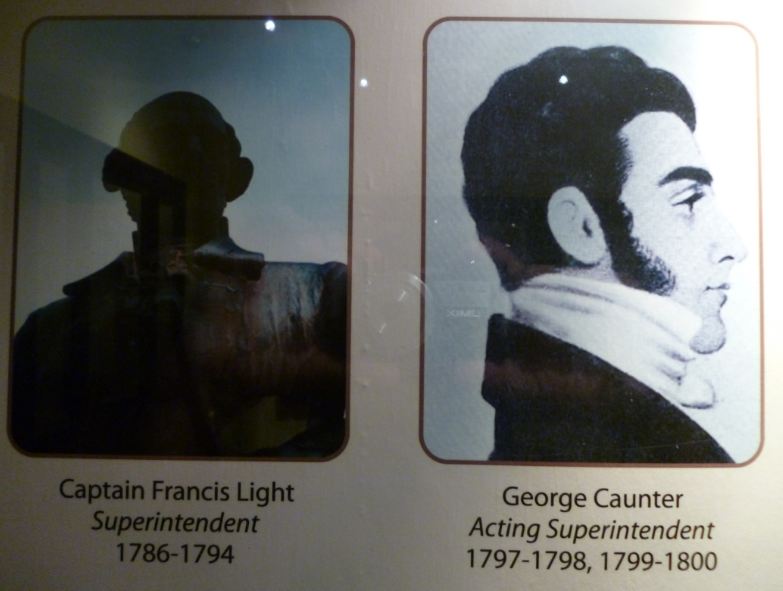
THE GOVERNORS OF PENANG
Images are from Penang Museum
 |
1. Captain Francis Light, Superintendent, 1786 - 1794
2. Philip Manington, Superintendent, 1794 - 1795
3. Thomas Pigou, Acting Superintendent, 1795 - 1796
4. John Beanland, Acting Superintendent, 1796
5. Major Forbes Ross Macdonald, Superintendent, 1796 - 1798
6. George Caunter, Acting Superintendent, 1797 - 1798, 1799 - 1800
7. Sir William Edward Maxwell, Acting Resident Councillor, 1887 - 1889
8. Francis James Anderson, Acting Governor, 1894 - 1895
9. Sir Robert Townsend Farquhar, Lieutenant-Governor, 1804-1805
10. Philip Dundas, Governor, 1805-1807
11. William Petrie, Acting Governor, 1812-1816
12. Robert Fullerton, Governor of the Straits Settlement and Resident Councillors, 1826-1830
13. William Peel, Acting Resident Councillor, 1917-1925
14. Prince Fushimi Hiroyasu, Governor, 1941-1942
15. Col. John Allen Harvey, Governor, 1945
16. Raja Sir Tun Uda Al-Haj bin Raja Muhammad, Governor, 1957-1967
| |
 |
GOVERNORS OF PENANG
1. Raja Sir Tun Uda Al-Haj bin Raja Muhammad, Governor, 1957-1967.
2. Tun Tan Sri Syed Sheh bin Syed Abdullah Shahabudin, Governor, 1967-1969.
3. Tun Tan Sri Syed Sheh Al-Haj bin Syed Hassan Barakbah, Governor, February 1969 – February 1975.
4. Tun Tan Sri Dato' Seri Dato' Haji Sardon bin Haji Jubir, Governor, 5 February 1975-1981
5. Tun Datuk Dr. Haji Awang bin Hassan, Governor, 1 May 1981 - 1989
6. Tun Tan Sri Datuk (Dr.) Haji Hamdan bin Sheikh Tahir, Governor, 1 May 1989-2001
7. Tun Dato' Seri Haji Abdul Rahman bin Haji Abbas, Governor, 1 May 2001-present
 |
| Portrait from Penang Museum |
Yang Teramat Mulia Raja Tun Uda Al-Haj bin Raja Muhammad was born on 1894, Kuala Langat, Selangor. He was educated in Malay College, Kuala Kangsar in Perak. He joined the Government Service in 1910, and MAS in 1914. He was promoted to Class V, MCS in January 1924. He was appointed in 1939 as Secretary to the British Resident in Selangor, the first Malay to hold such appointment. In the post-war, he became an Officer of Class IB, MCS in April 1946 and Class IA, MCS in February 1948. He was officiated as the Deputy Commissioner (Interior), Selangor before being appointed as the first State Secretary, Selangor on the inauguration of the Federation of Malaya (FoM) Agreement on 1 February 1948. He became the Menteri Besar (MB) of Selangor on 1 July 1949. He relinquished the post on being appointed Commissioner for Malaya in UK in July 1953. He relinquished the appointment in UK in October 1954. On his return to Malaya, he was reappointed MB, Selangor in November 1954. On 24 August 1955, he was appointed as Speaker of Federal Council. He was a Member of the Selangor State Council and Federal Council till the Japanese invasion in 1941. He served in the Federated Malay States Volunteer Force (FMSVF) and others. He was conferred 3 British awards - the CBE in 1947; CMG in 1951; and the KBE in 1953. As the first Governor of Penang, he was also a Member of the Conference of Rulers. His recreational activities included tennis, golf and gardening. Source: Who's Who in Malaysia 1971-1972.
MAPS OF PENANG
GEORGETOWN, BATU UBAN, BUKIT DATUK JENATON, TANJUNG BUNGAH, BUKIT DUMBAR, GELUGOR, JELUTONG
 |
| The British arrived in Penang in 1786. The Sumatran Muslim Malays arrived in Penang in the early 1730s. Datuk Jenaton sailed with Nakhoda and they arrived in Kedah, and then made their way to Penang, arriving at Batu Uban. An early British map showed the paddy areas of these Penang Malays.. |
 |
| A large area was paddy |
 |
| The deepwater harbour was along Beach Street, from Fort Cornwallis right up to the Acheen Street Mosque (Masjid Melayu Aceh), and onward to Jelutong at Masjid Jamek Jelutong. The Indian gold retailers operated not far from the wharf. Masjid Kapitan Keling is very near to the wharf at Beach Street. |
 |
| The Queen Victoria clock tower is at right in the pic above. The government offices are in the long building in the centre foreground. A few ships can be seen at 10 o'clock. |
PEOPLE OF PENANG

 |
Penang Malays cleared lands for cultivation of pepper and areca nut - major cash crops of Pulau Pinang. The British brought in the Chinese and Indians for agricultural purposes and labour. Thus, these 3 communities co-existed in Penang during colonial rule. The Penang Malays existed longest on Penang island. They were originally from West Sumatra, and they came via land and sailed the Straits of Malacca, pushing off from Batu Bara in East Sumatera, and arriving in Kedah, before sailing to Penang - on the sheltered side of the island. The Portuguese had earlier arrived on the unsheltered side of the island - at Ferringhi, the Arab word for Portuguese. The curved coastal stretch from Gurney Drive to the end of Batu Ferrighi forms North Bay. The West Sumatran people were of Minangkabau stock and one great man (Datuk Jenaton) married a lady of Arab-Chinese extract. This marriage started the Minangkabau-Arab-Chinese roots of the Datuk Jenaton clan in Penang, Kedah, Perak, Kuala Lumpur, Kelantan and elsewhere.
|
 |
| Plaque at the cemetery gate on Northam Road (Jalan Jutawan). This plaque is in 4 languages. |
 |
Protestant & Catholic graves where famous people in Penang history were laid to rest.
A lot of the graves here were not well-looked after. There were fallen headstones and some graves were in complete ruins. YouTube video: Captain Francis Light's grave.
|