Sultan Mahmud Shah III (d.1812)
The Sultan of Johor-Riau, Sultan Mahmud Shah III died in 1812 after reigning for more than fifty years, naming no formal heir to the throne. He left behind two sons with two different women, both of whom were of Buginese extraction. As the older son, Tengku Hussein stood the better chance of succeeding his father in favour of his younger half-brother, Tengku Abdul Rahman by primogeniture. Tengku Hussein, however, was away in Pahang at the time of his father's demise.
Sultan Hussein Mua'zzam Shah ibni Mahmud Shah Alam (b.1776 – d.5 September 1835)
(a) Sultan Hussein in Singapore
He was the 18th ruler of Johor. He was best remembered for his role as a signatory for two treaties with the British which culminated in the founding of modern Singapore; during which he was given recognition as the Sultan of Johor and Singapore in 1819 and the Sultan of Johor in 1824. However, Sultan Hussein's status as the Sultan was no more than a puppet monarch, at least during the first few years of his reign. Towards his last years of his term and during the first half of his son's reign as the Sultan of Johor, limited recognition was given by a few nobles and the British were accorded mainly with the purpose of their own economic and political gains.
 |
| Biodata of Sultan Hussein |
Tengku Hussein's father was Sultan Mahmud Shah. His mother was Cik Makoh.
This name, Cik Makoh, sounds very much Kelantanese and it could refer to a lady from Makkah, ie, of Arabic descent. Cik is the Kelantanese word for mother. Mak Cik means aunt or lesser mother/younger mother/smaller mother. But it says Buginese/Bugis. Could it be Bugis Arab?
At the time, the throne was in Lingga, not in Malacca. So Tengku Hussien had to sail back to Lingga when the monsoon winds were right. Of course the succession dispute occurred. The primary consort (Engku Putri Hamidah) wanted Tengku Hussein to succeed his father. The Temenggong and the Malay nobles supported Tengku Hussein. Raffles then came into the picture.
(i) Sir Stamford Raffles 1818
In 1818, Sir Stamford Raffles was appointed as the governor of Bencoolen (Bengkulu) on western Sumatra.
Raffles was convinced that the British needed to establish a new base in Southeast Asia in order to compete with the Dutch. Why did the British compete with the Dutch? Many in the British East India Company opposed such idea but Raffles managed to convince Lord Hastings of the Company, then Governor General of British India, to side with him. With the governor general's consent, he and his expedition set out to search for a new base. Where did Raffles go to?
Raffles' expedition arrived in Singapore on 29 January 1819. He discovered a small Malay settlement at the mouth of Singapore River headed by a Temenggung (governor) of Johor. Singapore River is still there today?
Though the island was nominally ruled by the sultanate (but was far away in Lingga), the political situation there was extremely murky. The incumbent Sultan, Tengku Abdul Rahman, was under the influence of the Dutch and the Bugis and would therefore never agree to a British base in Singapore. This means that Singapore was a Malay island and belonged to Indonesia. No wonder there are a lot of Indonesians in Singapore, even today. Singapore does not belong to Malaya or Malaysia. It is Indonesian. It also has an ancient Indonesian name - Temasek or Tumasik (referring to the swamp around Singapore River mouth).
Upon learning of these Johor political tensions, Raffles made a deal with Hussein Shah. Their agreement stated that the British would acknowledge Hussein Shah as the legitimate ruler of Johor, and thus Tengku Hussein and the Temenggung would receive a yearly stipend from the British. In return, Tengku Hussein would allow Raffles to establish a trading post in Singapore. This treaty was ratified on 6 February 1819. In Facebook it says 3 generations (Hussein, Ali and another) all get a stipend paid by Singapore. But why did Raffles take the entire island and only left Istana Kg Gelam and Masjid Sultan for the Malays today? What allowed Raffles to take the entire island when here it says he wanted to establish a trading post - which could mean just a building. How and why did Raffles take the entire island? Was this a legal move? I don't think so. Did Raffles cheat the Malays? Yes, I think so.
(ii) The Johor Throne 1822
Sultan Abdul Rahman
The British successfully sidelined Dutch political influence by proclaiming Sultan Hussein as the Sultan of Johor and Singapore to acquire legal recognition in their sphere of influence in Singapore and Peninsular Malaysia. The legitimacy of Sultan Hussein's proclamation as the Sultan of Johor and Singapore, was by all accounts not recognised by the Malay rulers and his title only served as a nominal title. I think the British used Tengku Hussein's position to get Singapore and further access to the Straits Settlements. Temenggong Abdul Rahman's position, on the other hand, was strengthened as the signing of the treaties detached him the influence of Raja Ja'afar. The Dutch took the bold initiative of taking the royal regalia from Engku Putri Hamidah by force after hearing of rumours of Sultan Hussein requesting British aid to get hold of the regalia. I think here again, we see illegal use of force by the Dutch who mistreated the queen/primary consort. In November 1822, Sultan Abdul Rahman was installed as the Sultan of Lingga, complete with the royal regalia. In the later part of his reign, growing British influence pressurised some Malay nobles, particularly Bendahara Ali to grant recognition to Sultan Hussein's legitimacy. Sultan Abdul Rahman, who had devoted himself to religion, became contented with his political sphere of influence in Lingga, where his family continued to maintain his household under the administrative direction of Raja Ja'afar who ruled under the auspices of the Dutch. However, unresolved legal ambiguity in the legitimacy various local affairs, such as the status of Johor and Pahang, which was the de jure property of the Dutch-aligned Sultan Abdul Rahman and his successors, yet the 1824 treaty would not allow Sultan Abdul Rahman to exert political authority over Johor and Pahang. In the light of these circumstances, the Temenggong and Bendahara increasingly exerted their independent authority. Also, largely as a result of the strong British influence in the Malay Peninsula, the continuously changing political dynamics gradually relegated these legitimacy disputes. (In 1857, the Sultan of Lingga, Sultan Mahmud Muzaffar Shah, who was also de jure head of the royal house of Johor, Pahang and Lingga, made a vociferous claim to his legitimacy of as the rightful ruler of these states and briefly sparked off a civil war in Pahang.)
(iii) Anglo-Dutch Treaty 1824
With the Temenggung's help, Raffles managed to smuggle Hussein Shah, then living in exile on one of the Riau Islands, back into Singapore. Riau is mid way between Singapore and Lingga. Riau is closer to Singapore in the north. Lingga is closer to Java in the south.
The Dutch were extremely displeased with Raffles' action. Tensions between the Dutch and British over Singapore persisted until 1824, until they signed the Anglo-Dutch Treaty. Under the terms of that treaty, the Dutch officially withdrew their opposition to the British presence in Singapore. The treaty has the effect of carving the Johor Empire into two spheres of influence; modern Johor under the British and the new Sultanate of Riau under the Dutch. The treaty was concluded in London, between the British and the Dutch, effectively break up of the Johor-Riau Empire into two. I think this was the biggest mistake and followed the British 'divide and rule policy'. What are the terms of this treaty? Does it say that Raffles can get the entire island?
(iv) Istana Kampung Gelam 1820s
Sultan Husein Shah lived at Istana Kampong Gelam, Singapore. The palace is still there.
ISTANA KAMPONG GELAM, SINGAPORE
 |
| Sultan Gate (pintu pagar depan istana Kg Gelam). From Google Map. |

Side gate of Istana Kg Gelam (faces Masjid Sultan). Photo my me.
 |
| Plaque of Istana Kg Gelam, at its side gate. Photo by me. |
 |
| View of Istana Kg Gelam inside its grounds, from the perahu pinisiq replica on display. Photo by me. |
 |
| Close-up of Istana Kg Gelam. Photo by me. |
MORE PHOTOS OF ISTANA KAMPUNG GELAM
(Internet photos)


For pictures of people who lived in the Istana Kg Gelam, readers can refer to Tengku Syawal Tengku Aziz in Facebook.
SULTAN MOSQUE (Masjid Sultan Hussein Mu'azzam Shah), SINGAPORE
(Below; Photos by me)
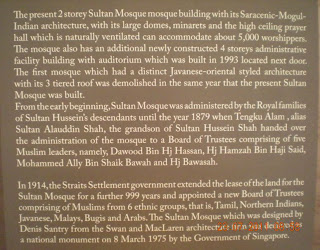
The Sultan Mosque was built twice. The original mosque with 3-tiered roof was constructed in 1824 (at the time of Raffles). The current one with a dome and minarets was constructed in 1928. Photos of construction of the present mosque are in Tengku Syawal Tengku Aziz's Facebook album.


(v) Sultan Mosque/Masjid Sultan
(Below; Photos by me)
The Sultan Mosque was built twice. The original mosque with 3-tiered roof was constructed in 1824 (at the time of Raffles). The current one with a dome and minarets was constructed in 1928. Photos of construction of the present mosque are in Tengku Syawal Tengku Aziz's Facebook album.

 |
| Masjid Sultan Hussein Mua'zzam Shah. This mosque was used from 1824 till it was demolished in 1928. |


 |
| This text mentions AMLA. AMLA was drawn up by the son of an early Malay doctor. The son was a lawyer, Dr Ahmad Ibrahim (later Tan Sri). His father was Dr Mohamed Ibrahim (1892-1962), who practised in Singapore and Malaya (Malacca and Kajang). |
(b) Sultan Hussein in Johor-Malacca 1834
(i) Rights to Johor Throne
Sultan Hussein on his part, did not pursue any active claim to his sovereignty rights over Johor, even after Temenggong Abdul Rahman died in 1825, and his successor, Temenggong Ibrahim was still a youth at the time of Temenggong Abdul Rahman's passing.
(ii) Move to Malacca 1834
Sultan Hussein on his part, did not pursue any active claim to his sovereignty rights over Johor, even after Temenggong Abdul Rahman died in 1825, and his successor, Temenggong Ibrahim was still a youth at the time of Temenggong Abdul Rahman's passing.
(ii) Move to Malacca 1834
Sultan Hussein spent much of his time at his Singapore residence in Istana Kampong Glam until 1834, when he moved to Malacca.
(iii) Death of Sultan Hussein 1835
(iii) Death of Sultan Hussein 1835
Reports cited that Sultan Hussein was a dispirited man, apparently with the lack of power and authority that he should be accorded as the Sultan. Sultan Hussein later died in September 1835, and was buried in Tranquera Mosque at the wishes of his Sultanah and Abdul Kadir, a Tamil-Muslim Imam. He is buried behind the mosque.
(iv) Masjid Tengkera
TRANQUERA MOSQUE (Masjid Tengkera), MALACCA
(Internet photos)
(Internet photos)


Now, this becomes highly interesting for me because Tan Sri Abdul Majid bin Ismail and I share the same story from this point onward. I must have written about it in my family blog at 262 Banda Hilir.
The story Tan Sri Abdul Majid and I share is that we are descended from the same Chinese people who married to the Malacca Sultan. The Chinese strand comes from Tranquerah. My dad also said my great grandmother came from Tranquerah, a Chinese dominated area. Of course they are many loopholes and gaps and it is hard to believe that this is so. Tan Sri Abdul Majid says it is true, that he and I are descended from the royal Chinese people. Does that mean I am partly a Ming royalty? Is that why I had to live in a Chinese-looking house in Banda Hilir when all Malays live in rumah Melayu? Is that why the Malays I have met were scared to talk to me? I don't even carry myself as a Ming nor a royalty, so how can I be linked to the Malay sultans? I don't know. I will wait for more news about my background. That is only half the story about my royal lineage; the other part of my lineage is royal Bavarian. Would you believe that? I think the world is crazy. Tan Sri Abdul Majid said he and I should write a story together about our royal Chinese heritage. My late mum said I must write about my life. I find it strange. Now would you believe it that the world came together in Malacca? All I can say is Wunderbar!
Now I see the link. Some of the papers I saw at our Banda Hilir house could have been the papers signed between the British, Dutch and the Malays at various times. They could also be correspondences. The black wooden chest that contained all those papers have gone missing and the house was demolished. Why? Erase evidence? Who took all the evidences from our house?
Now I see the link. Some of the papers I saw at our Banda Hilir house could have been the papers signed between the British, Dutch and the Malays at various times. They could also be correspondences. The black wooden chest that contained all those papers have gone missing and the house was demolished. Why? Erase evidence? Who took all the evidences from our house?