Thursday, 25 April 2013

Plague, Cholera and the Hajj 1865-1926

http://digitalarchive.gsu.edu/cgi/viewcontent.cgi?article=1021&context=history_theses

Empire of the Hajj: Pilgrims, Plagues, and Pan-Islam under British Surveillance,1865-1926
Michael Christopher Low
chrislow@earthlink.net
Georgia State University
Digital Archive @ GSU
Dept of History
16 July 2007

Follow this and additional works at: http://digitalarchive.gsu.edu/history_theses

Recommended Citation
Low, Michael Christopher, "Empire of the Hajj: Pilgrims, Plagues, and Pan-Islam under British Surveillance,1865-1926" (2007).
History Theses. Paper 22.


Contents:

CHAPTER TWO
THE CRISIS OF CHOLERA 38
“A Woeful Crescendo of Death” 38
Edwin Chadwick and the Foundations of British Attitudes Toward Cholera 44
Science versus the Science of Denial 48
International Sanitary Conferences and the Quarantine Controversy 54
The Thomas Cook Hajj: Reforming the “Sanitary Pariah of the East” 65
Pauper Pilgrims, the Suez Canal, and the Civilizational Boundaries of Travel 71

CHAPTER FOUR
TOWARD A NEW ERA OF SANITARY INTERVENTIONISM 105
Cholera’s Grande Finale 106
The Bombay Plague of 1896: The Defeat of British Sanitary Obstructionism 113

EPILOGUE
LEGACIES OF THE COLONIAL HAJJ 161
The Hashimite Interregnum 161
The Wahhabi Conquest of the Hajj 166

ILLUSTRATIONS
Figure 1. The Ka'ba and the Masjid al-Haram, Mecca, 1885 2
Figure 2. Major Pilgrimage Routes in the Nineteenth Century 4
Figure 3. "Actual and Supposed Routes of Cholera from Hindoostan to Europe" 5
Figure 4. The Western Indian Ocean Basin, c. 1935 34
Figure 5. An Early Sketch Map of the Kamarān Island Quarantine Station, 1892 61
Figure 6. Tihāma-style Hut, Kamarān Island 63
Figure 7. Sultan Abdul Hamid II, c. 1890 89
Figure 8. Early Twentieth-Century Pilgrims at Jidda's Harbor 103
Figure 9. Dastūr al-‘Amal, Anjuman-i Khuddām-i Ka‘ba, 1913 139

INTRODUCTION
The first House established for the people was that at Bakka [Mecca], a place holy, and a guidance to all beings. Therein are clear signs—the station of Abraham, and whosoever enters it is in security. It is the duty of all men towards God to come to the House a pilgrim, if he is able to make his way there.
-Qur’an, 3:96-97

And proclaim to humanity the Pilgrimage, and they shall come unto thee on foot and upon every lean camel. They shall come from every remote place that they may witness things profitable to them.
-Qur’an, 22: 27-28*

*All translations from the Qur’an have been taken from A.J. Arberry, The Koran Interpreted (London:
Allen and Unwin, 1955; repr. ed., New York: Touchstone, 1996).

Terminologies and things of general interest:
haramayn (sacred areas) of Mecca and its nearby sister city, Medina.
dar al-Islam (the Islamic world)
The Suez Canal was opened in 1869 [see page 3 footnote 3 for travel routes before 1869]
the ‘ulama’ (religious elites and scholars)

the introduction of steamship of “modern” hajj
the steamship-era hajj
C.A. Bayly,
The Birth of the Modern World, 1780-1914 (Malden, M.A. and Oxford: Blackwell Publishing, 2004), 354;
William R. Roff, “Sanitation and Security: The Imperial Powers and the Nineteenth Century Hajj” in Arabian Studies
VI (London: Scorpion Comm. and the Middle East Centre, University of Cambridge, 1982), 143.

influx of India’s destitute pilgrim masses and the globalization of epidemic disease

British Indian pilgrims were a “dangerous class” of “pauper pilgrims.”
David Arnold, Colonizing the Body: State Medicine and Epidemic Disease in Nineteenth-Century India (Berkeley: University of California Press, 1993), 186-189.

... see Foreign Office (hereafter F.O.) 78/4094 in “British efforts to improve travel conditions for pilgrims; appointment of travel agent; problem of indigent pilgrims,” Oct. 1884-Feb. 1887, Alan de L. Rush, ed., Records of the Hajj: A Documentary History of the Pilgrimage to Mecca, vol. 3 (London: Archive Editions, 1993), 593-626.

A virulent epidemic of cholera broke out in the Hijaz in 1865, killing an estimated 15,000 pilgrims.

Robert Koch discovered the bacillus vibrio cholera in 1884.

The VK7(C) Dream

The gate.


VK7(C) is the pay grade for Malaysian professors today. It is the most sought after and the most privileged pay for an academic at a government institution, especially in medical school, and especially in Kelantan, where I work.

The VK7(C) is the lowest rung of the Malaysian professors pay scheme; above it is VK7(B) and the top and highest paid is VK7(A). Going from C to B takes approximately 10 years; going from B to A takes about the same time. By the time a person gets VK7(C), he/she is about 50 years old (on average). Most professors end their career at 56/58/60 with VK7(C). Many never get to VK7(B) or VK7(A). Deputy VCs and their circle get VK7(B). The VC and his circle get VK7(A).

I am at VK7(C) since 29 January 2009. I have another 5 years to go before I reach compulsory retirement at 60. Under normal work conditions, I will never get to see VK7(B), unless of course a miracle happens. I will leave that matter alone.

The salary statement was issued by USM Bendahari and I received mine this morning. Let's see what is in store for the next 5 years ... The letter is in Malay but this is what I understand of it.

Pay Scheme for University Lecturers VK7(C)

Basic salary: RM12,278.04/mo

Allowances:

1. Official functions: RM2,500.00/mo ... this is the limit for us to spend on official things

2. Housing: RM1,300.00/mo .... got own house

3. Special Grade: RM1,000.00/mo ... not sure what this is

4. Servant: RM500.00/mo ... got no maid

The annual basic salary is RM147,336.45 per annum (~AUD$43,850.00 pa)

The allowance is good for spending inside Malaysia but is not too good for outside spending.

At retirement, the pension works out to 40% of last pay (basic salary) = RM4,911.22/mo (~AUD$1,461.00/mo) ... tax-free

The basic pay of an entry/fresh MSc/PhD lecturer is RM2,500.00/mo.

The maximum basic salary of an Office Assistant/Pembantu Am Rendah (PAR) is ~RM2,000.00/mo.

Minimum pay in Malaysia today is RM1,000.00/mo.

Not bad at all. Not bad at all. Living in Kelantan, this is heaven on earth! Life is better in Kelantan than anywhere else. There no highway toll. We use well water and electricity. Food is freshly cooked and halal anywhere in Kelantan. There are mosques and suraus everywhere and anywhere. There are fresh markets everywhere. There are no dogs and pigs except where they are allowed. Life is safe and very good up here in Kelantan. I wouldn't want to be anywhere else.

http://nst-live.blogspot.com/2012/06/nstlive-with-prime-minister.html

To bloggers elsewhere: Please do not copy-and-paste or re-post my posts elsewhere or in your blogs.

Wednesday, 24 April 2013

The Kasta System Lives On

I was talking to my son about his work status. He had just lost his job; he gave up on his last job. I asked him about what the working conditions were like in the private sector. His reply was simple - it is a dog eat dog world and the caste system is still in place, like it or not. Not knowing anybody is as simple as saying I can't get a good job right now.

He's gone away today and tomorrow. He flew on AirAsia this morning. He wanted to drive to KL but his car overheated at Kok Lanas last night and he had to turn back. He is taking his accountancy classes and exam somewhere in KL. I asked him what the classes are like. He said he is the only Malay in a class full of Chinese businessmen. I asked him if he felt ok or intimidated. He said it is better to study than to do nothing about himself. He likes the classes because the Chinese experts tell good stories of their experiences and fortunes. They provide a lot of case studies, good ones too, of international flavour. He will be taking another few months of private tuition classes before he takes the Australian professional accountancy exam, administered in KL on behalf of Australia. The private tuition is expensive and so is the exam, like paying for another degree. I hope he makes it and gets to work on his own in future. I want him to be happy and not worry about the caste system that's prevalent just about anywhere in any society. I hope he understands that this world is not so easy after all. But that's life.

CWTS Leiden Ranking 2013

http://www.leidenranking.com/ranking

My comments:
If minimum publication is set at 500, only UM made it to the charts.
If minimum publication is set at 100, both UM and USM made it.
UM did better than USM for Biomedical and Health Sciences, with collaboration, with minimum # of publications set at 500.

How many publications per lecturer?
500 publications, divided by 300 lecturers, means about 1-2 publications per lecturer. This is average.

Who is top in Asia?
UM scored 63rd place
USM scored 79th place

I think USM did ok being in the top 93 universities in Asia. Not too bad.

What's next?
I haven't seen the ranking for Asian medical schools.

Meet Tasneem bt Taha

Tasneem is a first-year medical student at USM, with keen interest in the history of medicine. She came to see me after I took the first lecture for year 1 medicine, History of Medicine. She said she was interested in the subject. I met her another time when she came to my room to ask for a book I had mentioned in my lecture. I had forgotten but she remembered. That was some time ago. Today, she came back to discuss the time-table. After that I asked her if she is the same person who came to see me after class after my first lecture and later to see about a book. Yes, it is the same girl except that I can't recall her face. So today, Tasneem received my 2 books on The Early Malay Doctors. This week is still exam week. I hope she will have some time during the GE13 holiday to read my books.

Tasneem is both American as well as Malaysian. Her father is from Connecticut, USA and her mother is from Pahang. Her father studied Arabic language in Saudi Arabia and now teaches Arabic language in Kubang Kerian. She is the second of 9 siblings. Her elder brother is studying chemical engineering.


From the Madrasah to the Museum: The Social Life of the Kietaabs of Cape Town


This article was written by Saarah Jappie, Researcher, University of Cape Town:
http://www.academia.edu/995998/From_the_Madrasah_to_the_Museum_The_Social_Life_of_the_Kietaabs_of_Cape_Town

Contents:
Ebrahiem Manuel's story of his kietaab and how he traced his ancestors' lineage to Sumbawa, Indonesia
Muslim heritage in Cape Town
Islamic manuscripts of Cape Town
Kietaabs of Cape Town
Kietaabs as schoolbooks in madrasah
Importance of kietaabs (kitabs) written in Jawi script in Cape Town Malay Muslim community
Arjun Appadurai's theory on social historical objects and archival biography
Contested uses of Jawi Islamic literature
Tombouctou Manuscripts Project
Jawi text and Patani identity
Linguistic change: Cape Arabic-Malay was replaced by Cape Dutch, which evolved to become Afrikaans today
Madrasah education at the Cape began during the time of slavery
The first official Muslim School was founded in 1793 in Cape Town, South Africa
Malay was the lingua franca at the Cape
Bahasa Bugis (Buginese) and Tamil were also spoken, written and used at the Cape\
The earliest extant Arabic-Afrikaans manuscript was written in the1840s by Imam Qadi Abdul Salaam, who was popularly known as “Tuan Guru” (“MisterTeacher”)
“Tuan Guru” was a Tidore prince from the Ternate islands of eastern Indonesia. He arrived at the Cape as a political convict in 1780 and was incarcerated on Robben Island until 1793. He wrote the entire Quran from memory.
The imams came from diverse backgrounds
The madrasah accepted slaves and Free Black students
Free Black” or “vrijzwarten” refers to manumitted slaves
“Malay” becamea a racial sub-category of “Coloured” during apartheid South Africa
Handwritten kietaabs were used for teaching purposes at madrasah in South Africa
One of the most popular texts copied and circulated, is the Umm Al-Barahin (“TheMother of Proofs”), also known as the Sanusiyya, after its author, influential AlgerianAsh’arite scholar, Muhammad ibn Yusuf Al-Sanusi (1787-1859), and Die Twintig Siefaat (“The Twenty Attributes” of God/ 20 Sifat Allah)
Koples boeke was a notebook which characterized the madrasah educational system
Talismanic kietaabs (azeemat reference books) including the azeemats (amulets) were written and used by the Muslim Sufis who arrived to live in the hostile social environment at the Cape.
Abdulkader Tayob, Islamic Resurgence in South Africa: The Muslim Youth Movement (Cape Town, 1995)
Abdulkader Tayob commented that Cape Sufism had secret knowledge and held secret meetings
The Cape Muslims, slaves and settlers believed in charm cures and practised them as they were effective. They were said to practise "Malay tricks".
Academic, poet and Malay enthusiast I.D. du Plessis wrote a novel about the adventure of 3 young Afrikaaner boys who went to see a doekoem (dukun) in Java
Doekoem or dukun were charm makers as well as spiritual healers
Witch doctors are magic men
Tuan Nuruman @ “Paay Schaapie,” was an exile banished to the Cape from Batavia in 1770. He made azeemat to help slaves escape in 1786 but it failed and he was sent to Robben Island.
Ajami manuscripts are used for daily social communication
Shift in education from traditional madrasah to mainstream schooling system resulted in literacy shift from Arabic to Latin (initially in Afrikaans and later in English)
Evolution on non White literacy at the Cape
Development of the Muslim mission school at the Cape
Development of mainstream schooling system at the Cape
"Bapak" Ismail Petersen had ~7 Jawi kietaabs. He burned incense every Thursday night but did not understand the reasons for doing so. Much of his kietaabs were burned by his brother which made him sad.
Many Cape Muslim families own kietaabs but can't read nor understand them; they merely possess them
Kietaabs were disposed by burning
The inside cover of the kietaabs contain family tree of the author and link them back to their forefathers
The kietaabs are passed down from master to students or interested individuals, not necessarily family members
Kietaabs become Cape Muslim family heirlooms
Many foreigners studied manuscripts of the Cape Muslims, including Dutch Adrianus van Selms in 1950s, German Hans Kahler in 1960s-1970s, and Achmat Davids in 1980s
Simon's Town Heritage Museum
Malaysian and Indonesian researchers began to study at the Cape Jawi manuscripts in mid-1990s, after apartheid ended
Malaysia, Indonesia and the Cape share their cultural legacies of the Malay World
Pusat Manuskrip Melayu, Perpustakaan Negara Malaysia researched the Cape Jawi manuscripts in 1996
Hassiem Salie is the President of the South African Melayu Cultural Society (SAMCS)

Parti Komunis Malaya (PKM)

Parti Komunis Malaya (PKM) or the Malayan Communist Party (MCP) comprised mainly Chinese, Indians and a few Malays who were forced to join. One of the Malays who was forced to join was Mokhtar Petah's father.

Mokhtar Petah wrote first-hand about the PKM at his blog:
http://mokhtarpetah.blogspot.com/2008/06/parti-komunis-malaya.html


PKM was a part of Parti Komunis China (PKC) or the China Communist Party (CCP). Both followed the orders of the Kuomintang, which aimed to create a New China State, comprising the addition of Tanah Melayu, Singapore and Borneo to existing China. Singapore was the first to yield.

When the Chinese capitalists were brought to Tanah Melayu, the Chinese tin miners, wealthy tawkays and traders were subordinate to two masters, what the Malays referred to as talam dua muka. They were loyal to the British and at the same time, supported PKM.

In UMNO's fight for the Malayan independence, the British sided and supported UMNO but battled the PKM. The Chinese benefited politically and economically.

Following the Japanese war, in the reoccupation period, under the British High Commissioner, Sir Edward Gent (1946-1948), the British immediately introduced the Malayan Union, in an attempt to gain control over Tanah Melayu. This was met with great resistance from the Malays who refused to be continued to be ruled  by the British. A state of emergency prevailed and the Malayan Emergency lasted 12 years, from 1948 to 1960.

The Malays met at Kelab Sultan Sulaiman (Sultan Sulaiman Club) in Kampong Baru, Kuala Lumpur in early May 1946. Dato Onn Jaafar and the Malays created PEKEMBAR (Pertubuhan Kebangsaan Melayu Bersatu). It comprised Malays who were English educated in the West. That's how UMNO was formed, with an English name (United Malays National Organisation) - it has no Malay name. Its possible Malay name could be Persatuan Nasional Melayu Bersatu (PNMB).

While other third world countries (India and Indonesia) gained their independence in the late 1940s, Malaya was slow to gain its independence. When Sir Henry Gurney ruled as the second British Resident (1948-1951), UMNO flourished and was amicable to the British. It paved the way for the Malayan independence, 9 years too late. This delay was due to putting off independence till the British got whatever they wanted. Malaya gained its independence on 31 August 1957 but its people still lived in fear. Many areas had to observe the curfew.

The years ahead met with many teething political and economic troubles and many Malays were captured and jailed. One was Dr Burhanuddin al-Helmy, an early Malay doctor and homeopathic practitioner who later turned politician. Singaporean Utusan newspaper editor, Said Zahari was jailed for 17 years without trial.

Rejimen Ke-10 Askar Melayu, Pahang played a big role in defending Malaya against its colonial masters. Its members killed many British officers who came to serve in Malaya, mainly for British gains. Some of the British officers favoured the Malays and continued to live in Malaya. They converted to Islam and served the interest of the poor Malays. A notable person is Haji Mubin Sheppard, who helped 2 early Malay boys through medical school and they became successful early Malay doctors.

Sir Gerald Templer was the third British High Commissioner to Malaya (1952-1953). It was under him that Malay villagers were translocated to specified areas in towns, and called Kampong Baru. Villages at the periphery of the Malaysian jungles and suspected of activities connected to the PKM were re-located to new areas. It was in his time that Pasar Chow Kit flourished under a Malay market supervisor? The Templer Hospital was opened in 1952 and named in his honour. These Malay villages have now become Chinese lands, mainly from land resale. There were also many change of hands after the war when landowners died during the Japanese war and new bogus landowners took the opportunity to claim lands without landowners. As a result, some families became poor while some became rich from such illegal activities. That's history.

All over Malaya and including Singapore, the Malays had to beg the government to give them land so they could till the land and build homes. It was a sad state. In Malacca, the same happened; the fallen Singapore Sultanate was given land in Umbai, just after the town centre in Banda Hilir. In Singapore, the Malays purchased land via its spokesperson, Encik Eunos, and they obtained Geylang. In Penang, Kampong Melayu in Ayer Hitam is still a Malay reserve, the area is a bit under developed compared to more modern housing areas on Penang island.

These Malay reserves receive modern amenities and the children attend better schools. There are police stations, bus stations and transportation in these new villages. These are about the only lands that Malays own today. Many Malays do not own any lands nor own homes even though this is Malaysia. Many Malays still cannot afford to own homes upon retirement under today's economic circumstances. The Malays who missed out on the Malay reserves have continued to live at the periphery of the Malaysian jungles, by the river, and life goes on as usual, mostly under very poor housing conditions. Children from these forgotten traditional villages suffer the most as a result. Unfortunately, due to the high cost of living in all cities in Malaysia today, many Malay families with working parents are still forced to live in slums lining the cities and towns. Some live in the clearings by the rail tracks, and there are many reports of narrow escapes and fatal railway accidents.

Now, even 55 years after Merdeka, many Malaysian families have problems with owning suitable family homes and getting decent jobs, with sufficient salary to pay for the families' basic needs. Today, the average family pays RM294 a month for electricity in hot weather with 4-5 fans blowing in the homes. Family meals cost RM25 per day for lunch and dinner; breakfast is an additional RM10 for a family of 6. There is not much left over after utility bills are paid. Most Malay families have to put their children on government scholarship if they want to take up tertiary studies. Very few Malay families can afford to pay RM6K per semester for university for per child. The average Malay adult earns RM3K per month. The minimum salary in Malaysia today in RM1K per month. Overall, the Malay is a poor person, and lives in perpetual poverty, inherited or otherwise. Education alone cannot help the Malays. Subsidised services cannot help them too. Providing land titles and a basic home-based income maybe half the answer. Good-paying jobs outside the home make the other half and complete the needs of the average working Malay. The whole thing about the dire needs of the Malays need to be properly addressed and studied. The Malays were living fine and freely before colonialism. Colonialism changed the fates of the Malays altogether, pushing them to the limits, to a point of no return. Some Malays have given up, ending up on the ever growing bankruptcy list. Will all these ever end? Can we hope to see an end to Malay problems? I think so yes if we deal with the problems properly. I think so no if we still want to continue the same way we worked from after Merdeka. We need an attitude change and the way we make things work.

So back to PKM and the Kuomintang ideology, do we still hope to save Malaysia for the Malays? I think so we should try our best. Where else do we want to send the Malays? They can't move north because it is too cold. They can't go south because it is too cold. This is all the land that the Malays have. There is no place elsewhere where they can live. They will become extinct if we send them elsewhere. So we have to stand by 'Tak kan Melayu hilang di dunia' if we want to see the Malays make it in this world, just like everyone else. PKM and Kuomintang aside, we must help the Malay people. Give back their lands and let them live they way they choose to.

Tuesday, 23 April 2013

Tengku Hassan di Tero

Tengku Hassan (83) was born in Pidie, Aceh on 25 September 1925. He was the third in line of the Aceh kings when the Dutch attacked Aceh in 1978. In his fight for Aceh's freedom, Tengku Hassan set up GAM (Gerakan Aceh Merdeka) in _____ . GAM soon became a symbol of Aceh's peoples' freedom fight but a controversial organisation and was later banned by the Indonesian government. Tengku Hassan fled to Stockholm, Sweden and lived in exile. He set up an Aceh government in exile while living in Stockholm. Aceh did not fare well without its warriors. Aceh suffered severely with some 200,000 lives lost in the tsunami of 26 December 2004.

After much deliberation, a peace treaty was signed between Indonesia and GAM in Helsinki, Finland on 15 August 2005. After 30 years living in exile, Tengku Hassan eventually returned to Aceh, via Penang, on 11 October 2008. He received a warm welcome by his relatives and the people of Aceh.

Tengku Hassan had friends in Penang. Among them were Malay leaders, including a religious man, Mualim Haji Yusof Rawa, the 5th PAS President (Yang di-Pertua PAS 1982-88) who succeeded Dato' Asri Muda (4th PAS President 1969-82). Haji Yusof Rawa owned a bookshop at Acheen St in Penang, close to the famed Masjid Jamek Melayu Aceh Pulau Pinang. Ustaz Fadzil Noor was the 6th PAS President (1988-2002).

A national hero, Tengku Hassan was regarded as Wali Negara and was alluded to as such. His colleague, also a national hero, was Daud Brueh. They wanted a free Negara Islam Aceh, from then President Soekarno and his deputy, Dr Mohd. Hatta. Indonesia gained its independence from the Dutch on 17 August 1947.

At the time, Mokhtar Petah was a student at the Daeratul Maariful Wataniah Islamic school in Kepala Batas, Seberang Perai Utara and was also a news writer with Warta Negara in Argyll Rd, Penang. He met with both the heroes Tengku Hassan and Daud Brueh in a room at Haji Yusof Rawa's bookshop in 1954. The two heroes always came to Penang for working out Aceh's independence. The two great men were not alone in Penang as there were also native Aceh traders who brought products from Aceh.

When President Soekarno was willing to deal with GAM, GAM requested for the Indonesian government to provide a free Quran to each Aceh subject aged 15 and above. President Soekarno agreed to the demand. The three men agreed to appoint Haji Yusof Rawa to print the needed quantity of Quran, which were then sent to Aceh.

Among those who met Tengku Hassan in Kuala Lumpur before he left for Aceh were PAS members, Kamaruddin Jaafar (Chief Secretary/Setiausaha Agung), Dr Mohd Hatta Ramli (Treasurer/Bendahari), and Abu Bakar Chik (AJK Agung). 7th PAS President (20003-present), Haji Abdul Hadi Awang could not make it to Aceh. However, his Political Secretary, Dr Ahmad Shamsuri Mokhtar, went as his representative.

Tengku Hassan returned to Aceh with 2 other leaders, Malik Mahmood (former prime minister of the Aceh government in exile) and Dr Zaini Abdullah (former external minister and health minister). There were some 20 people in his entourage.

Transpired and modified from:
http://mokhtarpetah.blogspot.com/2008/10/aceh.html

Mokhtar Petah


http://mokhtarpetah.blogspot.com/2011/12/maksud-ari-al-quran.html
- former journalist for Warta Negara (defunct)
- Penasihat Hal Ehwal Politik Sultan Idris Shah ibni Sultan Iskandar Shah (Sultan Perak)
- also learned from many others including Dr Burhanudin al-Helmy, Abdul Samad Said, etc
- prolific Malay author
- now owns his own publishing company, Mata Publication

Auditor General

Auditor General of the FMS/SS
Auditor General of the Colonial Administration
Auditor Malayan Union
Director of Audit, Malaya
Auditor General, Malaysia
https://www.audit.gov.my/docs/BM/1Ketua%20Audit%20Negara/Mantan%20KAN/MANTAN3x.pdf

- there are 16 names till 2006

From the UN

http://www.mir.com.my/lb/un/index.htm
http://www.mir.com.my/lb/un/html/18jan98b.htm (Tun Razak)
http://www.mir.com.my/lb/un/99html/101099.htm (Tun Mahathir's address at UN)

Sultan Idris Shah ibni Sultan Iskandar Shah

http://tuntelanai.blogspot.com/2009/02/sultan-azlan-shah-bodoh.html
http://cetusanmindamuda.blogspot.com/2009/02/umno-jangan-biadap-jangan-lupa-sejarah.html
http://mokhtarpetah.blogspot.com/2010/04/sultan-idris-shah_28.html

Names mentioned:
Sultan Idris Shah bernazar
Tun Razak
Tun Hussien Onn
Haji Ghazali Jawi and his son Tajol Rosli
(Tan Sri) Ishak bin Tadin

Year: 1974-1977

Political party: UMNO

Place: Perak

Mokhtar Petah:
http://mokhtarpetah.blogspot.com/2011/12/maksud-ari-al-quran.html
http://mokhtarpetah.blogspot.com/2012/02/mengenang-sultan_08.html
- former journalist for Warta Negara (defunct)
- Penasihat Hal Ehwal Politik Sultan Idris Shah ibni Sultan Iskandar Shah (Sultan Perak)
- prolific Malay author
- now owns his own publishing company, Mata Publication

Moral and Ethical Issues in HRD

IKD Monograph Series:
http://irep.iium.edu.my/74/1/kamal_hassan-moral_%26_ethical_issues.pdf


Moral and Ethical Issues in Human Resource Development: Old Problems and New Challenges
- by Prof. Mohd. Kamal Hassan

Published by:
Institut Kajian Dasar (IKD)
Tingkat 4, Bangunan Medan MARA
Jalan Raja Laut
Peti Surat 11109
50736 Kuala Lumpur
Malaysia
Tel: 03-2916976 / 2924722
Fax: 03-2925919

Contents:
Commercial crimes
The BMF scandal involved $2billion (NST 15 March 1989)
Unethical practices of professionals
Temptations of power
Integrating religious faith into existing systems
Developing moral integrity
Questioning the ethical values of the management (Tan Sri Ishak bin Tadin, Auditor General of Malaysia)
Multi-racial and multi-religious society
MMA paper on medical ethics, problems and prospects: problems of negligence, incompetence and unscrupulous tactics; less concerned about preventive medicine, access to healthcare and quality of care; less compassionate but more money-minded.
Unethical practices in public service: bribery, conflict of interest, favours, abuses, etc
Forms of corruption
Spiritual reform and developing into a model nation
Islamization of concepts at the workplace
The Islamic manager
The Secular Model vs The Islamic Model for Human Development
Citations from the Quran (Appendix)

Sejarah GPMS

Sejarah GPMS:
http://www.gpms.my/node/145

- has a photo of the 5 founder-members.

Monday, 22 April 2013

Conference Call: Penang and the Hajj 2013

Update (15 June 2013): http://www.pht.org.my/?page_id=1375

Official website: http://www.pht.org.my/?ai1ec_event=penang-and-the-hajj&instance_id=19

I'm circulating the conference details which I received from Dr Lubis today. You can respond directly to him.


Call for Papers: Penang and the Hajj
Workshop on PENANG AND THE HAJJ
Date: 17-18 August  2013 (Saturday and Sunday)
Venue: George Town, Penang
Organised by Penang Heritage Trust and Think City Sdn Bhd, with other partners


From as early as the 18th century, Penang was a port of embarkation for aspiring pilgrims travelling by ship to the ‘holy lands’. The activity was centered at the port, Acheen Street and adjoining areas. This era ended in the 1970s with the establishment of the Tabung Haji (Pilgrims Fund) corporation and popularity of air travel. Thousands of pilgrims from Sumatra, northern Malaysia and southern Thailand went through Penang to realize the fifth pillar of Islam. Their reminiscences and collective memories deserve to be celebrated, consolidated and documented for posterity. Prof. Eric Tagliacozzo has accepted our invitation to give the keynote ‘Penang Story Lecture’ (please see the following page).


The Penang Story Lecture (open to the public and limited to 150 persons) will be held in conjunction with a two-day closed workshop (about 30 persons). Registration will be waived for speakers, who are eligible to attend all our events and meals. Please apply to your institution to sponsor your travel expenses and accommodation, although we might be able to offer accommodation (limited to a few speakers). 

CALL FOR PAPERS (for workshop)
We are soliciting papers on a variety of topics on the “Penang and the Hajj”, for example:

·       The Penang Port as a port of embarkation for the Hajj, businesses of Penang Sheikh hajis/pilgrim brokers especially Hadhrami operators, the service industry at the port cluster, ships and shipping (conveyance of pilgrims).

·       Religious, social and cultural change stimulated by Hajj returnees, such as Islamic renewal and reform in the formal religious education and literacy in the pondok and madrasa, pan-Islamic ideas, anti-imperialism and anti-colonialism ideologies, with implication to Penang and the region.

·       Colonial regulations on hajj travel, including the medical practices of hajj doctors in Penang and the quarantine station at Pulau Jerejak off Penang island, in addition to the functions of the pilgrim officers in monitoring the pilgrimage movement.

·       Travel preparations for the pilgrimage such as religious classes, currency exchange, packing the peti sahara, clothing. The production of Hajj literature by the Penang Malay press and the narratives of pilgrims sharing their experience.

·       Socio-economic dimensions of hajj travel, such as saving schemes, exploitation of indentured labour, and the setting up of the monopolistic Tabung Haji (Pilgrims Fund) as an economic scheme in the context of national development.

As the coordinator of workshop I am seeking papers and inviting paper presenters on the above theme. I am also open to suggestions to topics for deliberations. Paper proposals should consist of an abstract of 300-500 words and short biographical information (100-150 words) and should be sent to Abdur-Razzaq Lubis at namorasende@gmail.com

Abstracts should be submitted by 6 May 2013 and acceptance of abstracts will be notified by 14 May 2013.


Full papers are required on or before 17 July 2013. The word limit is 10,000 inclusive of footnotes and bibliography. The papers will be considered for publication.

The Penang Story Lecture and workshop are organised by Penang Heritage Trust http://www.pht.org.my/  and Think City http://www.thinkcity.com.my/ 

A separate announcement will be issued by Penang Heritage Trust on registration, registration fee (for participants), accommodation and tour.


PENANG STORY LECTURE (keynote)
The Material World of the Hajj in Colonial-Era Southeast Asia
by Eric Tagliacozzo, Professor of History, Cornell University 

Abstract
The economic connections of the pre-colonial Hajj were very important; they brought Southeast Asia into a wider orbit of contacts across the historical Indian Ocean. Scholars have asked, as a result of this, how vital the economy of the Hajj may have been in creating an “Indian Ocean world”, with major thinkers both championing and dismissing this notion.  We know from a number of period observers in the 17th and 18th centuries that the number and dimensions of ships engaged in the Hajj were substantial, and that the Mughal Empire, Ottoman, Yemen, and Southeast Asia all become intertwined in the routes of such craft sailing across the ocean's rim.  In my lecture I will examine these far-flung connections, while also concentrating on Southeast Asia and its trans-oceanic economies more locally.  I will do this by looking at the careers of eminent Hajjis such as Shaykh Yusuf of Makassar, as well as through classical texts from the region such as the Tuhfat al-Nafis.  I argue that the Dutch were crucial as facilitators of the pilgrimage, and I sketch out some of the circumstances of the Javanese Hajj from the 17th to the early 19th centuries.  I will also focus on the the British Case, where the Malay Peninsula and Penang became important as well in sending these travelers overseas, in increasingly larger numbers as the nineteenth and early twentieth centuries wore on.  I highlight the means by which pilgrims from Southeast Asia were able to perform their Hajj, and the very real – and sometimes very difficult – material circumstances of their passage.  This was a world in the making, one that connected the paths of quite ancient travelers to the voyages of pilgrims from our own time.

Eric Tagliacozzo
Eric Tagliacozzo is Professor of History at Cornell University. His first book, Secret Trades, Porous Borders: Smuggling and States Along a Southeast Asian Frontier (Yale 2005) won the Harry Benda Prize from the Association of Asian Studies.  His second monograph, The Longest Journey: Southeast Asians and the Pilgrimage to Mecca (Oxford, 2013) has just been published. Tagliacozzo is also the editor or co-editor of four other books, and serves as the Director of the Comparative Muslim Societies Program at Cornell, as well as Director of the Modern Indonesia Project and editor of the journal INDONESIA.

Attached Eric Tagliacozzo, ‘The Pilgrimage to Mecca from Southeast Asia’, SEAP Bulletin 2009-2010.
2 attachments — Download all attachments  
Call for Papers Penang and the Hajj 2013.pdfCall for Papers Penang and the Hajj 2013.pdf
489K   View   Download  
The Pilgrimage to Mecca from SEA.pdfThe Pilgrimage to Mecca from SEA.pdf
1339K   View   Download  

Visiting Kubang Kerian

Kubang Kerian is a small university town. There are a few tailors in Kubang Kerian. There are a few Muslimah clothes shops in Kubang Kerian. There are 2 mosques in Kubang Kerian. The big blue mosque is the state mosque. The old small mosque is also used. There are several provision shops and kedai makan in Kubang Kerian. All shops in Kubang Kerian sell halal food.

There are petrol stations (Petronas) along Jalan Pasir Puteh and Jalan Wakaf Stan (towards Bachok). There is a Shell petrol station on Jalan Pasir Puteh.

There is also a sprawling open night market at Wakaf Che Yeh for those who like late night shopping and bargaining.

The big hotels in Kota Bharu are Renaissance Hotel, Ridel Hotel and Grandriverview Hotel. The main mosque in Kota Bharu is Masjid Muhammadi, which is closest to Ridel Hotel.

There are many homestays in Kota Bharu and Kubang Kerian.

Kubang Kerian Square is the shopping area in front of Hospital USM (HUSM). It has cheap hotels and good food outlets. There is Mydin and others. There is Pasar Malam on Friday evening and that goes on till 9-10 pm. There are many bank branches here.

All shops in Kota Bharu and Kubang Kerian close at 5-6 pm. However, restaurants and kedai makan continue till late at night. Food maybe a bit sweet for outsiders.


Shops and hotels line the main road in front of HUSM
External links
http://www.mpkb.gov.my/

BPSP

BPSP = Blok Pembelajaran dan Sumber Pelajar /Students' Learning and Resources Block

The BPSP is a new multipurpose block. It is used for interviews, SGD (small group discussion), PBL (problem-based learning), workshops and meetings.

The upcoming medical students interview will also take place at BPSP on 10-11 May 2013.

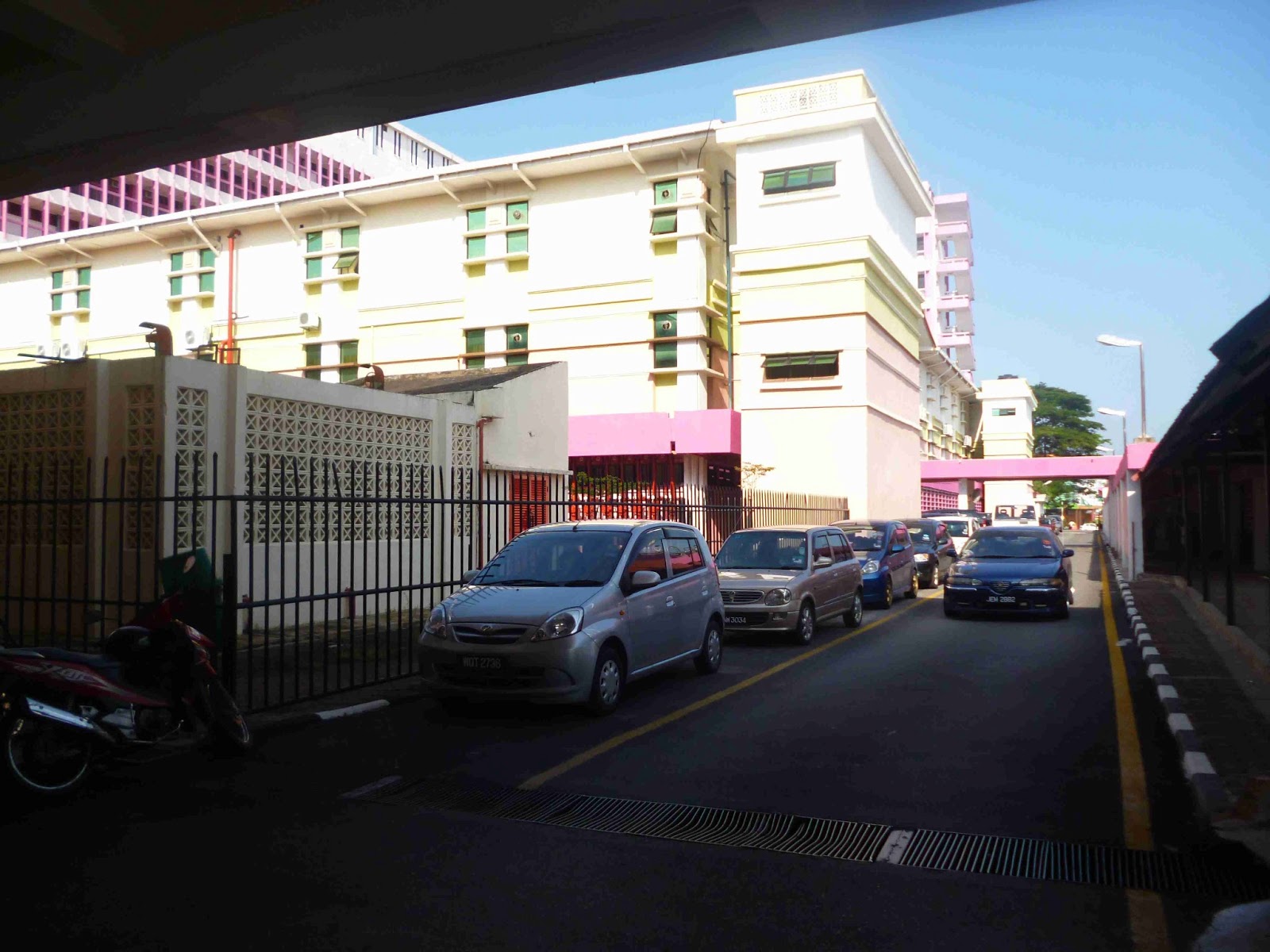
The BPSP is light green and white layers, on the first floor.

To access BPSP, from the front parking lot, walk past Pharmacy and Kedai Koop. Go upstairs to the first floor. Go to the right, past Jabatan Taksiran. Go through the wooden doors and till you come to the glass doors on the right. Access is via staff card. Campus security guards should be on duty. There are chairs and tables, prayer places and toilets inside BPSP.

The public surau is a red zinc building on the ground floor. Walk past the USAINS clinics toward the lift. Toilets are at all corners, a bit hidden though.

Friday and Saturday are non work days. Offices are closed on campus.

The crowd you will see are the general public who have come to visit their loved ones in the hospital. Visiting days are weekends, so the parking spaces maybe easily taken up by visitors.

HUSM is 8-storeys and purple and white.


BPSP
HUSM viewed from the main road

Scribd

http://www.scribd.com/doc/130057366/Biography-Of-The-Early-Malay-Doctors-1900-1957-Malaya-And-Singapore

eBook version courtesy of Xlibris.

Kelantan Honour List 2010

http://thestar.com.my/metro/story.asp?file=/2010/3/31/north/5965387

Booktopia

http://www.booktopia.com.au/research-on-the-early-malay-doctors-1900-1957-malaya-and-singapore-faridah-abdul-rashid/prod9781469172439.html