Sunday, 1 April 2012

Dr Abdul Majid bin Ismail

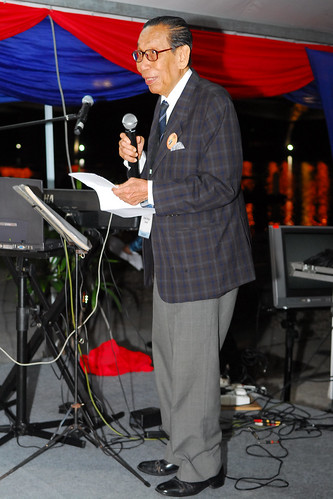
Tan Sri Dr Abdul Majid was the first Malay Queen's Scholar, first Eisenhower Fellow and second Director-General of Health Malaysia.

Dr Abdul Majid bin Ismail in The Who's Who in Malaysia 1965
Abdul Majid Ismail, the first Malaysian Fellow, talks about the lifelong impact of his fellowship experience
Tan Sri Dr Abdul Majid Ismail, the first Malaysian Fellow, talks about the lifelong impact of his fellowship experience at the Eisenhower Fellowship on 15 October 2008.
http://www.flickr.com/photos/eisenhowerfellowships/3232318794/

He was Tunku Abdul Rahman's golf buddy.
http://thestar.com.my/metro/story.asp?file=/2007/7/9/central/18215906


An old photo of the Victoria Institution I found in my father's collection in his home in Penang. This photo was taken by my grandfather (Walid). This could be an early photo of the Victoria Institution since there were no trees yet.


Std 6A Victoria Institution, Kuala Lumpur
Abdul Majid bin Ismail is seated 3rd from left.
Mohamed Noor bin Marahakim is seated 3rd from right.
Photo from Victoria Institute website by Chung Chee Min.
Photo from VI website by Chung Chee Min
US President Dwight Eisenhower
Book written by John Michael Gullick (JM Gullick) about Henry Syers and the Selangor Police. Syers ordered a group of Malacca Malays to move to Kampong Baru, Kuala Lumpur. Tan Sri's grandparents were among those who relocated to Kg Baru. His parents were from Kg Baru. Ujong Pasir in Kg Baru is named after the original village in Malacca (Ujong Pasir after Banda Hilir and before Umbai). JM Gullick was featured on Malaysian TV.

A History of Kuala Lumpur 1856-1939 by JM Gullick (MBRAS). Tan Sri recommended me to read this book to understand Kuala Lumpur. I borrowed the book via Inter-library Loan at USM.

Jebak as mentioned in Tan Sri's book. He loved the story where he caught birds
Tan Sri mentioned The Coliseum (1920), where he used to hang out as a young man.
Dr Mohd Bakri Musa informed me that Tan Sri often hangs out here.
I didn't see this building in KL.

The Jungle Princess is an American movie which Tan Sri watched as a medical student and later  acted in a play when he returned to the hostel.  He played the part of Coco the chimpanzee. The name has stuck since that time.
Dorothy Lamour who was the heroine in The Jungle Princess movie. Back at the hostel, the medical student who played the part of Dorothy was killed when a bomb struck him during the bombing at the King Edward VII College of Medicine in the Battle of Singapore in February 1942.
The Carcosa was Frank Swettenham's residence. Tan Sri was a young waiter at some of the  celebrations here.
Bangsar Hospital was formerly the European Hospital in Bangsar. Tan Sri's younger daughter Ellina was born here in 1959
District Hospital Kuala Lumpur (later General Hospital Kuala Lumpur). This photo of the old hospital in Kuala Lumpur was confirmed by Tan Sri who said the old buildings were wooden and on stilts. This photo was provided by the Malaysian Orthopaedic Association (MOA) where Tan Sri was the Founder-President. Dr Saw Aik gave permission and mentioned the original photo could have been taken by Prof Sengupta, a pediatrician who has returned to Singapore. I tried to call him, but I didn't manage to get in touch.

Tan Sri related the story of "Huxley's ruins", the unfinished building-development of the hospital that looked like ruins, which embarrassed the British person in charge of the construction whose name was Huxley. The expenses incurred by the Government and Major Huxley for the planned hospital buildings are explained in the book, Records and Recollections. Here are extracts of The Huxley Contracts on pages 83-86  of the book:

Link


The Eurasian Club at Jalan Pudu in Kuala Lumpur. Photo from Kuala Lumpur Old Photos at www.skyscrapercity.com.
Sultan Abdul Samad building, Jalan Raja in Kuala Lumpur
Masjid Jamek Kuala Lumpur is near where Tan Sri's mother was born. He wrote in his book about the location of the house where his mother was born.

Sg Klang and Sg Gombak confluence and the Benteng on the right.

Confluence of 2 rivers from my hotel room
Tan Sri and his memoir An Old Man Remembers (2006). Everything you need to know about him is in his book. He gave me a free copy. Photo from the Star.

Dato Harun bin Haji Idris was a close friend and they went for Hajj together, with 2 others

FAMILY

Federated Malay States Railway (FMSR). Photo from Walid's collection. Walid is Tan Sri's cousin and my paternal grandfather Mohd Yusope bin Hj Mohd Sharif.

Railway workshop office at Sentul. Tan Sri Abdul Majid's father worked in the repair section of the FMSR. Photo from Kuala Lumpur Old Photos at www.skyscrapercity.com.

Tan Sri Abdul Majid's mother, Enjah bt Muhammad Ariff, a Quran teacher.
I remember calling her Nenek Enjah when it should have been Moyang Enjah.


Tan Sri & Toh Puan Khairany have 3 children - Aljafri, Ellisha and Ellina.

Prof Aljafri's book
Fundamentals of Surgical Practice

Ellisha Majid's book
A Sausage Went for a Walk by Ellisha Majid and Peter Kendall

Tan Sri is seated at left. His younger daughter Ellina is standing at 2nd right. Her husband Azizuddin is beside her. Photo from Yayasan Tun Abdul Hamid (YTAH). Azizuddin is Chairman YTAH. YTAH does a lot of charity work in Selangor. Tan Sri and daughter are Directors of YTAH. The other 2 children are Prof Aljafri and Dr Ellisha (not shown). Prof Aljafri appeared on TV briefly when the TV reported there was a landslide at the Selesa Hillhomes Resort, maybe last year (2011). I have never met Prof Aljafri, Ellisha and Ellina in person.

Ellina's family. Captured from YTAH.

External links:

Saturday, 31 March 2012

En Abdul Rahman bin Haji Talib (1916-1968) [3], Minister of Education 1960-62


Rahman Talib was a name I heard as a child. I also heard of the Rahman Talib Report as a child. I didn't know who he was. Even when my mother was nearing pension age, she was still speaking about Rahman Talib Scheme. He is En Abdul Rahman bin Haji Talib. He was the Minister of Education Malaysia 1960-62 and Minister of Health Malaysia 1962-64. I wasn't even in school yet! I was 6 years old!
There is conflicting evidence of his post between 1962 and 1964. One evidence says he was Minister of Education in 1964 and another states he was Minister of Health 1962-64. Which is correct? This type of conflicting evidence in published matter makes writing for TEMD very difficult as I have to take time off to find out what is the correct information. Verification takes time as I don't know people in the first Cabinet. Checking facts takes a lot of time.
En Abdul Rahman bin Haji Talib
Minister of Education Malaysia 1960-62
Minister of Health Malaysia 1962-64
----

METHODIST BOYS' SCHOOL KUALA LUMPUR
ALUMNI ASSOCIATION

Copyright (C) 2010 Methodist Boys' School Kuala Lumpur Alumni Association.
Source: Eminent Alumni, Methodist Boys' School, Kuala Lumpur Alumni Association
Accessed on 12 May 2011. Here he is Minister of Health in 1964, the year he resigned.
-----

RAHMAN TALIB RESIGNS
7 December 1964, Kuala Lumpur
Chronicle of Malaysia 1957-2007

Rahman Talib resigns. Here the date cited  is 7 December 1964 and it states him as Minister of Education. This was at the time of Tunku Abdul Rahman, who was PM. Both were in the first Cabinet. The lady is his wife (provides a positive ID for her in the photo below).
Source: Chronicle of Malaysia 1957-2007, page 88.
My comment: The info above may be incorrect as he was the Minister of Health in 1964, according to the article above and below.
----

MINISTER OF HEALTH
ABDUL RAHMAN BIN HAJI TALIB
Who's Who in Malaysia 1963


En Abdul Rahman bin Haji Talib in Who's Who in Malaysia 1963.
In his entry here he is the Minister of Health in 1963. Since information must be submitted a year before, he was Minister of Health since 1962, at the time of submission of this entry.

----

OPENING OF A NEW DENTAL CLINIC, PAHANG circa 1962-1964

These photos below were received from the family of Dr Mohamed bin Taib (Pahang).
Please help me to identify the people in the photos. (I was in Standard 1 in 1965.)
Welcoming En Abdul Rahman bin Hj Talib. Dental staff of the new clinic lined up. Who is who from the right? Pahang circa 1962-64.
En Abdul Rahman bin Hj Talib opening a new dental clinic (Klinik Pergigian). Pahang circa 1962-64
En Abdul Rahman bin Hj Talib at extreme right with songkok.  Who is next to him? Is he Coco?
Checking out the new dental suite. En Abdul Rahman with songkok. Pahang circa 1962-64
Demonstrating new dental equipment to En Abdul Rahman bin Hj Talib (far right with songkok)
Tea break. En Abdul Rahman bin Hj Talib is seated in the middle. His wife is seated beside him. 
En Abdul Rahman bin Hj Talib with songkok and his back to the camera.
Dr Mohamed bin Taib (Pahang dentist) is in the centre, and facing the camera.


Pahang (3)

This post is about Menteri Besar Pahang (MBs of Pahang).


There are altogether 14 names of MBs of Pahang (table below). The first 11 names are unknown and there are no write-ups about them. I have acquired a few photos of Dr Mohamed bin Taib, and one was with then MB of Pahang, Yayha Mohd Seth (May 1964-Aug 1972). I don't know whether it is him or his brother  (Ghazali Seth) in one photo. The Seth family is from Johor.

List of Menteris Besar in Wikipedia
4 men posed by Pahang River (?) circa 1964-1972. 2nd left is Dr Mohamed bin Taib.
One of them is MB of Pahang, Yahya Seth (2nd right?).
Who are the 2 others at extreme left and right?  Photo belongs to the family of Dr Mohamed bin Taib, Pahang.
Ghazali Seth

Friday, 30 March 2012

Pahang (2)

This post is about Pahang.


STATE OF PAHANG
http://en.wikipedia.org/wiki/Pahang

MAP OF PAHANG
http://www.ncbi.nlm.nih.gov/ (Map of Pahang from PubMed)
Article about malaria research using Pahang as sampling frame and testbed and contains the above map.

Map of Pahang showing the 11 districts.

TOURISM IN PAHANG

Asia Explorers by Timothy Thye

HISTORY OF PAHANG

Full Malay name and Arabic honorific: Pahang Darul Makmur (Abode of Tranquility).

The origin of the name Pahang is unknown but there were many names known by the Chinese, Europeans and Arabs. The name Pahang could not be Arabic as the Arabic alphabet and pronunciation does not have a 'p'. Thus, there are no words beginning with the letter 'p' in Arabic. If it is Arabic, then it is Fahang and not Pahang. The name Pahang could be Siamese as there are many words in Siamese which begin with a letter 'p'. There are many p-words in Siamese. The word Pahang could be a hardwood tree, pokok Pahang or wood, kayu Pahang or cloth - kain Pahang or tenun Pahang.

Pahang joined the Federated Malay States (FMS): 1895
Japanese Occupation: 1942-45
Pahang became a part of the Federation of Malaya (FoM): 1948
Pahang became a part of Malaysia: 1963

STATE CAPITAL

Kuala Lipis was the first state capital in the old days till 1955 (see below for more info on Kuala Lipis). The present state capital of Pahang is Kuantan. 

KUANTAN

Kuantan is 72 feet above sea level. The population of Kuantan is unknown (data not trusted). There is a plan to transform Pahang as part of ECER (East Coast Economic Region) 2004-2015.

PAHANG SULTANATE

Pahang is ruled by a Bugis Sultanate and links to Tun Sri Lanang. The present monarch is Sultan Ahmad Shah. His father is Almarhum Sultan Sir Abu Bakar. The royal town is Pekan.
Sultan Haji Ahmad Shah Al-Musta'in Billah Ibni Al-Marhum Sultan Abu Bakar Ri'ayatuddin Al-Mu'adzam Shah (succeeded his father in 1974)
Sultan Sir Abu Bakar Riayatuddin Al-Muadzam Shah ibni Almarhum Sultan Abdullah Al-Mutassimu Billah Shah (reigned 1932–1974)

MB is Dato' Seri Adnan Yaakob.

HONOURS AND AWARDS

Pahang has a list of honours bestowed by the Sultan of Pahang. Pahang awards 4 honours - SSAP, SIMP, DSAP and DIMP. Only the SSAP carries the title Dato' Sri. The SIMP, DSAP and DIMP carry the title Dato'. 

2003 Honours
9 recipients of Sri Sultan Ahmad Shah Pahang (SSAP) which carries the title Dato' Sri.
16 recipients of Sri Indera Mahkota Pahang (SIMP) which carries the title Dato'.
16 recipients of Darjah Sultan Ahmad Shah (DSAP) which carries the title Dato'.
77 recipients of Darjah Indera Mahkota Pahang (DIMP) which carries the title Dato'.

GEOGRAPHY OF PAHANG

SUNGAI PAHANG

The Tembeling River joins the Jelai River to form the Pahang River which flows right through Pekan and then into the South China Sea. Sungai Pahang is the longest river in Pahang. 

There are riverine settlements. In the old days, doctors come by boats to visit patients in the settlements. They included Dr Pandak Ahmad, Dr Che Lah bin Mohd Joonos and Dr Mohamed Said bin Mohamed.

3 early Malay doctors in Pahang
Floating homes (rumah rakit). This is Sungai Kelantan at Tangga Krai.

DISTRICTS IN PAHANG

Pahang has 11 administrative districts: Bentong, Bera, Cameron Highlands, Jerantut, Lipis, Kuantan, Maran, Pekan, Raub, Rompin and Temerloh.
Bentong was previously known by another name. Bentong means to contain or to trap or a container, like a dam. The story of Datuk Bahaman took place in Bentong. Bentong is at the confluence of 2 rivers. People used to take boats to continue their journey either north or south bound. Bentong is a small town before the Karak Highway, which is the major highway that leads to Kuala Lumpur. Bentong is 80 km NE of KL. The Bentong Highway is a high-speed dual carriage way with heavy traffic during the festive season and when there are football matches in KL.
http://en.wikipedia.org/wiki/Bentong

Bera has a large freshwater lake, Tasik Bera, which contains a type of algal growth much like a seaweed, the bera, according to the Semelai Orang Asli who live by that lake.
http://en.wikipedia.org/wiki/Bera,_Pahang

Cameron Highlands is a highland resort. It used to be a cold place but with climate change today it is no longer cold but cool. Tea, vegetables, strawberries and flowering plants thrive here. Cameron Highlands is accessible from many states - Perak, Pahang and Kelantan. From Kota Bharu, take the Gua Musang Highway and turn off after Hospital Gua Musang and follow the winding road and signboards. Mamak Spicy Special is at the corner before the left turn to go uphill. Further up the same road as Mamak Spicy Special leads to a Malay village (Kg Ingin Maju) and an Orang Asli village. One of our medical students lives in the Malay kampung. In the old days, entomologists and the research team would go to Cameron Highlands to check on insects there.
Other hill resorts are Bukit Tinggi, Fraser's Hill and Genting Highlands.
http://en.wikipedia.org/wiki/Cameron_Highlands

This is my grandfather's team at a Government bungalow in Cameron Highlands.
Walid is the middle of the 3 men standing facing the bungalow.
Photo from Walid's collection.
This is my grandfather's team at a provision shop in Cameron Highlands.
Walid in seated on the highest steps, centre, with no one standing behind him. His hands come together like a full circle. He is in dark clothes.
Photo from Walid's collection.

Jerantut is near the coast. It is 200 km from KL.
http://en.wikipedia.org/wiki/Jerantut

Lipis is the district and Kuala Lipis is the district capital. Kuala Lipis was the previous capital city of Pahang before Pekan.  Kuala Lipis was the administrative capital of Pahang for 57 years from 1898 until 27 August 1955. Kuala Lipis is a small town and looks just like any small town in the other states. Some of the buildings were built in 1929. The roads are narrow. There is an old train station behind a row of old shophouses. Malay food is sold at the train station.
http://en.wikipedia.org/wiki/Lipis

Maran - ? 

Pekan is a royal town. PM Najib is also from Pekan. Pekan is named after a flower, bunga pekan. There is a museum near the mosque. The police  station is an old one. Pekan looks damp (lembab; basah). The road system is confusing for a small town.
http://en.wikipedia.org/wiki/Pekan

Raub is on the Gua Musang Highway, about 110 km from KL. Raub sits in a saddle or valley between 2 mountain ranges - the Titiwangsa Range (Banjaran Titiwangsa) and the Benom Mountain Range (Banjaran Gunung Benom). It was a gold mining town in the old days. Khary's parents (HUSM audiologist) live in Raub by the highway.
http://en.wikipedia.org/wiki/Raub

Rompin is a fishing village. People take the boat here to go to Pulau Tioman. Rompin is near Endau-Rompin National Park in Johor. This is a low-lying area with a lot of trees and floods easily. Some Orang Asli huts can be seen along the road. There is a camping ground somewhere.
http://en.wikipedia.org/wiki/Rompin

Temerloh - Temerloh is 130 km (81 miles) from KL on the KB-KL Highway 8 or Gua Musang Highway. There is Hospital Termerloh.
http://en.wikipedia.org/wiki/Temerloh

File:Hoshas Temerloh.jpg
Sultan Haji Ahmad Shah Hospital (Hospital Temerloh). Wikipedia

Thursday, 29 March 2012

Kelantan History (2)

This post is about Kelab Pencinta Sejarah Kelantan, which I discovered in Facebook today.

The text is written in Kelantan Malay but it is not too difficult to understand - you will get the hang of it, and in due time be able to understand. It not only covers history but there is coverage on Kelantan cuisine and interesting spots in, around and close to Kelantan. There is Bukit Bunga, Buketa and also Pattani Perintah Siam. A lot of old and new photos, some which I have never seen too. I like the elephant photos as they can't be found elsewhere on the Internet. There is Tok Kenali, Makam, WWII relics (kubu or pillboxes), Malay palaces and homes, old roads, paddy fields, floods (1926/27 and 1967), canons, soldiers, Tok Janggut after he was hanged to death, old Malay house turned into a wat Siam and archaeology digs at an ancient temple (kuil). A lot of stuff to help you reminisce in the old Malay charm. The stories are from the contributors' parents and grandparents. The stories are unique too and you can't get them from textbooks. Please visit Kelab Pencinta Sejarah Kelate.


Tuesday, 27 March 2012

Malay History (4)

This post introduces a man named Daeng Andak Al Habrah who hails from Malacca. 

Daeng Andak Al Habrah is of Bugis descent and of noble rank. He has 7 names. [It should be noted that almost all Malays have 7 names.] Daeng Andak's interest in Bugis Ancestry and Influence in this region. It should be noted that the Bugis is the largest group of Malays who mastered not only the sea but they have a good system of civilisation, which we continue to use today within the Malay Sultanates in present-day Malaysia. If we get rid of the sultans then we lose our entire history. So in the eyes and mind of the author, we should try our best to think positive and objectively about retaining and reclaiming our Malay Heritage, and make our presence and ownership of the Malay Lands (Tanah Melayu) felt and respected. Even though waves of foreign migration come to our shores, we must try our best to retain our Malay Heritage. 

Daeng Andak Al Habrah is one brave man who called me to ask so I told him just that. And I thank him for calling.

Daeng Andak Al Habrah in Facebook


Singapore History (1)

This post introduces Istana Kampong Gelam in Singapore. The photos are from Facebook by Tengku Shawal Tengku Aziz, the great grandson of Sultan Hussain of Johor who once owned the palace, mosque and village in Singapore.


Facebook album of Tengku Shawal Tengku Aziz, great grandson of Sultan Hussain of Johor (Singapore)

There are other useful historical photos in Tengku Shawal's Facebook album:

(1) Makam Sultan Alauddin.

(2) There is also coverage of Istana Sayap, of Sultan Mahmud I of Malacca. The place is marsh-swampland, and a few pokok gelam can be seen - which means the area was cleared and burnt for making the istana (replica?). The interior shows a lovely ornate golden throne, unlike the thrones we commonly see in other palaces in Malaysia.

FYI, Istana Kampong Gelam now houses the Malay Heritage Centre of Singapore.

Malay History (4)

This post is about the Malay rulers. It covers many eras - the Portuguese, Dutch, British, Bugis, Malacca Sultanate and Siamese. This video was produced by the public library under Arkib Negara Malaysia.

Turks in Aceh

This is the first time I came across Turkish graves in Aceh and linking back to Salehuddin, the powerful ruler. The graves are neatly arranged and the tombstones are unique but practical. I like the designs for the tombstones. 

Monday, 26 March 2012

Seni Lama Melayu

This is a good website and the author has published a lot of books. It has practically everything. One thing good is the collection of photos taken by the author and the walk-through narratives.

The books have nice designs too.

There are stories about Malay houses, tombs and mosques.


What is relevant to TEMD is Masjid Jamek Kuala Lumpur. This area is the heart of the old Kuala Lumpur, called Kampong Baru. Among families who lived here was Coco's parents, whose house was nearby the mosque. His mother was born in a house near the mosque. She became a Quran teacher. Coco's father worked nearby at the FMS Railway Repair Section, near PWTC. Their house was in Segambut area. Coco narrated a lot about Kg Baru, Masjid Jamek and the FMSR and I have included the info in his biography in my book.

Masjid Jamek in Wikipedia


UKM (2)

This post contains some information from UKM 1972-1973 report which is available online at:


Some highlights of the UKM 1972 report are the following:

UKM 1972

  1. The UKM Medical Faculty was established and functioning in 1972. Its progress was reported in the UKM 1972-1973 3rd official report.
  2. There were 3 men responsible for the set up of the UKM Medical Faculty (pages 47-46). The 3 men were Dr Amir bin Abbas, Dr Abdul Hamid bin Haji Abdul Rahman and Abdul Rahim bin Omar. All 3 men received their MBBS (Malaya) from the UM Medical Faculty
  3. Dr Amir bin Abbas = MBBS (Malaya), DTMH (Liverpool), MRCP (London)
  4. Dr Abdul Hamid bin Haji Abdul Rahman = MBBS (Malaya), DA (London), FFARCS (England)
  5. Abdul Rahim bin Omar = MBBS (Malaya), MRCP (UK)
  6. Two doctors were sent for specialty training under Sekim Latihan Tenaga Pengajar. They were Dr Mohd Roslani Abdul Majid and Dr Mustaffa Embong.
  7. Dr Mohd Roslani - to pursue DCP (Pathology). Expected date of completion Oct 1972
  8. Dr Mustapha Embong - to pursue MRCP (Gastroenterology). To train at UM for 1 year 1973-74
  9. Dr Mohd Roslani went to set up the USM Medical School in Penang in 1979.
  10. Dr Mustapha Embong went to USM and practised in Endocrinology in 1984/5.
  11. The UKM Medical Faculty had shortages of medical lecturers and hired Indonesian lecturers for Anatomy (4), Physiology (2) and Biochemistry (2).
  12. Alternative places had to be found for postgraduate training of UKM new medical lecturers.
  13. Assistance was obtained in many ways, including from the Tertiary Educational Research Centre (TERC) in Sydney, NSW and the American group MUCIA Council for International Health.

UKM (1)

This post is about the early report of UKM soon after it was established. This is the UKM 1971-1972 report which is available online at:


This report is highly informative and gives a good insight about the early days of UKM. Of note are the following:

UKM 1971
  1. Three early Malay doctors were involved with UKM in its infancy - Datuk Ariffin bin Haji Ngah Marzuki and Datuk Dr Haji Abdul Majid bin Ismail (both as Ahli Lembaga Pengurus) and Prof Ahmad Ibrahim (as Pensyarah Sambilan in Jabatan Syariah).
  2. There were 3 faculties (Pengajian Islam, Sains and Sastera), 12 departments and 2 units.
  3. Fakulti Pengajian Islam (> Jabatan Usuluddin, Jabatan Syariah, Unit Bahasa dan Sastera Arab).
  4. Fakulti Sains (> Jabatan Fizik, Jabatan Ilmu Hisab, Jabatan Kajibumi, Jabatan Kajihayat, Jabatan Kimia).
  5. Fakulti Sastera (> Jabatan Bahasa dan Kesusasteraan Melayu, Jabatan Ekonomi dan Perdagangan, Jabatan Ilmu Alam, Jabatan Kajimanusia dan Kajimasyarakat, Jabatan Sejarah and Unit Bahsa-bahasa).
  6. In Jabatan Syariah, Hasan bin Din was sent for further studies by UKM. Prof Ahmad Ibrahim who was lecturing in Law at UM was also a temporary lecturer at Jabatan Syariah, UKM (pages 34-35).
  7. Jabatan Sejarah produced a number of interesting publications which should still be relevant today since we are still talking about Malay History and Malacca History. The papers by Prof Zainal Abidin bin Abdul Wahid, Dr Chandran and Drs Ibrahim Alfian are highly relevant to today's debate on our Malayan/Malaysian History.
  8. There was no medical faculty in UKM in 1971.
  9. The 1971 operating budget was approx. $7 million.

Bugis History (2)

Bintan Island in Indonesia


Picture of Bintan Island thanks to yummiec00kies and Ookaboo!


Tanjung Pinang. Picture of Bintan Island thanks to Achmad Rabin Taim from Flickr and Ookaboo!


(Qudwah Bil 1 2012, page 44):
Pulau Penyengat, Kepulauan Riau, Indonesia

Pulau Penyengat is a small island off Kota Tanjung Pinang, the capital city of the province of Kepulauan Riau (KEPRI). There were 2 noble men in the history of the island, Raja Haji and his grandson, Raja Ali Haji.

In 1805, the island itself was the dowry (mahar, mas kahwin) of Raja Mahmud Shah for his bride, Engku Putri @ Raja Hamidah bt Raja Haji Fisabilillah Yang Dipertuan Muda Riau ke-4.


Pulau Penyengat. Picture of Bintan Island thanks to Achmad Rabin Taim from Flickr and Ookaboo!

Pulau Penyengat

YouTube video Pulau Penyengat

Wikipedia (Bahasa Indonesia) - Pulau Penyengat


Raja Haji Fisabilillah / Raja Haji

Wikipedia (Bahasa Indonesia) - Raja Haji Fisabilillah

Ancient Mariner - Makam Raja Haji, Pulau Penyengat

He was born at Ulu Sungai in Riau.

His full name was Raja Haji Fisabilillah ibni Daeng Celak (1727-18 June 1784) and was popularly known as Raja Haji. Raja Haji was the younger brother of Raja Lumu, who became the Sultan of Selangor.

He was the Yang Dipertuan Muda Kesultanan Johor-Riau-Lingga (reign 1777-1784).

Raja Haji was a famous poet who created the Bugis poetry Gurindam Dua Belas. Later, he was ennobled as Pahlawan Nasional Indonesia and named Bapak Bahasa Melayu Indonesia.

Raja Haji was a Bugis warrior and fought against the Dutch when they attacked Riau. He had also launched an attack on the Dutch fortress in Banda Hilir, Malacca in 1784 but he lost. He again met the Dutch forces in a battle at Telok Ketapang. He fought hard but died in the hands of the Dutch. His death angered his nephew, Raja Ibrahim and the Selangor Sultanate was also dragged into the conflict of the Dutch-Malacca and Johor rulers.

Even though he died in Teluk Ketapang, Malacca, he was interred at Pulau Penyengat Indera Sakti, Kepulauan Riau, Indonesia.


Raja Haji Fisabilillah Monument of Struggle. Picture of Bintan Island thanks to Achmad Rabin Taim from Flickr and Ookaboo!


Raja Ahmad

Son of Raja Haji and father of Raja Ali Haji.

A literary figure.


Raja Ali Haji

Raja Ali Haji was born in 1808 or 1809. He was the grandson of Raja Haji.

Wikipedia (Bahasa Indonesia) - Raja Ali Haji

His full name was Raja Ali Haji bin Raja Haji Ahmad (1808-1873) and was popularly known as Raja Ali Haji.

He was an ulama', historian, and a Bugis icon. He was a Bugis writer of the Malay language. In his book Pedoman Bahasa,  he wrote about the structure of the Malay language.  The book has become a standard Malay language reference text worldwide.His famous poetic masterpiece in 1847 was the Gurindam 12, which is now performed on stage in Pulau Penyengat and in many Malaysian schools.

Pembacaan Gurindam 12


Masjid Sultan Riau, Pulau Penyengat

There is a mosque on the island of Pulau Penyengat. The Masjid Sultan Riau was built in 1832 during the reign of Abdurahman Muazham Shah, Yang Dipertuan Muda Riau-Lingga (reign 1832-1844), who succeeded Raja Jaafar. A call was made for the people to help clean the area for construction of the mosque. The people had brought along a lot of raw materials and there were a lot of leftover eggs/egg whites after the Aidilfitri festivity. These egg whites were used for building the mosque. The mosque was initially white but was later painted, green for Islam and yellow for Malay royalty.

External links
http://www.rmkhalid.com/2011_01_02_archive.html

Bugis History (1)

I have copied and pasted this text below from the Ancient Mariner's blog. He is deceased and I have never met him. I wrote to him once to ask about ex-MB Tan Sri Dr Mohamed Said bin Mohamed but he never replied. Tan Sri was an early Malay doctor. Dr Yusof is his only son, the others are girls.

This text is on Bugis History about a family who got together and there were 1,400 of them in the get-together. I feel this is great and the Bugis people must pursue their culture and tradition. They are already great as a civilised society but they are not properly portrayed by the western media.


Hj Amir Abdul MajidMay 9, 2009 09:12 AM
Hj Amir bin Abdul Majid
Kamirmajid@gmail.com

Ampang Jaya,
10.05.09

Dear Capt Yusof,

The Bugis from Linggi
(in response to Homecoming in “The Ancient Mariner” April 29th 2009)

I was introduced to your blog today by your cousin Dr Yusof Tan Sri Mohd Said. He is close friend of mine. Our friendship started when he introduced himself as a descendent of Daeng Chelak and hails from Linggi. When I told him that both my maternal and paternal great grandfathers descended from Daeng Chelak, he declared that we are related. Our usual conversation topics centered on Bugis: Riau, Sulawasi, Daeng Chelak, Raja Haji and our own family connections. How proud was he to declare himself a Bugis! Yes, the Bugis ancestry brings with it dignity and honor, because the Bugis are people who place family honor above everything else, and even prepared to die in defending their dignity. They work hard to achieve stature in the community, and would not allow anything to wreck what had been achieved. The proverb “Biar putih tulang, jangan putih mata” may have its origin in the Bugis psyche.

My paternal great grand father followed his three elder siblings, one of them my maternal great grandfather, to start a new life in Merlimau, Melaka 154 years ago. They were from Pulau Penyengat and were of Bugis origin. Their mother was descended from Daeng Parani, while their father was a grandson of Raja Haji bin Daeng Chelak. They never revealed their origin outside the family circle. After three generations had lapsed, we felt it was time to reveal our identity. On 8th December 2002, the descendents of Rimbun, Pajar, Ismail and Masrobiah met for the first time, all 1400 of them, under one roof in Padang Temu Melaka. The gathering was recorded in the Malaysia Book of Records as the largest family gathering ever. Our family members, called the Masparimbunis Family, are found residing mainly in Merlimau, Muar, Batu Pahat and Kluang. The family head is called Ketua Limpo. He is Tuan Hj Kassim bin Ahmad bin Pajar bin Raja Ali bin Raja Jaafar bin Raja Haji bin Daeng Chelak. The four branches of the family are each headed by an Anang. We have a Lembaga Adat, the supreme council where the Anangs (branch heads) and Matoas (family heads) meet annually to discuss matters of interest. I am the General Secretary to this Lembaga Adat.

So Capt, that’s our story. As for the Ancient Mariner, do continue the good work. Selamat Berkenalan!

External links
http://www.rmkhalid.com/2011_01_02_archive.html

Malacca History (3)

This post is about my Malacca relatives and Coco.

The photos come from everywhere. There is a collection of photos I inherited from 1937 onward from my paternal grandfather who worked as an entomologist (pakar ulat) before the Serdang agricultural school was born and UPM began. I also inherited a lot of photos from my late father - his photos are from 1940s onward. Some photos are from my late mother. I haven't sorted out the photos by State, event or date as I don't know what the events were since 1937 but I can make out a few. It seems to me, a lot of the photos were about Malay life and some of the early organisations and striving for Independence. Some of the text on the rear of the paper prints are written in English and others in Malay Jawi (some were left blank but have #). The Jawi script is difficult to read as my father had compressed and stylised his Jawi writing beyond what I can read - it will take time to enlarge and decipher the Jawi script correctly before I can make out what the events were and where/when things took place. I checked the communication between my father and his father (Walid) and they had communicated in English, and even included jokes! All the written communication were written in pencil on thick brown paper and looked as good as original. I haven't tried scanning them yet because the contrast between the pencil marks and the dark brown bkgr is tricky to tackle. Some of the brown paper have postage stamps affixed - they could have been envelopes (DIY). I will blog about them in my other family blog.

My father is standing in back row, 4th left (between the 2 little boys in front of him).
With his kampung friends (kompang group?) and brothers at his sister's wedding in Semabok. The sister married to a schoolteacher, who became Imam of Masjid Semabok. circa 1948/49
Same as above. My father is kneeling 1st left.

Boy scouts at Padang Kubu, Banda Hilir, Melaka; 1947. This photo was taken 10 years before Tunku Abdul Rahman declared Merdeka in Malacca and before the first Merdeka Parade was held in Malacca at Padang Kubu (in front of A Famosa). My father is standing at 2nd left (short boy). The boys could be his schoolfriends - ACS Malacca.
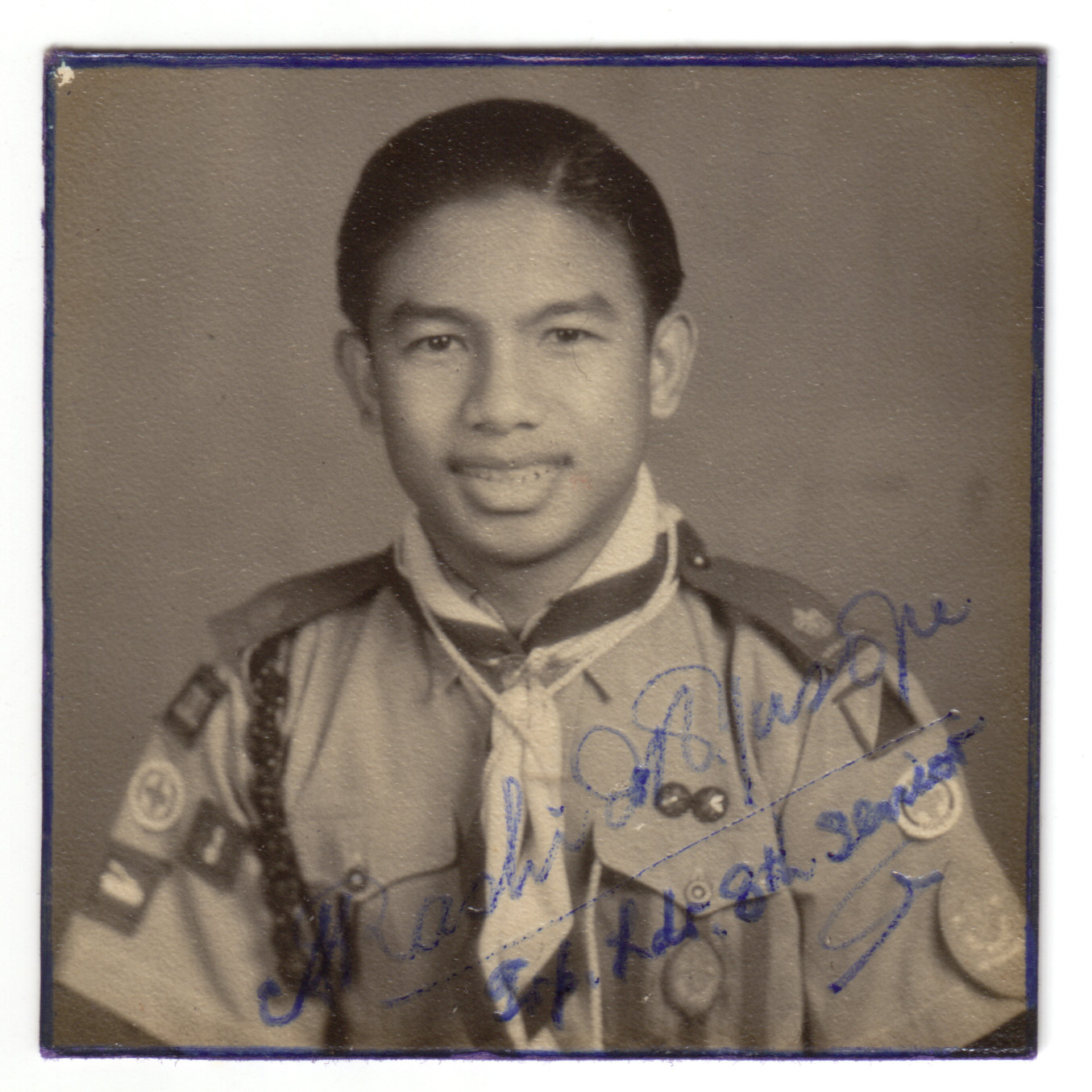
This is my father, Abdul Rashid Mohd Yusope (as he had signed on the first line).
The second line reads Troop Leader 8th Senior. This is ACS Scouts and he was in 8th Grade and was the Scouts Troop Leader. Undated; circa 1947. After school he was a cake seller by the sea, Straits of Malacca, at Banda Hilir padang. The only trait he shared with his sister Zainah and also Coco, is their mathematical skills - he wrote the mathematics syllabus and textbooks for Malaysia. Tun Mahathir asked him to be Malaysia's Ambassador to Germany for our engineering boys who were to be sent there - he refused because there would be nobody to take care of his mother. He loved his mother dearly. I will blog about his mother some other time at my family blog. Zainah is deceased. She was the most intelligent Malay woman I have ever met in my life - she could do 3rd root of any large number anytime! I was amazed! She only attended Grade 1 and quit school. She had a string of languages which I don't know where she learnt them.
My father is seated. He is as Scouts Troop Leader 8th Senior, ACS Malacca
circa 1947. He led the troop and most of the boys were Chinese. They liked him as he was intelligent especially when it came to mathematics. I will upload some pages of his mathematics exercise book at my family blog. I have never attended tuition in my entire life. My father taught me mathematics and when I went to first year university and took maths classes, my own American professors were amazed and asked me where I had learnt mathematics - I told them I learned math from my father. I taught some of the same skills to my children at age 3 onward - and they managed well in school without any math tuition. My first job offer was by the Math Dept when I was in 2nd year! By the time I graduated, they already alerted the entire UC system in California.

Yusuf bin Buntal, schoolteacher and Imam of Masjid Semabok, with his first son Mu'in. Photographed at  his home in Semabok, Malacca.  Sunday 10 September 1950. Later, Haji Yusuf became my father's mentor after my father's Walid died. 
Yusuf bin Buntal photographed at home in Semabok, Malacca before leaving for Makkah (pilgrimage for first Hajj). Thursday 10 June 1954

As above. Villagers visited Yusuf bin Buntal at home before he left for Makkah.
This is a family photo. There are probably 4 families in this photo. The names are on the right. At extreme left is Haji Noordin bin Ismail. He is my father's granduncle. Standing next to Haji Noordin is Haji Yusuf bin Buntal, schoolteacher and Imam of Masjid Semabok. At extreme right is Walid (Haji Mohd Yusope bin Haji Mohd Sharif). Standing next to Walid is Abas bin Abdul Rahman, Walid's son-in-law who married Walid's eldest daughter Ainon.

This is Abas bin Haji Abdul Rahman, as in the photo above.
If you study the facial features carefully, you will see that the same features occur in another man, Tan Sri Abdul Majid bin Ismail @ Coco. I only found this photo this year. It was in my father's pendrive and album all the time.


Abas when he was older. Pak Abas with some young relatives. My father is the boy behind his sister Sekmah. The boy squatting could be my father's younger brother Baharuddin Mohd Yusope, later Private Secretary to Tun Hussein Onn. Circa 1947-1950s


Coco

When I interviewed Coco for the first time on 11 May 2007 at his office in Jalan Damai in KL, it was the first time I met him but the features of Abas were so strikingly similar in Coco. When Coco asked me where I originated, I told him I was born in Malacca but my parents were from KL. When Coco probed further and asked me where I lived in Malacca, I said Banda Hilir, behind the mosque. Then, Coco probed even further and asked me if I knew others in Ujong Pasir. I said I didn't know but that I knew some relatives who lived in Umbai from my childhood. At that point Coco asked me whom I knew in Umbai and I told him I knew Pak Cik Abas (above), his wife Mak Ainon and the kids/my cousins (Kak Besar/Hawa, Kak Mariam, Abang Mohamad, Abang Abdul Rahman, Kak Zaleha, and Adik Musa). Then Coco asked who else I knew in Umbai. I said to him there is a big Malay house beside Pak Abas where Nenek Mun lived. Coco asked me about Nenek Mun. I said Nenek Mun lived with some assistance and her relatives lived in PJ-KL, and that my dad had great respect for Nenek Mun. At that point Coco said "then we are related!" You can imagine the shock I had on my face! Even my husband who was recording the interview stopped in shock! I did not know how to proceed as the man I was interviewing was my own granduncle! It took me awhile to come to terms with that shocking news. With tears in my eyes (and Coco's too), I proceeded with some trepidation for about another hour. Coco was much more relaxed after we found out we were related. 


I have met many of Coco's sisters and relatives but I never knew they were all related to him! I then informed my father of this new find. And to my surprise my father said there is no such name as Tan Sri Abdul Majid but there is Doktor Abdul Majid. Now I was so confused! But I had confirmed with Coco at his interview whether he was the only Dr Abdul Majid bin Ismail and also the only Tan Sri Abdul Majid bin Ismail. So I couldn't be wrong. My father then asked me for Coco's # which I gave him. When my father tried calling Coco's office, he said the lady who answered the phone said Coco was busy, and replied the same for further calls. As a result my father never had a chance to speak to his own uncle. My father died in 2009.


Coco had written in his book and I also mentioned in TEMD, that 'a friend had come to look for him while he was attending the King Edward VII College of Medicine'. I believe that 'friend' was my father. My father had narrated to me that when he was offered a place at the KE VII to do medicine (which he did but just for a brief 9 months), he first went to look for his uncle Abdul Majid. He did not elaborate what happened. But in Coco's account and in TEMD, Coco mentioned the 'friend had asked for Abdul Majid' whilst he was nicknamed Coco and nobody knew his real name, for which Coco's friends told my father that there was no one by the name of Abdul Majid. But in the end my father met Coco as they knew each other and were related. My father attended KE VII briefly for 9 months in first year medicine in 1951 before he went to UK.


Coco's last book

Coco's book 'An Old Man Remembers' (2006) has a lot more on our common ascendants. You can read his book and find out. I don't know whether he sells that book but you can go to his office and ask for one.

More on Coco in New Sunday Times 2006
More on Coco and daughter Ellina's family in Yayasan Tun Abdul Hamid
More on Coco at VI
More on Coco at Arkib Negara Malaysia
More on Coco in Malaysian Orthopedic Association (MOA)


Coco and I thought about whether we can possibly write a book together on our common ascendants and therefore provide a new breath to Malacca History. If that is possible then you will see how Princess Hang Li Poh comes into the family tree and the Malacca History. Coco knows it all too well.