This is a brightly painted mosque of the modern era. This is our second time being in the area of the mosque. We were here last time when a relative got married in a house some distance behind this mosque. This is Masjid Mukim Kedai Mulong in Jalan Kuala Krai, Kelantan.
Friday, 28 December 2012
Masjid ar-Rahman
We were searching for Masjid Kg Laut and came across this masjid. This is not Masjid Kg Laut. This is Masjid ar-Rahman in Jalan Kuala Krai.
Man vs Machine
I wrote a post about the Tanjung Kupang airplane tragedy. This post is about another airplane tragedy, as bad as that at Tanjung Kupang. Tanjung Kupang was an air-land crash. This one is an air-river crash, the worst in modern aviation history. This was the tragic SilkAir Flight 185 from Jakarta to Singapore on 19 December 1997. It has been 15 years now. Eyewitnesses are 15 years older since that crash date. Children who witnessed the crash are teenagers and adults today. In this aircrash, all died. Victim's families mourned endlessly. Investigations were troublesome and long-winded. No aircrash investigation is easy. The cause of many such aircrash remains unknown. There can never be a single cause. Most point to a multitude of probable causes. In this case, investigators gave many causes such as pilot suicide, indicating heavy financial losses of one pilot and a predated purchase of a life insurance as glaring evidence for his committing suicide. Other investigations brought up the rudder mechanism as being at fault for the airplane's yaw or roll (as 2 other planes had experienced the same). The airplane went down in a river near a village in Palembang, midway between Jakarta and Singapore.
Mayday - SilkAir 185 - Pilot Suicide
More details
I met Mr Champika Wijayatunga, a senior IT trainer and specialist based in Queensland, Australia. We met at the IPv6 Forum on 15-16 March 2007 at dinner in Putrajaya (refer to Research on the Early Malay Doctors 1900-1957 Malaya and Singapore, page 63). I sat next to him and we started talking about IT applications in various fields. We hopped from hospitals to airplanes. Both Champika and I loved the IT applications for the airplane cockpit. He loved video game airplane simulations; I don't. We discussed about autopilot and whether there was any safety when things are flying on autopilot. Champika said a lot of things about autopilot. A haunting feeling I had was WHAT IF pilots died in their seats and passengers were to fly an autopilot airplane. Would they know how to read and comprehend the dials, buttons and levers? We laughed. But an eerie feeling ran through me. WHAT IF an autopilot driven airplane had mechanical problems? It was no joke when passenger safety is at risk in an aircraft that's flying on autopilot. We were both silent. Anyway, Champika wished me luck for completing my book on The Early Malay Doctors.
Many years ago, I had a female medical student who asked me if there is a new field that she could take up after graduation. I proposed to her the topic of emergency air medicine and told her how to go about it. It would require a basic medical training (as for a doctor, plus postgraduate A&E training), a basic mechanical & electrical engineering training (as for engineers) and a good training in faith (as in Islam). You see, in any emergency involving a machine (in this case an aircraft that rolled to the right and flew upside down before it crashed), sometimes we can still bring things under control. However, in many emergencies, there is a point where we cannot change things happening right in front of our eyes, and have to accept the inevitable - in this case, aircrash.
Despite many investigations that follow after any aircrash, it is the people that matter. People who made the aeroplane parts are responsible for inspecting that these mechanical parts are of quality and have passed strict inspection tests. Technicians cannot just shut one eye and pass an object that is defective. A corrected mechanical defect is fine if it passes inspection and tests (the defect becomes history). A pilot's mental health is of utmost importance as he flies the airplane. One wrong move by the captain can bring down an entire 6-ton airplane and jeopardise or end the lives of hundreds on board. It is not a joke.
We all must be very careful with the duties entrusted to us. We cannot pass something that is defective or wrong. There is a limit to bring personal problems to the work space. There is a limit to bring domestic problems to the work scene. It is difficult to separate a person from his pressing problems but this is the greatest challenge that employers face today. The other challenges are employee honesty and trust.
I am troubled every time I hear of an aircrash. It makes me wonder, with all the IT that we have today, we still cannot control even the airplanes that we fly. It simply tells us a message that there is a bigger power that controls us. It should make us contemplate on our lives and the lives of others.
On 29 December 2012, Ustaz Pahroi said on Radio IKIM that we read doa before using any transport as we cannot fully control the transport.
Mayday - SilkAir 185 - Pilot Suicide
More details
I met Mr Champika Wijayatunga, a senior IT trainer and specialist based in Queensland, Australia. We met at the IPv6 Forum on 15-16 March 2007 at dinner in Putrajaya (refer to Research on the Early Malay Doctors 1900-1957 Malaya and Singapore, page 63). I sat next to him and we started talking about IT applications in various fields. We hopped from hospitals to airplanes. Both Champika and I loved the IT applications for the airplane cockpit. He loved video game airplane simulations; I don't. We discussed about autopilot and whether there was any safety when things are flying on autopilot. Champika said a lot of things about autopilot. A haunting feeling I had was WHAT IF pilots died in their seats and passengers were to fly an autopilot airplane. Would they know how to read and comprehend the dials, buttons and levers? We laughed. But an eerie feeling ran through me. WHAT IF an autopilot driven airplane had mechanical problems? It was no joke when passenger safety is at risk in an aircraft that's flying on autopilot. We were both silent. Anyway, Champika wished me luck for completing my book on The Early Malay Doctors.
Many years ago, I had a female medical student who asked me if there is a new field that she could take up after graduation. I proposed to her the topic of emergency air medicine and told her how to go about it. It would require a basic medical training (as for a doctor, plus postgraduate A&E training), a basic mechanical & electrical engineering training (as for engineers) and a good training in faith (as in Islam). You see, in any emergency involving a machine (in this case an aircraft that rolled to the right and flew upside down before it crashed), sometimes we can still bring things under control. However, in many emergencies, there is a point where we cannot change things happening right in front of our eyes, and have to accept the inevitable - in this case, aircrash.
Despite many investigations that follow after any aircrash, it is the people that matter. People who made the aeroplane parts are responsible for inspecting that these mechanical parts are of quality and have passed strict inspection tests. Technicians cannot just shut one eye and pass an object that is defective. A corrected mechanical defect is fine if it passes inspection and tests (the defect becomes history). A pilot's mental health is of utmost importance as he flies the airplane. One wrong move by the captain can bring down an entire 6-ton airplane and jeopardise or end the lives of hundreds on board. It is not a joke.
We all must be very careful with the duties entrusted to us. We cannot pass something that is defective or wrong. There is a limit to bring personal problems to the work space. There is a limit to bring domestic problems to the work scene. It is difficult to separate a person from his pressing problems but this is the greatest challenge that employers face today. The other challenges are employee honesty and trust.
I am troubled every time I hear of an aircrash. It makes me wonder, with all the IT that we have today, we still cannot control even the airplanes that we fly. It simply tells us a message that there is a bigger power that controls us. It should make us contemplate on our lives and the lives of others.
On 29 December 2012, Ustaz Pahroi said on Radio IKIM that we read doa before using any transport as we cannot fully control the transport.
Thursday, 27 December 2012
Muzium Kelantan
We visited Muzium Kelantan today after we last set foot here. We entered the main office and asked for Encik Sabki Ibrahim, Muzium Kelantan's famed photographer. But the receptionist said he was busy. A lady approached us to assist. We told her we wanted to see Sabki. She said he was busy in the back office photocopying stuff for a meeting in the afternoon. She asked us to see another person instead. I took her photo before she disappeared. I don't have her name.
We were asked to see another officer, Haji Abustarim bin Yaacob. He is Penolong Pengarah (Kurator), Konservasi & Penyelidikan. I didn't see his name on his doorplate which was set high above his office door (above the door frame). I managed to quickly glimpse the doorplate above my head as we walked into his room. I only saw the word Yaacob on the doorplate. Affandi said his name is "Abu or something". We forgot to ask for his business card. We were warmly invited in and asked to be seated. Affandi salam and we both sat down to talk. Affandi gave Haji Abustarim my 2 books, and said thanks for Muzium Kelantan's help with the old photos that went into my books.
Muzium Kelantan was very helpful. It kept a lot of photos of British Kelantan and willingly assisted me from the outset of my research on The Early Malay Doctors. When I first approached Muzium Kelantan, it was a cold welcome but that slowly became good over time. I was not used to working with the Muzium and my language style had to be fine tuned to match the fine Malay language used at Muzium Kelantan. The staff were courteous and they spoke very softly, unlike the noisy staff I am used to at my workplace.
Haji Abu was very happy to receive us. Affandi did all the talking and I butted in once in a while. I took 2 photos of Haji Abu. He said nobody had written about the Malays and more so on doctors. He said my effort in writing on the early Malay doctors was a worthwhile effort in the right direction in helping to increase knowledge about the Malay people. He was very happy. He said people should be happy about the 2 books I wrote. I told him that whatever I wrote was to the best of my ability, given the published materials which I used as reference. I told him there were limited information on Kelantan for my reference. He mentioned there is Sejarah Kelantan which was written in English. He also mentioned Dr Gimlette. I reiterated Dr John Gimlette who wrote Malay Poisons and Charm Cures, and he instantly recalled that book.
I told Haji Abu that I had faced problems when trying to identify people in some of the photos as either I knew them but only as a child or I had never heard of them and did not know them by face and name. I said to him to let me know if he spots inconsistencies and mistakes. I could correct them in future, In sya Allah.
He said now that the 2 books are available, people can now read and if they find errors, they can make note of them and let me know. I said they can email me. He said it was unfair if critics bombard me after my hard work in trying to publish the 2 books; they should appreciate that the books are published. He said I must have spent a great amount of time to write the books and got them published. He said it was a great contribution to the Malay world. He was pleased that I had done a good job of publishing my 2 books. I thanked him and felt blessed. Alhamdulillah.
I said to Haji Abustarim that I hoped Muzium Kelantan would continue to assist me in my future book writing activities, In sya Allah. He agreed that Muzium Kelantan would be happy to assist me. It made me very happy to know that Muzium Kelantan is agreeable to assist me. Alhamdulillah. I took some photos while the men were talking. We then left to catch up with Encik Sabki on our way out.
GOMO KLATE GOMO!!
![]() |
| Receptionist at Muzium Kelantan, 27 December 2012. |
We were asked to see another officer, Haji Abustarim bin Yaacob. He is Penolong Pengarah (Kurator), Konservasi & Penyelidikan. I didn't see his name on his doorplate which was set high above his office door (above the door frame). I managed to quickly glimpse the doorplate above my head as we walked into his room. I only saw the word Yaacob on the doorplate. Affandi said his name is "Abu or something". We forgot to ask for his business card. We were warmly invited in and asked to be seated. Affandi salam and we both sat down to talk. Affandi gave Haji Abustarim my 2 books, and said thanks for Muzium Kelantan's help with the old photos that went into my books.
Muzium Kelantan was very helpful. It kept a lot of photos of British Kelantan and willingly assisted me from the outset of my research on The Early Malay Doctors. When I first approached Muzium Kelantan, it was a cold welcome but that slowly became good over time. I was not used to working with the Muzium and my language style had to be fine tuned to match the fine Malay language used at Muzium Kelantan. The staff were courteous and they spoke very softly, unlike the noisy staff I am used to at my workplace.
Haji Abu was very happy to receive us. Affandi did all the talking and I butted in once in a while. I took 2 photos of Haji Abu. He said nobody had written about the Malays and more so on doctors. He said my effort in writing on the early Malay doctors was a worthwhile effort in the right direction in helping to increase knowledge about the Malay people. He was very happy. He said people should be happy about the 2 books I wrote. I told him that whatever I wrote was to the best of my ability, given the published materials which I used as reference. I told him there were limited information on Kelantan for my reference. He mentioned there is Sejarah Kelantan which was written in English. He also mentioned Dr Gimlette. I reiterated Dr John Gimlette who wrote Malay Poisons and Charm Cures, and he instantly recalled that book.
I told Haji Abu that I had faced problems when trying to identify people in some of the photos as either I knew them but only as a child or I had never heard of them and did not know them by face and name. I said to him to let me know if he spots inconsistencies and mistakes. I could correct them in future, In sya Allah.
He said now that the 2 books are available, people can now read and if they find errors, they can make note of them and let me know. I said they can email me. He said it was unfair if critics bombard me after my hard work in trying to publish the 2 books; they should appreciate that the books are published. He said I must have spent a great amount of time to write the books and got them published. He said it was a great contribution to the Malay world. He was pleased that I had done a good job of publishing my 2 books. I thanked him and felt blessed. Alhamdulillah.
I said to Haji Abustarim that I hoped Muzium Kelantan would continue to assist me in my future book writing activities, In sya Allah. He agreed that Muzium Kelantan would be happy to assist me. It made me very happy to know that Muzium Kelantan is agreeable to assist me. Alhamdulillah. I took some photos while the men were talking. We then left to catch up with Encik Sabki on our way out.
![]() |
| Affandi with Haji Abustarim bin Yaacob, Muzium Kelantan, 27 December 2012. |
Encik Sabki bin Ibrahim (Pembantu Muzium, Muzium Negeri). He is the muzium photographer, He remembered us and was happy to know that the books are ready. He said he would take a look at the books later as he had a meeting to attend to. I took a photo of him with Affandi. He then asked us to see Muzium Kelantan's current display - The Red Warriors! I thought he was joking but he was not. He led us to the display section and then had to leave for his meeting. We went round to see all the displayed items including a photo of Apek, a lot of red jerseys, a lot of gigantic trophies, a wall of newspaper clippings, photos of football coaches, including Boyan Hodak! There were personal paraphenalia & memorabilia belonging to Dali Omar and Hisham ... (can't recall his name). I still marvel at the trophies - I would love to hold one up high - for what? I don't know. The 2 big trophies I saw had intricate designs and relief, that I think they must have been made by Kelantanese craftsmen or some British counterparts. I don't know where they make such huge trophies - I could put my head in the 2 large trophies! Awesome!
GOMO KLATE GOMO!!
External links
Drinking Water
In our history, many Malay households used well water for drinking, cooking, washing, bathing, watering, etc. Others used the river for the same purposes if their homes were close to rivers. Rivers were clean and there was no problem of contaminated rivers then.
A few British government homes had piped water where lead (plumbum, Pb) was used to make the metal pipes. 55 years after independence, these lead pipes are rusty and give us rusty water that stain our white school blouses a rusty colour.
There is one source of clean drinking water that the Malays used to obtain hygienic clean drinking water and that is the hollowed granite potable water. I had seen one at the Cheng Ho Expo in November 2010. I saw one outside Muzium Kelantan today.
It makes me wonder, did the Ming Chinese introduce clean drinking water to the Malays well before the British introduced lead pipes which rusted easily? Did the Malays use hygienically doubly filtered sand-filtered granite-filtered drinking water? If they did, then the Malays had a good water filtration system well before the British colonials arrived in Malaya. Another question is, did the British colonials learn about water filtration from the Malays in Malaya during British Malaya? Did they then bring the idea back home to England and then tried making a similar system that worked?
Back in the mid-1970s, I was in my grandfather's kitchen while he wanted to show me his new British water filtration system. It was a dull clay colored earthen cylindrical column with a few removable parts. There was a column, a lid and some inside parts I am unable to recall. The water filter system should still be in his house in Penang. I have not seen it since he died. A similar water filter can be seen at this website: http://bostonpast.blogspot.com/2011_01_01_archive.html
A few British government homes had piped water where lead (plumbum, Pb) was used to make the metal pipes. 55 years after independence, these lead pipes are rusty and give us rusty water that stain our white school blouses a rusty colour.
There is one source of clean drinking water that the Malays used to obtain hygienic clean drinking water and that is the hollowed granite potable water. I had seen one at the Cheng Ho Expo in November 2010. I saw one outside Muzium Kelantan today.
MALAY
![]() |
| A traditional Malay water-filtration system outside Muzium Kelantan, 27 December 2012 |
It makes me wonder, did the Ming Chinese introduce clean drinking water to the Malays well before the British introduced lead pipes which rusted easily? Did the Malays use hygienically doubly filtered sand-filtered granite-filtered drinking water? If they did, then the Malays had a good water filtration system well before the British colonials arrived in Malaya. Another question is, did the British colonials learn about water filtration from the Malays in Malaya during British Malaya? Did they then bring the idea back home to England and then tried making a similar system that worked?
CHINESE
![]() |
| A Chinese water filtration system, similar to that of the Malays, Cheng Ho Expo, 23 November 2010 |
![]() |
| A display board at Cheng Ho Expo, 23 Novermber 2010 |
BRITISH
Bazar Tuan Padang
We were in front of the new Bazar Tuan Padang today. I saw it from a distance before but this is the first time that we were close to it. I managed to get some photos from across the busy main street while we were at Muzium Kelantan.
Who was Tuan Padang? Accounts say he was a great man, an ustaz from Terengganu who was well-known in Kelantan. I don't have the complete story on him yet. Affandi said Tuan Padang's son is also an ustaz, and often appears on Malaysian TV9.
The bazaar is a new place and is named after this great ustaz. I saw people selling kain tudung here but I haven't been inside. There is a surau within the bazaar.
Who was Tuan Padang? Accounts say he was a great man, an ustaz from Terengganu who was well-known in Kelantan. I don't have the complete story on him yet. Affandi said Tuan Padang's son is also an ustaz, and often appears on Malaysian TV9.
The bazaar is a new place and is named after this great ustaz. I saw people selling kain tudung here but I haven't been inside. There is a surau within the bazaar.
![]() |
| Bazar Tuan Padang |
Wednesday, 26 December 2012
Lorong Minyak Gas
We couldn't locate Lorong Minyak Gas (literally kerosone street) in the vicinity of Lorong Gajah Mati. This road was named after a shop that sold kerosene for use in kerosene stoves for cooking purposes. Long long ago, Malay homes used either charcoal or kerosene stoves. Many homes chose kerosene stoves over charcoal stoves. My home in Malacca used a big homemade charcoal stove while my Malacca aunt used a commercial kerosene stove.
We stopped at an old squatting WC (jamban cangkung) that was roughly 2 feet above ground. I took a close look at the interior - I didn't like the sight of it. We were starring at the masterpiece when a lady called from behind us. I turned to look at her - she had false front teeth. She asked us what we were doing in the area. Affandi asked her for the direction to Lorong Minyak Gas. She said we were in the wrong place and to go back to where we came from the main road, and to go the opposite direction.
We headed back to the main road (Lorong Gajah Mati). There we met with an elderly lady named Nab (could be short for Zainab). She asked who we were and Affandi explained we were looking for Lorong Minyak Gas. Affandi described who he was - son of Yah, daughter of Esah, Yah sister of Nik Kob. It is rather strange that in the Kelantanese language, names are usually simplified to a single syllable and relationships are remembered. Nab knows Yah and they were friends, they are possibly of the same age. Nab appeared very happy talking to us. He asked Affandi where he worked and Affandi replied at USM. Nab interrupted and asked, "Doktor ke"? Nab said Yah had mentioned one of her children is a doctor! OMG! Nab turned to me and asked what I do. Affandi replied I teach, which is correct. We didn't bother to specify what our occupations are in order to keep the conversation lively and not to surprise Nab. Then it was time to go. I don't have a photo of Nab as my camera ran out of battery. Will try to bring Yah to see Nab next time, insyaAllah.
We stopped at an old squatting WC (jamban cangkung) that was roughly 2 feet above ground. I took a close look at the interior - I didn't like the sight of it. We were starring at the masterpiece when a lady called from behind us. I turned to look at her - she had false front teeth. She asked us what we were doing in the area. Affandi asked her for the direction to Lorong Minyak Gas. She said we were in the wrong place and to go back to where we came from the main road, and to go the opposite direction.
We headed back to the main road (Lorong Gajah Mati). There we met with an elderly lady named Nab (could be short for Zainab). She asked who we were and Affandi explained we were looking for Lorong Minyak Gas. Affandi described who he was - son of Yah, daughter of Esah, Yah sister of Nik Kob. It is rather strange that in the Kelantanese language, names are usually simplified to a single syllable and relationships are remembered. Nab knows Yah and they were friends, they are possibly of the same age. Nab appeared very happy talking to us. He asked Affandi where he worked and Affandi replied at USM. Nab interrupted and asked, "Doktor ke"? Nab said Yah had mentioned one of her children is a doctor! OMG! Nab turned to me and asked what I do. Affandi replied I teach, which is correct. We didn't bother to specify what our occupations are in order to keep the conversation lively and not to surprise Nab. Then it was time to go. I don't have a photo of Nab as my camera ran out of battery. Will try to bring Yah to see Nab next time, insyaAllah.
Malay House
While Affandi was talking to some villagers of Lorong Gajah Mati, I searched the area. I came across an interesting building. I went back to asked the villagers about the building. A boy said that it was the house of Wae Deng (Wan Din) who was a skilled house builder. I asked the boy where was he. The boy replied he died long ago. The house seemed vacant. I took some shots to show you what a Malay house looks like on the exterior. I can't tell which was the front and back. You decide.
External links:
http://archnet.org/library/
Hijjas bin Kasturi
http://archnet.org/library/
Hijjas bin Kasturi
Lorong Gajah Mati
The sultan's office in Kota Bharu is at Istana Balai Besar, and was once surrounded by big bamboo poles. Once is a while these bamboo poles would make a bursting sound in the dry season. Thus, the area is called Pintu Pong and the road named Jalan Pintu Pong.
Istana Balai Besar is not far from a Malay village which is sited at Jalan Gajah Mati. We asked the villagers (2 boys and an elderly lady in her late 70s) why the place was named Jalan Gajah Mati. One boy said a white elephant that had 6 legs died in the village long ago. The lady informed us nobody remembers the story of the white elephant that had died here and the village named after it.
From my reading, a white baby elephant had escaped from the palace and the villagers gave chase to recapture it. It ran in the direction of a Malay village by Sg Kelantan. However, the villagers' huts huddled close together and there was only a narrow path in that village. This baby elephant ran and entered this narrow path. Because it could not pass through the narrow path it got stuck and then died at this village. The lane was thus name Lorong Gajah Mati after the white royal elephant that died while trying to escape. Whatever the true story of how this village derived its name, nobody remembers anymore.
We went to look at the house where Affandi grew up and where we met his mother, 17 years after mother and son were separated. It took us a month to search for his mother's location. We knocked on every door and asked everyone we met on the way to the old house. We found her! It was a tearful meeting after that long.
Map of Jalan Gajah Mati and nearby areas
http://goo.gl/maps/47GTL
Istana Balai Besar is not far from a Malay village which is sited at Jalan Gajah Mati. We asked the villagers (2 boys and an elderly lady in her late 70s) why the place was named Jalan Gajah Mati. One boy said a white elephant that had 6 legs died in the village long ago. The lady informed us nobody remembers the story of the white elephant that had died here and the village named after it.
From my reading, a white baby elephant had escaped from the palace and the villagers gave chase to recapture it. It ran in the direction of a Malay village by Sg Kelantan. However, the villagers' huts huddled close together and there was only a narrow path in that village. This baby elephant ran and entered this narrow path. Because it could not pass through the narrow path it got stuck and then died at this village. The lane was thus name Lorong Gajah Mati after the white royal elephant that died while trying to escape. Whatever the true story of how this village derived its name, nobody remembers anymore.
We went to look at the house where Affandi grew up and where we met his mother, 17 years after mother and son were separated. It took us a month to search for his mother's location. We knocked on every door and asked everyone we met on the way to the old house. We found her! It was a tearful meeting after that long.
Map of Jalan Gajah Mati and nearby areas
http://goo.gl/maps/47GTL
![]() |
| Path to Affandi's old rented house by Sg Kelantan |
![]() |
| Affandi's feels happy to be back in his village |
Masjid To' Mesir
We visited an old mosque in Kota Bharu. This is Masjid To' Mesir. We don't know about the background of To' Mesir. The mosque was recently renovated in 2010. A narrow broken bitumen path leads to the mosque from Jalan Gajah Mati entrance. Corrugated zinc sheets were used as fence by the villagers for privacy. They can be a problem as some parts of the zinc fences were rusty and jutting out. There were no fences when we visited the area in the early 1980s. It was a madrasah (Kelantan malasoh) from 1963 to 2009. Its status was upgraded to masjid on 31 January 2010.
![]() |
| Lorong Gajah Mati entrance in Kota Bharu |
![]() |
| Affandi showing the way to the mosque which lies in his village |
![]() |
| Masjid To' Mesir |
![]() |
| Renovation plaque |
Banjir 2012
It is the monsoon season now. It rained for a week and stopped today on 25 December 2012. My husband and I went about to see the flooded areas in Pasir Tumboh, Kg Mentuan, Binjai and Kota Bharu.
In Pasir Tumboh, the area by the bridge was flooded and villagers used boats to get around. This year the boats were better and looked stronger. There were only a few cars parked by the roadside, indicating the outsiders (working children of the villagers) have long left the area.
In Kg Mentuan, water filled the low lying areas (possibly old abandoned paddy fields). We went to see my husband's brother's house in the area. The flood water had subsided but there was still a large patch of water-logged area of the road that led to his house which is sited in a clearing at the edge of the forest.
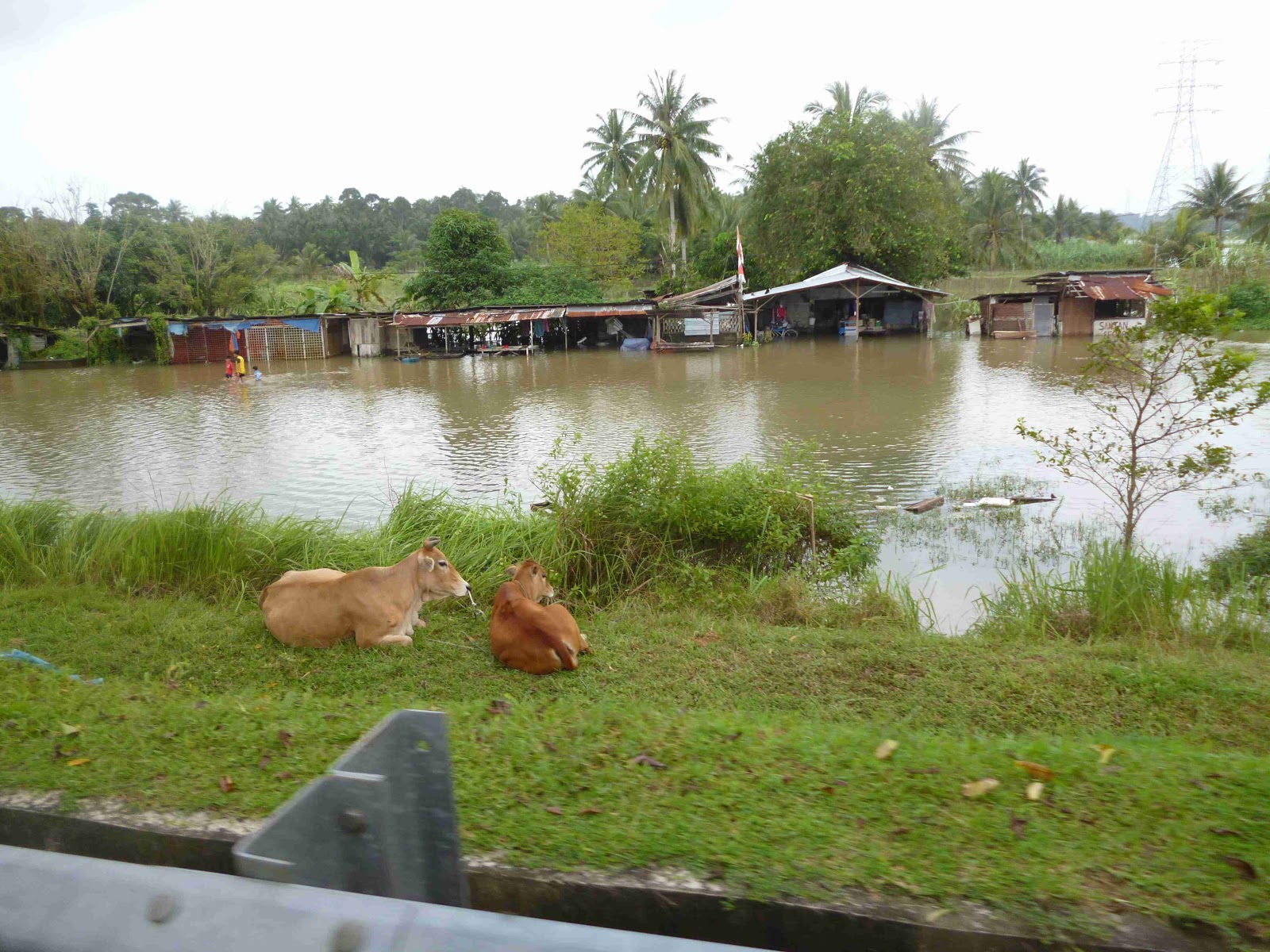
In Binjai, the huts for the daily market by the main road were all submerged. A few kids could be seen playing in the water. There was a bunch of kids playing water football. Domesticated animals (cows) were up on the verge.
In Kota Bharu, the roads were clean after the heavy rain. Traffic jams formed in all roads and at all intersections. People went about on foot to obtain food. Sg Kelantan swelled to almost maximum but did not flood Kota Bharu. The roads were not flooded. High concrete embankment slabs lined the entire water's edge. Residents said they could not view the river anymore. The rainwater that was trapped between the concrete slabs and land appeared much like air teh tarik (I use this analogy for lipaemia for my class lectures). I saw a well at the water's edge.
Banjir December 2012/January 2013 was rather queer. It rained heavily beginning 15 December 2012 for 3 weeks till 3 January 2013. Then it didn't rain on Friday, 4 January 2013 for 4 days. The sun shone bright for 4 days and all the flood water dried up. Even the flood water next to Pasir Tumboh bridge dried up except for a few areas where the flood water could still be seen and muddy tracks led to the wooden houses on stilts. Heat was intense and I suffered a headache after walking in the hot weather. Then it rained for a second time on 9 January 2013 but with weaker force. It only rained for a brief while in the afternoon when the schoolchildren had completed school. The children walked home in the light rain, not carrying any umbrella. They probably thought the rain was gone for good and were caught unprepared and without umbrellas.
In Pasir Tumboh, the area by the bridge was flooded and villagers used boats to get around. This year the boats were better and looked stronger. There were only a few cars parked by the roadside, indicating the outsiders (working children of the villagers) have long left the area.
In Kg Mentuan, water filled the low lying areas (possibly old abandoned paddy fields). We went to see my husband's brother's house in the area. The flood water had subsided but there was still a large patch of water-logged area of the road that led to his house which is sited in a clearing at the edge of the forest.
In Binjai, the huts for the daily market by the main road were all submerged. A few kids could be seen playing in the water. There was a bunch of kids playing water football. Domesticated animals (cows) were up on the verge.
In Kota Bharu, the roads were clean after the heavy rain. Traffic jams formed in all roads and at all intersections. People went about on foot to obtain food. Sg Kelantan swelled to almost maximum but did not flood Kota Bharu. The roads were not flooded. High concrete embankment slabs lined the entire water's edge. Residents said they could not view the river anymore. The rainwater that was trapped between the concrete slabs and land appeared much like air teh tarik (I use this analogy for lipaemia for my class lectures). I saw a well at the water's edge.
![]() |
| Pasir Tumboh |
![]() |
| Binjai |
Tuesday, 25 December 2012
Dikir Barat
I have just missed this event today. It ended about an hour ago. This is Pertandingan Dikir Barat. It was once banned in the 1980s because the lyrics of the dikir barat songs were obscene. It has made a comeback after the lyrics were improved. Today the lyrics focus on advice to the community. USM has a team that performs and competes in dikir barat.
The Doctors' Cars
It is intriguing to read about what cars the early Malay doctors had owned. It is amazing to know what the cars looked like back then, compared to the first car that Henry Ford made.
Ford Model T cars were produced from 1 October 1908 onward. A photograph from the Herbert Hoover Library showed 3 great American inventors met in Florida, dated 11 February 1929. They were Henry Ford (inventor of Ford Model T cars), Thomas Alva Edison (inventor of electric lamps), and Harvey Firestone (inventor of pneumatic rubber tyres).
These early Ford Model T cars appeared on the streets including in Malaya and Singapore in the 1930s. Many museum photographs depicted these early Ford Model T cars. Family photographs also depicted these early cars.
Rolls Royce were also popular at the time of the early Malay doctors. It is unknown how many Rolls Royce were brought into Malaya and Singapore and who owned them.
There were carriages in the 1900s. Muzium Kelantan has a wooden carriage that was used then. A photograph by Muzium Kelantan showed a doctor's carriage and the doctor with his family. A Malay man served as the driver.
Henry Ford (1863-1947) incorporated the Ford Motor Company in 1903, proclaiming, "I will build a car for the great multitude." He made many car models including the Ford Model T cars. His signature became the Ford car logo. His portrait appears on the cover of Time magazine issue of 14 January 1935. More at http://inventors.about.com/od/fstartinventors/a/HenryFord.htm and http://en.wikipedia.org/wiki/Henry_Ford and http://en.wikipedia.org/wiki/Ford_Model_T and http://www.eyewitnesstohistory.com/ford.htm and http://www.hfmgv.org/exhibits/hf/
Ford Model T cars were produced from 1 October 1908 onward. A photograph from the Herbert Hoover Library showed 3 great American inventors met in Florida, dated 11 February 1929. They were Henry Ford (inventor of Ford Model T cars), Thomas Alva Edison (inventor of electric lamps), and Harvey Firestone (inventor of pneumatic rubber tyres).
These early Ford Model T cars appeared on the streets including in Malaya and Singapore in the 1930s. Many museum photographs depicted these early Ford Model T cars. Family photographs also depicted these early cars.
Rolls Royce were also popular at the time of the early Malay doctors. It is unknown how many Rolls Royce were brought into Malaya and Singapore and who owned them.
Tokoh-tokoh Perubatan Malaysia dan Singapura
The link is here:
http://ms.wikipedia.org/wiki/Tokoh-tokoh_perubatan_Malaysia
It only mentions Malaysia whereas 2 doctors on the list were Singaporeans - Dr Mohamed Ibrahim bin Shaik Ismail and Dr HS Moonshi.
TQ for making the Malay pages in Wikipedia.
TQ for citing my book.
Haji and Tabung Haji
My husband and I visited Tabung Haji (TH) building in Kota Bharu, Kelantan on 24 December 2012 at 11 am. TH counters have moved from Upper Ground (UG) to 11th floor. Renovations are on-going on UG floor. We were brought by a senior officer to the TH main office. He was previously in charge of opening new TH account. On the way to the TH main office, I handed him the business cards for my 2 books. When we were at TH main office, we were given TH calendars for 2013. In return, my husband said we will return to give TH free complimentary copies of my 2 books. We may go today (25 December 2012) or after that date. It is quite dangerous to travel out when the monsoon rain is torrential.
I have highlighted the role of TH in the hajj rites executed by fellow pilgrims, many of whom were the early Malay doctors. Many early doctors had perform the hajj and for many they traveled by ships before flights became available. The first flight was in 1974/75.
At the time my 2 books went to print I hadn't had time to request more information about TH activities. TH has compiled/published books/reports on its hajj trips. Some of the early Malay doctors served on board TH ships and also in Jeddah, Makkah and Madinah. It took very long to reach Jeddah and to return to Malaya after the Hajj.
We visited Tabung Haji again on 27 December 2012 after solat zohor. We met with a friendly Haji Amin on the 11th floor and he said to see the Timbalan Pengarah TH on the 9th floor. Down we went on the technicians' lift with plywood as wall cover. On the 9th floor, Affandi pressed the bell and we were allowed in. Once inside, we were warmly greeted and asked why we came and whom we wanted to see. Affandi said we got books to give to the Timbalan Pengarah TH and we were asked to be seated. I saw a young man in blue silk batik shirt talking to another senior man in yellow silk batik shirt some distance from where I was seated. It's Thursday and it is government general orders that men wear batik shirts to work. The man in yellow batik shirt was working on the computer and turned to look at me. He must think somebody came to the wrong place for the wrong reason. We waited less than 5 minutes and the young man in blue batik shirt called us in to meet his superior. The man in yellow batik shirt pushed himself away from his computer and stationed himself at his main desk as he welcomed us in. Then I knew he was THE BOSS!! I'm glad. Since he was busy Affandi said we would only take a few minutes of his time. We were asked to sit and Affandi quickly gave him my 2 books. As we sat, the boss asked "Dari mana?" Affandi replied "Dari USM." Then Affandi explained "Buku ini isteri saya tulis dan ada banyak maklumat dia ambil daripada TH lama dulu, agak-agak 2008 macam tu. Jadi kami nak bagi buku-buku ni sebagai tanda terima kasih." Gee, I could not have said that correctly and fluently. So it was nice to listen to him speak "Bahasa Melayu Standard". I was tickled but I enjoyed their conversation. I didn't say much because my BM is "tonggang-langgang", and very slow, and my Malay verbs go all over the place, and nobody seems to understand what I say in Malay, except Affandi! It is not even worth trying. Sometimes my kids fail to understand. My Malay text is usually very brief.
The boss's phone buzzed and we thought we had better leave. But he wanted to talk. He said TH supports research and has supported USM research on TH pilgrims. I said that was another group in USM. Affandi explained that many of the early Malay doctors also served as Hajj doctors. The boss said yes. We asked him whether TH had publications. The boss said yes. I said it would be good if TH can provide good reports which we can use for our research at USM. In my present research on the early Malay doctors, we obtained information from the former Timbalam Pengarah TH. I said I had used information published in newspapers about hajj travels between 1900 and Merdeka (1957). He was happy to know that. I asked if TH had other reports that had the details of the doctors who served as hajj doctors between 1900 up till Merdeka. I think TH should have that information. I said I didn't use any data on health statistics or other as we have an understanding that researchers cannot publish sensitive data about TH or the pilgrims' state of health. The boss said researchers can use statistical data (how may got sick of what particular disease, etc). We were happy that the boss had shed some light on the matter. The boss was happy that I had written those 2 books and he said it was a lot of work. He thanked us for the books and we left. I forgot to take photos of him.
TABUNG HAJI
HAJI MUHAMAD ZAKI BIN HAJI BAIJURI
Timbalan Pengarah Negeri
Lembaga Tabung Haji Negeri Kelantan
Wisma Ilmu, Bangunan Tabung Haji
Jalan Doktor, 15000 Kota Bharu, Kelantan
D/L: +609-747 0809; +609-748 1020/748 3770; +609-748 6160
Fax: +609-744 4577
Email: tpnkbh@lth.gov.my
Web: www.tabunghaji.gov.my
UMRAH
Diurus oleh anak syarikat Tabung Haji
Tel: 09-744 6667
Sebarang Pertanyaan/Aduan boleh disalurkan kepada Tabung Haji Contact Centre
Tel: 03-6207 1919
Fax: 03-7727 959
SMS: 33990
Email: th-info@lth.gov.my
I have highlighted the role of TH in the hajj rites executed by fellow pilgrims, many of whom were the early Malay doctors. Many early doctors had perform the hajj and for many they traveled by ships before flights became available. The first flight was in 1974/75.
At the time my 2 books went to print I hadn't had time to request more information about TH activities. TH has compiled/published books/reports on its hajj trips. Some of the early Malay doctors served on board TH ships and also in Jeddah, Makkah and Madinah. It took very long to reach Jeddah and to return to Malaya after the Hajj.
We visited Tabung Haji again on 27 December 2012 after solat zohor. We met with a friendly Haji Amin on the 11th floor and he said to see the Timbalan Pengarah TH on the 9th floor. Down we went on the technicians' lift with plywood as wall cover. On the 9th floor, Affandi pressed the bell and we were allowed in. Once inside, we were warmly greeted and asked why we came and whom we wanted to see. Affandi said we got books to give to the Timbalan Pengarah TH and we were asked to be seated. I saw a young man in blue silk batik shirt talking to another senior man in yellow silk batik shirt some distance from where I was seated. It's Thursday and it is government general orders that men wear batik shirts to work. The man in yellow batik shirt was working on the computer and turned to look at me. He must think somebody came to the wrong place for the wrong reason. We waited less than 5 minutes and the young man in blue batik shirt called us in to meet his superior. The man in yellow batik shirt pushed himself away from his computer and stationed himself at his main desk as he welcomed us in. Then I knew he was THE BOSS!! I'm glad. Since he was busy Affandi said we would only take a few minutes of his time. We were asked to sit and Affandi quickly gave him my 2 books. As we sat, the boss asked "Dari mana?" Affandi replied "Dari USM." Then Affandi explained "Buku ini isteri saya tulis dan ada banyak maklumat dia ambil daripada TH lama dulu, agak-agak 2008 macam tu. Jadi kami nak bagi buku-buku ni sebagai tanda terima kasih." Gee, I could not have said that correctly and fluently. So it was nice to listen to him speak "Bahasa Melayu Standard". I was tickled but I enjoyed their conversation. I didn't say much because my BM is "tonggang-langgang", and very slow, and my Malay verbs go all over the place, and nobody seems to understand what I say in Malay, except Affandi! It is not even worth trying. Sometimes my kids fail to understand. My Malay text is usually very brief.
The boss's phone buzzed and we thought we had better leave. But he wanted to talk. He said TH supports research and has supported USM research on TH pilgrims. I said that was another group in USM. Affandi explained that many of the early Malay doctors also served as Hajj doctors. The boss said yes. We asked him whether TH had publications. The boss said yes. I said it would be good if TH can provide good reports which we can use for our research at USM. In my present research on the early Malay doctors, we obtained information from the former Timbalam Pengarah TH. I said I had used information published in newspapers about hajj travels between 1900 and Merdeka (1957). He was happy to know that. I asked if TH had other reports that had the details of the doctors who served as hajj doctors between 1900 up till Merdeka. I think TH should have that information. I said I didn't use any data on health statistics or other as we have an understanding that researchers cannot publish sensitive data about TH or the pilgrims' state of health. The boss said researchers can use statistical data (how may got sick of what particular disease, etc). We were happy that the boss had shed some light on the matter. The boss was happy that I had written those 2 books and he said it was a lot of work. He thanked us for the books and we left. I forgot to take photos of him.
![]() |
| Affandi in front of the lifts on 11th floor, 27 December 2012 |
TABUNG HAJI
HAJI MUHAMAD ZAKI BIN HAJI BAIJURI
Timbalan Pengarah Negeri
Lembaga Tabung Haji Negeri Kelantan
Wisma Ilmu, Bangunan Tabung Haji
Jalan Doktor, 15000 Kota Bharu, Kelantan
D/L: +609-747 0809; +609-748 1020/748 3770; +609-748 6160
Fax: +609-744 4577
Email: tpnkbh@lth.gov.my
Web: www.tabunghaji.gov.my
UMRAH
Diurus oleh anak syarikat Tabung Haji
Tel: 09-744 6667
Sebarang Pertanyaan/Aduan boleh disalurkan kepada Tabung Haji Contact Centre
Tel: 03-6207 1919
Fax: 03-7727 959
SMS: 33990
Email: th-info@lth.gov.my
Sunday, 23 December 2012
Long Holiday and New Year
I was at TESCO in Kota Bharu, Kelantan yesterday, shopping for garlic, chocolates and coffee. Yesterday was Saturday, which means shoppers have to bring their own plastic bags. I brought along 2 yellow cloth bags from Billion, a TESCO green bag and lots of plastic bags for whatever. I arrived at TESCO shopping complex in heavy downpour as this is the monsoon season. I had lunch first before performing zohor prayer upstairs, and then went to look for groceries. To my surprise, TESCO was filled with shoppers, families and kids. Kids were everywhere but there were not many people between the shelves. Anyway, most of the shelves were empty. I wondered why. Did the lorries not make it through the heavy rain? Did the accidents this week prevent delivery lorries from arriving on time? At the fruit and vegetable section, there were Bombay onions and only 2 miserable shallots. There was no garlic in sight. I wondered why. Since I could not find what I needed, I moved on to the coffee and chocolate section. There were new coffee selections but not my usual coffee 3-in-1 mix. I wondered why. I bought a new Colombian coffee mix just to try. I also saw Kopi Tupai? It was not Kopi Musang (coffee beans excreted by the musang and fried to make ground coffee). When I was at the chocolate section, some music played in the tube. It was Jingle Bell by possibly Dean Martin. I wondered why TESCO played such a song when the shoppers are 99% Malays and don't celebrate Christmas. There was no Christmas decor in the store and I didn't see Santa and any reindeer. So why play Jingle Bell? TESCO could have played Pulanglah or any of the Malay songs since shoppers here are predominantly Malay. I wondered why.
Kota Bharu is jammed with holiday traffic. Parents can't even make it to the shops to buy cheap school clothes. It's terrible and worse each coming year. Sometimes I wonder if shopping online for school clothes is better or even buy things in February 2013. I can't even get to Kota Bharu in this wet season and crazy traffic here. Really crazy shoppers' craze. Year end madness and the long wait for holiday to be over.
Scott Perry (Xlibris) went on 5-day leave so I can't order my own books - the offer ends at Christmas. I will catch up with readers next year. I have a lecture to prepare for 7 January 2013. The title is Acid-Base Homeostasis: Blood Buffers. I have been teaching this topic together with Hemoglobin, but Hemoglobin was taken by Hematology after its lecturers returned from overseas. I am still stuck with Acid-Base lecture because nobody likes the 3-series lecture (trilogy, to put it right). I don't mind doing it but I'm doing it from a chemistry perspective and the physiology lecturers can cover gas exchange and such. I wonder whether the anaesthesiology lecturers would like to handle this lecture series in 6 years time when I leave.
Kota Bharu is jammed with holiday traffic. Parents can't even make it to the shops to buy cheap school clothes. It's terrible and worse each coming year. Sometimes I wonder if shopping online for school clothes is better or even buy things in February 2013. I can't even get to Kota Bharu in this wet season and crazy traffic here. Really crazy shoppers' craze. Year end madness and the long wait for holiday to be over.
Scott Perry (Xlibris) went on 5-day leave so I can't order my own books - the offer ends at Christmas. I will catch up with readers next year. I have a lecture to prepare for 7 January 2013. The title is Acid-Base Homeostasis: Blood Buffers. I have been teaching this topic together with Hemoglobin, but Hemoglobin was taken by Hematology after its lecturers returned from overseas. I am still stuck with Acid-Base lecture because nobody likes the 3-series lecture (trilogy, to put it right). I don't mind doing it but I'm doing it from a chemistry perspective and the physiology lecturers can cover gas exchange and such. I wonder whether the anaesthesiology lecturers would like to handle this lecture series in 6 years time when I leave.
Saturday, 22 December 2012
The Philippines
Has anyone been to the Philippines? I haven't. When Frank Williams (Xlibris) called me yesterday, he asked whether I have been to the Philippines. I said no and never will. He was probably startled and asked why. I replied I was intimidated.
I remember as a child, we used to get Sunday Times and inside was a magazine. I used to read the magazines because I couldn't read the big newspaper - I couldn't connect with news. One fine Sunday, this magazine featured a Filipino delicacy called manoq (or some other spelling). The photograph that I saw was manoq being sold at a marketplace, and people squatted to eat manoq. A close-up showed the nature of manoq. What is manoq? Manoq is a fertilzed hen's egg when the growing chicken had reached full term or almost that. That eggs are actually rotten but they are eaten as a delicacy, right there at the marketplace. I couldn't accept people eating manoq and I went to ask my mother who was cooking in the kitchen. I don't remember what I asked her. But manoq stirred me alot, so much so that it angered me (as a child).
Many years after that manoq incidence, I read about jai alai, a Filipino bat-and-ball game that I had never tried. The glove is made of rattan and fitted over the hand as a long extension, much like an elephant's trunk. It made me wonder why people needed to extend their hands while they can just catch the fast ball with their hands. That question was never answered.
My Malacca friend Mohaini's brother got married to a Filipino lady and I had the chance to meet her after the wedding, at a birthday party. She was great and asked us to make animal sounds - I had to make an elephant sound. When I studied at the University of California, Riverside, I met 2 Filipinos. They were fine as friends. Rizal was in business studies, and Rufina was in another study. Maria was another Filipino lady who came to work at USM as a lecturer and was my colleague. We shared our research on brain trauma. The Filipinos I met were fine. They resembled the Malay people in appearance but they spoke English with a thick Filipino accent. I also met some Filipino singers at a hotel in Kuala Lumpur/Penang and they sang fine. My late mother said Filipinos are great as singers. I have no doubt about that after listening to Soliano and also Lea Salonga.
The 3rd DG Tan Sri Dr Raja Ahmad Noordin had served in the United Nations office in Manila after he retired. He wrote about the community transformation that happened when he was there and he had brought back those concepts to have them repeated at Kuala Langat, and that worked out fine. My impression then was the Philippines was more advanced than Malaysia on community and health matters.
Volcanic eruptions, presidential turmoils, and rising poverty are recurring events in the Philippines. It is these that held me back from visiting the Philippines. I looked through some YouTube videos of the state of poverty of the Filipino people where children waited for leftover food from fast food chains - as dinner. That was the last straw I could take. I'm not going to the Philippines if the Filipino children have to eat from waste bins.
I was talking to some people about the plight and poverty of the Filipino children at the slums and graves, and consuming such "food" from waste bins. Nobody can tell me what we can do to help. We are the same race but divided by culture, traditions, beliefs, faith, and by distance. Did the colonials robbed the Filipinos? Now the US uses the Philippines for air base. We all know the USA is a first world nation (very rich). Why aren't anyone helping to get rid of the slums and feed the poor children and the homeless?
What is wrong with today's uncaring society? Don't they have eyes and hearts? Don't they have feelings for other people, not even for kids? I still cannot understand extreme poverty in southeast Asia. We are free nations but we cannot live without poverty. I don't understand why we want to keep poverty. I still think the rich nations must help the poor kids and not just rob their parents and their nations. It will be lovely to see happy kids smiling in their own homelands and not have to go abroad to find a means of survival. It will be a dream if all kids can be happy. I want to see happy kids.
I remember as a child, we used to get Sunday Times and inside was a magazine. I used to read the magazines because I couldn't read the big newspaper - I couldn't connect with news. One fine Sunday, this magazine featured a Filipino delicacy called manoq (or some other spelling). The photograph that I saw was manoq being sold at a marketplace, and people squatted to eat manoq. A close-up showed the nature of manoq. What is manoq? Manoq is a fertilzed hen's egg when the growing chicken had reached full term or almost that. That eggs are actually rotten but they are eaten as a delicacy, right there at the marketplace. I couldn't accept people eating manoq and I went to ask my mother who was cooking in the kitchen. I don't remember what I asked her. But manoq stirred me alot, so much so that it angered me (as a child).
Many years after that manoq incidence, I read about jai alai, a Filipino bat-and-ball game that I had never tried. The glove is made of rattan and fitted over the hand as a long extension, much like an elephant's trunk. It made me wonder why people needed to extend their hands while they can just catch the fast ball with their hands. That question was never answered.
My Malacca friend Mohaini's brother got married to a Filipino lady and I had the chance to meet her after the wedding, at a birthday party. She was great and asked us to make animal sounds - I had to make an elephant sound. When I studied at the University of California, Riverside, I met 2 Filipinos. They were fine as friends. Rizal was in business studies, and Rufina was in another study. Maria was another Filipino lady who came to work at USM as a lecturer and was my colleague. We shared our research on brain trauma. The Filipinos I met were fine. They resembled the Malay people in appearance but they spoke English with a thick Filipino accent. I also met some Filipino singers at a hotel in Kuala Lumpur/Penang and they sang fine. My late mother said Filipinos are great as singers. I have no doubt about that after listening to Soliano and also Lea Salonga.
The 3rd DG Tan Sri Dr Raja Ahmad Noordin had served in the United Nations office in Manila after he retired. He wrote about the community transformation that happened when he was there and he had brought back those concepts to have them repeated at Kuala Langat, and that worked out fine. My impression then was the Philippines was more advanced than Malaysia on community and health matters.
Volcanic eruptions, presidential turmoils, and rising poverty are recurring events in the Philippines. It is these that held me back from visiting the Philippines. I looked through some YouTube videos of the state of poverty of the Filipino people where children waited for leftover food from fast food chains - as dinner. That was the last straw I could take. I'm not going to the Philippines if the Filipino children have to eat from waste bins.
I was talking to some people about the plight and poverty of the Filipino children at the slums and graves, and consuming such "food" from waste bins. Nobody can tell me what we can do to help. We are the same race but divided by culture, traditions, beliefs, faith, and by distance. Did the colonials robbed the Filipinos? Now the US uses the Philippines for air base. We all know the USA is a first world nation (very rich). Why aren't anyone helping to get rid of the slums and feed the poor children and the homeless?
What is wrong with today's uncaring society? Don't they have eyes and hearts? Don't they have feelings for other people, not even for kids? I still cannot understand extreme poverty in southeast Asia. We are free nations but we cannot live without poverty. I don't understand why we want to keep poverty. I still think the rich nations must help the poor kids and not just rob their parents and their nations. It will be lovely to see happy kids smiling in their own homelands and not have to go abroad to find a means of survival. It will be a dream if all kids can be happy. I want to see happy kids.
Western Australia January 2013
I plan to return to Western Australia to visit a few friends and relatives, and my alma mater, the University of Western Australia (UWA). From my knowledge when I was a postgraduate student there, I was the only Malaysian Muslim female student doing research at PhD level from October 1986 to August 1989. I was probably the first Malaysian Malay to complete a PhD there too. Because I was the first PhD student for the Muslim community in Perth, it got everyone excited. The excitement didn't reach me then because I was up in the laboratories working long hours, both at the Nedlands campus in Crawley and at the biochemistry lab at Royal Perth Hospital. I was oblivious to the excitement in the Muslim community who knew of my status as the first PhD student at this prestigious university. Much later after I joined UWA, UWA was roped in under the "Circle of Eight", a group of Australia's elite universities where not everyone who applies gets to enter. The dropout rate was higher than acceptance rate. I didn't apply because I knew my application would not pass through the first sieve. But a miracle happened and I was invited to join UWA at PhD level by a professor who had just returned from Boston, USA. So that was how I got there - by chance and miracle, Alhamdulillah. I was there for less than 3 years and obtained my PhD in 1990, after I returned to Malaysia. I only needed to correct one page in my PhD thesis - a figure legend had to go beneath the diagram instead of hanging above the diagram; that was all. It scored the best PhD thesis in Physiology, Faculty of Medicine at UWA. I was informed by my PhD Supervisor that it was also the best PhD thesis in a long long time in the history of Physiology at UWA. I still think what made it a good thesis was I enjoyed doing my experiments and I also enjoyed working with the photographer to get good photographs for my thesis. I also enjoyed writing my PhD thesis - I used the first generation Macintosh that came to Western Australia, a great improvement over the Wang computers I was used to. I remember I wrote my PhD thesis in winter, in between breastfeeding my newborn second son! Well, you can really laugh at this. LOL
UWA is very special. It feels like the Tower of London plunged into a Mediterranean setting. If you have been to Stanford University in Palo Alto, California, then UWA is like that too, except on a smaller scale, of course. The campus is by Matilda Bay. It is rare that university campuses are set by the lake or sea. So being by the bay makes UWA a romantic and scenic campus. You don't have to travel to Alhambra in Granada, Spain to get that lovely feeling. On Sundays, there are weddings everywhere on UWA campus. Malaysian campuses don't give sufficient attention to landscapes and gardens and therefore we cannot make our campuses into "enterprising gardens". I think even Carcosa Sri Negara in Kuala Lumpur is more beautiful than Malaysian campuses. Everywhere you walk in UWA campus, you will be amazed at the facades of the old and new buildings, the pavements, the rose gardens, the sunken garden, the bushes, etc. The campus is picturesque. When my parents visited UWA towards the end of my research at UWA, they were amazed I was studying at such a lovely place.
Twenty-two years on after graduation, my family still thinks UWA is a lovely place. My husband wants me to bring my books to UWA because it is one place that I love. We plan to visit UWA some time in February 2013, after my first lecture for 2013, insyaAllah.
UWA is also a sponsor of the Australian Book Review (ABR). I had written an earlier post on ABR.
UWA also produces its own magazine, the UniView.
UniView
http://www.news.uwa.edu.au/uniview
YouTube - Undercurrent - UWA
http://www.youtube.com/UnderCurrent - UWA
Facebook - The University of Western Australia Alumni
http://www.facebook.com/pages/The-University-of-Western-Australia-Alumni/
Development and Alumni Relations
http://www.development.uwa.edu.au/alumni
Contact us: http://www.development.uwa.edu.au/contact
UWA Library
http://www.is.uwa.edu.au/information-resources/collections/gifts
UWA is very special. It feels like the Tower of London plunged into a Mediterranean setting. If you have been to Stanford University in Palo Alto, California, then UWA is like that too, except on a smaller scale, of course. The campus is by Matilda Bay. It is rare that university campuses are set by the lake or sea. So being by the bay makes UWA a romantic and scenic campus. You don't have to travel to Alhambra in Granada, Spain to get that lovely feeling. On Sundays, there are weddings everywhere on UWA campus. Malaysian campuses don't give sufficient attention to landscapes and gardens and therefore we cannot make our campuses into "enterprising gardens". I think even Carcosa Sri Negara in Kuala Lumpur is more beautiful than Malaysian campuses. Everywhere you walk in UWA campus, you will be amazed at the facades of the old and new buildings, the pavements, the rose gardens, the sunken garden, the bushes, etc. The campus is picturesque. When my parents visited UWA towards the end of my research at UWA, they were amazed I was studying at such a lovely place.
Twenty-two years on after graduation, my family still thinks UWA is a lovely place. My husband wants me to bring my books to UWA because it is one place that I love. We plan to visit UWA some time in February 2013, after my first lecture for 2013, insyaAllah.
UWA is also a sponsor of the Australian Book Review (ABR). I had written an earlier post on ABR.
UWA also produces its own magazine, the UniView.
![]() |
| Winthrop Hall, pond and rose garden, UWA October 2012 |
![]() |
| Department of Physiology and sundial, UWA October 2012 |
UniView
http://www.news.uwa.edu.au/uniview
YouTube - Undercurrent - UWA
http://www.youtube.com/UnderCurrent - UWA
Facebook - The University of Western Australia Alumni
http://www.facebook.com/pages/The-University-of-Western-Australia-Alumni/
Development and Alumni Relations
http://www.development.uwa.edu.au/alumni
Contact us: http://www.development.uwa.edu.au/contact
UWA Library
http://www.is.uwa.edu.au/information-resources/collections/gifts
Friday, 21 December 2012
Australian Book Review (ABR)
Where do I advertise my books? Frank Williams (Xlibris) suggested to try the Australian Book Review (ABR). According to him, my books are great and they must make it to a great advertising space, and that is the ABR. How much does it cost to advertise my books at ABR? Expensive, AUD$399 to start with for a quarter page of the ABR magazine. What is the ABR? It is where new books get advertised for Australia and New Zealand, and where 17,000 educated and affluent books readers check for new books. Is it worth for me to advertise there and pay for advertisement?
I asked him to check on the sales of my 2 books. The sales register ends at mid-February to mid-March 2013. So I will only know about my book sales at Xlibris, Amazon, Barnes & Noble, etc in late March 2013. So far there are no sales for both the books as recorded by Xlibris register. So this is bad news for December 2012. But I will know by March 2013 if there is sale.
Bad or good sales, I have published already. Now is the marketing and sales activities which I have no advanced skillset with to move forward. But I'm learning about the book market at the local and international fronts everyday from asking around and reading online.
Will any university or organisation assist me? I don't think so because my book titles are a new genre and my name is also new (first time author).
My books are classified as Australian because they are published by Xlibris Australia (the principal company is in USA). However, at Amazon, it says the book source is USA. I guess it doesn't matter because my university degrees are both USA and Australian. Only my citizenship is Malaysian. I guess with authorship, readers are concerned with "popular countries" as source of books. Malaysia is actually insignificant as a source of books at the international scene. That's how I see things.
Australian Book Review:
https://www.australianbookreview.com.au/
ABR Advertising rates:
https://www.australianbookreview.com.au/advertise/advertise-in-print
I asked him to check on the sales of my 2 books. The sales register ends at mid-February to mid-March 2013. So I will only know about my book sales at Xlibris, Amazon, Barnes & Noble, etc in late March 2013. So far there are no sales for both the books as recorded by Xlibris register. So this is bad news for December 2012. But I will know by March 2013 if there is sale.
Bad or good sales, I have published already. Now is the marketing and sales activities which I have no advanced skillset with to move forward. But I'm learning about the book market at the local and international fronts everyday from asking around and reading online.
Will any university or organisation assist me? I don't think so because my book titles are a new genre and my name is also new (first time author).
My books are classified as Australian because they are published by Xlibris Australia (the principal company is in USA). However, at Amazon, it says the book source is USA. I guess it doesn't matter because my university degrees are both USA and Australian. Only my citizenship is Malaysian. I guess with authorship, readers are concerned with "popular countries" as source of books. Malaysia is actually insignificant as a source of books at the international scene. That's how I see things.
Australian Book Review:
https://www.australianbookreview.com.au/
ABR Advertising rates:
https://www.australianbookreview.com.au/advertise/advertise-in-print
EBook Publishing vs Libraries
Library Journal:
http://lj.libraryjournal.com/
http://reviews.libraryjournal.com/2012/12/best-of/best-books-2012-top-ten/
http://lj.libraryjournal.com/2012/11/opinion/aaron-schmidt/less-clutter-more-useful/
Other websites:
http://scholarlykitchen.sspnet.org/2012/12/06/theory-of-the-e-book/
http://www.forbes.com/sites/davidvinjamuri/2012/12/11/the-wrong-war-over-ebooks-publishers-vs-libraries/
http://www.fastcompany.com/3003791/how-amazons-all-you-can-scroll-kindle-content-bad-kids
http://www.thedigitalshift.com/research/ebook-usage-reports/
http://www.bookverdict.com/?utm_source=lj&utm_medium=web&utm_campaign=bookverdict
http://www.libraryasincubatorproject.org/?p=7567
Facebook:
http://www.facebook.com/toccon
https://www.facebook.com/thedigitalshift
http://lj.libraryjournal.com/
http://reviews.libraryjournal.com/2012/12/best-of/best-books-2012-top-ten/
http://lj.libraryjournal.com/2012/11/opinion/aaron-schmidt/less-clutter-more-useful/
Other websites:
http://scholarlykitchen.sspnet.org/2012/12/06/theory-of-the-e-book/
http://www.forbes.com/sites/davidvinjamuri/2012/12/11/the-wrong-war-over-ebooks-publishers-vs-libraries/
http://www.fastcompany.com/3003791/how-amazons-all-you-can-scroll-kindle-content-bad-kids
http://www.thedigitalshift.com/research/ebook-usage-reports/
http://www.bookverdict.com/?utm_source=lj&utm_medium=web&utm_campaign=bookverdict
http://www.libraryasincubatorproject.org/?p=7567
Facebook:
http://www.facebook.com/toccon
https://www.facebook.com/thedigitalshift
Subscribe to:
Comments (Atom)