
What do we know about Kuala Lumpur (KL)? What does Kuala Lumpur mean? How did KL history begin? Who opened KL? How many people lived in KL in the 1700s? 1800s? 1900s? 20th century? Today? What attracted people to KL?
Why are there few Malays in KL? Why isn't the sultan's palace in KL? How far is KL from Klang?
How was KL connected to the other cities in the past 400 years? What is the significance of KL in Malaysian history? If there was no KL, would there be a Malaysia today?
KL is connected to the Chinese. Why? What attracted the Chinese to KL? When?
Who were the early Chinese of KL? Where are the families today?
What was KL initially? How did KL develop? How were roads paved in KL? Who erected the buildings in KL? What are some of the famous landmark buildings in KL? What are the buildings that have remained till today? What are some of the important structures in KL today?
How many hospitals were built in KL over the past 400 years? Whom did the hospitals serve? How were the hospitals managed in KL? Who were the early doctors who served in the hospitals in KL? What photos of old KL hospitals have survived?
Saturday, 4 August 2012

Friday, 3 August 2012
British Malacca
British Malacca was quite recent. British Malaya ended with the Malayan independence on 31 August 1957. British Malacca is limited to Malacca while British Malaya affected the entire kingdom of the Malay peoples. British Malacca restored some faith among the people of Malacca but British Malaya practically robbed Malaya so much so that by the time Malaya eventually gained its independence, it was such a poor country! The Malays were so poor that they could not enjoy life at all; many could not go to school or complete tertiary education. The Malay people were so poor at the time of the Malayan independence. Let's not forget that.
Back to British Malacca...
Malacca was a good point of focus for the British. They obtained Malacca from the Dutch. Three things the British did right for Malacca were they blasted the Dutch-protected Portuguese fort to pieces and left just the gate we see today. They painted the red buildings white. They build a fountain after Queen Victoria right in the heart of the red square in Banda Hilir. Many photos taken before the fountain was built point to this era.
There were other buildings made by the British, and a lot have remained to this day. These include all the schools in Banda Hilir and its vicinity, and also the Malacca General Hospital, which was the third hospital in Malacca. Other things they did for Malacca was to run a post office, which operated as a bank. I still have my trust account book from that time. A small airport operated at Batu Berendam. I still have photos of that time at the airport.
Why was Malacca special to Britain?
Malacca was a Straits Settlement, and so were Penang and Singapore. Why was Malacca special? Malacca was obtained by exchange, and not through any war. The last war fought on Malacca soil was between the Dutch and Portuguese in 1641. So Malacca was 'peaceful' since 1641. Malacca was passed on to the hands of yet another European colonial master, a 'better' master that managed Malacca well but still put the Malays at a disadvantage. The British used Malacca for its missionary expansion to spread Christianity while it knew that the Malays were Muslims. Many churches were built in Malacca but hardly any mosque were built by the British for the people of Malacca.
Even today, Malacca still cannot portray its initial Islamic image as it has so many churches and convents, etc. We should remember that the Malacca Sultanate went from Hindu to Islam and remained at that when the Portuguese attacked Malacca. Now that all the 3 colonial masters have returned to their homelands, it is time to manage Malacca properly and give it its long overdue Islamic image that was there before European colonialism.
What we need to do is to critically assess the damages done by the colonials in Malacca's history, clear up all the mess and return the clean image that Malacca once had. Remember, Malacca flourished as the world's trading port at a time when it was under the Malacca Sultanate. The Malacca Sultanate can be restored because there are many who qualify to step up to the throne and be Malacca's new sultan in the post-colonial era. It is just us eggheads who can't think straight who cannot see what is happening to Malacca. The Malay rulers can sit and discuss who should be Malacca's new ruler (Sultan Melaka).
We can forget the colonials altogether because they damaged our reputation. I don't think they even cared about our local customs and tradition. Similarly with Penang - return it to Sultan Kedah. Similarly with Singapore - return it to Sultan Riau-Lingga. That is how I look at the region and its people.
Back to the question of why was Malacca special?
The British acquired Malacca first, then the other states. It was in Malacca that the Malays got together to deal for Malaya's independence. Why didn't they discuss in Kuala Lumpur? Kuala Lumpur may sound Malay but it was a Chinese city opened by the Chinese people when they were forced out of Klang, then a Malay stronghold and where the Malay Sultan of Selangor had his palace. So Malacca bravely dealt for the Malayan independence.
After the Japanese war (1941-45), in the late 1940s, our parents were probably just teenagers. There were already loyal Malays who dealt for our nation's independence. Who were they? Many were people from Malacca or related to Malacca or had connections with Malacca. Tunku himself was married to a Malacca lady - Sharifah Rodziah, a lady born of noble birth and from a good Muslim family. Malacca had high regards for her. I still remember her. When Tunku was successful in dealing for the Malayan independence, of course he returned to Malacca and pronounced the Malayan independence first at Padang Melaka and later at Stadium Merdeka in Kuala Lumpur. I will upload some photos of that historical event from my grandfather's collection later.
When Henry Syers sought assistance from the Malay quarters, he took Malays from Malacca and moved them to Kuala Lumpur. These Malacca people were relocated to a place called Kampong Baru in Kuala Lumpur. Among some of the famous people from Kampong Baru in Kuala Lumpur was Tan Sri Abdul Majid bin Ismail (Coco Majid). His parents were originally from Malacca.
Why was Kampong Baru special?
Kampong Baru was special as it was a trusted Malacca community. It was a community that was relocated into the heart of Kuala Lumpur (then a Chinese community) and became the heart of Kuala Lumpur. Thus, you can see the role that the people of Malacca played in bringing up Kuala Lumpur. Of course as a transplated community, Kampong Baru people were poor (Malays were never rich under the colonials anyway). The best that the Kampong Baru people could do was to excel in their studies when the opportunity arose. They became the community leaders, and almost all of them were Malacca people born and bred in Kuala Lumpur. Of course the language points to their Malacca heritage. There is no language difference between the Malays of Kampong Baru and the people of Malacca.
What can we conclude about Malacca now?
So in conclusion, is British Malacca important? Yes, it was a turning point at least. Is Malacca special? I think so yes, it was a source of hope for a new beginning of a new nation. Will Malacca shine again? If we restore what was there before colonialism, yes, it should rise to fame as before. That's how I look at Malacca, my hometown and birthplace. I will never forget Malacca and its people.
Back to British Malacca...
Malacca was a good point of focus for the British. They obtained Malacca from the Dutch. Three things the British did right for Malacca were they blasted the Dutch-protected Portuguese fort to pieces and left just the gate we see today. They painted the red buildings white. They build a fountain after Queen Victoria right in the heart of the red square in Banda Hilir. Many photos taken before the fountain was built point to this era.
There were other buildings made by the British, and a lot have remained to this day. These include all the schools in Banda Hilir and its vicinity, and also the Malacca General Hospital, which was the third hospital in Malacca. Other things they did for Malacca was to run a post office, which operated as a bank. I still have my trust account book from that time. A small airport operated at Batu Berendam. I still have photos of that time at the airport.
Why was Malacca special to Britain?
Malacca was a Straits Settlement, and so were Penang and Singapore. Why was Malacca special? Malacca was obtained by exchange, and not through any war. The last war fought on Malacca soil was between the Dutch and Portuguese in 1641. So Malacca was 'peaceful' since 1641. Malacca was passed on to the hands of yet another European colonial master, a 'better' master that managed Malacca well but still put the Malays at a disadvantage. The British used Malacca for its missionary expansion to spread Christianity while it knew that the Malays were Muslims. Many churches were built in Malacca but hardly any mosque were built by the British for the people of Malacca.
Even today, Malacca still cannot portray its initial Islamic image as it has so many churches and convents, etc. We should remember that the Malacca Sultanate went from Hindu to Islam and remained at that when the Portuguese attacked Malacca. Now that all the 3 colonial masters have returned to their homelands, it is time to manage Malacca properly and give it its long overdue Islamic image that was there before European colonialism.
What we need to do is to critically assess the damages done by the colonials in Malacca's history, clear up all the mess and return the clean image that Malacca once had. Remember, Malacca flourished as the world's trading port at a time when it was under the Malacca Sultanate. The Malacca Sultanate can be restored because there are many who qualify to step up to the throne and be Malacca's new sultan in the post-colonial era. It is just us eggheads who can't think straight who cannot see what is happening to Malacca. The Malay rulers can sit and discuss who should be Malacca's new ruler (Sultan Melaka).
We can forget the colonials altogether because they damaged our reputation. I don't think they even cared about our local customs and tradition. Similarly with Penang - return it to Sultan Kedah. Similarly with Singapore - return it to Sultan Riau-Lingga. That is how I look at the region and its people.
Back to the question of why was Malacca special?
The British acquired Malacca first, then the other states. It was in Malacca that the Malays got together to deal for Malaya's independence. Why didn't they discuss in Kuala Lumpur? Kuala Lumpur may sound Malay but it was a Chinese city opened by the Chinese people when they were forced out of Klang, then a Malay stronghold and where the Malay Sultan of Selangor had his palace. So Malacca bravely dealt for the Malayan independence.
After the Japanese war (1941-45), in the late 1940s, our parents were probably just teenagers. There were already loyal Malays who dealt for our nation's independence. Who were they? Many were people from Malacca or related to Malacca or had connections with Malacca. Tunku himself was married to a Malacca lady - Sharifah Rodziah, a lady born of noble birth and from a good Muslim family. Malacca had high regards for her. I still remember her. When Tunku was successful in dealing for the Malayan independence, of course he returned to Malacca and pronounced the Malayan independence first at Padang Melaka and later at Stadium Merdeka in Kuala Lumpur. I will upload some photos of that historical event from my grandfather's collection later.
When Henry Syers sought assistance from the Malay quarters, he took Malays from Malacca and moved them to Kuala Lumpur. These Malacca people were relocated to a place called Kampong Baru in Kuala Lumpur. Among some of the famous people from Kampong Baru in Kuala Lumpur was Tan Sri Abdul Majid bin Ismail (Coco Majid). His parents were originally from Malacca.
Why was Kampong Baru special?
Kampong Baru was special as it was a trusted Malacca community. It was a community that was relocated into the heart of Kuala Lumpur (then a Chinese community) and became the heart of Kuala Lumpur. Thus, you can see the role that the people of Malacca played in bringing up Kuala Lumpur. Of course as a transplated community, Kampong Baru people were poor (Malays were never rich under the colonials anyway). The best that the Kampong Baru people could do was to excel in their studies when the opportunity arose. They became the community leaders, and almost all of them were Malacca people born and bred in Kuala Lumpur. Of course the language points to their Malacca heritage. There is no language difference between the Malays of Kampong Baru and the people of Malacca.
What can we conclude about Malacca now?
So in conclusion, is British Malacca important? Yes, it was a turning point at least. Is Malacca special? I think so yes, it was a source of hope for a new beginning of a new nation. Will Malacca shine again? If we restore what was there before colonialism, yes, it should rise to fame as before. That's how I look at Malacca, my hometown and birthplace. I will never forget Malacca and its people.
Thursday, 2 August 2012
Dutch Malacca
Dutch VOC vs Malay Courts of Tanah Melayu - Nazli Aziz
After the Portuguese ruled Malacca, the Dutch came and fought against the Portuguese and won. Malacca became Dutch. Under Dutch rule, the Dutch used the same Portuguese fort for protection and added a few buildings, including a hospital, the governor's office row, a clock tower(?), and a church. The Dutch structures were painted a very striking bright red.
I remember as a pre-school child, being at the 'red square' and I asked my mother, why 'the place was red'. I didn't know the buildings then but I remember all the buildings around me were a glaring red colour. I didn't feel easy - I didn't like being at the 'red square'. I was used to black walls of wooden Malay houses and the red colour of the Dutch buildings in Banda Hilir stood totally out of place!
Now as an adult, and after studying photos of buildings in Banda Hilir taken by the Malay people, I noticed that the Malay people would take photos of the Dutch buildings but they avoided certain features, and especially capturing the cross on the church building. The Stadhuys didn't matter but the church did. A strange thing is there is no mosque in the heart of Banda Hilir, a Malay town and the name says it in Malay. There are many churches but not even a single mosque in Banda Hilir. Why? Have we been blind for hundreds of years, and not noticed that there in no masjid in the centre of Banda Hilir? Where do the Muslims pray if they are shopping in Banda Hilir? Where are the public prayers spaces?
The mosque that my ancestors build in Jalan Parameswara in Banda Hilir (further up towards the Portuguese Settlement and the Gurney School), is the only mosque in this weird place! And a weird thing I find is that Masjid Banda Hilir is never highlighted for its importance at all, never in the history of Malacca. People talk and write about all the other mosques, but they sure fail to even notice the earliest of the mosques at the periphery of Banda Hilir.
When Masjid Banda Hilir was built, it was very near to the sea; I remember walking down from the mosque to the beach in the early 1960s. The beach had soft white sand and the sea was crystal blue. Today, the beach is far away from the mosque, after so much land reclamation.
Were the Dutch better than the Portuguese conquerors? I don't know. My maternal grandmother and her generations were all Dutch-Sinhalese extracts - they were Burghers. Burghers aside, I feel the Dutch left a very lasting impression on the Malacca people, especially in architecture, not so much cuisine or apparels, and maybe a bit of the language and the Christian faith for some. We had Dutch doors and Dutch louvered windows covers for our house in Banda Hilir, which was possibly built during the Dutch era by my great-grandfather, or possibly there was another house on the same site before the one I had lived in, which was approx. 150 years old in the early 1960s. I remember discussing the age and antiquity of our Banda Hilir house with my father in the early 1980s.
So do we still need the red Christ Church, Stadhuys and clock tower in Bandar Hilir today to remind us of our Dutch conquerors? I don't think so. My feeling is we must learn to accept defeat, happily remove the red structures which weren't ours anyway, and build our own lovely Malay structures. I think a mosque, a big public eatery, a multipurpose hall, a garden, and good parking spaces are better - no A&W, no Hungry Jacks, no bowling alley, etc, and don't paint any structure red. The colours of Banda Hilir as I remember were white and green, not white and red. Red is for the Red Warriors - the powerful Kelantan football team! Red means 'ong' (good fortune) for the Chinese.


External links:
http://www.expatgomalaysia.com/article/1773/revenge-conquest-and-a-murder-plot-learn-more-about-melakas-turbulent-history
Muslim marriages during Dutch Malacca
http://www.tanap.net/content/archives/archives.cfm?ArticleID=208#voc
Wednesday, 1 August 2012
Portuguese Malacca
Now I will write a bit about my hometown, Banda Hilir in Malacca. The images are not mine but are from the Internet.
If we have to remove A Famosa, and rebuild a sultan's palace and a sultan's mosque in Banda Hilir, what would the structures look like? It would possibly have a low-lying Minangkabau-styled palace and mosque, with Chinese brickwork. It would use only teak for the beams and no nails.
Do we still need A Famosa? I don't think so. It is a symbol of our failure to defend Banda Hilir and therefore Malacca, against the Portuguese conquerors.
What else needs to go? The big ship - the model of the Portuguese ship, Flor de la Mar. It was Flor de la mar then but not today. The Malays can build better ships and even luxury yatchs - these should be there at Sungai Malacca, and not the Portuguese galleon. I remember visiting Banda Hilir and seeing the replica ship for the first time - my heart sank! How can we even consider re-building a replica ship of our first conqueror! Where is our jati diri? Where is our spirit of Sejati Berdiri? I cried for the shame of seeing this galleon in Banda Hilir. It broke my heart that someone even built it to remind us we were defeated for the first time in our Malay history, and for a long time to come. It is a shame to have that galleon build in Banda Hilir. To me, it is just an empty maritime museum that brings a lot of shame. And worst of it all, my son made a full multimedia of that galleon for his final year project without telling me. But it was a blessing that his multimedia project failed to materialise at the 11th hour. His Flor de la Mar project crashed unexpectedly one strange night and I was sent an SOS to help. That was when I found out he was designing the Flor de la Mar. Of course I refused to help because it was Flor de la Mar! I would help if it was some other battleship.
The Encyclopedia of Malaysia
Muzium Negara
http://www.mbras.org.my/monograph45.html
 | ||
| This is an ancient map of the Portuguese fort in Malacca built in 1511, on a Macau 40 cents stamp. I don't know the currency used in Macau. The characteristic curved bridge is on the left.
Both Macau and Banda Hilir were Portuguese trading ports and ports of call of the Portuguese tradeships. The fort is laid down like a tortoise with the head pointed towards the sea and the 4 legs stretched out. It was a pentagon when it was built. Notice that the sea reached up to the fort's front facade. So the fort was surrounded by land on 3 sides and the Straits of Malacca on two sides (front sides). Malacca hill is where the word 'Malaca' is written on the stamp. Notice that the spelling is with only one c, not two cc's as we spell it now. So the Portuguese name was spelled as Malaca. Today, we use Malacca (which is quite wrong as it is not pronounced as Malak-ka but Me-la-ke, with a very light intonation on the letter k). I still think we need to correct the English spelling and go back and re-use the Portuguese spelling, which translates better to Melaka (pronunciation, Me-la-ke).

Fortaleza de Malaca
The fort walls are clearly outlined, prominent and thick. Notice the curved bridge again. And to the left is written Banda Malaca (Banda Melaka). There is a church icon further up the river bank. There is a lighthouse on the left coast after the curved bridge. There is a big river labelled as Rio de Malaca (Malacca river or Sungai Melaka). To the northeast, there is written Banda Ilher (Banda Ilir) - that was where my ancestors lived for 8 generations. If you head 700m in that direction, you will come to Masjid Banda Hilir, the only surviving mosque in Malacca from our colonial history. The Malacca govt dated Masjid Banda Hilir to 1820, ie during the Dutch era. I would date the mosque to mid-1730s, just like Masjid Batu Uban in Penang. Notice that there are rocks or stones drawn in the southeast aspect - land reclamation? More later.
Macau stamps 1, Macau stamps 2 Map of modern Malacca (from Asia Web Direct)
|

A close look at the brick material used to build the fort brings a rather unexpected find - the red volcanic rocks were actually bricks from the mosques in Banda Hilir which were demolished by the Portuguese conquerors. Why did the Portuguese arrive and destroy the mosque(s). They used the bricks from the mosque(s) to build A Famosa. Was this a good or bad move? Of course it was a bad move and so the Muslim people of Malacca fought back - the wanted their mosque back.
In the meantime, only one mosque survived to this day - Masjid Banda Hilir. Why then do the Malays have this pantun line: Kalau roboh Kota Melaka, papan di Jawa akan ku dirikan...? Why do we still let A Famosa survive till today when it should be a large mosque that was there initially? It could also be the very site of the lost Malacca Sultanate palace that everybody is looking for. Usually, if there is a sultan's palace, then there is an associated mosque for the sultan and his people to pray.
Early Malacca was frequented by Arab and Chinese Muslims. Where is the 'old' mosque in Banda Hilir before the Portuguese arrived? Where is the sultan's palace before the Portuguese arrived? It is a serious offence to demolish a mosque and build something else on its former site. If a mosque must be reconstructed (with the A Famosa demolished), which direction is Qiblat? Qiblat would be facing the curved bridge. Masjid Banda Hilir is about the only mosque that has kept its secrets for a long time, since 1800s. There could possibly be just a small prayer place initially (refer to history of Masjid Sultan in Singapore and Masjid Kapitan Keling in Georgetown, Penang).
Why has attention focused on Masjid Tranquerah, and not Masjid Banda Hilir? Masjid Banda Hilir is an Arab-Minangkabau mosque. Masjid Tranquerah is a Chinese mosque and where Indian Muslims were imams. Masjid Tranquerah is not a Malay mosque - it was built either during Portuguese or Dutch era. The last sultan of Singapore, Sultan Hussein was buried here at Masjid Tranquerah.
If you read about Alfonso de Albuquerque, his suffix Albuquerque comes from the Arabic word Al-buque or Al-baqah, which means 'the terrible' or even 'razed to the ground, and left no trace! Why was Alfonso called the Terrible? Alfonso or Aphonso, must have been so terrible to the Arabs (Muslims) that they labelled him as such and that goes into our history books. We can pen him down as Alfonso The Terrible, just like we did for Ivan the Terrible and also Nero. Albuquerque just sounds nice as it is Arabic but still the meaning is he was terribly terrible. More on Alfonso in Wikipedia.
 |
| Alfonso the Terrible. Image from Wikipedia. |
Do we still need A Famosa? I don't think so. It is a symbol of our failure to defend Banda Hilir and therefore Malacca, against the Portuguese conquerors.
What else needs to go? The big ship - the model of the Portuguese ship, Flor de la Mar. It was Flor de la mar then but not today. The Malays can build better ships and even luxury yatchs - these should be there at Sungai Malacca, and not the Portuguese galleon. I remember visiting Banda Hilir and seeing the replica ship for the first time - my heart sank! How can we even consider re-building a replica ship of our first conqueror! Where is our jati diri? Where is our spirit of Sejati Berdiri? I cried for the shame of seeing this galleon in Banda Hilir. It broke my heart that someone even built it to remind us we were defeated for the first time in our Malay history, and for a long time to come. It is a shame to have that galleon build in Banda Hilir. To me, it is just an empty maritime museum that brings a lot of shame. And worst of it all, my son made a full multimedia of that galleon for his final year project without telling me. But it was a blessing that his multimedia project failed to materialise at the 11th hour. His Flor de la Mar project crashed unexpectedly one strange night and I was sent an SOS to help. That was when I found out he was designing the Flor de la Mar. Of course I refused to help because it was Flor de la Mar! I would help if it was some other battleship.
 |
| A parked Flor de la Mar, a maritime museum in Banda Hilir, Malacca. |
 |
| My son's rendition of the Portuguese galleon, Flor de la Mar in 2012. |
Muzium Negara
http://www.mbras.org.my/monograph45.html
Conference Call
International Conference:
Title: Penang in the Malay World
Date: 19-21 November 2012
Time: 8 am - 5 pm
Venue: Auditorium INFORMM, Universiti Sains Malaysia (USM), Penang
Title: Penang in the Malay World
Date: 19-21 November 2012
Time: 8 am - 5 pm
Venue: Auditorium INFORMM, Universiti Sains Malaysia (USM), Penang
 |
| Download pamphlet |
Tuesday, 31 July 2012
Syed Abdul Malik of Batavia
Who was Syed Abdul Malik of Batavia? Why Batavia? What is Batavia? The old name for Java? What happened in history? Are there Muslim graves in South Africa? What is the oldest Muslim graves in South Africa?
http://www.ajol.info/index.php/jis/article/viewFile/39943/58117
http://www.ajol.info/index.php/jis/article/viewFile/39943/58117
Dutch East India Company (VOC)
INTRODUCTION
I have rewritten this post to include all posts on the Dutch VOC. I am from Malacca. As a descendant of the Dutch Burghers of Ceylon, I collect interesting stories and details about the Dutch VOC.
Students are still doing research on the Dutch VOC even today, 342 years after the capture of Malacca in 1641.
The original Dutch VOC Archives is in Den Haag (The Hague), The Netherlands. This archive is good for everyone who has interest in Malacca's history.
PART 1: Dutch Conquest of Malacca 1641
What do we know about the Dutch conquest of Malacca? What did the Dutch do to the Indonesians? We know from history that there were Malays who opposed the Dutch rule in Indonesia. What happened to those politicians who refused to cooperate with the Dutch authorities in Indonesia? In Malacca? Were there many political refugees? Yes, the Dutch exiled Malay politicians to as far away as South Africa.
http://www.ecu.edu/african/sersas/MasonSERSASF99.htm
PART 2: Dutch VOC Hospitals in Malacca 1641-1796
I am interested in the early hospitals in Malacca 1641-1796. From reading, I know Dutch Malacca had 3 hospitals inside the Portuguese fort - a royal hospital, a civil hospital and one for the poor. There is a map of the grounds of the fort with the 3 hospitals, in Hospital Melaka's history.
PART 3: Dutch VOC Maritime Empire in the East Indies and the Hajj Pilgrimage 1641-1796
How far did the Dutch empire retain its status as a maritime empire in the nineteenth century? How big was Dutch espionage on the Muslim World?
Adventurer's photos capture a bygone Mecca by Barry Neild for CNN, 18 November 2010, updated 1954 GMT (0354 HKT)
http://edition.cnn.com/2010/WORLD/meast/11/11/mecca.hajj.snouck/index.html
Christiaan Snouck Hurgronje - with his rare 1885 photographs and sound recordings of Mecca.
http://edition.cnn.com/2010/WORLD/meast/11/11/mecca.hajj.snouck/index.html
Mecca: A Dangerous Adventure -- Snouck Hurgronje's early photographs 1885 is showing until December 6, 2010 at Dubai's Empty Quarter Gallery.
The earliest Dutch recordings of Makkah was in 1885, by Snouck Hurgronje. He was a pioneer multimedia journalist, and was accused as a Dutch spy. He stayed in Makkah for 5 months and converted to Islam. He fled Makkah when he took something and was accused a thief. he left his camera and recordings to a Syed partner. Syed continued to write to Hurgronje in Netherlands. Hurgronje left his pregnant Ethiopian wife in Makkah but they remarried and lived in Indonesia. He married more wives. What happened to him in the end? Nobody knows.
F. Gaastra, The Dutch East India Company: Expansion and Decline (2003).
J. van Goor, eds. Prelude to colonialism: The Dutch in Asia (2004).
Nigel Worden eds. Contingent Lives: Social Identity and Material Culture in the VOC World (2007).
N. Tarling ed. The Cambridge History of South-East Asia, Vol.2 19th and 20th centuries
K. Ward, Networks of Empire: Forced Migration in the Dutch East India Company (2009).
JH Bentley, R. Bridenthal and K. Wigen eds. Seascapes: Maritime histories, littoral cultures and
trans-oceanic exchanges Chapters by Gaynor and Ward
Eric Tagliocozzo, ‘Hydrography, technology, coercion: Mapping the sea in South-east Asian imperialism, 1850-1900’ in Rigby, Lincoln, Killingray eds. Maritime empires
Eric Tagliocozzo, ‘Kettle on a slow boil: Batavia’s threat perception in the Indies’ Outer islands, 1870-1910’ in Journal of South-east Asian Studies, 2000.
P. Carey, The Power of Prophecy: Prince Dipanagara and the end of an Old order in Java
L. Blusse, Visible Cities: Canton, Nagasaki and Batavia and the Coming of the Americans
R Betts and R. Ross eds. Colonial Cities: Essays on Urbanism in a Colonial Context essay by Blusse
on Batavia and Ross on Cape Town.
N H Schulte, The Spell of Power: A history of Balinese Politics, 1650-1940 (1996)
A. Schrikker, Dutch and British Colonial Intervention in Sri Lanka, 1780-1815
A Singh, Fort Cochin in Kerala, 1750-1830: The Social Conditions of a Dutch Community in an
Indian Mileu (2010).
R Ross, Status and Respectability in the Cape Colony, A Tragedy of Manners (1999)
U Bosma and R. Raben, Being Dutch in the Indies: A history of creolisation and empire (2008).
J G Taylor, The Social World of Batavia
L. Blusse and W. Remmelink, I Smits, eds. Bridging the Divide: 400 years of Netherlands-Japan
(2000).
N Tarling, Anglo-Dutch rivalry in the Malay World 1780-1824 (1962)
J van Lohuizen, The Dutch East India Company and Mysore 1762-1790 (1961)
C. Skott, ‘The VOC and Swedish natural history: The transmission of scientific knowledge in the
eighteenth century’ in The Dutch trading companies as knowledge networks, (2010)
PART 4: Dutch VOC and Slavery in the East Indies 1641-1796
Details of VOC treatment of natives and slaves have not been brought to the fore. The world does not know about slavery as practised by the Dutch VOC. Since slavery has been banned in most civilised and democratic nations, the topic of slavery itself becomes a good historical topic to learn and research. Some of the cases uncovered were frightening and totally unexpected. We have to wait till the VOC researchers today write fully about the Dutch VOC slavery for us to read and see the extent of it.
I have rewritten this post to include all posts on the Dutch VOC. I am from Malacca. As a descendant of the Dutch Burghers of Ceylon, I collect interesting stories and details about the Dutch VOC.
Students are still doing research on the Dutch VOC even today, 342 years after the capture of Malacca in 1641.
The original Dutch VOC Archives is in Den Haag (The Hague), The Netherlands. This archive is good for everyone who has interest in Malacca's history.
PART 1: Dutch Conquest of Malacca 1641
What do we know about the Dutch conquest of Malacca? What did the Dutch do to the Indonesians? We know from history that there were Malays who opposed the Dutch rule in Indonesia. What happened to those politicians who refused to cooperate with the Dutch authorities in Indonesia? In Malacca? Were there many political refugees? Yes, the Dutch exiled Malay politicians to as far away as South Africa.
http://www.ecu.edu/african/sersas/MasonSERSASF99.htm
PART 2: Dutch VOC Hospitals in Malacca 1641-1796
I am interested in the early hospitals in Malacca 1641-1796. From reading, I know Dutch Malacca had 3 hospitals inside the Portuguese fort - a royal hospital, a civil hospital and one for the poor. There is a map of the grounds of the fort with the 3 hospitals, in Hospital Melaka's history.
PART 3: Dutch VOC Maritime Empire in the East Indies and the Hajj Pilgrimage 1641-1796
How far did the Dutch empire retain its status as a maritime empire in the nineteenth century? How big was Dutch espionage on the Muslim World?
Adventurer's photos capture a bygone Mecca by Barry Neild for CNN, 18 November 2010, updated 1954 GMT (0354 HKT)
http://edition.cnn.com/2010/WORLD/meast/11/11/mecca.hajj.snouck/index.html
Christiaan Snouck Hurgronje - with his rare 1885 photographs and sound recordings of Mecca.
http://edition.cnn.com/2010/WORLD/meast/11/11/mecca.hajj.snouck/index.html
Mecca: A Dangerous Adventure -- Snouck Hurgronje's early photographs 1885 is showing until December 6, 2010 at Dubai's Empty Quarter Gallery.
The earliest Dutch recordings of Makkah was in 1885, by Snouck Hurgronje. He was a pioneer multimedia journalist, and was accused as a Dutch spy. He stayed in Makkah for 5 months and converted to Islam. He fled Makkah when he took something and was accused a thief. he left his camera and recordings to a Syed partner. Syed continued to write to Hurgronje in Netherlands. Hurgronje left his pregnant Ethiopian wife in Makkah but they remarried and lived in Indonesia. He married more wives. What happened to him in the end? Nobody knows.
F. Gaastra, The Dutch East India Company: Expansion and Decline (2003).
J. van Goor, eds. Prelude to colonialism: The Dutch in Asia (2004).
Nigel Worden eds. Contingent Lives: Social Identity and Material Culture in the VOC World (2007).
N. Tarling ed. The Cambridge History of South-East Asia, Vol.2 19th and 20th centuries
K. Ward, Networks of Empire: Forced Migration in the Dutch East India Company (2009).
JH Bentley, R. Bridenthal and K. Wigen eds. Seascapes: Maritime histories, littoral cultures and
trans-oceanic exchanges Chapters by Gaynor and Ward
Eric Tagliocozzo, ‘Hydrography, technology, coercion: Mapping the sea in South-east Asian imperialism, 1850-1900’ in Rigby, Lincoln, Killingray eds. Maritime empires
Eric Tagliocozzo, ‘Kettle on a slow boil: Batavia’s threat perception in the Indies’ Outer islands, 1870-1910’ in Journal of South-east Asian Studies, 2000.
P. Carey, The Power of Prophecy: Prince Dipanagara and the end of an Old order in Java
L. Blusse, Visible Cities: Canton, Nagasaki and Batavia and the Coming of the Americans
R Betts and R. Ross eds. Colonial Cities: Essays on Urbanism in a Colonial Context essay by Blusse
on Batavia and Ross on Cape Town.
N H Schulte, The Spell of Power: A history of Balinese Politics, 1650-1940 (1996)
A. Schrikker, Dutch and British Colonial Intervention in Sri Lanka, 1780-1815
A Singh, Fort Cochin in Kerala, 1750-1830: The Social Conditions of a Dutch Community in an
Indian Mileu (2010).
R Ross, Status and Respectability in the Cape Colony, A Tragedy of Manners (1999)
U Bosma and R. Raben, Being Dutch in the Indies: A history of creolisation and empire (2008).
J G Taylor, The Social World of Batavia
L. Blusse and W. Remmelink, I Smits, eds. Bridging the Divide: 400 years of Netherlands-Japan
(2000).
N Tarling, Anglo-Dutch rivalry in the Malay World 1780-1824 (1962)
J van Lohuizen, The Dutch East India Company and Mysore 1762-1790 (1961)
C. Skott, ‘The VOC and Swedish natural history: The transmission of scientific knowledge in the
eighteenth century’ in The Dutch trading companies as knowledge networks, (2010)
PART 4: Dutch VOC and Slavery in the East Indies 1641-1796
Details of VOC treatment of natives and slaves have not been brought to the fore. The world does not know about slavery as practised by the Dutch VOC. Since slavery has been banned in most civilised and democratic nations, the topic of slavery itself becomes a good historical topic to learn and research. Some of the cases uncovered were frightening and totally unexpected. We have to wait till the VOC researchers today write fully about the Dutch VOC slavery for us to read and see the extent of it.
PART 5: Dutch Burghers of Ceylon 1640-2015
The Dutch Burghers of Ceylon 1640-2015 will be hosting the world exhibition "VOC Heritage in Sri Lanka" in Amsterdam in 2015. The same exhibition is due in Kuala Lumpur in 2018. Please get in touch with the Secretariat. You can contact them in Facebook and also write to Nina van Dort.

PART 6: Dutch Submarines in WWII 1941-1945
There are many naval details of WWII which we do not know about. Here are a few links for ships and Dutch submarines which were in Malayan waters. There is mention of Singapore, Borneo, and local cities and towns of Malaya and Siam - Kota Bharu, Patani, etc. There is mention of Pantai Timour in Bali, Indonesia. There is mention of Station Soerabaja (Surabaya). The Dutch submarines blog webmaster also seeks help from readers re people ID, event, location and date.
PART 7: Dutch VOC vs Malay Courts in Tanah Melayu
This is an article written by Nazli Aziz on the diplomatic corpus at the time of Dutch occupation in Tanah Melayu.
http://jati-dseas.um.edu.my/filebank/published_article/448/Nazli%20Aziz-Diplomatic%20Corupus-Between%20the%20Dutch%20in%20Tanah%20Melayu%20and%20the%20Northern%20Malay%20Courts-1641-2699.pdf
External links:
http://www.dutchsubmarines.com/boats/boat_kxii.htm
http://www.dutchsubmarines.com/men/crew/men_g_tigchelaar.htm
http://www.dutchsubmarines.com/pictures/pictures_k_boats_1930s.htm
http://www.dutchsubmarines.com/pictures/pictures.htm
The Dutch Burghers of Ceylon 1640-2015 will be hosting the world exhibition "VOC Heritage in Sri Lanka" in Amsterdam in 2015. The same exhibition is due in Kuala Lumpur in 2018. Please get in touch with the Secretariat. You can contact them in Facebook and also write to Nina van Dort.

PART 6: Dutch Submarines in WWII 1941-1945
There are many naval details of WWII which we do not know about. Here are a few links for ships and Dutch submarines which were in Malayan waters. There is mention of Singapore, Borneo, and local cities and towns of Malaya and Siam - Kota Bharu, Patani, etc. There is mention of Pantai Timour in Bali, Indonesia. There is mention of Station Soerabaja (Surabaya). The Dutch submarines blog webmaster also seeks help from readers re people ID, event, location and date.
Dec 23 1939: Arrived in the Dutch East Indies. Transferred to the K X after a month of exercise patrols on O 20. The O 20 was sunk later in The Gulf of Siam (19 Dec 1941). Exercised on K X, then K XI, K VIII, K XVIII, and K XII in August 1940.Was off West coast of Borneo when war with Japan started (7 Dec 1941). Sailed on board K XII to Singapore, loaded torpedoes from Submarine tender (probably tender Janssens) and went on patrol off the coast of Malaya. http://www.dutchsubmarines.com/men/crew/men_g_tigchelaar.htm
Dec 12 1941: Under the command of Ltz. I H.C.J. Coumou we torpedoed a transport ship of about 8000 tons off Kota Bharu (Battle of Patani). http://www.dutchsubmarines.com/men/crew/men_g_tigchelaar.htm
O 20's deck phone, June 2002 off Kota Bharu (Malaysia). The official name of this phone is electro megaphone and it is manufactured by Brown. (Photo: © Roy Leenderts). http://www.dutchsubmarines.com/pictures/pictures_diving_o20.htm
The dive team at the bow of the Mata Ikan, June 2002 off Kota Bharu. (Photo: © Collection Roy Leenderts). From left to right: Top row: Daniël Zuidema, Klaas Brouwer, Guido Granacher, Dick Cohen and Roy Leenderts. Bottom row: Michael Lim, Simon Bok, the captain (name unknown) and Marcel Conradi. http://www.dutchsubmarines.com/pictures/pictures_diving_o20.htm
K XV arriving in Tandjong Priok (Dutch East Indies), 1945. The submarine on the right is probably the Dutch Tijgerhaai (1). (Photo: © Collection Aart Hopman). http://www.dutchsubmarines.com/pictures/pictures_kxv_wwii.htm
PART 7: Dutch VOC vs Malay Courts in Tanah Melayu
This is an article written by Nazli Aziz on the diplomatic corpus at the time of Dutch occupation in Tanah Melayu.
http://jati-dseas.um.edu.my/filebank/published_article/448/Nazli%20Aziz-Diplomatic%20Corupus-Between%20the%20Dutch%20in%20Tanah%20Melayu%20and%20the%20Northern%20Malay%20Courts-1641-2699.pdf
External links:
http://www.dutchsubmarines.com/boats/boat_kxii.htm
http://www.dutchsubmarines.com/men/crew/men_g_tigchelaar.htm
http://www.dutchsubmarines.com/pictures/pictures_k_boats_1930s.htm
http://www.dutchsubmarines.com/pictures/pictures.htm
Dr Ralph George Hendrickse
http://www.scielo.org.za/scielo.php?pid=S0256-95742010001200017&script=sci_arttext
Dr Ralph George Hendrickse married Begum Abdurahman, whose father Dr Abdullah Abdurahman was a third generation African-Malay. His grandparents were brought to South Africa as slaves from the Dutch East Indies.
Dr Ralph George Hendrickse married Begum Abdurahman, whose father Dr Abdullah Abdurahman was a third generation African-Malay. His grandparents were brought to South Africa as slaves from the Dutch East Indies.
Indian Subcategories
1891 - 3 categories:
- Bengali
- Burmese
- Parsee
1911 - 3 categories in the Straits Settlements (SS):
- India-born
- Straits-born
- Born elsewhere
1911 - 10 categories in the Federated Malay States (FMS):
- Tamil
- Telugu
- Punjabi
- Bengali
- Malayali
- Hindustani
- Afghan
- Gujarati
- Maharatta
- Burmese
1931 - 10 categories
- Tamil
- Telegu
- Malayali
- Punjabi
- Indians from United Provinces
- Burmese
- Bengali
- Indians from Bombay
- Bihari
- Nepali
The Great Amazon Basin
1. Who do you think live in the Great Amazon Basin?
Answer:
Amazing people!
http://rainforests.mongabay.com/amazon/amazon_people.html
2. Why is the Amazon Basin important to Malaysia?
Answer:
We got rubber from the Amazon Basin. Without rubber, we would be poor.
Answer:
Alfred Russel Wallace:
http://www.goodreads.com/author/show/32343.Alfred_Russel_Wallace?auto_login_attempted=true
http://www.fredlangfordedwards.com/previous_works/ar_wallace/ar_wallace_biography.htm
Answer:
Amazing people!
http://rainforests.mongabay.com/amazon/amazon_people.html
2. Why is the Amazon Basin important to Malaysia?
Answer:
We got rubber from the Amazon Basin. Without rubber, we would be poor.
Malaysia is the leading producer of natural rubber in the world. About 46% of the total world's rubber is produced in Malaysia. The rubber plantation was started in Malaysia in 1877. First, the seedlings were brought from the Amazon Basin, and were planted here on a experimental basis. Later, when the rubber seedlings were successfully planted, attempts were made to produce it on a commercial scale. The British people, who colonised the region and introduced rubber tree, provided the capital for clearing the forest and planting rubber trees. They also provided the market for rubber. The skilled labour that was needed was managed from India, particularly from South India. Source: http://wiki.answers.com/Q/Rubber_plantation_in_Malaysia3. Who wrote about the Amazon Basin and linked it to the Malay Archipelago?
Answer:
Alfred Russel Wallace:
http://www.goodreads.com/author/show/32343.Alfred_Russel_Wallace?auto_login_attempted=true
http://www.fredlangfordedwards.com/previous_works/ar_wallace/ar_wallace_biography.htm
Prof Sedick Isaacs 1939-2012
Introduction
He was born in 1939 and grew up in Bo-Kaap, Cape Town in Western Province (now Western Cape) in South Africa.
He was the second of 4 siblings. His father was a businessman in fishing and died when he was 6 years old. His mother worked in embroidery and raised the kids.
Career
He was a schoolteacher and taught Mathematics and Physics.
He was arrested in 1964 and sentenced to 12 years on Robben Island (prisoner #883/64). While in prison, he read and memorized the Quran.
How I met Prof Sedick Isaacs
I met Prof Sedick Isaacs once only when he visited Universiti Sains Malaysia Health Campus in Kubang Kerian, Kelantan. I was placed in charge of his visit and his wife.
Prof Sedick spoke German, so I said Welkomen and Dankeshon to him. We talked about his life when I interviewed him at Perdana Resort in Pantai Cahaya Bulan, Kelantan, long long ago, back in 1997/98. I have not emailed him for a long long time!
He had a very good story about humanity and imprisonment. We talked about life imprisonment, apartheid, sharks at the Cape, Robben Island and great hope for a free life. What hope is there when one is imprisoned for whatever it was?
Prof. Seddick Isaacs was a hafiz, and a good one too. Imagine if you have nothing else to read in your prison cell and all you have is the Quran. What would you do? The best thing is to recite and commit to memory, and come out a hafiz.
That was what he did for 13 years! He memorised the Quran for 13 boring years at Robben island prison.
A free man again
An active young man, 38-year old Sedick Isaacs was released from Robben Island towards the end of September 1977.
Following his release, he was banned for 7 years and could not find employment. In the meantime, he married a nurse Maraldea in 1979 and they had children.
Re-entering academia
The ban was uplifted in 1986 and he re-entered academia, completing his PhD in Germany in 1990.
He was Honorary Fellow, International Medical Informatics Association in 2010.
He was nominated as a Sports Icon in 2010, for bringing sports to Robben Island.
His memoirs of Robben Island were published in 2010.
He was Companion of Demontford University, UK in 2011.
Demise
He passed away on 18 October 2012 in Cape Town (3 months after this post was first written).
Update 16 October 2017
Today, I found out online that Prof Sedick Isaacs had passed away five years ago on 18 October 2012 in Cape Town, South Africa.
He wrote a book entitled Surviving in the Apartheid Prison, which was published by Xlibris in 2010.
External links:
http://www.sahistory.org.za/people/sedick-isaacs
http://www.prisonmovies.net/more-than-just-a-game-2007-south-africa
http://newafricanmagazine.com/sedick-isaacs-the-unsung-anti-apartheid-hero/
This is him on the issue of Islamic banking where charges are high:
http://zulkiflihasan.wordpress.com/2010/07/23/high-islamic-banking-fees-irk-customers-in-south-africa/
He was born in 1939 and grew up in Bo-Kaap, Cape Town in Western Province (now Western Cape) in South Africa.
He was the second of 4 siblings. His father was a businessman in fishing and died when he was 6 years old. His mother worked in embroidery and raised the kids.
Career
He was a schoolteacher and taught Mathematics and Physics.
He was arrested in 1964 and sentenced to 12 years on Robben Island (prisoner #883/64). While in prison, he read and memorized the Quran.
How I met Prof Sedick Isaacs
I met Prof Sedick Isaacs once only when he visited Universiti Sains Malaysia Health Campus in Kubang Kerian, Kelantan. I was placed in charge of his visit and his wife.
Prof Sedick spoke German, so I said Welkomen and Dankeshon to him. We talked about his life when I interviewed him at Perdana Resort in Pantai Cahaya Bulan, Kelantan, long long ago, back in 1997/98. I have not emailed him for a long long time!
He had a very good story about humanity and imprisonment. We talked about life imprisonment, apartheid, sharks at the Cape, Robben Island and great hope for a free life. What hope is there when one is imprisoned for whatever it was?
Prof. Seddick Isaacs was a hafiz, and a good one too. Imagine if you have nothing else to read in your prison cell and all you have is the Quran. What would you do? The best thing is to recite and commit to memory, and come out a hafiz.
That was what he did for 13 years! He memorised the Quran for 13 boring years at Robben island prison.
A free man again
An active young man, 38-year old Sedick Isaacs was released from Robben Island towards the end of September 1977.
Following his release, he was banned for 7 years and could not find employment. In the meantime, he married a nurse Maraldea in 1979 and they had children.
Re-entering academia
The ban was uplifted in 1986 and he re-entered academia, completing his PhD in Germany in 1990.
He was Honorary Fellow, International Medical Informatics Association in 2010.
He was nominated as a Sports Icon in 2010, for bringing sports to Robben Island.
His memoirs of Robben Island were published in 2010.
He was Companion of Demontford University, UK in 2011.
Demise
He passed away on 18 October 2012 in Cape Town (3 months after this post was first written).
Update 16 October 2017
Today, I found out online that Prof Sedick Isaacs had passed away five years ago on 18 October 2012 in Cape Town, South Africa.
He wrote a book entitled Surviving in the Apartheid Prison, which was published by Xlibris in 2010.
External links:
http://www.sahistory.org.za/people/sedick-isaacs
http://www.prisonmovies.net/more-than-just-a-game-2007-south-africa
http://newafricanmagazine.com/sedick-isaacs-the-unsung-anti-apartheid-hero/
This is him on the issue of Islamic banking where charges are high:
http://zulkiflihasan.wordpress.com/2010/07/23/high-islamic-banking-fees-irk-customers-in-south-africa/
Monday, 30 July 2012
Poster 1
This is the poster for the first book. It arrived this morning from the USA, via UPS.
 |
| Poster |
Sunday, 29 July 2012
Streamlining Contents and Knowledge Gap
Now that I have many readers at this blog, what I can do now is streamline the contents and links, edit entries and move the contents to the next stage. At the next stage, what I can do is get the experts to come in and do a better searchable bog/website. If I put it up for hired work, then it is difficult to edit the contents. If I do things by myself, I can still edit the contents.
What readers can do is pick up sensitive information and write in the comments to alert me. Then I can come in and check the contents and edit. Once I am done editing the online contents, I can then move the contents for 'database' work, which allows for easier content searching (can also be more complicated too). It will take some time as I will need to ask around and also learn in the process. I will see what I can manage and find solutions.
Whatever it is, it must be easy for the schoolchildren to manage. I have the schoolchildren in mind as they will be the next generation taking over from me. The university students may not be that interested as they usually have decided on a major and history is not everybody's cup of tea. Most people don't like history and don't care about history, so it is better to think about the young schoolchildren or teenagers.
I don't have any data on what groups of young Malaysians are motivated to read blog, most importantly academic blogs like this one. If there is a cue to this question, then it is easy to pitch the contents.
For adult and elderly readers (age 50+), this blog may seem too busy for them or unimportant. But I will still write for them since the elderly is usually talking to or has a teenager by his/her side. I don't have any data to show how close teenagers are to the elderly family members and therefore gain in terms of reading material and sense of direction, but I take it that teenagers today do depend for a small part on the elderly to give them some direction. That's taking the positive perspective. Whether teenagers listen to and in turn benefit from information from their elderly, is something that needs a bit more research.
The science of knowledge transmittance from the elderly to the younger generation is a much ignored field of research. When we do research, we forget that younger humans will depend on parental support for supposedly useful information. The sort of information passed down from the elder to the younger generation is unknown. What aspects of information is handed down from generation to generation is unknown. How much aberrant information is passed down is also unknown. So, there is a lot of research and writing to do if we are to become a K-community, where the K stands for knowledge. How much a younger generation benefits from knowledge handed down through the generations is unknown. If we study some of the top-performers, we should have some idea of what is passed down from one generation to the next. If we then look at those who are unfortunate, then we sort of know what is missing - it could just be a knowledge gap. So we need to work on narrowing or closing this knowledge gap in order for our younger generation to benefit.
What readers can do is pick up sensitive information and write in the comments to alert me. Then I can come in and check the contents and edit. Once I am done editing the online contents, I can then move the contents for 'database' work, which allows for easier content searching (can also be more complicated too). It will take some time as I will need to ask around and also learn in the process. I will see what I can manage and find solutions.
Whatever it is, it must be easy for the schoolchildren to manage. I have the schoolchildren in mind as they will be the next generation taking over from me. The university students may not be that interested as they usually have decided on a major and history is not everybody's cup of tea. Most people don't like history and don't care about history, so it is better to think about the young schoolchildren or teenagers.
I don't have any data on what groups of young Malaysians are motivated to read blog, most importantly academic blogs like this one. If there is a cue to this question, then it is easy to pitch the contents.
For adult and elderly readers (age 50+), this blog may seem too busy for them or unimportant. But I will still write for them since the elderly is usually talking to or has a teenager by his/her side. I don't have any data to show how close teenagers are to the elderly family members and therefore gain in terms of reading material and sense of direction, but I take it that teenagers today do depend for a small part on the elderly to give them some direction. That's taking the positive perspective. Whether teenagers listen to and in turn benefit from information from their elderly, is something that needs a bit more research.
The science of knowledge transmittance from the elderly to the younger generation is a much ignored field of research. When we do research, we forget that younger humans will depend on parental support for supposedly useful information. The sort of information passed down from the elder to the younger generation is unknown. What aspects of information is handed down from generation to generation is unknown. How much aberrant information is passed down is also unknown. So, there is a lot of research and writing to do if we are to become a K-community, where the K stands for knowledge. How much a younger generation benefits from knowledge handed down through the generations is unknown. If we study some of the top-performers, we should have some idea of what is passed down from one generation to the next. If we then look at those who are unfortunate, then we sort of know what is missing - it could just be a knowledge gap. So we need to work on narrowing or closing this knowledge gap in order for our younger generation to benefit.
Friday, 27 July 2012
It's Friday!
Now is the planning stage...
One book is done. One book is at the final stage of copy-editing (proofreading) maybe another 2 months.
I am now designing the bookmarks myself because nobody has offered to help with the designing. I'm selecting images to go with some text for the bookmarks. I love bookmarks so I will design a few so people will get to choose.
I am also looking at possible dates to do the official launch. I don't know what is a good time. Please suggest dates (use the comments at the right bottom of this post). I teach again in September as all universities begin at the same time. Maybe December 2012 is good? Maybe do it next year January 2013?
Where to do the launch? My husband said to do it in USM in Kelantan first, then USM in Penang and then do for KL. Singapore? Want to launch in Singapore or not? Can I hear from Singaporeans? I'm also planning for a launch in London and maybe one in California. If I have sponsors, then I will launch the overseas ones.
What I will do for the launch. I will speak about my 2 books for 15 minutes. That's all. Then I will sign for those who wish to purchase the book(s). I don't have any price tags for the books yet (tak tau kira lah). Funny thing is I don't even own a black pen! Hahaha....kena pergi cari satu pen hitam pulak or I borrow yours.
I need another printing company to print my bookmarks nicely. There is one in Penang (Sinaran Brothers S/B?). I saw a beautiful bookmark and kept it. It is from the Mathematics Dept in USM.
Food? My husband says only bihun and air teh-O. No access food. I was thinking of nasi briyani for everyone at the 3 launches in Malaysia. I love nasi briyani. Any sponsors?
Who can buy my books? Anyone. My husband said not to forget the schoolchildren who are in Form 6. They will be leaving school for good and need directions in life so my books are good for them too.
I haven't made any arrangement with any booksellers except one in Singapore. Universities can purchase direct from Xlibris. Please contact Xlibris directly (later because the other book is still not ready).
Which of the 2 books should you buy? The ones that says 'Biography of the Early Malay Doctors 1900-1957 Malaya and Singapore'. But I like the other one 'Research on the Early Malay Doctors 1900-1957 Malaya and Singapore'. My youngest daughter also liked the Research one (because it bears her name). She says the book is pretty.
My husband said to contact the Ministry of Higher Education (MOHE), Ministry of Health (MOH), and Kementerian Warisan, etc. I don't have their numbers and contacts. Must check the web pages and get their details. I need a proper secretary so I can get some rest after 10 years of writing/typing. I am quite exhausted now.
Venue for launches - prefer universities or convention centres where parking is easy. No point holding functions where parking in difficult.
USM Kelantan - Dewan Utama
USM Penang - Dewan Budaya
KL area - UM/UKM/UPM nak sponsor tak?
One book is done. One book is at the final stage of copy-editing (proofreading) maybe another 2 months.
I am now designing the bookmarks myself because nobody has offered to help with the designing. I'm selecting images to go with some text for the bookmarks. I love bookmarks so I will design a few so people will get to choose.
I am also looking at possible dates to do the official launch. I don't know what is a good time. Please suggest dates (use the comments at the right bottom of this post). I teach again in September as all universities begin at the same time. Maybe December 2012 is good? Maybe do it next year January 2013?
Where to do the launch? My husband said to do it in USM in Kelantan first, then USM in Penang and then do for KL. Singapore? Want to launch in Singapore or not? Can I hear from Singaporeans? I'm also planning for a launch in London and maybe one in California. If I have sponsors, then I will launch the overseas ones.
What I will do for the launch. I will speak about my 2 books for 15 minutes. That's all. Then I will sign for those who wish to purchase the book(s). I don't have any price tags for the books yet (tak tau kira lah). Funny thing is I don't even own a black pen! Hahaha....kena pergi cari satu pen hitam pulak or I borrow yours.
I need another printing company to print my bookmarks nicely. There is one in Penang (Sinaran Brothers S/B?). I saw a beautiful bookmark and kept it. It is from the Mathematics Dept in USM.
Food? My husband says only bihun and air teh-O. No access food. I was thinking of nasi briyani for everyone at the 3 launches in Malaysia. I love nasi briyani. Any sponsors?
Who can buy my books? Anyone. My husband said not to forget the schoolchildren who are in Form 6. They will be leaving school for good and need directions in life so my books are good for them too.
I haven't made any arrangement with any booksellers except one in Singapore. Universities can purchase direct from Xlibris. Please contact Xlibris directly (later because the other book is still not ready).
Which of the 2 books should you buy? The ones that says 'Biography of the Early Malay Doctors 1900-1957 Malaya and Singapore'. But I like the other one 'Research on the Early Malay Doctors 1900-1957 Malaya and Singapore'. My youngest daughter also liked the Research one (because it bears her name). She says the book is pretty.
My husband said to contact the Ministry of Higher Education (MOHE), Ministry of Health (MOH), and Kementerian Warisan, etc. I don't have their numbers and contacts. Must check the web pages and get their details. I need a proper secretary so I can get some rest after 10 years of writing/typing. I am quite exhausted now.
Venue for launches - prefer universities or convention centres where parking is easy. No point holding functions where parking in difficult.
USM Kelantan - Dewan Utama
USM Penang - Dewan Budaya
KL area - UM/UKM/UPM nak sponsor tak?
Tuesday, 24 July 2012
Salute to Che-cheh
Every time I think of this woman, it makes me smile. She is Che-cheh, my Chinese sister, aunt, etc. She was everything to me. Che-cheh (Chinese for sister) was my talking Chinese dictionary. Che-cheh was my personal bodyguard. Che-cheh was my chef. Che-cheh was my all-time storyteller, the best in the postwar and growing-up years. Che-cheh was Chinese. Why did I fall for this Chinese woman? She was different.
When I came to know about Che-cheh, I was a little girl, before school age. I never went to kindy. I never learnt to write my name, and never did Che-cheh. Che-cheh had very little in life to go by, and so did I. But Che-cheh was probably many many years my senior. When I was 5, Che-cheh was probably nearing her 40s. But Che-cheh never looked her age and she spoke a kind of Chinese-Malay that has stuck in my memories for more than 50 years! I can even act her role. What's special about her?
Che-cheh was my grandfather's housemaid. As the only one housemaid, Che-cheh was in-charge of everything, from cooking, cleaning, taking out the rubbish, cleaning all the toilets, to laying the table for meals, practically everything. How did she manage? Where did she draw her strength from? It has puzzled me for many many many years. Who was she? Was she made of steel?
I was a quiet child, too frighten to speak. I never would try asking anyone what they did in their lives before I met them. I had observed Che-cheh while growing up. Everyone called her Che-cheh. I kept watching her, wanting to get close and ask her who she was. One fine quiet afternoon, I went up to Che-cheh in the kitchen. She was cleaning some dishes and preparing for evening tea for my grandfather. I began asking her, things she never thought anyone would ask her. She was uncomfortable with having me by her side, as she was scared that my Chinese grandmother or my grandfather might see us together, and she would be scolded for speaking to me. Che-cheh said I cannot be by her side because we are 'different' - of different status, breed and creed. I was startled. I started begging her to tell her life story to me. She refused and sent me away. It was very difficult to get Che-cheh's story.
One day, I went to see Che-cheh in her quarters which was attached to my grandfather's kitchen. I knocked on her door and asked if I could come in and talk to her. Che-cheh was scared. She was scared that my grandparents might get angry if she talked to me. She would send me away, calling out loudly, 'Apa lu mau?!' Pigi pigi, nanti lu punya datuk malah, pigi pigi...' I wondered why Che-cheh was like that - too intimidated to even talk to me, not even tell her life story. She kept her distance from me. I was after all my grandfather's loveliest granddaughter, the best granddaughter a grandfather could ever wished for. Che-cheh knew that I was very a special child in the eyes of my aging grandfather. She respected me like she respected my grandfather. Why didn't she accept me just as a normal child?
I had to have a different approach in order to speak to Che-cheh. I began helping her with her tight schedule of house chores. She enjoyed having me by her side when I offered to help her. She became my second mother, and I became her Malay child. She called me Paa-lida. That went on for many years and we sat for lunch together and fed the dogs, and had a lot of conversation about life. It was like I just found a new mother. I was barely 9 years old.
My grandfather was retired but he worked in his postretirement years. I have no recollection of exactly where he worked but he worked somewhere in Penang and was away from home, from very early in the morning till lunch time. My grandmother also left for work with my grandfather early in the morning. She worked as a matron in the maternity wards of Penang General Hospital. People always connected her to her post at that hospital. It was like her second home, I guess, or maybe because she was what she was - a big boss! Who would if she's married to my handsome grandfather, the most charming of Penang's gentlemen?
As I recall, my grandfather was dressed, like what Tok Chu said, 'macam orang puteh'. I had thought he was a Mat Salleh flung from Europe to Penang island. He wore a hat and didn't expose his head to the hot sun. He always had a hat on when he stepped outside the house. This I found out is the Oz style whenever they step outside the house - to have a hat on the head. My children too had to have their hats on when they went to school in Perth. Much much later when I was bigger I found out that my grandfather had a cattle ranch in Queensland! No wonder he wore a hat, not any hat but an Australian jackaroo hat!
My Chinese grandmother was dressed in a 'weird'-looking attire, and that weird-looking attire has remained in my mind for a long time. I was usually in my grandparent's bedroom when they got dressed for work. I was usually still in my pyjamas when I went to their bedroom. My grandmother would have her matron's uniform brought to her bedroom the evening before. Che-cheh would bring her uniform into her bedroom and hang it on the rail close to the bathroom cum dressing room. My grandfather would get dressed first and sit at the lounge chair in his bedroom, reading newspapers and listening to easy-listening music - a habit that has caught on to me. I sat with him while waiting for my grandmother to get dressed. When she was dressed in her white uniform, it looked ok but so stiff! Then much later she wore the green matron's uniform, it was weird, so very weird! And she would smear red lipstick across her juicy lips and make smooch-smooch gesture to my grandfather! Cheeky grandma, I thought! Well, that's them. Every couple has its own way. Then they would happily go off to work. I too left the bedroom and went off to see my favourite friend, Che-cheh. Of course it was mandi time for me and Che-che would boil some hot water and make a pail of lukewarm water for me to bathe. She would call out to me and say, 'Paa-lida, lu punya ayak sudah siap ma, mali mali kasi mandi...' After mandi it would be my breakfast and again she would call me, 'Paa-lida, lu punya loti sudah siap ma, mali mali kasi makan...' After I was done eating my breakfast, I would thank Che-cheh in my usual way, 'Sher-sher Che-cheh, wo ai nee' and I gave her a child's hug and a big kiss for doing everything for me. That was how I bonded to Che-cheh. Then I was off to play in the garden till Che-cheh would call me again for morning break. Sometimes I followed her around, sometimes I played by myself.
Since there was no one else around in the mansion, just Che-cheh and me, I felt very much like a princess with an aide by my side. I didn't feel like a brat but I enjoyed being left in Che-cheh's company. I followed her around while she did her routine, cleaning, wiping and dusting, taking out the used clothes to wash, putting on fresh sheets for the bed in my grandfather's bedroom, removing the waste from the wastepaper basket, etc. His bedroom was better than any hotel room I have visited. His was a king's bedroom, in the true sense. I enjoyed being given the privilege to be in his bedroom and to experience what a 'master bedroom' means and what 'king size' really means. Not little cubicles.
Anyway, back to my story of Che-cheh. After cleaning the bedroom, Che-cheh would clean the livingroom and my grandfather's study cum TV room. They were luxurious living spaces, something I cannot find in modern homes anywhere. After she's done with dusting, cleaning, emptying out waste, etc, she goes back to her prime spot - the kitchen, facing the road and the dog house. I watch cooking on TV, Master Chef etc, but it is nothing compared to how Che-cheh worked in the kitchen. She was more than a master chef. She was a chef par excellence, I would say.
Che-cheh taught me how to cook crab and French beans, the loveliest I have ever tasted! She taught me how to make fried pomfret (bawal hitam) with soy sauce, Chinese style. She taught me how to cook vegetables, Chinese style. Everything was 'Chinese style' such that when I had my own kitchen, I only knew the Chinese dishes that Che-cheh taught me and the dishes I learnt in my Domestic Science classes in Form 1 to 3. But Che-cheh's dished were better. When I looked through French cuisine magazine, I can't help but smile, noting the similarities of the dishes Che-cheh taught me and the pictures I saw in the magazines. There was so much similarity between cooking Chinese and French vegetables and presentation matters if one is to stimulate the appetite! Now I understand what it means to 'fill the appetite'. Of course it was vague for a 9-year old.
After feeding the dogs and cleaning the dog pen/house and hanging the clothes in the garden, Che-cheh and I would sit outside the house in the shade, and we listened to Chinese drama on radio. Che-cheh would have her glass of Chinese black coffee and I had my cup of Milo. Che-cheh said little girls like me must not take coffee. We would sit and listen to radio and that was the time I found it right to ask Che-cheh about herself, about her life and about her future.
Che-cheh had a beautiful heart. She was married and had 2 daughters. When the Japanese war broke out, Che-cheh and her family ran south on foot mostly, from China to Malaya, landing in Kota Bharu, Kelantan where my grandfather worked at the hospital in the postwar. While on the run, Che-cheh had no breastmilk to feed her infant daughter and the baby died. Further into the war, the elder daughter died, I suppose from starvation. Finally the husband died, I suppose from exhaustion and starvation. Che-cheh said he was very thin and weak. Such was the cruelty that struck Che-cheh's life. When she was found, Che-cheh was brought to the hospital where my grandfather worked in the postwar. At the hospital, my grandmother had attended to Che-cheh till she recovered and could walk again. They took her in for full recuperation till she regained normal health. Because she was found and she was fully nursed by my grandparents, Che-cheh said she owed her life to them, and would do any work for them. She wanted to be their maid (orang gaji). She had her wish granted. My grandparents took her back with them to Pahang first and thenlater to Penang. She was with my grandparents from that time onward till she went to her Chinese kongsi in her old age. I last met her in 1976 before I left for California. The last I heard of her, she had died at her kongsi and they had buried her somewhere. I love her anyway. She's my sister, my mother, my sifu....
 |
| My grandparents |
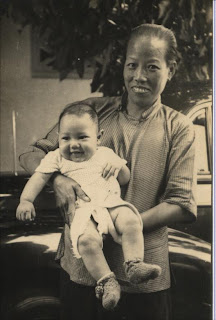 |
| Che-cheh carrying baby Din |
NEE HOW MA?
Monday, 23 July 2012
Message to Readers
This is to notify readers that you cannot link to any post inside the blog for now because there is an error in my programming. It will take me some time to locate and fix the error for this blog.
I managed to locate Dr Lim Ju Boo's comments in the Comments Trash bin and saved it to Not Spam. It is now posted under Dr Syed Mahmood Al-Kudcy's post. Click on the Comments icon there.
Some of you wrote comments but used Anonymous or some other ID which is not your name. Since there are no links back to the sender of those comments, and I cannot respond appropriately, I have chosen not to respond. I would encourage everyone to use their own name when writing in the Comments field. For now I have allowed Anonymous and Non-Name IDs. For future, I may change it to Registered Users only.
I have allowed this blog for public viewing. There are other forms of browsing including restricted browsing. I don't want to use those features.
I will be submitting my manuscript for the big book today, insyaAllah. I will make a prayer first and then submit it to Xlibris. You can also help by making a prayer that the big book will make it to print. I started blogging in 2002 before writing it for 2007 submission. The writing for the big book has taken me more than 10 years, only that I wasn't familiar with the Internet and I didn't have a computer to do the writing. I had worked on computers but they were big ones higher than my head and looked like a refrigerator.
Once the 2 books (big book & small book) hit the market, I will be working on my other books and my other blogs. So I won't be writing for this blog so much. I will come and visit this blog once in a while. You can always write to me - use the Boxbe at the side panel. You can also email me directly. You can also call me but my phone is all over the place and not near me, so I may not be able to take your call. SMS is the worst form of human communication. Voice is better.
TQ everyone for your support of this blog and my books.
Prof Faridah
012.963.2218
\\\\\faridahar[a]gmail.com\\\\
I managed to locate Dr Lim Ju Boo's comments in the Comments Trash bin and saved it to Not Spam. It is now posted under Dr Syed Mahmood Al-Kudcy's post. Click on the Comments icon there.
Some of you wrote comments but used Anonymous or some other ID which is not your name. Since there are no links back to the sender of those comments, and I cannot respond appropriately, I have chosen not to respond. I would encourage everyone to use their own name when writing in the Comments field. For now I have allowed Anonymous and Non-Name IDs. For future, I may change it to Registered Users only.
I have allowed this blog for public viewing. There are other forms of browsing including restricted browsing. I don't want to use those features.
I will be submitting my manuscript for the big book today, insyaAllah. I will make a prayer first and then submit it to Xlibris. You can also help by making a prayer that the big book will make it to print. I started blogging in 2002 before writing it for 2007 submission. The writing for the big book has taken me more than 10 years, only that I wasn't familiar with the Internet and I didn't have a computer to do the writing. I had worked on computers but they were big ones higher than my head and looked like a refrigerator.
Once the 2 books (big book & small book) hit the market, I will be working on my other books and my other blogs. So I won't be writing for this blog so much. I will come and visit this blog once in a while. You can always write to me - use the Boxbe at the side panel. You can also email me directly. You can also call me but my phone is all over the place and not near me, so I may not be able to take your call. SMS is the worst form of human communication. Voice is better.
TQ everyone for your support of this blog and my books.
Prof Faridah
012.963.2218
\\\\\faridahar[a]gmail.com\\\\
War and the Dragonfly
Many have experienced life during a war. Many have lived through a war or some wars. I have not seen war but I have heard of war - Japanese War, Vietnam War, War of the Falkland Islands, War in Afghanistan and some others in the northern hemisphere. Why do we have wars in the first place? Why have wars remained with us, supposedly civilised humans? This is the 21st century already. What is the purpose of war? Why war? Who needs to kill whom? Why? Why do we kill? Who are the war mongers? Who are the war victims? Can POWs become war mongers? Can war mongers become victims? Who can order wars to end? Will wars ever end while we are still alive? Where do wars lead us to? Why are wars regarded as hell? How can some people continue to enjoy life in luxury while a war is happening somewhere out there? Why are some people indifferent to war, any war? Why are we (humans) hopeless and helpless when it comes to war? Is there nothing we can do about news of a war? Who declares war? Is it a crime to declare a war? If the world suddenly divides into 2 halves, one for war mongers and the other for peaceful people, which half would you jump to? Wouldn't you want the dragonfly to fly in the morning and kiss the rose buds? Or do we still need wars so dragonflies can cease to exist? Isn't the dragonfly a mark of peace? Isn't the rose a mark of human civilisation? When was the last time you saw a real dragonfly and a real rose? I saw both this morning and the world around me was peaceful. I don't need war. Have peace.
This is war, the Worst of 2012:
From my backyard
 |
| A dragonfly holds on to a rose bud ... and dew drops from last night keep the rose plant cool. Can't you see the wonder of this? The dragonfly doesn't visit a dry place; it visits a blessed garden. |
 |
| The red rose is ever beautiful ... with dew drops from last night ... in a blessed garden. |
IF YOU ARE THINKING OF CREATING WAR, STOP!
IF YOU THINK WAR IS GOOD, STOP!
IF A WAR WILL BENEFIT YOU, STOP!
THERE SHOULD BE NO WAR ON EARTH.
EARTH IS THE ONLY PLANET WHERE ALL HUMANS CAN LIVE.
WE CANNOT LIVE ON MARS OR SATURN OR JUPITER.
WE CAN ONLY LIVE ON E-A-R-T-H.
ONLY EARTH ... ONLY EARTH ... ONLY EARTH ...
THERE IS ONLY EARTH ...
FOR ME AND YOU
AND ALL PEOPLE
FOR ME AND YOU ...
AND ALL PEOPLE
WE ARE ONE
YOU ARE MY BROTHER
YOU ARE MY SISTER
WE ARE ONE BIG FAMILY
EARTH IS OUR HOME
OUR ONLY HOME
HOME ON EARTH
DO NOT DESTROY WHAT WE CANNOT REPLACE
STOP WAR!
Sunday, 22 July 2012
Coffee: Beans of Change
History of coffee
Discovery of coffee
Birds and goats eat coffee beans for energy. With coffee, birds could fly far. With coffee, goats could wander far. An Ethiopian goat herder, Khalid, tried them too and discovered its benefits - energy, vitality. He was jumping for joy. He took the coffee berries to a clergy who boiled them and obtained an ugly liquid, so he threw it away in the fire. The ambers burned the liquid and the beans started roasting among the ambers. It gave a coffee aroma that attracted the clergies, so they put out the fire and saved the roasted coffee beans.
The Arabs came to learn of coffee and called it kahwa (liquid of wine), for the liquid that steeped the roasted beans looked very much like wine. It was also called kahwa al-bunn (wine of Bunn) since it was discovered in the town of Bunn, in the Kingdom of Kaffa.
In Yemen, coffee plants thrived and a different type of coffee was born - mocha, after the town of Mocha. Mocha reached California in the early 1980s. I remember making mocha ice-cream for my graduate class and we ate that under a big palm by the road that led to my hostel. It was a very hot summer but still, it didn't matter to the graduates, as if they never had receptors under their skin. My ice-cream almost melted.
From Yemen, coffee went all over the Arabian peninsula and coffee Arabica was born. This is a fragrant coffee. I have the beans somewhere among the piles of books. It is part of my collectors' items.
How we got expresso today is my wonder. I guess if you put coffee granules in the coffee machine, you get good black coffee, expressed, thus, expresso. I remember my lady professors drank that and also smoked cigarettes, to remain slim so they could fit size S dresses. That was the fad in the late 1970s, a time when the effects of Woodstock were wearing off and something new had to be found - coffee and smoking. Coffee did not affect the male professors as they had the alcoholic beverages every Monday morning. Coffee and cigs were the subject of choices for the ladies who didn't want to seen drunk on Mondays but needed something to fill their tummies. Most ladies left brownies, peanut-butter sandwiches, etc and just stuck to black coffee and cigs. Poor thing.
 |
| Expresso |
Coffee reached Java and the foxes also liked them and ate the berries, and excreted whole coffee berries which are taken and roasted and made into the world's best Java coffee. I have a musang that visits my house and stays in the roof. When it excretes, it excretes nothing more than coffee beans in the drain which drains my laundry - so the drains are clean at that part of the house. I took a close look, and yes it is the classic biji kopi tahi musang, which is reddish as the pulp is partially digested by the gastric juices after a single pass through the musang's GI tract. Lovely, eh?! Want some? Dare take fox excreta and roast it to get a special coffee blend? The enzymes in the fox gut added to the flavour. I'm still wondering where the musang ate the coffee beans. There are lots of trees in my area but I have yet to locate a coffee climber.
We humans are very funny indeed. We loved that brand of the world's most exotic and expensive coffee - kopi tahi musang.
 |
| Acai berry coffee mix. This tastes like chocolate drink |
We humans are very funny indeed. We loved that brand of the world's most exotic and expensive coffee - kopi tahi musang.
Health uses of coffee
- Stimulant - keeps your brain awake; even sleepy brains will wake up
- Keeps you awake when you should be in bed at 3 a.m.
- Alleviates migraine - this means if you are a migraine-prone person, you can try and take sweet black coffee, sit back and feel the difference; it works wonders especially if you want to kill your pill-popping habit
- If you are the lazy type to brush your teeth early in the morning, or can't find where you left your toothbrush last night, then try and take coffee as it will washout all the stale saliva from last night (air liur basi)
- Relieves all pain especially if you are 50+ and always complain of sakit badan
- Keeps you youthful
- Keeps you well hydrated if you drink dilute coffee; thick or strong coffee will make you go to the loo every 5 minutes. If you fall into the habit of going to the loo every 5 minutes after coffee consumption, then dilute your coffee down to a level where you don't need to go to toilet too frequently. Then that becomes your coffee mix and will only suit you. Other people may not like your dilute coffee but stick to it because that is what your system can tolerate. If you keep drinking strong coffee and urinate too frequently, then you are draining your body of necessary vitamins and minerals, which can spell disaster in the long run - that is when coffee drinkers or coffee addicts fall into osteoporosis, etc from protracted acidic environment (acidosis) from the coffee, then you can add all the acidic foods you eat (all the beef, chicken, etc) and the biggest difference you will notice is a marked drop in stature - you become shorter too fast, from advanced osteoporosis - your bones dissolve too fast under prevailing acidic environment, akin to anorexia. So don't drink strong coffee, light coffee is healthier in the long run.
- Light coffee is the best before jumping into bed because a full tumbler will keep headaches away the following day. This is if you are the type like me, who keeps at the keyboard till 3 a.m. then have a brief bedtime, and 3 hours later you have to jump out of bed and go to work. So for this chronic problem with very little sleep, light coffee before bedtime is a wonderful relief. It feels really good to have very little sleep time.
- If you don't like stroke, then drink light coffee. Staying awake in the afternoon is better than siesta. The chances for getting stroke is higher after an afternoon nap, and worst if sour fruits are taken by the kilos just before sleep - I don't know why. Not studied that bit yet. The most dangerous time to sleep is after Asar as that is when people suffer from brain damage and memory loss - I still have not studied this problem in detail.
- Mood swing suppressor. It suppresses feelings of unhappiness, drudgery, practically all negative moods. That's how I feel about coffee, of course, light coffee. I don't know about strong coffee because I don't take strong coffee.
 |
| Added red yeast, for a statin effect on blood cholesterol. But there may just be a spec of red yeast and hardly any effect on blood cholesterol. Omega from habbatus sauda (blackseed). |
 |
| Omega from the black seeds of the blackseed plant |
 |
| Thick white coffee |
 |
| Chilled vanilla flavoured coffee |
 |
| Omega coffee with Pal Sweet artificial sweetener |
 |
| Omega coffee with Equal artificial sweetener |
 |
| High calcium white coffee |
 |
| Omega coffee for breakfast and kuah sardin |
 |
| Coffee with dried fruits as snacks |
 |
| Coffee for two |
Dato Mushir Ariff & Dato Zubaidah Tan Sri Che Din Hashim
 |
| From Who's Who in Malaysia 1963 |
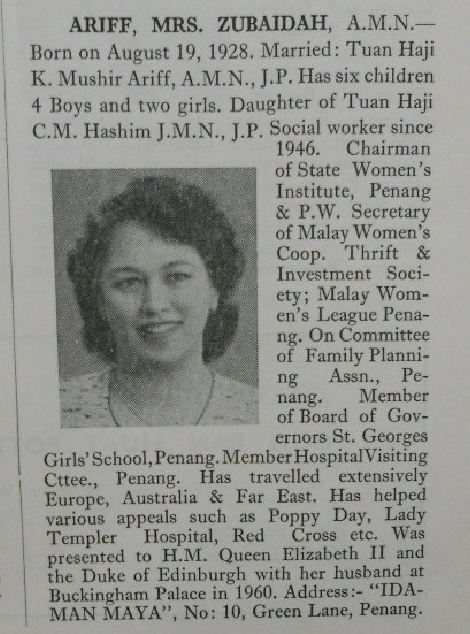 |
| From Who's Who in Malaysia 1963 |

 |
| Portraits from a photo by Datuk Zubaidah Ariff |
External link:
Subscribe to:
Posts (Atom)


