Tuesday, 3 May 2011

The Civilised Malay

Zimbra Collaboration Suite

The Civilized Malay
1 Messages

The Civilized MalaySaturday, 29 November, 2008 10:37:52 PM
From:
To:
It seems that we are just one race after all...please read from:

Malaya and Its History by Sir Richard Windstedt, London. 1948

THE CIVILIZED MALAY

The migration of the Malays from Yunnan down to the Malay peninsula took place between 2500 and 1500 B.C. Their
quadrangular adze culture, accompanied by unglazed cord­-marked pottery of great variety, has been traced from China
southward, and "the highly specialized pick-adzes of Java and Sumatra from a simple adze type with quadrangular cross­
section and semi-circular edge found in Laos through an inter­mediate type frequent in Malaya indicates the direction and
way of their migration"--namely, down the Malay peninsula. Some may have travelled by land, others across the Gulf of
Siam in craft developed from bamboo outriggers still in use on rivers in Burma and Indo-China. Among the earliest waves may
have been the Jakun. But the most important movement brought the ancestors of the Malays of Kedah, Kelantan and
Patani to become the civilized hinduized subjects of Langka­ suka and Sri Vijaya. The people of Kelantan, who have been
compared to the Polynesians, are bigger than the Malays of the south, perhaps because they represent a different strain,
perhaps on account of a better climate or the better food of an ancient rice area.

For the culture of primitive Malays, language and pre-historic discoveries provide the only evidence. And while
earlier peoples, apparently with an Australo-Melanesoid strain, lived in caves or left gigantic shell-heaps, the debris of
antediluvian meals, to bear witness to their location, the more highly civilized Indonesian and primitive Malay inhabited
villages that are revealed only by some accident like the great flood of 1926, which unearthed one at Tembeling in Pahang.
Yet there is ample evidence that, before these neolithic people left the continent of Asia, they made pottery and built mega­
liths. They were hunters--not only of game but of human heads for the sake of their soul-substance. They were fishermen
acquainted with traps of bamboo and wood, though not, apparently, with the cast-net or other nets of cord. They lived, as villagers still live, in houses built on piles and lashed with rattan, with bamboo flooring and walls. In their gardens they
cultivated sugarcane, bananas, the gourd and the coconut. Their field-crops were millet (still a Sakai crop) and rice, both of
which provided them with food and fermented drink. They had domesticated the pig and the buffalo and perhaps cattle. Their
clothes were of bark. Their numerals went up to a thousand and they possessed some knowledge of the stars.

It must have been long before the Christian that Malay names were given to many parts of Malaya like Kelantan, Muar and Tumasik (which Hindus changed to Singapore). The meaning of Naning, for example, is forgotten today, but we know from the Malay element in the Khasi of Assam that it means "Upriver". Possibly no generic name was adopted by the scattered tribes until Jambi or Melayu succeeded Sri Vijaya in the thirteenth century, after which they called them­selves Malays.

Jambi fell, to be succeeded by inland Minangkabau. But when Malacca was founded with a population largely made up of Malay sea-gipsies, its commerce attracted many Malays from the opposite coast of Sumatra, more especially Hindu Minang­kabaus, who sought the gold districts of Pahang and the valleys of what in the eighteenth century became Negri Sembilan. Bugis, too, from Celebes, in 1700 founded modern Selangor and in 1722 became Underkings of the Johore empire. Most of the Bugis immigrants, at any rate, were men of birth who inter­married with peninsular royalties and dominated their local Malay subjects. And to infer from the legends of the Malay Annals that most of the Malays of the peninsula crossed from Sumatra in mediaeval times is to ignore the evidence of pre-
history and place-names. The Malays have at least as much right to be regarded as the aboriginal people of Malaya as the English have to be called the aborigines of England.

The Malay of today, a broad-headed individual with olive skin, fine eyes, a neat well-proportioned body, lank black hair and almost hairless chin, is the primitive Malay plus many foreign strains derived from marriage with Chinese from Chou times down to the advent of Islam, with Hindus of the Deccan and Bengal, with Muslim Indians, Siamese and Arabs. They have changed little since Magellan's brother-in-law, Duarte Barbosa, described them from his experience in the East between 1500 and 1517: "They are well-set-up men and go bare from the waist up but are clad in cotton garments below. They, the most distinguished among them, wear short coats which come half-way down their thighs, of silk cloth--in grain or brocade--and over this they wear girdles; at their waists they carry daggers in damascene-work which they call creews.

Their women are tawny-coloured, clad in very fine silk garments and short skirts decorated with gold and jewels. They are very
comely, always well-attired and have very fine hair. . . . They live in large houses outside the city with many orchards, gardens and tanks, where they lead a pleasant life. They are polished and well-bred, fond of music and given to love."

To bring the picture up to date: all but the peasant at work in his fields wear coats nowadays: creeses are worn only at court ceremonies, and many Malays have adopted European dress for working hours. Some years ago when a Resident issued a circular in praise of Malay costume and in favour of its retention, the Malay chiefs at the next meeting of the State Council asked him the reason: was he concerned lest they should contract chobi[1]-itch?

It is a pity that modern life and the Malay's own administration for European ways have conspired to make the white man for­
get what Miss Isabella Bird, author of The Golden Chersonese, knew in 1879: "The Malays undoubtedly must be numbered among civilized peoples. . . . They have possessed for centuries systems of government and codes of land and maritime law, which in theory at least show a considerable degree of enlightenment."

The Malay has great pride of race--due, perhaps, as much to his Muhammadan religion as to a past he has forgotten. He has, as Sir Frank Swettenham once wrote, "as good a courage as most men", and a better sense of the values of what life offers than is generally gained from book philosophies. Even the aborigines of Malaya have attractive manners, and the Malay has not only undergone the discipline of Hindu etiquette but has been affected by his Muslim teaching much as an English boy has been affected by the public school, acquiring poise and confidence. Because he is an independent farmer with no need to work for hire, the Malay has got an undeserved reputation for idleness, which his Asiatic competitors take care to foster. In affairs he is not only diplomatic but intelligent and states­manlike, with a natural ability to weigh both sides of a question. His domestic life is happy. He marries young, but in spite of the latitude of Islamic practice the peasant has seldom been a polygamist, though the immemorial need for sons to work his fields makes him prone to repudiate a childless wife.

At the 1947 census, out of 2,395,123 Malays in the Federation, 264,630 were comparatively new-comers from Sumatra and Java, men of the Malay's own racial stock and religion, who alone of the country's immigrants rapidly become absorbed into the Malay community. In the Federation, too, the Malays formed 43·77 per cent of the total population and the Chinese 38·6 per cent. But in Kelantan, for example, the population is almost wholly Malay.
____________________
1 Hindustani for "laundryman".


Sunday, 1 May 2011

Japanese Occupation

The Japanese war heightened and the heartless killings went on a spree till sheer misery loomed over the entire Tanah Melayu for more than three tragic years. Survivors of the gory war could only narrate torture, atrocities including teen rapes, deep sorrow and broken dreams even as this chapter is being written. There was no hope of victory against a fierce nation, the land of the rising sun. Though faced with fear of the glistening samurai swords, the soft-hearted Malays still referred to Japan by its poetic name, Negara Matahari Terbit and the Japanese people as orang Jepun.

"My death is my apology for my great crime" - a kamikaze (suicide) note.

"Sayonara, my soldier...you are brave to die for your country." That's all I have to say to the Japanese soldiers who died fighting for Japan in WWII.

What are the "International Laws of Warfare"? I haven't heard of them. Who made them? Who approved them? And how come we still have war today involving superpowers? Or is it a masked genocide? So the Japanese war wasn't so bad after all? Necessary evil?

Hiroshima - Dropping the Bomb
Hiroshima - Atomic Bombing (nuclear fission and mushroom cloud) 

This song is for all who have broken hearts, from all causes, including war.

Behrang Ulu in Perak

Behrang Ulu is in Perak. Behrang Ulu is located approximately 12 km north of Tanjung Malim if passing through Proton City, and 7 km west of Behrang or Behrang Stesen, and approximately 25 km south of Slim River, Perak.

Behrang Ulu comprises two settlements at the upper reaches of Sungai Behrang which flows into Sungai Bernam. One settlement Kampung Sungai Sekiah and Batu 8 has many Malay settlers while the another settlement at Kampung Baru Behrang Ulu (called POS in the local accent) has Chinese and Indian settlers. The Orang Asli live nearby in Kampung Chinggong and Chinaen.

The Malay settlers of Behrang Ulu comprise various ethnic groups such as the Mandailing, Minang, Rokan, Selayang, Rawa and Kampar among others.

Dr Burhanuddin al-Helmy had studied at Sekolah Melayu Behrang Ulu before proceeding to Sekolah Melayu Bakap.

Behrang Ulu is agricultural land and produces seasonal fruits such as durian, mangosteen and petai. 

Its rubber lands are no longer lucrative and have given way to newer industries including car manufacture.

Bandar raya Proton or Proton City was created based on an agreement between the government of Perak and Selangor to develop Lembah Bernam (Bernam Valley). Proton City was created for the production of Gen 2 cars after the Shah Alam plant was operating at maximum capacity and further expansion needed a new site.

Sources:
http://ms.wikipedia.org/wiki/Behrang_Ulu
http://ms.wikipedia.org/wiki/Bandar_raya_Proton

Dr Amir Burhanuddin Al-Helmy

This was my first e-mail to Dr Farish Ahmad-Noor re Dr Burhanuddin al-Helmy.

Faridah Abdul Rashid

Dr Burhanuddin al-Helmy
1 message

Faridah Abdul Rashid Fri, Jun 27, 2008 at 11:36 PM

To: farish@othermalaysia.org
Dear Dr. Farish Ahmad-Noor,
Assalamu'alaikum,

Guten Tag,

I heard about you from En Mohd. Fadli Ghani, Pengarah, Pusat Kajian
Kota based in KL.

I am in the midst of writing "The Early Malay Doctors" 1900-1957.

I need your help with one chapter on Dr. Burhanuddin al-Helmy (attached).

TQ

Danker,

Faridah

Assoc. Prof. Faridah Abdul Rashid
USM Kubang Kerian, Kelantan


CHAPTER 13 Professor Burhanuddin al-Helmy-27June2008.doc
101K

Labour Day Special

This song is for everyone who's visiting my blog today.

Thank you for visiting....

BEE GEES - HOW DEEP IS YOUR LOVE?

Enjoy!

Primary Care Research Database

UM Letter 6 June 2005

The text below is reproduced from the letter by Assoc. Prof. Dr. Khoo Ee Ming. It was wrongly addressed to UKM and went to Dept. of Pathology, USM before it finally arrived in my pigeon-hole on 13 June 2005 - Faridah.


Dr Faridah Hj Abd Rashid
Associate Professor
Department of Chemical Pathology
School of Medical Sciences
Universiti Kebangsaan Sains Malaysia
Kubang Kerian
16150 Kelantan

6 June 2005


Dear Dr Faridah Hj Abd Rashid

Re: Bibliography of Primary Care Research

We are a group of primary care physicians and researchers from University of Malaya, International Medical University and the Ministry of Health conducting a research on "Evaluation of Primary Care Research". As part of the project, we need to collect as comprehensive a list as possible of all the research and publications done that is pertaining to primary care in Malaysia. As many of the articles published were not accessible electronically, researchers and doctors were not able to access the information which is essential for the progress of research in our country.
We understand that you have conducted research and published papers in Malaysia. We would really appreciate your co-operation to let us have a copy of all your full text articles for completeness of the data. We are hoping to produce a bibliography of the researches done from 1966 to date and this list will be valuable to all doctors who are going to conduct research. We appreciate your contribution to this research and will be happy to provide you a list of studies done when we have completed the project. We will also be happy to pay for the postage when you sent us your copies of papers if you provide us a receipt.

Please send your copies of papers to:

Associate Professor Dr Khoo Ee Ming

Department of Primary Care Medicine
Faculty of Medicine
University of Malaya
50603 Kuala Lumpur
 
We would like to thank you for your cooperation for the advancement of primary care research.

Yours sincerely

Dr Khoo Ee Ming
Associate Professor
Principal investigator for project on Bibliography of Primary Care Research
Jabatan Perubatan Rawatan Utama
Fakulti Perubatan, Universiti Malaya, 50603 Kuala Lumpur, Malaysia
Tel: (603) 7950 2306 / 2802 / 2803 · Faks: (603) 79577941

Blog Statistics 30 April 2011

We now have 6,224 pageviews (audience) for this blog (TEMD blog). Thank you for visiting this blog.

Saturday, 30 April 2011

Sejarah Awal Pulau Pinang

Muhammad Haji Salleh, Editor. Sejarah Awal Pulau Pinang. Penerbit Universiti Sains Malaysia, Pulau Pinang. 2008. ISBN 978-983-861-356-9. Printed by Sinaran Bros Sdn Bhd. [Malay text]

Font: ACaslon Regular


Distributors:
Koperasi Kedai Buku Universiti Sains Malaysia Bhd
MPH Distributors Sdn Bhd

Other books by the same author:
Syarahan Perdana: Muhammad Haji Salleh, 1989. Puitika Sastera Melayu: Suatu Pertimbangan, ISBN 967-942-157-0

Points to ponder in Sejarah Awal Pulau Pinang:
  1. What ethnic groups existed in Malaya?
  2. Who came to Malaya before Independence?

--*--*--
Page 88, footnote 75
Terdapat juga pendatang dari India Utara yang disebut Benggali. [...] hampir semua kumpulan etnolinguistik dari India terdapat di Malaya. Antara kumpulan etnolinguistik India yang terdapat di Malaya pada tahun 1921 hingga 1957 ialah orang India Selatan (Tamil, Telugu, Malayali dan lain-lain), orang India Utara (Sikh, Punjabi, Pathan, Benggali, Gujarati, Mahratta, Sindhi, Rajput, Marwari dan Parsi) dan kumpulan orang India yang lain.

Pada awal abad ke-20, orang India di Pulau Pinang juga terdiri daripada dua kategori lain iaitu askar/sepoi yang dihantar untuk berkhidmat di Negeri-Negeri Selat dan banduan yang didatangkan dari Bangkahulu selepas Perjanjian Inggeris Belanda pada tahun 1824.

Askar dan banduan ini sudah pasti tidak terdiridaripada satu kumpulan etnolinguistik sahaja.

Kumpulan banduan ini juga mempercepatkan kadar pertumbuhan Jawi Peranakan apabila mereka mengambil keputusan menetap di Pulau Pinang selepas mendapat keampunan daripada kerajaan India.

--*--*--

Analysis of the footnote above is given below.

Composition of Indians who came to Malaya. This composition is by etnolinguistic (ie by their spoken languages) and also for what they were hired in the British Army.

South Indians
Tamil - the founders of Masjid Kapitan Keling in Penang are forefathers of the Merican doctors
Telugu
Malayali
Other

North Indians
Sikh - non Muslim?
Punjabi - [Yasmin Begum Mokhtar Ahmad's ancestors]
Pathan - Sir Dr Kamil Ariff's ancestors
Benggali - Dr Mohamed Ibrahim Shaik Ismail Ballah's ancestors who arrived in Singapore
Gujarati
Mahratta
Sindhi - Dr Che Lah Md Joonos' ancestors in Butterworth who relocated to Kg Dodol, Jalan Perak
Rajput
Marwari
Parsi - non Muslim?

Soldiers (sepoy) - mixed etnolinguistic
Convicts - mixed etnolinguistic

  1. Two other groups which are not mentioned are launderers (dhobi) and tailors (tukang jahit). The tailors served in the British Army and made uniforms. The other group washed dirty clothes and linen.
  2. The sepoy category has sub-categories just like in the army today.
  3. I will try and match the various etnolinguistic groups to the doctors' families but only for the ones I know and have been informed. You can read about them when the proposed book is published.
  4. I was told that the Parsi group are non Muslim but are sun worshipers?  True? False?

Lung Cancer in Malaysia

I've picked out the salient points and listed them here for public interest and for my present research and writing, and maybe later for my IT contract research. I've written the points in appraisal form so you can see what's lacking in health & disease statistics wrt lung cancer in Malaysia.

Published review:

Dr Hooi Lai Ngoh
http://www.eimjm.com/Vol1-No2/vo1-No2%20K1.html
- comprehensive national population-based cancer registry 
- it is the leading cause of cancer death in Malaysia
- one of the most common cancers in Malaysia
- there were 38,836 cancer admissions to government hospitals in 1998 [ie 15 MOH hospitals excluding district hospitals]
- lung cancer was the commonest cause of cancer admission among adult males [which means we don't have to worry about adult females getting lung cancer]
-  Cancer of the trachea, bronchus and lung is listed as the leading cause of cancer death in Malaysia  [affected is the respiratory system and 3 major sites - the trachea, bronchus and lungs; can try pull out images from Radiology PACS and collate that with Pathology biopsy slides with all the different stainings; can also do height, body mass, BMI and other parameters on the patients physical attributes (anthropometry); then do Artificial Intelligence (AI) for selecting young smokers and work on their potential for lung cancer and get them on treatment earlier before cancer goes to a non reversible stage and cancer death becomes real; may have to co-plan for psychology and counseling for hard core young smokers]
- mortality rate is 2.48 per 100,000 population in 1999 based on deaths in government hospitals [should at least mention how many govt hospitals were used for the statistical analysis; with 10 years data prior to 1999 should be able to project data for next 10 years (1999-2010) and compare that to real mortality rate for 2010; can also do projection for the next 10 years (2010-2020)]
- lung cancer ranked fifth in males with a prevalence of 7.7 per 100,000 [ignore females for now; what are the 4 major killers in males?]
- lung cancer has an overall poor prognosis and low survival rate [the more reason to ban smoking in Malaysia. It is banned in USM Health Campus.]
- household community survey [what advice did the researchers give the smokers among family members? Among those smokers who were advised, how many did actually heed medical advice and totally quit? Was quiting ever surveyed? If not why not?]

Selected References:
  1. Ministry of Health Malaysia.  Discharge rate and mortality rate in government hospitals per 100,000 population.  In: Malaysia’s Health 2000; Appendix 4: 293.
  2. Ministry of Health Malaysia.  Cancer control.  In:  Annual report 1999; 132.
  3. Ministry of Health Malaysia.  Mortality rate of malignant neoplasm/cancer per 100,000 population, Malaysia, 1999.  In: Indicators for monitoring and evaluation of strategy for health for all by the year 2000; Health Indicator No. 3.10, 2001; 78.
  4. Lim KG.  Cancers.  In: A review of diseases in Malaysia.  2nd edition 2001; 7: 79 – 85.
  5. Norhayati O, et al.  Cancer statistics, HUSM 1985 – 1992.  Mal J Pathol 1994; 16: 103 (abstract No. P10).
  6. Penang State Health Department.  Penang Cancer Registry 1996 statistical report.
  7. Ismail Y, Zulkifli A, Zainol H.  Lung cancer in Kelantan.  Med J Malaysia 1990; 45: 220 – 4.

A Review of Diseases in Malaysia

Lim Kean Ghee, A Review of Diseases in Malaysia. 2001, Second edition. 456 pp. ISBN 983-40800-0-X. (RM80). Published by Lim Kean Ghee, 5, Upper Museum Road, Taiping 34000, Malaysia. E-mail: lknghee@pop.jaring.my


Dr Lim Kean Ghee is a consultant surgeon in private practice. He had previously served in the Ministry of Health (MOH) hospitals as medical officer and consultant surgeon.

The book is a compilation of diseases in Malaysia. It is a good resource since it covers most diseases and gives citations. Most of the information is not easily obtained elsewhere and often inaccessible to researchers.

The Preface gives an important message to all doctors who wish to practise in Malaysia. It reminds us that our medical textbooks are mostly written by doctors in Britain and United States whilst we try to apply such texts in our Malaysian context. While the diseases are similar the disease severity and pattern of disease spread are often dissimilar. Thus, our management of the same diseases cannot be similar and cannot be verbatim from such textbooks.

A second message in the Preface is prior research data of a locality would serve as basis for further research. Thus, this book captures prior research data for that purpose.

A third message in the Preface is for medical students to use the book to familiarise themselves with data for local diseases since they will rejoin and serve the Malaysian community upon graduation.

A fourth message in the Preface is for non medicos (including lawyers, researchers, etc) who need to quickly refresh themselves on knowledge of Malaysian diseases which we don't find in medical textbooks written by the West.

Reviews of the book are available online:

Singapore Medical Journal:
Singapore Med J 2006; 47(12) : 1101
http://www.sma.org.sg/smj/4712/4712br1.pdf

Malaysian Family Physician:
Malaysian Family Physician 2006; Volume 1, Number 1, page 45
http://www.e-mfp.org/v1n1/book_review.htm

Medical Journal of Malaysia:
Reviewed by Akhtar Qureshi, International Medical University
Med J Malaysia Vol 57 No 2 June 2002
http://www.e-mjm.org/2002/v57n2/Diseases_in_Malaysia.pdf


I actually bought this book because this was exactly what I needed for research and writing. I needed past health & disease data to verify disease patterns and spread in order to account for the high number of deaths resulting from malaria prior to, during and after the Japanese war. The postwar period up till Merdeka also recorded many deaths from malaria among the Malay families so far under study. I am a bit upset about our past health and disease statistics and accounts by families as in none of the narratives by the families have they mentioned quinine which we know the Malay people use for malaria. I am most concerned about malaria since I grew up in Malaysia after the Independence when malaria was the number one killer before heart disease superseded it. We had to use mosquito nets at night and also use ubat nyamuk made from cow dung to fumigate our bedrooms at night. So bad was the situation with malaria that I also had a classmate who died of malaria in 1972 in Malacca. We were 14. Measures to destroy the Anopheles mosquito breeding grounds were stepped up and malaria was then well-controlled. Malaria is non existent in Malaysia today. Even Gua Musang in Kelantan has ceased to report any malaria cases - the last being in the early 1980s. When I worked with Hospital USM Diagnostic Labs in 1983-5 I didn't hear of any malaria cases. Researchers from outside Malaysia still come to want to do "malaria research" in Malaysia when malaria has been non existent for so long now. The last group of "mosquito researchers" was an Australian group that came to our Routine Lab in Chemical Pathology in 1994 to try and determine serum electrolytes for malaria cases when they hoped to get such cases from Gua Musang but the entire research came to nought! Haven't they read about Malaysia before coming? They should read this book then.

Thursday, 28 April 2011

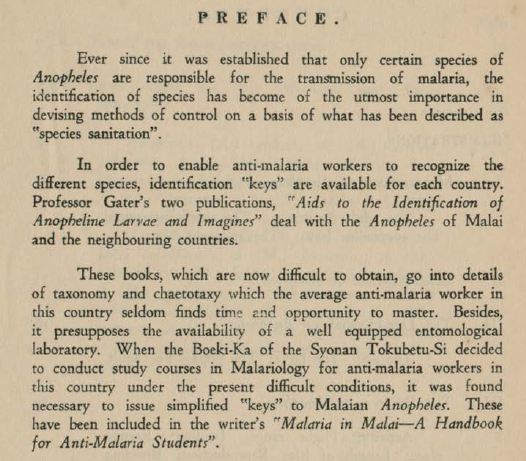
The Identification of the Common Anophelines of Malai and Thailand

Taken from http://knol.google.com/k/rajani-p/malaria/21p64adxvkkqh/4#

Dr AA Sandosham was the Officer-in-charge of the Bogyaku Kenkyu Shitsu. He wrote Malaria in Malai, A handbook for antimalaria students. It was published by the Syonan Tokubetu-Si and was printed by Messrs GH Kist & Co, Ltd, Singapore. 2605 (Lee 2005:102).

Ref:
1. Lee, Edmund JD. To Sail Uncharted Seas. 2005. National University of Singapore. ISBN 981-4138-33-9.

-----

Identification of the common anopheles of Malai and Thailand [1945]

File Format: PDF/Adobe Acrobat

by AA Sandosham

Bogyaku Kenkyu Shitsu. Booki-Ka, Syonan Tokubetu-Si. Published by the Syonan TokubetuSi. Printed by Messrs. G. H. Kiat & Co., Ltd., Syonan.

Source: mms.elibraryhub.com/SHC/NLBHB/020003334.pdf


More information on malaria can be found here:
http://knol.google.com/k/rajani-p/malaria/21p64adxvkkqh/4#

Tuesday, 26 April 2011

Committee of Penang Festival ’86. Well-Known Persons. In: Historical Personalities of Penang 1986


Committee of Penang Festival ’86. Well-Known Persons. In: Historical Personalities of Penang. Phoenix Press Sdn Bhd, Penang. 1986. Pp. 173-179.

Faridah Abdul Rashid

Artikel (ruj. 10114)
3 messages

Inter Library. Loan, PHT Mon, Apr 4, 2011 at 10:25 AM
To: faridah 
salam
Artikel yang dimohon seperti berikut telah diproses.

1) City Council of Georgetown, Penang. Penang Past and Present, 1786-1963. 1966. Ganesh Printing Works. 17 pp.


2) Committee of Penang Festival ’86. Well-Known Persons. In: Historical Personalities of Penang. Phoenix Press Sdn Bhd, Penang. 1986. Pp. 173-179.


Terima Kasih
MOHD AFIZULL AHMAD
Bahagian Perhubungan Pelanggan
Perpustakaan Hamdan Tahir
USM Kampus Kesihatan
16150 Kubang Kerian Kota Bharu, Kelantan
Tel: 09-7671468 Faks: 09-7651823

Inter Library. Loan, PHT Tue, Apr 26, 2011 at 1:34 PM
To: faridah 
salam

Artikel yang bertajuk "Committee of Penang Festival" telah diperolehi. Prof boleh datang mengambilnya di PHT mulai hari ini.

Terima Kasih

MOHD AFIZULL AHMAD
Bahagian Perhubungan Pelanggan
Perpustakaan Hamdan Tahir
USM Kampus Kesihatan
16150 Kubang Kerian Kota Bharu, Kelantan
Tel: 09-7671468 Faks: 09-7651823

Faridah Abdul Rashid  Tue, Apr 26, 2011 at 2:05 PM
To: "Inter Library. Loan, PHT"
Wa'alaikumussalam,

InsyaAllah, saya datang sekejap lagi.
TQ

Prof Faridah

2011/4/25 Inter Library. Loan, PHT <interlib@kk.usm.my>

"Well-Known Personalities" 1986, Penang

Dr Haji Abdullah Ghani bin Mohamed (born 1906) - Senior Health Officer, Penang and Province Wellesley. Committee Member, Penang Malay Association.

 
Habib Marican Noordin, J.P.

Allen Dennys & Co in Beach Street, Penang
Hamid Khan - teacher at Penang Free School for 30 years. PFS was in George Town before a new school was built in Green Lane and has since remained.
Mr RA Hogan - lawyer in 1970s. Hogan Road is named after him. ***** Hu Shih Min - Second and last Kapitan China of Penang. Dr Hutton - Only registered doctor in Penang in 1805. Hutton Lane was named in his honour. ***** Pak Itam - A contemporary of Syed Shaik Alhadi.
M Puteh bte Hassan M? Why use 'Bte' for a male? Should be M Puteh bin Hassan M.
Shaik Mohamed Shaffe bin Shaik Mohamed (born 1892) - Secretary of the Crescent Star Sports Club. Prominent in sports, athletics and football (soccer). ***** Shaik Tahir Jalaludin - astrologer and theologian. Teacher and imam in Masjidil Haram in Makkah (the grand mosque in Makkah). Father of Tan Sri Hamdan Tahir, former Vice Chancellor of USM. **** Shaik Zakaria Basheer Omar - religious teacher, first Mufti and founder of Almashoor (first religious school in Penang)
K. Sultan Merican - teacher, publisher, Islamic activator, journal "Islamic Voice of Malaya". Isn't this the father of Tan Sri Ismail Merican, 13th DG MOH Malaysia (who recently retired)?
Syed Shaik Alhadi - writer and reformist. Started Arabic School on Tek Soon Street, Penang. This is the grandfather of Dr Syed Mohamed Alhady. ****** Captain Syed Salleh Alsagoff (1880-1959) was a captain in Penang Volunteer Researve, Malay Company and Kelantan Field Force. Involved in the Tok Jenggid Rebellion at Kelantan. I think it should be Tok Janggut (i.e., referring to his beard). ****** There's a photo of Tok Janggut being hung upside down in the WWII Museum in Kota Bharu, Kelantan. It is humiliating to see a pious Muslim dressed only in his loin cloth (pants) and hung upside down. The present belief is it was not Tok Janggut but someone else who took his place. Tok Janggut was never hung. Salah macam mana pun kita tak akan gantung orang Islam macam tu, iaitu upside down.
Thessin Salleh Layu - Malay Surveyor of Ceylon Malay origin
External link

The Malays by Anthony Milner (2008)

Anthony Milner, The Malays (2008)


Faridah Abdul Rashid

chapters 5 and 6
1 message

Wan Emilin Thu, Oct 21, 2010 at 2:23 PM
To: Faridah Abdul Rashid 
----- Original Message -----
From: Faridah Abdul Rashid
Sent: Tuesday, October 19, 2010 4:56 PM
Subject: Re: pdf Thinking about 'the Malays' and 'Malayness' *

Salam Wan Emilin,

TQ untuk segera hantar Chapter 1, saya amat gembira dapat membacanya hari ini.

Saya ingin tahu adakah kita boleh mendapatkan bab-bab yang lain?

Saya tahu ada versi 2010 yang sudah keluar. Boleh ke dapatkan Front Matter nya?

TQ

Prof Faridah

2010/10/18 Wan Emilin <emilin@kck.usm.my>

Salam,
Prof. Faridah,
Dilampirkan artikel dari Wiley Online Library seperti yang diminta.
Chapter 1. Thinking about ‘the Malays’ and ‘Malayness’
Anthony Milner Visiting Professor
Sekian, terima kasih.
~~  Rakan Maklumat Anda  ~~
Wan Emilin W. Mat Alli
Bahagian Rujukan & Penyelidikan
Perpustakaan Hamdan Tahir
USM Kampus Kesihatan
Tel: 09-767 1478
Emel: emilin@kck.usm.my
Laman sesawang : http://www.kck.usm.my/pustaka
--
Professor Dr Faridah Abdul Rashid
Dept of Chemical Pathology
School of Medical Sciences
Universiti Sains Malaysia
16150 Kubang Kerian, Kelantan
Malaysia
Tel: +609-767 6484
Fax: +609-765 3370
http://chempath.blinkweb.com/index.html
http://faridah.businesscard2.com
http://theearlymalaydoctors.blogspot.com/
http://bioinformatiko.blogspot.com/

2 attachments

the malays ch4.pdf
325K

the malays ch5.pdf
438K

Monday, 25 April 2011

Muslims in Malaya: Annual Report of United Islamic Association

Information contributed by Izrin Muaz bin Md Adnan, CenPRIS, USM, Penang
Received Mon, Apr 25, 2011 at 2:39 PM


MUSLIMS IN MALAYA
Annual Report of United Islamic Association

Reference source:
Straits Times
26 August 1924, p. 12.


Link:
http://newspapers.nl.sg/Digitised/Article/straitstimes19240826.2.86.aspx


From Izrin Muaz:
  1. I think it reveals quite a bit about the social role of Muslim doctors in Islamic propagation in early 20th century Malaya.  
  2. There is mention of Dr HS Moonshi and Dr Shaik Ibrahim.

    Saturday, 23 April 2011

    Singapore Hospitals

    This article was contributed by Dr Mohamed Tahir Ahmad Ibrahim, Singapore
    Revised version was received on 23 April 2011


    SINGAPORE HOSPITALS

    Dr Mohamed Tahir Ahmad Ibrahim
    Mon, Apr 18, 2011 at 4:39 PM
    Singapore

    When I was in medical school some hospitals in Singapore tended to be named after roads.  There was Outram Road General Hospital (ORGH), and Thomson Road Gen Hospital (TRGH).  There were also other hospitals, Tan Tock Seng Hospital (in Jalan Tan Tock Seng), and Alexandra Hospital (in Alexandra Road), and of course Kandang Kerbau Hospital.  The hospital entrance is from Hampshire Road, but it is in a kerbau area for Buffalo Road is nearby. So is Kerbau Road.  Our local lembu must have reminded the British of Hampshire cows.

    The Singapore General Hospital (also used to be called Outram Road Gen Hospital) was known as "see pai poh" to the Chinese.  It means Sepoy Plains, and the hospital area used to be the garrison for the Sepoy Soldiers of the British.  There was also Outram Road Prison nearby, but it had been demolished by the time I was a student.  Till today when I want to refer Chinese patients to Singapore Gen Hospital, I have to say "see pai poh".  All the local Chinese, young or old will know what it is, as well as the taxi drivers of whatever race. ORGH was renamed Singapore General Hospital in 1981 when the Prime Minister (Lee Kwan Yew) officially opened the new SGH, in Outram Road.  The hospital is Singapore’s oldest and largest hospital.  It is located along Outram Road, and is along the central expressway.  It is in the heart of a medical hub kown as Outram Campus (comprising several medical institutions including the Health Promotion Board and Health Sciences authority). Along the boundary of one side of the complex is College Road.  The Ministry of Health is presently situated in a building at 16 College Road.  It used to house the Medical Faculty of the University of Singapore when I was a student.  At that time  it felt like an ancient building (which it was).  It had the old type of lifts where you had to manually open and close the lift gates.  It was an imposing building with tall rounded columns and motifs over the huge front doors.  Prior to this it housed the King Edward VII College of Medicine.  The building was extensively renovated and revamped internally before the Ministry of Health headquarters took over the building.  The external part of the building was fortunately largely preserved. The Building actually faces the Singapore General Hospital.

    There might be some confusion regarding the term KE VII.  The medical college used to be called KE  VII College of Medicine in the old days but when I was in the University of Singapore for my basic MBBS, KE Hall was the term for the University student's quarters. The predecessor of KE Hall was the Federated Malay States Hostel built in 1916.  It is a 4-storey building overlooking the Singapore General Hospital. The "Hall" tended to move wherever and whenever the University moved to a new location. Presently it is in Kent Ridge, where the University of Singapore and its medical faculty is housed.

    The old KKMH where I used to work was demolished and it now has a spanking new building in the same vicinity.  It is divided into two Sections, the Women's tower and the Children's called KK Women's hospital and KK Children's hospital.  The KK is just that (two letters) and Kandang Kerbau is not articulated in full anymore.

    Thomson Road General Hospital was later renamed Toa Payoh Hospital (to identify with a newly built satellite town it serviced).  It later merged with the old Changi Hospital in Netheravon Road in Changi village, and became known as the Changi General Hospital in 1998.

    Alexandra hospital was formerly the British Military Hospital.

    Thursday, 21 April 2011

    Malay Medicine & Settlements in Singapore

    In the field of medicine and health Malay medicine is slowly giving way to modern medicine but there still persists a fear of hospital treatment and operation.

    In February 1960 the Government announced a scheme whereby all Malay students who are either born in Singapore or are children of Singapore citizens will receive free education in the schools, the Singapore Polytechnic and the University of Singapore or Malaya [Singapore Annual Report, 1960, p. 228].

    There are no Malay reservations in Singapore as in the States of Malaya but there are Malay Settlements in which temporary occupation licences (TOL) for the occupation of land are given to persons of Malay parentage who habitually speak the Malay language, profess the Muslim religion and conform to Malay customs. The occupation of the land and houses in such Settlements are restricted to Malays. 

    The existing Malay Settlement are at Jalan Eunos, at West Coast Road, at Sembawang and at Kampong Pahang, Pulau Tekong Besar [Rules for the Occupation of Land in the Malay Settlement at Jalan Eunos (G. N. No. 1236/57); The Occupation of Land (Malay Settlement, West Coast Road) Rules, 1957, (G. N. No. 2344/57); The Occupation of Land (Malay Settlement, Sembawang) Rules, 1960, (G. N. No. 1809 of 1960); Special Conditions for the Occupation of Land in the Kampong Pahang Settlement, Pulau Tekong Besar (G. N. No. 2525 of 1953)]

    Source:
    Ahmad bin Mohamed Ibrahim, M.A., LL.D.,
    State Advocate-General
    Singapore
    Malayan Law Journal Ltd
    1965
    The Legal Status of The Muslims in Singapore
    USM Call No: (DS 599.42) M9A286

    ----
    from    adminlib@notes.usm.my
    to    faridah
    date    Wed, Mar 16, 2011 at 9:07 AM
    subject    WebOPAC Search Result
       
    Control Number    0000111040
    CLASS NUMBER    DS599.42
    CALL NUMBER    DS599.42.M9 A286
    AUTHOR    Ahmad Ibrahim
    TITLE    The legal status of the Muslims in Singapore
    PUBLISHER INFORMATION    : Malayan Law Journal, Singapore, 1965.
    NOTES    a-si--- by Ahmad bin Mohamed Ibrahim 75 p. ; 25 cm. Juga dalam Koleksi Malaysiana Bibliography: p. 73-75
    SUBJECT    Muslims -- Singapore

    ----- Modified Original Message -----

    Gmail faridah
    Re: Buku (ruj. 10077)
    1 message
    Inter Library. Loan, PHT     Tue, Mar 29, 2011 at 3:42 PM
    To: faridah

    salam

    Buku-buku tersebut telah sampai dan boleh mengambilnya di PHT mulai hari ini.

    Terima Kasih

    MOHD AFIZULL AHMAD
    Bahagian Perhubungan Pelanggan
    Perpustakaan Hamdan Tahir
    USM Kampus Kesihatan
    16150 Kubang Kerian Kota Bharu, Kelantan
    Tel: 09-7671468   Faks: 09-7651823

    ----- Original Message -----
    From: "Inter Library. Loan, PHT"
    To: faridah
    Sent: Wednesday, March 16, 2011 10:04:19 AM
    Subject: Buku (ruj. 10077)

    salam

    Permohonan buku berikut telah diproses.

    Title: The legal status of the muslims in singapore

    Call No: DS599.42 M9A286

    Author: Ahmad Ibrahim

    Accession: 425071


    Terima Kasih

    MOHD AFIZULL AHMAD
    Bahagian Perhubungan Pelanggan
    Perpustakaan Hamdan Tahir
    USM Kampus Kesihatan
    16150 Kubang Kerian Kota Bharu, Kelantan
    Tel: 09-7671468   Faks: 09-7651823


    Wednesday, 20 April 2011

    Japan and Japanese

    The Japanese used ships to trade with the rest of Asia. The Japanese ships (like this one below of 1634) look similar to the Portuguese galleon, Flor de la Mar (Flower of the Sea).


    Picture of Japan thanks to Moroboshi from Wikimedia Commons and Ookaboo!

    The Japanese are religious people and there are about 100,000 Shinto shrines (as shown below) in Japan.


    Picture of Japan thanks to :ja:user:663highland and Ookaboo!

    A Japanese monk waits on in Arashiyama, Kyoto.
     

    Picture of Japan thanks to Marubatsu from Wikimedia Commons and Ookaboo!

    Emperor Akhito and Empress Michiko.


    Picture of Japan thanks to Stefan_Kühn from Wikimedia Commons and Ookaboo!

    Tuesday, 19 April 2011

    Centennial Dinners 2005

    The NUS Centennial Dinner was held on 2 July 2005.
    Link http://www.nus.edu.sg/centennial/events/calendar.htm 


    The Centennial Medical Dinner 1905-2005 for the Medical Faculty was held in the Istana Grounds (President 's official residence) and the guest of honour was Mr Lee Kuan Yew, who was the "Minister Mentor". There was a commemorative book, The Centennial Medical Dinner 1905-2005 (2005) published by NUS. The commemorative publication had two chapters - "Looking Back in Wonder" and "Looking Ahead". - Dr Mohamed Tahir Ahmad Ibrahim (Singapore) Tuesday, 19 April 2011 at 4:04 PM

    Commemorative book, The Centennial Medical Dinner 1905-2005 (2005) published by NUS

    80th Reunion & Gala Dinner 29 Nov 2003

    Alumni Association of the KE VII College of Medicine
    Universities of Malaya and Singapore
    29 November 2003

    Here are four names which I picked up from a noticeboard in the lobby at Marriott Putrajaya:

    Tan Sri Abdul Majid
    Tan Sri Dr Abu Bakar
    Tan Sri Raja Ahmad Nordin
    Dr Amir Abbas

    Author's notes written in Marriott Putrajaya, 29 Nov 2003


    Here are 2 names I have with me:

    Teo Choo Soo
    Director, NUS,  Office of Alumni Relations
    20 Lower Kent Ridge Road, Singapore 119080
    Tel: (65) 6874 6336
    Fax: (65) 6774 0757
    E-mail: oarhead@nus.edu.sg
    Website: www.nus.edu.sg


    Teo Choo Soo
    Senior Consultant
    Dept of Preventive Dentistry
    Faculty of Dentistry
    National University Hospital
    5 Lower Kent Ridge Road, Singapore 119074
    Tel: (65) 6772 4986
    Fax: (65) 6778 5742
    E-mail: pndteocs@nus.edu.sg
    Website: www.nus.edu.sg

    William Chew Loy Soong
    E-mail: chewloysoong@hotmail.com

    Sunday, 17 April 2011

    Profil Tokoh-tokoh Gemilang Universiti Malaya 1999

    UM Canseleri complex, 2009
    Book title:
    Profil Tokoh-Tokoh Gemilang Universiti Malaya. 1999. Universiti Malaya, Kuala Lumpur. 114 pages. Hardcover. Call No.: M LG396 P964 1999

    This book gives the biography of the following individuals (arranged alphabetically and without salutations):
    1. Tun Dato' Seri Dr Haji Hamdan Sheikh Tahir
    2. Dato' Seri Dr Mahathir Mohamad
    3. Datuk Seri Abdullah Ahmad Badawi
    4. Abdul Majid Ismail
    5. Abdullah Mohd Salleh
    6. Abdullah Sanusi Ahmad
    7. Ahmad Sarji Abdul Hamid
    8. Ali Abul Hassan Sulaiman
    9. Aminuddin Baki
    10. Asiah Abu Samah
    11. Asmah Hj Omar
    12. Awang Had Salleh
    13. Bujang Mohammed Nor
    14. Dol Ramli
    15. Elyas Omar
    16. Lloyd Fernando
    17. Hamzah Sendut
    18. Hanif Omar
    19. Clifford F Herbert
    20. Ismail Hussein
    21. Khalidah Adibah Amin
    22. Khoo Kay Kim
    23. Lamin Haji Mohd Yunus
    24. Shirley Lim Geok Lin
    25. Ronald Stephen McCoy
    26. Mohd Kamal Hassan
    27. Mohamed Taib Osman
    28. Muhammad Haji Salleh
    29. Murad Mohd Noor
    30. Musa Hitam
    31. Ramon V Navaratnam
    32. Augustine Ong Soon Hock
    33. James Ongkili
    34. Othman Yeop Abdullah
    35. K Pathmanaban
    36. Rafidah Aziz
    37. Razali Ismail
    38. Salma Ismail
    39. Siew Nim Chee
    40. Siti Hasmah Hj Mohd Ali
    41. Syed Husin Ali
    42. Tajuddin Ramli
    43. Tan Chee Khoon
    44. Tan Wan Seng
    45. Thong Yaw Hong
    46. Ungku Abdul Aziz Ungku Abdul Hamid
    47. Ungku Omar Ungku Ahmad
    48. Wang Gungwu
    49. Zakiah Hanum Abdul Hamid
    50. Zuraina Majid
    The names highlighted above are doctors. The following five doctor-names below will appear in TEMD, insyaAllah:
    1. Dato' Seri Dr Mahathir Mohamad
    2. Abdul Majid Ismail
    3. Salma Ismail
    4. Siti Hasmah Hj Mohd Ali
    5. Ungku Omar Ungku Ahmad

    Profil Tokoh-tokoh Gemilang Universiti Malaya 1999

    Re: Cari buku
    Noraida Hassan     Sun, Apr 17, 2011 at 3:05 PM
    To: Faridah Abdul Rashid
    Cc: asmak , hairani

    Waalaikissalam,

    Prof. Faridah,

    Untuk makluman, buku yang dikehendaki baru siap diproses dan masih di Bahagian Teknikal. Apabila mendapat makluman En. Affandi datang mencari buku tersebut, staf saya bergegas ke kaunter untuk memberikannya tetapi En. Affandi sudah tiada di PHT.

    Buku tersebut boleh didapati dengan Cik Nor Hairani Abd Rashid, ext : 1448. Kami mohon maaf atas kesulitan yang dihadapi.

    Terima kasih.


        Noraida Hassan
        Pen. Pustakawan Kanan
        Bahagian Perolehan
        Perpustakaan Hamdan Tahir
        USM Kampus Kesihatan
        Tel : 09-7671466
        Fax : 09-7651823

    ----- Original Message -----
    From: "Faridah Abdul Rashid"
    To: "Noraida Hassan"
    Cc: "Affandi Hussein"
    Sent: Sunday, April 17, 2011 2:50:49 PM
    Subject: Re: Cari buku - Studies in Malaysian and Singapore History 2010

    Assalamu'alaikum,

    Tadi suami saya pergi kat ILL kaunter nak ambil buku tapi staf situ kata tak de?
    "Profil Tokoh-tokoh Gemilang Universiti Malaya"

    Prof Faridah
    --
    2011/4/6 Noraida Hassan
     

    Waalaikissalam,

    Untuk makluman, buku ini tiada di PHT atau perpustakaan USM cawangan lain. Hasil semakan saya dapati ianya ada di UKM.

    Saya juga ingin maklumkan yang buku Profil Tokoh-tokoh Gemilang Universiti Malaya telah sampai di PHT dan akan diproses. Saya akan maklumkan apabila ia boleh dipinjam nanti.

    Tq

        Noraida Hassan
        Pen. Pustakawan Kanan
        Bahagian Perolehan
        Perpustakaan Hamdan Tahir
        USM Kampus Kesihatan
        Tel : 09-7671466
        Fax : 09-7651823

        ----- Original Message -----
        From: "Faridah Abdul Rashid"
        To: "Noraida Hassan"
        Sent: Monday, April 4, 2011 8:08:10 PM GMT
        Subject: Cari buku - Studies in Malaysian and Singapore History 2010

        Assalamu'alaikissalam Puan Noraida,

        Saya ingin tahu sama ada PHT ada tak buku ini:
        Studies in Malaysian and Singapore history
        by Bruce McFarland Lockhart; Tse Siang Lim; Mubin Sheppard;

        TQ

        Prof Faridah
        --
        Professor Dr Faridah Abdul Rashid
        Dept of Chemical Pathology
        School of Medical Sciences
        Universiti Sains Malaysia
        16150 Kubang Kerian, Kelantan, Malaysia
        Tel: +609-767 6484
        Fax: +609-765 3370
        http://chempath.blinkweb.com/index.html
        http://faridah.businesscard2.com
        http://blinkweb.academia.edu/FARIDAHAbdulRashid
        http://theearlymalaydoctors.blogspot.com/
        http://bioinformatiko.blogspot.com/p/quran-databases.html
        http://blip.fm/profile/FaridahAR/playlist
        To do good is not only our greatest duty, but should be our greatest interest.
        It's a small world after all!