Sunday, 21 April 2013

Development of Hospital USM (HUSM) 2013

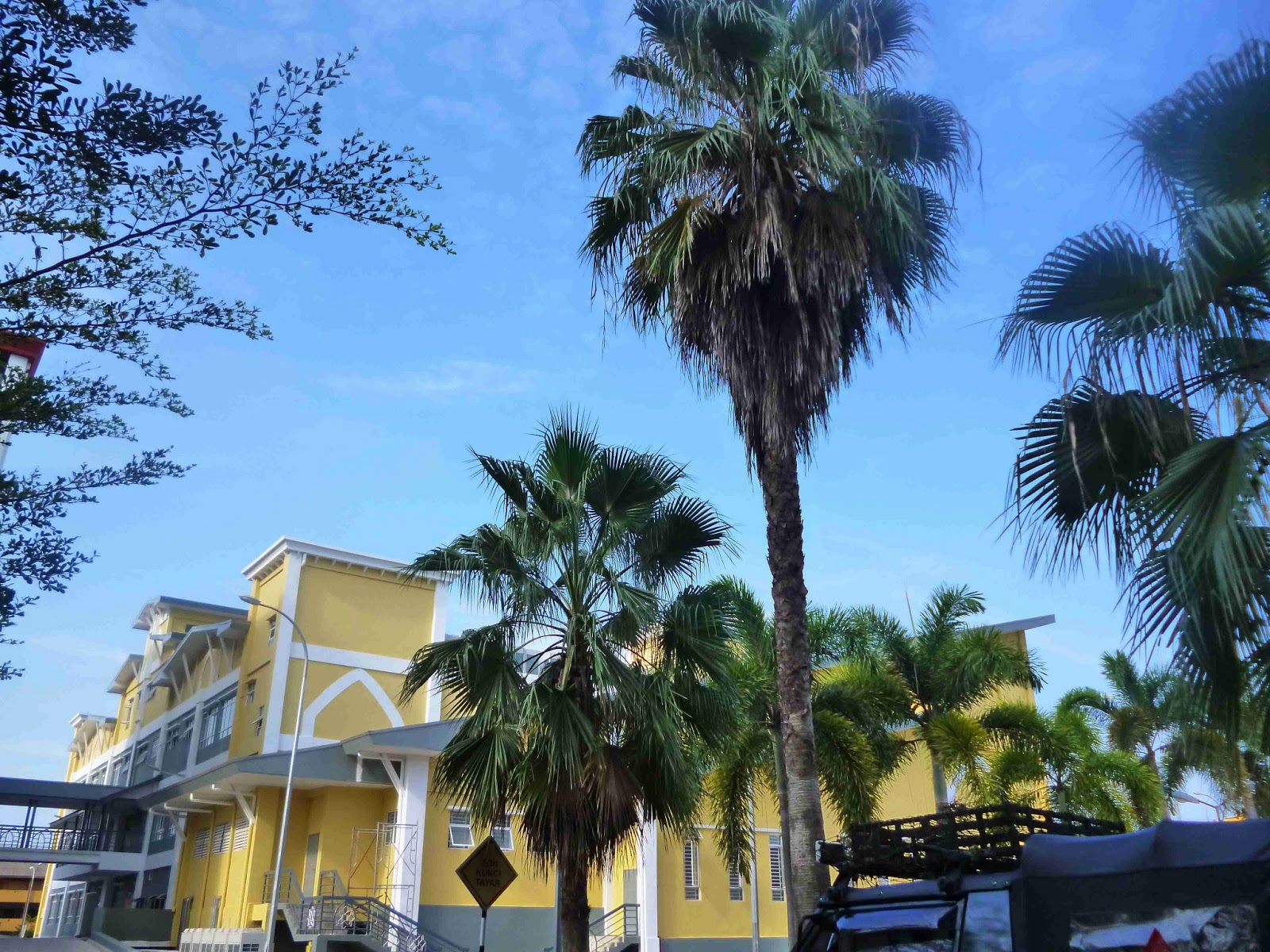
There are only green flags along the main road in front of HUSM today. I saw 4 dark blue Marias rushed by on the main road in front, towards the airport. On campus, things are fine, nobody seems bothered by the 2-week political campaigns that take place outside. People are selling and buying as usual on campus. The Kedai Koop is filled with shoppers. Patients still come to hospital early in the morning. I saw an ambulance arriving. The two new buildings of HUSM are nearing completion. I just noticed the yellow admin building fronting the main road has a small poster that says "1 lagi janji ditepati". These photos are before the polling date, 5 May 2013.


New admin


New A&E

Develop or Doom

When it comes to decide what we shall decide for our future, we tend to listen to what our leaders say. We hardly think. We hardly say no. We hardly reassess what is being said. We are after all, 'yes men'. That's what my late mother said. That's what I want to echo. We are better off being 'yes men' than to have our say. We have a voice that's dysfunctional.

I remember when they had the Aku Janji stuff for us lecturers on campus, the first thing that came to my mind was "Aku janji dengan Allah" and nothing else. So when I was forced to come to the Aku Janji swearing ceremony (which beats me), I refused but I turned up 30 minutes after the affair when they were done doing Aku Janji.

Why was I obstinate? I cannot kow tow to any other but Allah SWT. I can work hard and earn little but I will never turn in myself to an Aku Janji that's man-made and when I can be exploited. I am after all, human - I want choices and not be exploited. That's my stand.

So I did not get my Aku Janji certificate as everyone did by going up and shaking hands and picking up the certificate from the boss. It was not my idea of a free work process. I don't believe in being forced to do work when beautiful work can come out from hands of highly initiated people who are motivated.

When it comes to money as in salary or research funds, I find that we are corrupt, both as employers and employees. We request for money like nobody's business and we spend public money likewise. We are a corrupt mass of irresponsible lesser humans. I don't want to be a part of a corrupt mass. I want to be a part of a mass that's clean.

Same with employment. I had always thought of employment as a free thing and by chance but that's not true. Employment is often biased and often than not, cronies get hired. You must know somebody inside if you want to join. I don't like it but I can see it happening around me. People talk and I can hear, "I know so and so here ...".

Kelantan versus any other town outside Kelantan, I think Kelantan has low unemployment in the farms compared to Klang Valley or Penang. There is more crime in Klang Valley and Penang compared to Kelantan. We were once agricultural and labour intensive. Now we are more industrial and less labour intensive, which I think is not good in the long run. We don't need our own labour but we import and buy cheaper foreign labour and make tons of profits for the MNCs. In the long run, our society will polarise into the rich at one end and the poor at the other end. Does anyone care? No. We are comfortable living what we are doing and we just don't care what happens to others around us.

What will happen if we don't try to narrow the gap between the rich and poor? Worse things can be expected. Will development come to poor regions? No, it is not profitable to develop poor areas. Development will continue at already developed regions. People who live in developed regions will become more dependent on facilities developed for them. The minute they fail to earn a sufficient income, they are bankrupt and have nothing to fall back on. They become useless human beings and problems develop within the family - unwanted, rejected, depressed, suicidal, etc.

We have manipulated our society to uphold a certain image of itself, that of a rich, sophisticated lifestyle where nothing less is wanted. We want pretty faces, slim bodies, fancy hairstyles and sexy clothes for our women. We want handsome young macho faces, healthy muscular figures and good looking expensive clothes for our men. We want our children to consume McDonald's, A&W, KFC, Marry Brown, all the Western fast foods where possible. Our own food becomes less glamorous compared to Western food. Our kids are intimidated to speak Malay but prefer English; Manglish is accepted and a status. We are throwing away our Malayness and becoming more Anglophiles. We take English as a preferred language, forcing kids through IELTS and TOFFEL, etc. There are no Malay language exams apart from SPM level Malay.

So where are we heading? I think we are developing ourselves to doom, by ignoring that we are first and foremost, Malay. As Malays we are supposed to develop our farms and employ all our young men, and become self-reliant. It is not surprising that our society is divided but the young do not know that their seemingly poor parents tilled the soil to earn an honest living. We are not stupid. We are stupid if we don't develop our farms and try to provide food for all. We cannot continue to rely on globalization. It is not for our community. We have 26 million Malaysians who need to eat and stay alive comfortably, not make money for a few rich people. I am against industrial development if the farms are ignored and our young have no proper jobs. Japan developed both its industries and its farmlands, and that's why she is a strong player in the world economy.

External links
The Economics of Happiness
http://www.1malaysia.com.my/manifesto/

Friday, 19 April 2013

The First Malaysian Hajj Flight

The Hajj was celebrated twice in 1974. The first Hajj was early in the year (2-6 January 1974; 1393 Hijrah). The second Hajj was at the end of the year (22-26 December 1974; 1394 Hijrah).

My father had performed his first Hajj during winter, on 22-26 December 1974. He had taken the first Hajj flight from Malaysia to Saudi Arabia. He wrote 'Aku di Mekah, Disember 1974' as a filename on one of his Hajj photos in his pendrive.

Before the Hajj flight, Malaysian pilgrims boarded ships to go to Makkah. They also returned by ships. From late 1974 onward, the pilgrims took flights from Malaysia. The ships have since ceased to be used. I didn't notice the significance of this first Hajj flight till I became aware of it tonight.


BEFORE HAJJ RITE

Ziarah Jabal Nur Gua Thur
http://www.eyecairo.net/Heraa.htm
Ziarah Jabal Rahmah, on the Plains of Arafah
Atop Jabal Rahmah
At the foothill of Jabal Rahmah
Uncertain which mosque this is
Same as above
Same as above


AFTER HAJJ RITE
Haji Abdul Rashid bin Haji Mohd Yusope
a former first year medical student at the KE VII, Singapore , 1950/51.
'Aku di Mekah, Disember 1974'
He then went to Leeds University after the Hajj.
External links
http://live.utusan.com.my/Event/Dari_Tanah_Suci_Musim_Haji_2012_Masihi__1433_Hijrah
http://almiskeenah.com/archives/1872
http://www.utusan.com.my/utusan/Bicara_Agama/20120810/ba_01/Kelebihan-Mekah
http://www.onthecorner.co.za/html/haj_-_performing.html

Obituary: Tan Sri Aishah Ghani

Today, I received sad news of my grandaunt's demise. I heard her name before I went to school in Alor Star, Kedah. Her cousin, the late Tan Sri Dr Abdul Majid bin Ismail (Coco) also told me about her and explained his relationship with her family. Her father and Coco's father were blood brothers. Coco went to fetch chickens in Alor Star during the war, where Aishah's father lived.

Bapak always told me about her but he didn't mention our families were related. I only knew from Coco that we were.

I have never met her in person. As a small child and teenager, I would always come close to the TV to watch her and listen to whatever she said. I read her biography in a book at Arkib Negara Malaysia before I completed writing my books on The Early Malay Doctors. She comes from a Malay background with religious upbringing. She went to Sumatra to study there.

Tan Sri Aishah Ghani was the first female MP in the first Malaysian Cabinet. She worked alongside Malaysia's PMs - Tunku, Tun Razak, Tun Hussien Onn and Tun Mahathir.

She passed away today, Friday, 19 April 2013 at noon. She is laid to rest at Tanah Perkuburan Islam at Bukit Kiara.

Aishah Ghani while in Pahang, handing a scroll to Dr Mohamed bin Taib, an early Malay doctor.
Photo from the album of Dr Mohamed Taib's family.

Thursday, 18 April 2013

The Quiet World

The Audiology unit at Hospital Universiti Sains Malaysia (HUSM) held its official opening yesterday, 17 April 2013. The event was launched by Datuk Prof. Omar bin Osman, USM VC. Among those present were Prof. Mafauzy Mohamed (Campus Director) and Affandi Hussien (Head of Audiology and Speech Pathology Unit) and heads of HUSM departments. Most heads of depts were away in Penang for this morning's Senate meeting (18 April 2013).

Affandi said the event went well but was a quiet affair. There were newsmen but there was insufficient time for a press conference (PC) with the VC as he had to return to Penang (for Senate meeting today). The PC was done anyway (for the record). Affandi said, after this Audiology may want to become a separate unit with its own staff.

The event is still on today, with patients and families coming to visit the booths. Two patients I saw this morning were communicating using sign language. It feels a bit sad watching them ... I didn't take photos of the patients because it is against our work ethics and hospital regulations. There were a few sponsors.

Audiology is a new field in Malaysia and in Kelantan. It is offered as a 4-year course at UKM as well as at USM. The audiologists at HUSM are graduates of UKM or USM. The Audiology subunit operates daily at HUSM. It assesses patients with hearing loss or impairment and makes recommendations for hearing aid. The hearing aid will need to be carefully fitted by trained audiologists. It takes approximately a month or two, to order the hearing aids for the patients. Most patients are very happy when they are fitted with hearing aid, and don't have problems. Some do have problems because they soak their hearing aid when they forget that they are wearing hearing aid - usually when they are drenched or go bathing or swimming. The Audiology subunit also works closely with Surgery dept and they do cochlea implant. So far so good. I've not heard complaints from the implant group.

For children and teenagers with burst eardrums (pierced or damaged), it is possible to do surgery and repair the eardrum. Usually, some mass from the ear nearest the cheek is used. Blood is allowed to soak and drain the transplanted cells. The kid goes back to school, college or university within a week or so. The stitches at the outer ear will disappear. The kid should be able to hear normally again. HUSM does ear surgery to repair burst or damaged eardrums. You can contact Audiology, which will in turn liaise with Surgery. Doctors work round the clock to get ear surgery done on time. Don't keep quiet when a child has a bleeding ear from damaged eardrum. Bring the kid to hospital immediately. We can always try to save the eardrum and hearing somehow.

If you or your loved ones have hearing problems, please contact En Mohd Khary, Audiology, HUSM or any audiology clinic at the nearest hospital. If the ear is bleeding, please go immediately to the Accident & Emergency (A&E). Don't wait till it is too late.

There are 70 million deaf people (orang pekak) worldwide!

Backdrop
Lucky draw ... students
Ear model ... students
Ear implants (sponsor's booth)
Hearing aids (sponsor's booth)
External links
More photos in Mohd Khary Hussain's Facebook
Sound is Life
Deafness (Wikipedia)
World Federation of the Deaf
RC Deaf Missions Malaysia
Persatuan Orang Pekak Malaysia
Deaf.com
Discovering Deaf Worlds

Sunday, 14 April 2013

Malaysian Polling dates 1959-2013

Photo source: rtm in Facebook

Polling dates (rtm pic)
PRU = Pilihan Raya Umum (General Election)

      0. PRU-0 27 July 1955
  1. PRU-1 19 August 1959 ---> end of Malayan Emergency 1948-1960
  2. PRU-2 25 April 1964 ---> Singapore expelled from Malaysia 1965
  3. PRU-3 10 May 1969 ---> 13 May incidences ensued
  4. PRU-4 24 August 1974
  5. PRU-5 8 July 1978
  6. PRU-6 22 April 1982
  7. PRU-7 3 August 1986
  8. PRU-8 21 October 1990
  9. PRU-9 25 April 1995
  10. PRU-10 29 November 1999
  11. PRU-11 21 March 2004
  12. PRU-12 8 March 2008

Malaysian Political Parties
Political parties in Malaysia
Malaysian Parliament 2008 (Wiki pic)
2/3 majority rules

Prime Ministers of Malaysia (rtm pic)
Malaysian independence: 31 August 1957

Prime Ministers of Malaysia
Term
(PRU)
No.
Name
(Constituency)
In Office
Party
Coalition
Took Office
Left Office
1
Tunku Abdul Rahman
MP for Kuala Muda
31 August 1957
19 August 1959
UMNO
19 August 1959
10 May 1969
10 May 1969
22 September 1970
2
22 September 1970
24 August 1974
UMNO
AP
24 August 1974
14 January 1976
BN
3
Tun Hussein Onn
MP for Johor Timur
14 January 1976
8 July 1978
8 July 1978
16 July 1981
4
Tun Dr. Mahathir Mohamad
MP for Kubang Pasu
16 July 1981
10 May 1982
10 May 1982
3 August 1986
3 August 1986
October 1990
October 1990
24 April 1995
24 April 1995
29 November 1999
29 November 1999
31 October 2003
5
Tun Abdullah Ahmad Badawi
MP for Kepala Batas
31 October 2003
21 March 2004
21 March 2004
8 March 2008
8 March 2008
3 April 2009
6
3 April 2009
Incumbent
BN

MALAYSIAN ELECTORAL PROCESS 2013
PRU-13 

PRU-13 (rtm pic)
1. Parliament dissolved (dibubarkan) 3 April 2013
2. Writ to hold PRU-13 5 April 2013

PRU-13 (rtm pic)
3. Announcement of PRU-13 (rtm pic)
Wednesday, 10 April 2013

PRU-13 (rtm pic)
4. Nomination of candidates 20 April 2013
5. Polling 5 May 2013
Holiday 5 & 6 May 2013

PRU-13 (rtm pic)
Polling day, Sunday, 5 May 2013, 8 a.m.-5 p.m.
Hari mengundi

Saturday, 13 April 2013

Kuningan

I spent the whole day reading Facebook about Cirebon and Kuningan in West Java, trying to learn Bahasa Sunda and not understanding a word! Anyway, I will write what I have learnt today so I can depend on my own notes later.

When I first did the eel research with the 'fish' lecturers of UPM, I came across 'Cili' and 'Chipangi' names. I wondered what the words were. Today I learnt a few more: Sanskreta, Ki Ageng, Mempawa, membabah, Medang, kerbo, Andi, and many more.

About Kuningan

Kuningan means yellow and not golden. It could refer to the sulphur deposits found in the area.

Bugis keris

The Bugis keris is laden with gold, especially the sheath and keris head. Where did the gold come from?

Gold 

How much gold is used in Cirebon and Kuningan? Which is the richer of the 2 cities?

Cirebon apparel

The official Cirebon male attire (kelambi Cirebon) has elaborate embroidered golden threads. The cloth cap is batik. The inner shirt is white satin. I didn't see the shoes. What do Cirebon women wear?

Facebook

I have just joined Cirebon Heritage in FB to see if I can get help about Cirebon and Kuningan. There is also a man by the name of Prabu Raksa Bumi Kusuma who writes about the actual history of the Malay Civilisation in this region (Nusantara), and highlights how the west changed our historical records and created misleading information about our history. He also highlights Singapore and its geographical significance. There is mention that the Arabs could be responsible for spread of Islam to Aceh and Minangkabau and onward to Cirebon. There are details of who are the Malays. There is also something on Filipino Malay. There is a lot on history and pre-history  details, a lot of stone inscriptions than any textbooks can cover. He also discusses about Imam Mahdi. That's enough.

Temenggong Ngah Ibrahim

There are 3 big names in Perak's history, Temenggong Ngah Ibrahim (1836-1895), his father-in-law, Laksamana Mohd Amin, and Shahbandar Uda Maamor (mayor).

The men were exiled to the Seychelles for having plotted to kill then British Resident, JWW Birch, in Pasir Salak in 1875. Birch died while bathing by the river, and the Ngah Ibrahim and Mohd Amin lived in exile in Seychelles, then Sarawak but died in Singapore.

Temenggong Ngah Ibrahim was buried at the Al-Junied cemetery and Mohd Amin at Kubor Aman, both in Singappore.

I remember the news about bringing back Temenggong Ngah Ibrahim's remains from Singapore to Perak. News of bringing their remains back to Perak caught many by surprise. The remains of Temenggong Ngah Ibrahim was brought back to Taiping. He was a Malay warrior and sufi. The remains of Mohd Amin was laid to rest at the royal mausoleum at Bukit Chandan.

The lands surround Masjid Banda Lama Taiping belonged to Temenggong Ngah Ibrahim. His wife is buried at Tanah Perkuburan Masjid Banda Lama Taiping. It is in a big enclosure with thick but low brick perimeter wall.

External link:
http://zabidin13.wordpress.com/2008/05/18/dua-pahlawan-terbuang-kembali-ke-perak/


Cirebon Trails

I'm trying to locate the early religious settlers from Cirebon who came to Malacca in the early 1820s. They possibly came to 2 places in Malacca, Tengkerah (Tranquera) and Banda Hilir. What is special is that they brought along their practice of folk medicine, mainly of Chinese influence. There is also a big mystery surrounding the death of the founder of the 2 mosques, Masjid Tengkerah and Masjid Banda Hilir. He maybe 2 separate imams but I suspect he is one and the same man, my great-great grandfather. Why did the British kill him in their lockup? What fruit or nut can be forced into an adult man's oral cavity (mouth) and left in place to make him die of thirst, hunger and whatever? Since when are humans allowed to torture others?

I'm doing the Cirebon write-up first. I've not been to Indonesia but this is what I have gathered on Cirebon so far. I have not investigated the mosques and mausoleums in Cirebon. The last clue from Cirebon was in 2012. One year has passed and the Cirebon people have not returned to visit the great imam's tomb (makam) in Malacca. Things are still hazy.

Cirebon comes from 2 words - chai river and rebon (geragau, shrimp). Cirebon is a fishing port in West Java (Jawa Barat) and is famous for fish and shrimps (Kota Udang) in addition to batik and kaca tulis.

There is a main mosque (Masjid Besar Cirebon) and an ancient mosque (Masjid Trusmi, dated to 1500s). Trusmi village is also famous for batik. The awan mega mendung (stormy clouds) motif with Chinese details are characteristic of Cirebon batik.

In Kasepuhan village, there is a grand palace called Keraton Kasepuhan, in Cirebon city centre. It is regarded as the oldest keraton in Cirebon. However, there is another old palace nearby, Keraton Kanoman. The entrance to Keraton Kasepuhan has 2 white lions which are symbols of Prabu Siliwangi's pride. Keraton Kasepuhan is in Cirebon city centre, in Kasepuhan village. Gamelan  music dominates at palace performances in Cirebon. The most famous piece is the Gong Sekati or Sekaten, which is played twice a year. The marketplace, Pasar Kanoman is near Keraton Kanoman.

Approximately 5 km north of Cirebon city, towards the beach, is Astana Sunan Gunung Jati which houses the royal graves of Gunung Jati on its hill slopes. There are mausoleums (makam) behind the pavillion which only the sultan will open to visitors. Otherwise the mausoleums are closed to visitors. The locals come together during festivities to relive the story of a shipwreck where many died and were buried here.

Kuningan is a small town in the southern suburb and is cooler compared to Cirebon. It has the Sangkan Hurip hot springs and the historical Linggardjati building (Gedung Naksa). It was at this Linggardjati building where The Netherlands signed The Linggardjati Treaty with the Indonesian authorities, and the Republic of Indonesia (RI) was born in 1947. The hills lead to Mt Ciremai, the nearest volcano, and rice terraces cover its slopes.

External links
http://gimonca.com/indonesia/cirebon.html
http://www.maplandia.com/indonesia/jawa-barat/kodya-cirebon/cirebon/
http://www.virtualtourist.com/travel/Asia/Indonesia/West_Java_Province/Cirebon-1220562/TravelGuide-Cirebon.html