Tuesday, 24 April 2012

Sultan Hussein Mua'zzam Shah ibni Mahmud Shah Alam

I was trying to find the full name of Sultan Hussein when I stumbled upon him in Wikipedia. The story in Wikipedia is very sad indeed. The story in Facebook is also very sad.


Sultan Mahmud Shah III (d.1812)

The Sultan of Johor-Riau, Sultan Mahmud Shah III died in 1812 after reigning for more than fifty years, naming no formal heir to the throne. He left behind two sons with two different women, both of whom were of Buginese extraction. As the older son, Tengku Hussein stood the better chance of succeeding his father in favour of his younger half-brother, Tengku Abdul Rahman by primogeniture. Tengku Hussein, however, was away in Pahang at the time of his father's demise.


Sultan Hussein Mua'zzam Shah ibni Mahmud Shah Alam (b.1776 – d.5 September 1835)

(a) Sultan Hussein in Singapore

He was the 18th ruler of Johor. He was best remembered for his role as a signatory for two treaties with the British which culminated in the founding of modern Singapore; during which he was given recognition as the Sultan of Johor and Singapore in 1819 and the Sultan of Johor in 1824. However, Sultan Hussein's status as the Sultan was no more than a puppet monarch, at least during the first few years of his reign. Towards his last years of his term and during the first half of his son's reign as the Sultan of Johor, limited recognition was given by a few nobles and the British were accorded mainly with the purpose of their own economic and political gains. 


Biodata of Sultan Hussein

Tengku Hussein's father was Sultan Mahmud Shah. His mother was Cik Makoh. 

This name, Cik Makoh, sounds very much Kelantanese and it could refer to a lady from Makkah, ie, of Arabic descent. Cik is the Kelantanese word for mother. Mak Cik means aunt or lesser mother/younger mother/smaller mother. But it says Buginese/Bugis. Could it be Bugis Arab?

At the time, the throne was in Lingga, not in Malacca. So Tengku Hussien had to sail back to Lingga when the monsoon winds were right. Of course the succession dispute occurred. The primary consort (Engku Putri Hamidah) wanted Tengku Hussein to succeed his father. The Temenggong and the Malay nobles supported Tengku Hussein. Raffles then came into the picture.


(i) Sir Stamford Raffles 1818

In 1818, Sir Stamford Raffles was appointed as the governor of Bencoolen (Bengkulu) on western Sumatra. 

Raffles was convinced that the British needed to establish a new base in Southeast Asia in order to compete with the Dutch. Why did the British compete with the Dutch? Many in the British East India Company opposed such idea but Raffles managed to convince Lord Hastings of the Company, then Governor General of British India, to side with him. With the governor general's consent, he and his expedition set out to search for a new base. Where did Raffles go to?

Raffles' expedition arrived in Singapore on 29 January 1819. He discovered a small Malay settlement at the mouth of Singapore River headed by a Temenggung (governor) of Johor. Singapore River is still there today?

Though the island was nominally ruled by the sultanate (but was far away in Lingga), the political situation there was extremely murky. The incumbent Sultan, Tengku Abdul Rahman, was under the influence of the Dutch and the Bugis and would therefore never agree to a British base in Singapore. This means that Singapore was a Malay island and belonged to Indonesia. No wonder there are a lot of Indonesians in Singapore, even today. Singapore does not belong to Malaya or Malaysia. It is Indonesian. It also has an ancient Indonesian name - Temasek or Tumasik (referring to the swamp around Singapore River mouth).

Upon learning of these Johor political tensions, Raffles made a deal with Hussein Shah. Their agreement stated that the British would acknowledge Hussein Shah as the legitimate ruler of Johor, and thus Tengku Hussein and the Temenggung would receive a yearly stipend from the British. In return, Tengku Hussein would allow Raffles to establish a trading post in Singapore. This treaty was ratified on 6 February 1819. In Facebook it says 3 generations (Hussein, Ali and another) all get a stipend paid by Singapore. But why did Raffles take the entire island and only left Istana Kg Gelam and Masjid Sultan for the Malays today? What allowed Raffles to take the entire island when here it says he wanted to establish a trading post - which could mean just a building. How and why did Raffles take the entire island? Was this a legal move? I don't think so. Did Raffles cheat the Malays? Yes, I think so.


(ii) The Johor Throne 1822

Sultan Abdul Rahman
The British successfully sidelined Dutch political influence by proclaiming Sultan Hussein as the Sultan of Johor and Singapore to acquire legal recognition in their sphere of influence in Singapore and Peninsular Malaysia. The legitimacy of Sultan Hussein's proclamation as the Sultan of Johor and Singapore, was by all accounts not recognised by the Malay rulers and his title only served as a nominal title. I think the British used Tengku Hussein's position to get Singapore and further access to the Straits Settlements. Temenggong Abdul Rahman's position, on the other hand, was strengthened as the signing of the treaties detached him the influence of Raja Ja'afar. The Dutch took the bold initiative of taking the royal regalia from Engku Putri Hamidah by force after hearing of rumours of Sultan Hussein requesting British aid to get hold of the regalia. I think here again, we see illegal use of force by the Dutch who mistreated the queen/primary consort. In November 1822, Sultan Abdul Rahman was installed as the Sultan of Lingga, complete with the royal regalia. In the later part of his reign, growing British influence pressurised some Malay nobles, particularly Bendahara Ali to grant recognition to Sultan Hussein's legitimacy. Sultan Abdul Rahman, who had devoted himself to religion, became contented with his political sphere of influence in Lingga, where his family continued to maintain his household under the administrative direction of Raja Ja'afar who ruled under the auspices of the Dutch. However, unresolved legal ambiguity in the legitimacy various local affairs, such as the status of Johor and Pahang, which was the de jure property of the Dutch-aligned Sultan Abdul Rahman and his successors, yet the 1824 treaty would not allow Sultan Abdul Rahman to exert political authority over Johor and Pahang. In the light of these circumstances, the Temenggong and Bendahara increasingly exerted their independent authority. Also, largely as a result of the strong British influence in the Malay Peninsula, the continuously changing political dynamics gradually relegated these legitimacy disputes. (In 1857, the Sultan of Lingga, Sultan Mahmud Muzaffar Shah, who was also de jure head of the royal house of Johor, Pahang and Lingga, made a vociferous claim to his legitimacy of as the rightful ruler of these states and briefly sparked off a civil war in Pahang.)


(iii) Anglo-Dutch Treaty 1824

With the Temenggung's help, Raffles managed to smuggle Hussein Shah, then living in exile on one of the Riau Islands, back into Singapore. Riau is mid way between Singapore and Lingga. Riau is closer to Singapore in the north. Lingga is closer to Java in the south.

The Dutch were extremely displeased with Raffles' action. Tensions between the Dutch and British over Singapore persisted until 1824, until they signed the Anglo-Dutch Treaty. Under the terms of that treaty, the Dutch officially withdrew their opposition to the British presence in Singapore. The treaty has the effect of carving the Johor Empire into two spheres of influence; modern Johor under the British and the new Sultanate of Riau under the Dutch. The treaty was concluded in London, between the British and the Dutch, effectively break up of the Johor-Riau Empire into two. I think this was the biggest mistake and followed the British 'divide and rule policy'. What are the terms of this treaty? Does it say that Raffles can get the entire island?


(iv) Istana Kampung Gelam 1820s

Sultan Husein Shah lived at Istana Kampong Gelam, Singapore. The palace is still there.


ISTANA KAMPONG GELAM, SINGAPORE

Sultan Gate (pintu pagar depan istana Kg Gelam). From Google Map.
Side gate of Istana Kg Gelam (faces Masjid Sultan). Photo my me.
Plaque of Istana Kg Gelam, at its side gate. Photo by me.
View of Istana Kg Gelam inside its grounds, from the perahu pinisiq replica on display.
Photo by me.
Close-up of Istana Kg Gelam. Photo by me.
MORE PHOTOS OF ISTANA KAMPUNG GELAM
(Internet photos)

For pictures of people who lived in the Istana Kg Gelam, readers can refer to Tengku Syawal Tengku Aziz in Facebook.

(v) Sultan Mosque/Masjid Sultan


SULTAN MOSQUE (Masjid Sultan Hussein Mu'azzam Shah), SINGAPORE
(Below; Photos by me)

The Sultan Mosque was built twice. The original mosque with 3-tiered roof was constructed in 1824 (at the time of Raffles). The current one with a dome and minarets was constructed in 1928. Photos of construction of the present mosque are in Tengku Syawal Tengku Aziz's Facebook album.


Masjid Sultan Hussein Mua'zzam Shah. This mosque was used from 1824 till it was demolished in 1928.
 
This text mentions AMLA. AMLA was drawn up by the son of an early Malay doctor. The son was a lawyer, Dr Ahmad Ibrahim (later Tan Sri). His father was Dr Mohamed Ibrahim (1892-1962), who practised in Singapore and Malaya (Malacca and Kajang).


(b) Sultan Hussein in Johor-Malacca 1834

(i) Rights to Johor Throne

Sultan Hussein on his part, did not pursue any active claim to his sovereignty rights over Johor, even after Temenggong Abdul Rahman died in 1825, and his successor, Temenggong Ibrahim was still a youth at the time of Temenggong Abdul Rahman's passing.

(ii) Move to Malacca 1834

Sultan Hussein spent much of his time at his Singapore residence in Istana Kampong Glam until 1834, when he moved to Malacca.

(iii) Death of Sultan Hussein 1835


Reports cited that Sultan Hussein was a dispirited man, apparently with the lack of power and authority that he should be accorded as the Sultan. Sultan Hussein later died in September 1835, and was buried in Tranquera Mosque at the wishes of his Sultanah and Abdul Kadir, a Tamil-Muslim Imam. He is buried behind the mosque.

(iv) Masjid Tengkera

TRANQUERA MOSQUE (Masjid Tengkera), MALACCA
(Internet photos)


THE TRANQUERA CONNECTION

Now, this becomes highly interesting for me because Tan Sri Abdul Majid bin Ismail and I share the same story from this point onward. I must have written about it in my family blog at 262 Banda Hilir.

The story Tan Sri Abdul Majid and I share is that we are descended from the same Chinese people who married to the Malacca Sultan. The Chinese strand comes from Tranquerah. My dad also said my great grandmother came from Tranquerah, a Chinese dominated area. Of course they are many loopholes and gaps and it is hard to believe that this is so. Tan Sri Abdul Majid says it is true, that he and I are descended from the royal Chinese people. Does that mean I am partly a Ming royalty? Is that why I had to live in a Chinese-looking house in Banda Hilir when all Malays live in rumah Melayu? Is that why the Malays I have met were scared to talk to me? I don't even carry myself as a Ming nor a royalty, so how can I be linked to the Malay sultans? I don't know. I will wait for more news about my background. That is only half the story about my royal lineage; the other part of my lineage is royal Bavarian. Would you believe that? I think the world is crazy. Tan Sri Abdul Majid said he and I should write a story together about our royal Chinese heritage. My late mum said I must write about my life. I find it strange. Now would you believe it that the world came together in Malacca? All I can say is Wunderbar!

Now I see the link. Some of the papers I saw at our Banda Hilir house could have been the papers signed between the British, Dutch and the Malays at various times. They could also be correspondences. The black wooden chest that contained all those papers have gone missing and the house was demolished. Why? Erase evidence? Who took all the evidences from our house?

North Bay, Penang

After I watched the Blue Lagoon (US hit movie) many years ago, I started looking at the Malaysian coastlines to see what we have. I have lived by the sea after I was born and have always lived close to the sea. Even when I went to study overseas, I chose universities or campuses which were close to the sea or where I could easily go to the sea. Why the sea? I don't know. I guess maybe because all humans were made in aqueous medium (water), therefore tendency is humans will want to seek abodes near a body of water. For me, that's seawater or close to the sea. I cannot live too far inland as I'm not used to it. I need to be by the sea.

These are the places I have lived which were close to the sea or were by the sea:
  1. Banda Hilir house, Malacca - 5 minutes walk to the sea. I had access to the sea for 5 full years from age zero to 5 years old.
  2. Alor Star, Kedah - we lived inland and quite far from the sea, so we drove to Penang (island) on weekends, used the ferry service and had full access to the sea for 2 days every weekend. In Penang, I swam either at the beach or Penang Chinese Swimming Club at Tanjong Bungah (I was the only non Chinese).
  3. Gaya College, Jesselton, Sabah (Borneo) - we lived in the highlands facing Mt Kinabalu, but we went to the beach for swimming/wharf for fishing/river for fishing every weekend.
  4. Maktab Perguruan Perempuan Melayu, Pengkalan Chepa, Kelantan - this place was by the airport and close to the sea, near where the Japanese landed in Malaya on 7-8 December 1941. The house we lived in was haunted after the Japanese left and the British took over, and later left. When we moved in our house had a lot of beer/whiskey/wine bottles in the backroom/servants quarters. We went to 2 beaches - Sabak and Pantai Cahaya Bulan. I don't recall going to the beaches in Bachok and Tumpat.
  5. Maktab Perguruan Perempuan Melayu, Durian Daun, Malacca - this was a bit far from the sea. We went to Tanjung Bidara and also to Port Dickson for swims to see the corals.
  6. California (northern and southern) - I lived inland but went to Bidwell Park, Chico (northern California) where there was a creek from ancient volcanic eruptions of the Sierra mountain range in the area. On another occasion in winter I went to watch the gray whales off San Bernadino. I also went to drive a boat on a dam and had an accident but I didn't drown ( I had a life jacket on). I also swam at the university with my labmates at lunch time but since there were so many peering eyes, I decided to quit swimming on campus.
  7. Minden Heights, Penang - I lived beside the university and walked to work for exercise. I swam at the USM small pool and also at the big Olympic swimming pool on weekdays. I went to Tanjung Bungah for swims/floats and laksa Penang. I stopped swimming altogether after I had my first child/after surgery. Never went back to swimming. I only knew freestyle and nothing else, not butterfly, etc.
  8. Bedford Park, outskirt of Adelaide, South Australia - on weekends we drove our small car to the beach at Glenelg and also went to the zoo by the river, and took the train to Outer Harbour.
  9. Crawley, Nedlands, between Perth and Fremantle, Western Australia - we lived in the students' flats at the periphery of the University of Western Australia, where I completed my PhD. This is a lovely place to be and to study. It is near the Swan River which is an inland freshwater lake, and also near Fremantle, which is a seaport and faces the vast Indian Ocean. The Fremantle Markets is the place to be for the family.

Penang has many swimming sites but today, with many hotels and residential homes built by the beaches, the immediate sea is filthy and unclean for swimming. I remember my kids went for a swim and returned with itchy blisters, rashes, etc. They never went back to swimming on Penang beaches.

I particularly like North Bay in Penang. North Bay is depicted in many old books about Penang. North Bay is quite picturesque. Here are some photos of North Bay:

Painting of North Bay. Photo from Penang Museum.
North Bay viewed from the 7th floor, Hotel Flamingo by the Beach, Penang. Photo by me.
Children playing on the sand at North Bay, Penang. Photo by me.

Suffolk House

I was in the Penang Museum on 15 & 16 April 2012, in one of the colonial display rooms when I noticed many picture frames depicted Suffolk House. I was wondering why would Penang Museum want to display a British home. I read the captions and it says Suffolk House belonged to Francis Light - it was his residence. I found it strange that a British man would want to live in style in Penang where everybody lives in simple wooden homes. So I dug deeper on Suffolk House. Suffolk House was also connected to my alma mater, the MBS at Jalan Air Hitam. I knew from my childhood days that Penang had a lot of estates owned by the British, one in particular was Brown Garden which is adjacent to Minden Heights.

This is Suffolk House in Wikipedia:

The text in Wikipedia says Francis Light lived in a timber house with thatched roof, not the brick Suffolk House (below) which was built later over the original house that Light had lived in. Light was the first governor of Penang (1786-94). He was governor till he died in 1794. No cause of death is mentioned in the text but I think he died young from malaria (just like Alexander the Great and Stamford Raffles).

The other structure comparable at that time was the original Masjid Kapitan Keling which was also a thatched structure, and was later built over in brick in early 1800s, and renovated many times till its present-day state.

The second Suffolk House from Wikipedia. This building was associated with Light but Light never lived in this brick mansion.
Here are 2 paintings of Suffolk House from my visit to Penang Museum on 15-16 April 2012.


The Penang Museum text mentioned Governor W. E. Phillips and Light's son-in-law, Captain James Welsh. James Welsh visited Suffolk House and described it in 1818. In 1818, two structures would be outstanding in Penang - Suffolk House and Kapitan Keling Mosque. It will be worthwhile to study the structures at both sites and find similarities.

Ayer Hitam, Air Hitam or Ayer Itam refers to the blackish and smelly water that flows nearby, Sungai Air Itam. When I was growing up and often visited Penang on weekends (1964-67), it was smelly. According to my grandfather who was a former Penang Health Inspector, after he retired, the river became foul-smelling. He said when he was in charge, the river was clear and not foul-smelling. I gather after he retired, people just started throwing stuff into this river and it became foul-smelling. One of the TV documentaries featured it as a dead river - fish could not survive in the black foul-smelling river.

Anglo-Chinese School, Penang vs Methodist Boys' School, Penang


An early Malay doctor, Dr Che Lah bin Md Joonos had attended the Anglo-Chinese School in Penang (ACSP). I had problems trying to locate the ACSP and to get a photograph of the school (as I did for the other old schools mentioned in my books on The Early Malay Doctors).

From a photograph shown to me by his step-daughter, what I saw was a Scout Troop group photo taken under a big tree and with some run down zinc/tin building or an old shed in the background. I don't know if Penang has any sheds today. I thought the place must have been at the edge of a big field or something. Where are the big fields in Penang today? Which schools have big fields in Penang today? I was lost as to where to locate the ACSP.

ACSP Scout Troop. Che Lah bin Md Joonos at right. Who is at left? Photo from his own album.
ACSP Scout Troop. Che Lah bin Md Joonos in dark uniform (without hat) sitting next to a scout with hat. Photo from his own album. Re-photographed on 20 January 2009.

One day as I was working on documents at a USM workshop in Penang, I sat next to Assoc. Prof. Dr Wan Fauzy bin Wan Ismail. He is the head of PTPTM (Pusat Teknologi dan Pengajaran Teknologi dan Multimedia). I said to Wan Fauzy that I couldn't locate ASCP for my book. He quickly searched on his iPad and told me the MBS was the ACSP. I was totally shocked!

Assoc. Prof. Wan Fauzy bin Wan Ismail (at right), PTPTM, USM Penang. The lady is Dr Ong from School of Education, USM (she's hails from Taiping and knows everything about Taiping). Photographed at the USM workshop, Hotel Flamingo by the Beach, Tanjong Bungah, Penang, 13-15 April 2012. Photo by me.
Why was I shocked? I was shocked because I never thought the ACSP would become the MBS. It never occurred to me. My grandftather went to ACSP and I went to MBS, at different times, almost 57 years apart! We both went to the same school! What a coincidence. I was happy with the new info from Wan Fauzy but at the same time amazed and fazed.

Why was I amazed? I was amazed because when I attended MBS in early 1976 (Form 6), I was living with my mother and sibings next to my grandfather's house in Minden Heights. He didn't say anything about the MBS nor ACSP. He didn't mention anything at all. I find it quite strange that my grandfather never said anything about his alma mater - ACSP, which became my school, MBS.

Anyway I had taken a few shots of the MBS before Wan Fauzy informed me of the MBS and ASCP connection. I had taken photos for another book I wish to write.

Here's the history of the ACSP and MBS from Wikipedia:
http://en.wikipedia.org/wiki/Methodist_Boys'_School_(Penang) 
The Methodist Boys' School, Penang, known as the Anglo-Chinese School, Penang (ACSP) at its inception, had a humble beginning at a little shop house in Carnavon Street. Its founder, Rev. B. H. Balderstone, a native of Prince Edward Island, came to Penang (then a British Straits Settlement) after nearly two years in Singapore to start on a mission work. Rev. Balderstone opened the school doors on May 28, 1891. Rev. Balderstone was joined by Rev. D. D. Moore, also a Canadian, a few months later to teach in the school. The Moores established the Methodist Girls' School in 1892. Due to failing eyesight, Rev. Balderstone was forced to resign on April 10, 1893. The Moores left two years later. 
Rev. G. F. Pykett arrived in 1892 to replace Rev. Balderstone. Pykett was born on December 20, 1864 in Lincolnshire, England. His absolute dedication to the school deservedly earned him the title of founding father of ACSP. He was with ACSP for most of the years from 1892 to 1932. 
The school had 173 pupils and was housed in three shophouses in Carnavon St. when Pykett came to take over. As a teacher, Rev. Pykett took great interest in his pupils. Despite having to supervise the whole school, he also taught in the Cambridge classes daily. Under Rev. Pykett's direction, the school grew. A site at Maxwell Road, now the location of Kompleks Tun Abdul Razak (KOMTAR), was purchased in 1895. Two years later, 456 pupils were moved into the new premises, which then became the headquarters of ACSP. The first Junior Cambridge Class (today's equivalent of Form Four) was established during the Pykett era. MBS earned a good reputation among the merchants and Chinese community. The school-leavers were highly praised by prospective employers. 
In 1906, a School Union was organized to promote closer relationships among ex-pupils and teachers, and to render mutual help in various ways. A Cadet Corps was established in the same year, and for many years the pride of ACSP until 1931 when it was abolished by Pykett in line with the mission of peace and harmony. In 1907 the Boarding School was instituted and grew under the management of Mrs Pykett. At about the same time, the Normal Class was started for promising students who had completed their Cambridge Senior Class (equivalent to today's Form Five). They were to be trained as teachers and eventually sat for the Normal examinations conducted by the Government. The Normal class became an important source of teachers to ACSP in the years to come. The first school magazine, The Scholar's Own was published in 1909. Publication ceased in 1911 when editors Mr Ung Ban Hoe and Mr Goh Huan Ho left for further studies. Publication resumed in 1924. The first Scout Troop was organized 1910 but was only registered in 1916, making it the oldest scout troop in Penang. Due to increasing number of students, ten shophouses along Penang Road were bought and used as classrooms. By 1920, the school building was so congested that it was necessary to obtain another place for pupils. The building at 422 Chulia Street was rented and about 600 of the Primary and Middle School students were housed there. Rev. Pykett left for England in 1932 but died in September that same year. His demise was mourned by all. Rev. Pykett was considered a leading power in the Methodist mission as were his contemporaries. He was recognised as one of the forerunners of education in Malaya. In tribute to his good work, the MBS rightly honours him as the man who "came to blaze the trail." 
Rev. Peach assumed the principalship of ACSP and divided the school into three units: Primary at Chulia St., Middle at a very fine and spacious rented home at 193 Hutton Lane and Higher at Maxwell Road. Rev. Peach purchased the Suffolk House for $20,000 in 1929. The playing field was given by Mr Lim Cheng Teik in memory of his wife, and was named the Mdm Khoo Guat Lee Playground. A sum amounting to $140,000 was needed to build a new building at the Suffolk House grounds. However, the Government was only willing to pay $70,000 and the remainder to be borne by the school. Unfortunately, the Great Depression of the 1930s put the project on hold. The committee finally managed to raise $6000 and the amount was used to renovate the Suffolk House. The final cost was $10,000, of which $4000 was advance by the Methodist Mission. 
There was a reshuffle in the school organization in 1931. Classes from Standard Six (present Form Two) upwards were transferred from the building in Maxwell Road to the Suffolk House. The building on Maxwell Road in turn was occupied by the Middle School. Dr L. Proebstel was a supervisor during Pykett's administration before assuming the principal's post in 1934. His second term of office (1936-1938) saw the beginning of the fund which eventually materialised as the Pykett Building. 
Rev. Fred David reorganized the ACSP in 1945. Bishop Edwin Ferdinand Lee moved Primary School (Standards 1-6) to the Suffolk House while the Secondary section stayed at Westlands Road with the intention of providing the upper forms with more adequate facilities. A new laboratory, named after Rev. Pykett was built in response to the new demand made by the Government that all secondary schools teach science. In 1949, Dr Ho Seng Ong became the first Asian principal of ACSP. The following year witnessed the beginning of the Post School Certificate (present Form Six). In 1961, Form Six became co-educational. However, only Arts subjects were taught in those days. The system was to prepare students for University of Malaya Entrance Examination and further education overseas. In 1951, the teaching of Malay language was introduced and was subsequently made a compulsory subject. Chinese and Tamil were introduced and offered in the School Certificate Examination. The Dental Clinic began to function in 1953 at Suffolk House with part of the equipment donated by the United Nations International Children's Emergency Fund. 
The Suffolk House was rapidly deteriorating and a new building was necessary to provide more accommodations and better teaching facilities. The Department of Education gave a grant of $50 000 towards a new building at 250, Ayer Itam Road (present location). Dr H. H. Peterson, the principal launched a fundraising campaign to raise funds and received overwhelming response. In the same year (Oct 1954), building operations began. In May 1955, the first block of 12 classrooms was completed. In June 1955, the Right Honourable Mr Malcolm MacDonald, Commissioner General of Southeast Asia declared open the first new block. The second phase of the building project, consisting of 14 classrooms, an administrative block, five laboratories, an art and craft room and a library was completed in 1956, and was declared open on December 15 the same year by Dr N. K. Menon. The top floor of the new administrative block houses the Shaw Hall. The sum of $50 000 was presented to the school by Messrs. Shaw Brothers Ltd. to meet the cost of the assembly hall. With the completion of the new building, the entire secondary school was moved to Air Itam and the primary school to Pykett Avenue, thus becoming two separate schools. The secondary school was renamed the Methodist Boys' School and the primary school Pykett Methodist School in 1957. In 1963, a fundraiser was started to acquire the money necessary to build the library and theaterette. Events such as a stage performance, combined with Methodist Girls' School, and two fun fairs in 1963 and 1966 were held to raise funds. The Ministry of Education gave $25 000 and the Lee Foundation presented $50 000 in memory of Tan Sri Lee Kong Chian's father. The new block was named Bangunan Lee Kuo Chuan and comprises an air-conditioned theatre, the general library, and the art-and-craft room. The Minister of Education, Mohammad Khir Johari declared it open in 1967. In 1964, the MBS 2nd.& 20th. George Town South Troop Scout Den had also been completed due to the efforts of the scouts in raising funds. 
For a long time Suffolk House was used as a canteen. However, in 1975, the House was declared unsafe and was vacated. The school then planned a two-storey block, comprising a canteen on the ground floor and a gymnasium on the upper floor. However, fundraising projects enabled the construction of only the canteen to be successfully completed in 1973. Link to Suffolk House. 

Here are some photos of the MBS at 250 Jalan Air Hitam from my collection. The early photos were taken on 25 June 2007 and the latter ones on 22 October 2011.

MBS 25 June 2007


MBS 22 October 2011


Sunday, 22 April 2012

A Guide to Tasawwuf and Sufism

There is a branch of knowledge called tasawwuf which is a part of wisdom. Many of the early Malay doctors were students of tasawwuf or sufism. They were wise, their lives were disciplined, and they took a positive approach to life and as practising doctors.

The two Singaporean early Malay doctors were people of tasawwuf and were very involved with such activities. Until today, their descendants are also students of a tariqat.

There are many tariqats but the active ones I have heard about are the Nashqbandi and Tijaniyah. I can't tell which is which.

Here is a video I just found on Tawakal. It is quite clear.

Shaykh Umar Vadillo - The Journey of Tawakal:
http://www.youtube.com/watch?v=Vp78YX2OmsI

This one is a story about being pious and repentance. The text is simple.
http://www.haqislam.org/two-paths-leading-to-allah/

Selawat Faatih / Selawat Fatih / Selawat Al-Faatih
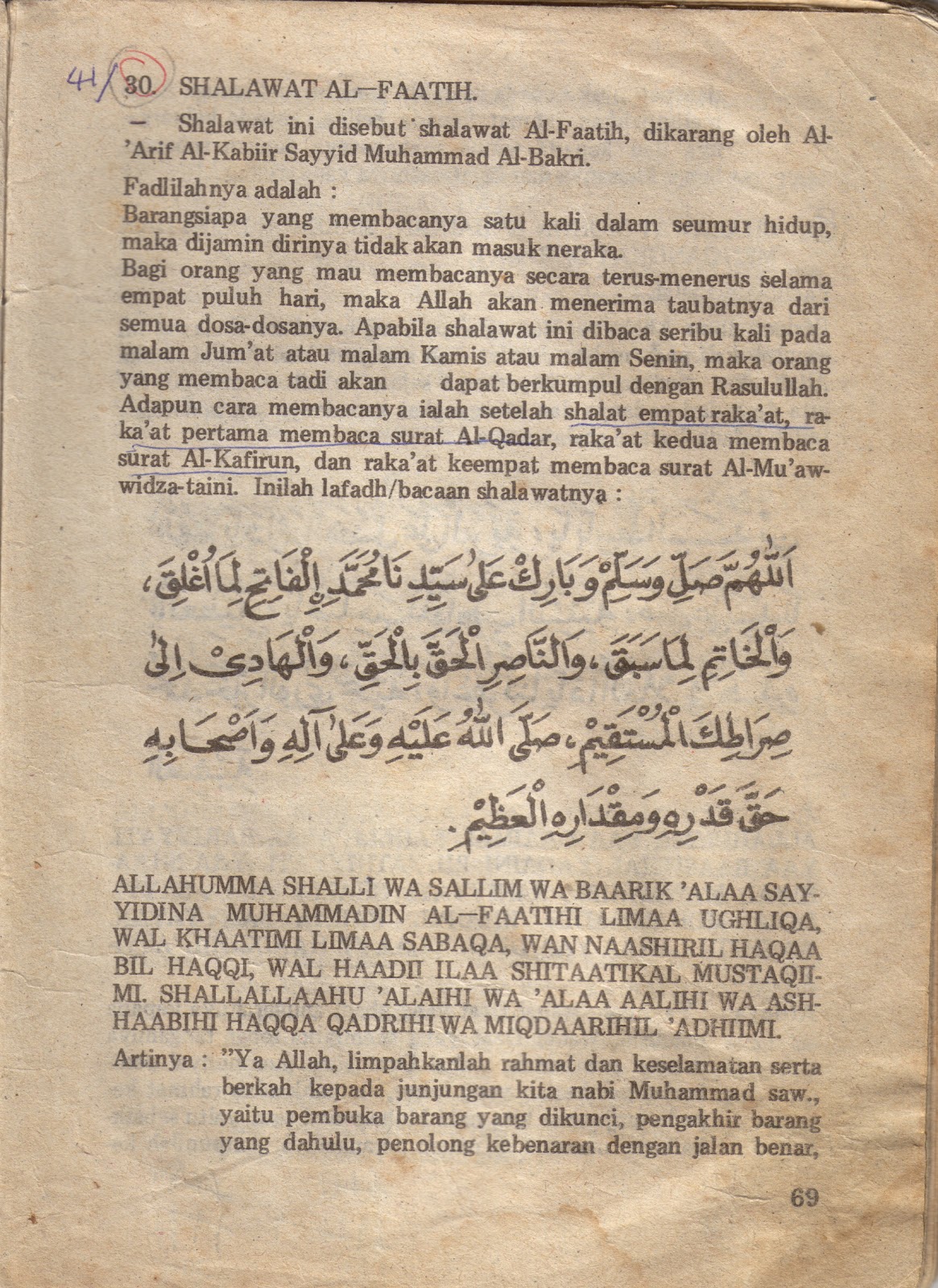
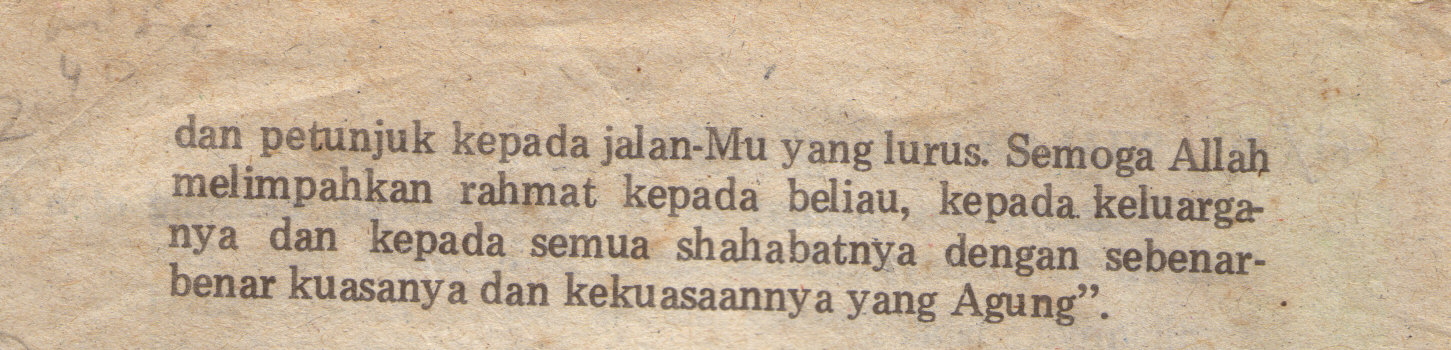
Here is Selawat Fatih from a book that belongs to my husband who's from the pondok in Batu Uban, Pasir Mas, Kelantan. I don't know if the publisher is still around today or where to locate it. I would like to get a brand new copy if possible. I browsed the old copy and found many other very good doa in the book. I'm reproducing it here because I can't find a good image of Selawat Fatih elsewhere. The language is Indonesian.


This is a good introduction to Islam for people who don't know Islam and people who need a refresher. It is well-written and is a simple text. Read the entire document and not half way. It will make you think about your life and where you're heading. It makes more sense about the life we have today and will have after today. It is written for thinkers or people who like to reflect on life. Most people, not counting race or creed, will come around and start asking questions about their lives - where they came from , who are their parents & grandparents, what happened in the past, who's who, where do we go from here, what can we hope for, are we alone, etc. It is best read when you are alone at night or in the wee hours of the morning when everyone is sleeping, a quiet time, where you can practically hear your own heartbeat. That's when to reflect and read this passage. Don't read it when you're hurrying. It will make no sense to you when your life is just hurry, hurry, hurry! Read it again every 5 years and you will stand to gain the deeper message in the passage. Remember, Islam was never made for a useless purpose. It is for to enrich the human experience. The concepts are very important. People criticise Islam because they don't understand the full breath and depth of the concepts mentioned in the passage. So it is best to just ignore the critics and get to the core of Islamic knowledge. Give them the link below so they can learn something about Islam. Read the article below too so you become a thinker, and a thinker in Islam is a Sufi - a source of knowledge, not just simple knowledge but knowledge of knowledge (which is wisdom, truth from truth, haqqi bil haqq). The word philosophy comes from the Arabic word falsafah, whose root word is sufi or safah, and similar. Arabic does not have a letter 'p' so falsafah becomes philosophy in another language; Persian has a lot of 'p' words; Sanskrit has a lot of 'b' and 'w' words. Arabic has a lot of 'th' and 'gh' words. So, that's how to tell the words and source languages apart. Anyway, read the passage below.

Islam - Its concepts and meanings:
http://www.cssforum.com.pk/islam-its-concepts-meanings.html

Seat 61

I have always loved trains and prefer to travel by train. Here are some info for train travel.

A beginner’s guide to train travel in Singapore and Malaysia
This is a very good website that provides very detailed information for train travel in Malaysia and Singapore. Good for beginners. Covers Tanjong Pagar (closed 30 June 2011) and Woodlands in detail. A lot of travel tips. Lots of lovely photos.
His Facebook is too busy with FAQ and >5,000 friends.

These are other informative train sites with lovely photos:
KTMB website: http://www.ktmb.com.my/
Tumpat train station: http://travel.nuraina.com/tumpat-train-station/

Chinese Temples in Penang


Chinese places of worship are the Chinese temples. Chinese temples are usually big and with big statues of the Chinese gods. I remember the word Tok kong from my schooldays in Alor Star, Kedah. There were a lot of Chinese temples in Alor Star.

I remember in Penang, going round with my Chinese step-grandmother to a Chinese shop where they baked pink buns with a dot, for offering to the Chinese gods. My grandmother bought some for me to eat that morning. Did I eat the pink buns? Yes, I did - I was hungry. It didn't matter to me. They had a bean paste inside.

I was walking with my Chinese-Malay husband and we passed a row of shops in Penang where they made giant joss sticks for the Chinese temples. I was curios so we walked slowly and I could pause longer and take a closer look at the giant joss sticks - they were made of sandalwood sawdust and were so colourful.

I have never been close to a Chinese temple nor gone inside one to see what is inside or what goes on inside. I only watched them from outside. Our medical students are posted to Chinese tok kongs in Kota Bharu, Kelantan and they also have to clean the tok kong for the Chinese community they visit for the Community and Family Case Study (CFCS) programme. There is Kampung Cina just before Pantai Cahaya Bulan in Kota Bharu.

Here are pictures of Syed Sheikh's old residence at the corner of Jalan Solok and Jalan Jelutong in Penang, next to Esso petrol station. They were taken on 22 October 2011. The house is now a Chinese tok kong. Syed Sheikh was the grandfather of Dr Syed Mohamed bin Alwi Alhady (Dr SMA Alhady), an early Malay doctor.


From the book Syed Syeikh al-Hadi by Sohaimi Abdul Aziz (2003), page 79.
Photo from Arkib Negara Malaysia
Same as above. Page 46.

Here are some pictures of a Chinese shop and 2 Chinese temples which I captured in my balik kampung trip to Penang, on 13-16 April 2012. These are near Masjid Kapitan Keling area. My old camera was slow and I missed a lot of good scenes. I had saved the new camera for my visit to the Penang Museum.

Red lanterns, green roof, dragons
Chinese shophouse with unique features
A Chinese temple (we got lost and went round in circles and passed this place three times!)
KOMTAR in the background
Almost missed it
Very big front yard. The giant joss sticks can be seen smoking/fuming ... the pigeons in the foreground didn't mind the smoke

Te Zhi Bai Feng Wan

Have I taken Te Zhi Bai Feng Wan? Yes. Who coerced me to take Te Zhi Bai Feng Wan? My Chinese father-in-law. His name is Wong Seong Keong @ Hussien - the youngest male from the 'millionnaire' Wong family in Kota Bharu, Kelantan (I think they are also millionnaires in Penang and Singapore too). Anyway, why did he want me to take Te Zhi Bai Feng Wan? My Chinese father-in-law is health conscious. He says even the Chinese Empress took it. What is the history of Te Zhi Bai Feng Wan? Read below.

History of Te Zhi Bai Feng Wan:
This is the story from my Chinese father-in-law. The story is from northern China, maybe Beijing. He says the remedy is a 'cold concoction', ie, used in the cold region. Here's the story from him ... The Empress of China was weak and the healers went in search of a cure for her. They concocted Te Zhi Bai Feng Wan for her ailment. She took it and recovered. The concoction was kept a secret and only given to the empress. Anyway, time passed and she also passed on. The secret for making Te Zhi Bai Feng Wan became public domain.

Chinese song:
Ai Mei
Ai mei rang ren shou jin wei qu
Zhao bu dao xiang ai de zheng ji
He shi gai qian jin he shi gai fang qi
Lian yong bao dou mei you yong qi

What is Te Zhi Bai Feng Wan?
A traditional Chinese medicine used for overcoming menstrual problems and fatigue.

Where do they sell this?
Read here: Hai-O eStore

Halal certificate:
Read here: Herba Maharani

Contents and indications:
Read here: Te Zhi Bai Feng Wan
I have edited and reproduced the text below. I have corrected the names of the ingredients and linked the ingredients where possible.

Beijing Tong Ren Tang Te Zhi Bai Feng Wan
(Malay name: Herba Maharani)

Ingredients:
It is made from Gallus Gallus Domesticus (Wuji), which is from cultured farm owned by Tong Ren Rang, Ginseng, Radix Angelicae Sinensis, etc.

Indications:
Traditionally used to relieve menstrual pain, body weakness, improve blood circulation and regulate menstruation.

Function:
Enhances health, regulates blood circulation and menstruation.

Suitability:
1. Enhances body health and recovers fatigue
2. Relieves discomfort during menstruation

Dosage:
1 pill each time, twice daily; to be taken with warm water.

Price:
1 box RM 65
5g x 6 wax golf balls (inside with 50 small pills)

These are my pictures of the Te Zhi Bai Feng Wan box which I purchased and consumed from June 2005 onward (I was 47 and in the last phase before full menopause). I still keep the box and contents for teaching. These are my teaching slides for my class 'History of Medicine'.


6 embroided red boxes
Nice packing, and with instructions.

1 wax golf ball inside each red box.
A wax golf ball ... need to find where to pry open
Each wax golf ball has another plastic ball inside
Contents of plastic ball ... black beads ... 50 of them 
Collectors' items
Patients will be happy just receiving an empty pill box this lovely!

Saturday, 21 April 2012

Malaria field work and MPH course


The Postgraduate Medical Studies Committee was set up at the University of Singapore in 1961. University of Singapore postgraduates for the Master in Public Health (MPH) were able to do a part of their field work at the rural health clinics in Malaya/Malaysia.

Dr Mohamed Tahir bin Ahmad Ibrahim graduated with MPH from the National University of Singapore in 1981. His field work related to malaria was part of the MPH course and was performed at Sungai Ramal Luar, Selangor.

Where is Sungai Ramal Luar?

Sungai Ramal Luar is near Kajang. It is situated at the fork of Lebuhraya Silk (Silk Highway). It is close to Taman Perindustrian Selaman and Taman Perindustrian Miel on one side of the Lebuhraya Utara-Selatan (North-South Highway) and Uniten and Kuala Lumpur Infrastructure University College on the other side of the NS hwy. Country Heights lies to the NW. Bandar Baru Bangi lies to the SW. Bangi Golf Club lies south. Kajang lies to the NE.


View Larger Map

Chinese Sinsehs in Penang

The traditional Chinese doctors are called sinsehs. The are knowledgeable and keep centuries old formula and knowledge about Chinese herbal medicine. Chinese herbal medicine is widely used and is available globally from Chinese medicine halls or stores. In British Malaya, the Chinese medicine halls and the sinsehs played an important part in the health of the British Malayans residing in Malaya and Singapore. Big Chinese medicine halls served just like the hospitals we have today. With progress and as Malaya shifted to British-built hospitals, and now with modern Malaysian hospitals, the usage and importance of the Chinese medicine halls have declined somewhat, but it does not mean they are not needed anymore. Many Chinese and also Malay patients attend the Chinese medicine halls and prefer treatment from the sinsehs.

Chinese medicine hall. Photo from Penang Museum display.
The hall has ornate furniture and a distinct layout. The treatment altar where the sinseh presides is up in front (near the back wall in this pic). The medicines are on a long table where the sinseh sits.
It is a matter of choice where patients want to go and whom they wish to consult for their ailments. There should be no coercion. However, we do worry about patients not knowing their medicines. Most traditional Chinese medicines sold in Malaysia have a cover to say they are safe for human consumption. But do patients know or do they read the tiny print about the safety of their medicines? We often hear abuses of the system when it comes to instant cures and especially from quarters dealing with traditional Chinese medicine.

We must be clear about the root of the problems and that there are two sides to the coin. The intentions of the manufacturers of traditional Chinese medicine maybe good but what can happen is the middlemen can take the medicines and manipulate the contents for higher monetary returns. That is the root of many problems we get today when it comes to traditional Chinese medicine. The best practice is to consult the sinsehs or any practising Chinese doctor who knows traditional Chinese medicine. They can differentiate between genuine and adulterated traditional Chinese medicines.

Is Chinese traditional medicine an acceptable means of treatment today? Yes.


Forced Sterilisation in Uzbekistan

BBC Radio 4: Forced Sterilisation in Uzbekistan.

Friday, 20 April 2012

Wars and War Veterans

I have lived through many wars but I have never been involved in any of them. Here are the wars that I have lived through:

Vietnam War (I was 11 years old)
War in the Falkland Island
War in Afghanistan (I was 46 years old)
War in Somalia

What impacts me most are the war veterans I came in contact with. 

I went to university in Fall 1976 when US soldiers were returning from the Vietnam War. My partner for my lab class was a Caucasian war veteran in wheelchair. I did everything for him.

I did my PhD in Perth and met a Vietnamese girl who fled to Australia. She's resourceful

I was working one day when I received a call to pick up a family of Somalian refugees who re-settled in New Zealand. I became their sister.

I once had a student who came from Afghanistan and he cried when he could not get any response from his family at home when the US went to war in Afghanistan.

Here's a video on a war veteran who was involved in the Afghan war. He has PTSD.

Many people say that war veterans returned with some form of mental disturbances. You can watch the video and similar videos on YouTube, and decide for yourself. 

In my opinion, war is totally unnecessary. Humans have brains, and we must use our brains to interact - ie, discuss our differences and unhappiness, not by going to war.

Jawi Peranakan Experience in Malaysia

This is a response by a reader for my post on Identities and Ethnicities (13 Oct 2010). I have re-posted the response here for visibility.


Call for Entries on the Jawi Peranakan Experience in Malaysia

Would you like your family to be featured in an exciting book on the Jawi Peranakan? Do you know your family genealogy? Can you do a kinship chart?

I am helping to edit a collection of autobiographical stories and part anthology on the lives and experiences of being Jawi Peranakan in Malaysia. Its editors are respected women of Jawi Peranakan descent.

The Jawi Peranakan of Penang, Kedah, Melaka and of other Malaysian cities were locally-born, Malay- and, often, English-speaking Muslims of mixed non-Malay and Malay ancestry. See also the definition of Jawi Peranakan in the book “Straits Muslims: Diasporas of the Northern Passage of the Straits of Malacca” by Wazir Jahan Karim et al (2009).

Each prose piece must be autobiographical in nature, but considerable latitude will be given to content and narrative style. Manuscripts in English should be double-spaced using Word format and not be more than 10 pages or 2,500 words in length. Only one entry per person will be accepted.

The best nine entries will be accepted for publication in the collection mentioned above. Those chosen for publication will be asked to submit scanned family photos to accompany their pieces. Photos should be high resolution of above 300 pixels. They should contain detailed captions of place, date of event, description of persons in the photo from left to right, with comments on the persons’ dress, context of photos, etc.

This is a great chance for you to test your talent as a writer.

Submit entries for consideration by July 1, 2012 to mtimor_2005@yahoo.com. Questions on prose requirements may be directed to this email address as well.

April 20, 2012 11:29 AM

Picking out talents in children

There is a lot to learn from children. From the time they were born, growing up years, till they can make it on their own, all parents WORRY about their children. I've always observed how parents raised their children. They basically fall into 3 types - the very caring, the not so caring, and the couldn't care less. The outcomes of the 3 groups vary greatly and there are a lot of modifiers which affect outcome when it comes to children. 

When children are asked what they wish to be when they grow up, the first answer is always they want to be a doctor, then lawyer and then engineer. Why do they choose such high-sounding professions when they don't even understand the professions? Sometimes I wonder, whether parents are to blame for pushing their children. Sometimes, we may go overboard and expect too much from our children. Sometimes, we think we make the right decisions for our children and all their choices and opinions don't count. Sometimes children refuse to listen to parents and they want to try something of their own wants, only to find later that nothing works right for them - and then parents come in to blame and criticise and make the children feel unfit.

I have seen and I have listened to many such instances where parents are unhappy with their children's decisions, and vice versa. Many a time, nothing seems to work right for anyone. Why?

For children to choose to study medicine, the choice is one of the most difficult. The course itself is 5-6 years. For students who have the right background, life at medical school should work out fine. But for some who don't have the optimum background, then life at medical school can be a difficult trial. I have worked 29 years (come 28 June 2012) and I have seen children come to study at our medical school. Some make it great in the end, some never graduate, and most just about made it.

Where do we strike a balance and make studying medicine a wonderful experience?

As I penned the 43 biographies of our early Malay doctors, I noticed that most of these doctors came from poor Malay families and made it great as doctors. They had interesting lives as children which I enjoyed hearing about and wrote in their biographies. They had hopes and dreams, and every child was different. But they all turned out to be very good doctors and served the society well. They did not forget their roots and their society. Almost all doctors returned to serve at home.

Today, we have many medical schools and different medical curricula. Most are sound curricula and are constantly reviewed for many things. One that I particularly pay attention to is whether students really enjoyed learning and will the learning experience help to direct them to be more open and resourceful persons. Will they only serve as doctors or can they take on other responsibilities that their society requires from time to time. 

I am most open to suggestions for human resource development for the medical school, not only students but lecturers too. I am probably #3 oldest in age rank in my medical school. Most of my seniors have retired and gone elsewhere, mostly to make extra money after retirement.

I am not concerned about retirement and what it pays. But I am concerned about the quality of doctors that medical schools produce today. I am concerned about hospitals not having enough nurses and the hospital operational budget cannot afford to hire extra hands. I am concerned about a good hospital being poorly managed. I am worried about patients seeking help at hospital and not getting the help they need. I am worried that we are sweeping a lot of our problems under the carpet.

I think it pays to study little problems and try to see what can be done. It pays to walk around at peak hour to find out what are patients' problems are and overcome that. It pays to know how much trouble patients have trying to come to hospital. It pays to have a friendly hospital service that reaches out to patients rather than wait upon them to turn up, if they do.

I still don't understand why we have so many patients waiting in overcrowded corridors even in our modern hospital clinics. I don't understand the clinics are unmanned at peak hour when the patients fill the corridors and they smell of sweat even with air-conditioning. What is happening?

Where should doctors be? Where do you expect to find doctors in a teaching hospital? Where do you expect to find doctors in a medical school?

I still feel doctors are nowhere to be found. Where are they?

In the modern working environment today, teaching does not count. Only Key Performance Index (KPI) matters. Even teaching in a medical school has low priority. Lecturers don't know how to strike a balance and thus 3 strands arise - the research doctor, the lecturer doctor, and the plain doctor who does no research and no lectures.

Doctors have a choice where they wish to be and what they want to be. Many prefer the high posts, better status, better pay and no hands-on in the clinic (ie, no clinic). We all know doctors are paid 3 things - a basic salary, a clinical allowance (if they do clinic)/a critical allowance (if they don't do clinic) and a teaching allowance. Clever doctors what what path to take.

This is not the point I'm writing this post. The point is, why are we taking so much trouble to graduate a doctor, only to find that in less than 5-10 years, the doctor does not want to be a doctor in practice? The doctor does not want to do clinic. The doctor has no interest in petty things like patients. The doctor now has a business mind and has become a businessman! I still find it hard to come to terms that doctors want to be enterprising when initially we teach them to be doctors and expect them to function just as doctors and never leave bedside practice and clinic practice.

Many doctors are in administration and not in clinics or clinic practice. This is the root of the problem in the medical industry. They don't want to be medical lecturers because the pay is small (despite it being hte highest pay in the teaching professon) nor do they want to stay put in the clinics. Why did they choose to be doctors then? Did they lie at medical school interviews? I don't know but it worries me. I don't want to teach a medical student who upon graduation only wants to fill his pockets. If I had my way, I would shoo him/her out of my class, for having the wrong attitude towards a wonderful profession.

I have a workshop on medical school interview on 24 April 2012. I hope this matter is stressed when we look for potential medical students. It is not worth spending half a million Ringgit a student, and expecting him/her to become a doctor, when the student only wishes to become a businessman/administrator upon graduation. I would rather accept a student who would want to spend 20 years in clinical work/practice and then go on to become a businessman.

Thursday, 19 April 2012

British Monarchs

Official website of the British Monarchy
http://www.royal.gov.uk/sitemap.aspx

Historic speeches and broadcasts
QEII

Wartime Children's Hour Broadcast by QEII


QEII Coronation (2 June 1953)


Queen Victoria
http://www.youtube.com/watch?v=p31cHJJESIE&feature=related

Queen Victoria's Diamond Jubilee 1897


King Edward VII


DUCHESS OF KENT VISITS S.A.T.A. MALAYA.

http://www.britishpathe.com/video/duchess-of-kent-visits-s-a-t-a-malaya/query/Ray

Duchess of Kent visits Singapore 1952
http://www.britishpathe.com/video/duchess-of-kent-in-singapore/query/01271100
The venue is the Padang in Singapore


Rubber

Links for rubber, rubber estates, people involved with the rubber industry and laws.