Monday, 2 November 2020

Race, Religion, And Royalty: The Barnacles On Malay Society


Race, Religion, And Royalty

The Barnacles On Malay Society


M. Bakri Musa (www.bakrimusa.com)


(First of Four Parts)


Introduction:


Race, religion, and royalty have long defined Malay culture and society. Today those three elements have degenerated to be the treacherous troika of Malaysia’s increasingly dangerous identity politics. This development more than anything else threatens to radically alter Malaysia’s political dynamics, and with that, the nation’s stability.


There is yet another related and equally (if not far more) consequential aspect that is not appreciated. That is, race, religion, and royalty are the barnacles on Malay society that not only impede Malay progress but also threaten to sink Malay society and culture. That in turn could have a severe and adverse impact on Malaysia. There cannot be stability if the nation’s majority ethnic group were to be left behind or remained marginalized. It is unfortunate that this is fast becoming the sorry and tragic reality for Malays.


The narrative or “explanation” spun by Malay leaders and followers alike has been to blame others. In colonial times, the “others” were the colonialists; today, after more than six decades of independence, with the government as well as all the major levers of powers dominated and controlled by Malays, the “others” are now non-Malays and the West.


This weakness or tendency to blame others is not unique unto Malays. South African Blacks still wallow in their victimhood status at the hands of the minority whites. The Chinese, at least until a generation or two ago, still blamed the humiliations they suffered under the British during the Opium War. White Americans today blame illegal immigrants for what ails America, with President Trump spending billions to build a wall at the southern border.


That Malays are not unique in this blame-the-others game is no consolation. Nor would that help solve the problem.


My commentaries on race, religion, and royalty penned within the last decade examine this neglected but important proposition that the three elements have become barnacles on Malay society. They impose a severe and costly drag, becoming the major factors contributing to Malay backwardness. Unresolved, race, religion, and royalty could be the undoing of Malay society and culture.


Conflicts Based On Race, Religion, and Royalty

Conflicts based on only race, religion, or royalty have plagued mankind throughout history. Those involving any two of the three simultaneously, as with race and religion or religion and royalty, are likewise not unusual. However, conflicts where all three are invoked and in parallel are rare. I cannot think of any. Rare or unheard of it may be, that is the unfortunate grim prospect facing Malaysia today. The nation is now deeply polarized along race, religion, and attitude or loyalty towards royalty. This is never more keenly felt than within the Malay society.


During the last decade of the last century there was the Rwandan civil war that pitted the Tutsis and Hutus. Not too long before that, there was the Biafran War in Nigeria, with the Ibos against the rest. A non-African would find it difficult to tell a Tutsis from a Hutus, or an Ibo from the rest. Those conflicts were based solely on ethnicity, a variant of race.


The turmoil still plaguing India is based on religion–Hindus against Muslims. Indians are ethnically or racially similar. You can’t tell them apart by their physical features, the language they speak, or their personal mannerisms. Both Muslims and Hindus shake their heads to signal yes and no. As for intra-religious conflicts, the centuries-old Sunni-Shiite divide in Islam is still being played out today in all its lethality and brutality.


Royalty too is no stranger in many conflicts. Within my memory and closest to Malaysia geographically and culturally was the 1962 rebellion in nearby Brunei. Only the quick intervention by the British through its mercenary Gurkhas saved the sultan. A decade and a half later, the Iranian Revolution forced the Shah of Shahs to flee his country. The Iranian Revolution that triggered it is still ongoing.


All those horrors occurred during my lifetime and memory. The history books document many more, and much worse.


Less common but not rare is where two of the three elements of race, religion, and royalty are combined, or where their dynamics paralleled. The centuries-old and still very deadly Arab-Jew conflict reflects this combination, with tribe and religion in play. The “troubles” in Northern Ireland between the Irish and English is but a residuum and reflection of a much bigger divide between the two that has plagued the Emerald Island for centuries. That too is a combination of ethnicity (Gaelic versus English) and religion (Catholic versus Protestant).


To reiterate for emphasis, a conflict involving all three–race, religion, and royalty–is rare. That is where Malaysia is headed towards on its current trajectory. With all three elements involved and in parallel, once the conflagration is ignited, expect it to be much more vicious, protracted, and difficult to resolve. That makes preventing such a catastrophe from happening be the highest priority.


Next:  The Race Barnacle  (Second of Four Parts)


Friday, 30 October 2020

No "Guided" Constitutional Monarchy

 No “Guided” Constitutional Monarchy

M. Bakri Musa (www.bakrimusa.com)


Alas the accolades heaped upon the Agung for not acceding to Prime Minister Muhyiddin’s earlier request for Emergency Rule had not yet ebbed when the Agung startled Malaysians with his unprecedented “advice” for Members of Parliament to pass Muhyiddin’s forthcoming 2021 budget.


            This royal “advice,” or “guided” constitutional monarchy from the palace if you will, has all the stink of an overripe durian. At least with that you could salvage it into tompoyak paste, a delicacy if you can get past the odor.


            The Agung issued that menasihat (advice) only a few hours after Muhyiddin had presented his proposed budget to him. The Agung had barely enough time to skim the headings and he already had his advice for the rakyat.


            Something about Malay language. You and I menasihat each other, but sultans decree. Therein lies the danger. Already those in UMNO and Muhyiddin’s camp are making this point of the menasihit being a titah(decree), and to be obeyed as such, to suit their political expediency. Indeed, a few paragraphs into the palace statement, it used the word titah to describe it, just in case you missed the message. There was no subtlety there.


            Those who think that this was merely an advice from a concerned King are ignorant of Malay language, culture, or norms. To go against a titah is derkaha. That would make those who would vote against the budget traitors.


            It is not coincidental that the palace issued the statement in Malay and with no accompanying English translation, as is the practice. I would like to see palace officials (or anyone else) translate the first few words of the fifth paragraph of the October 28 Palace Statement:   “Al Sultan Abdullah bertitah [my emphasis]demikian selepas menerima menghapad YAB Perdana Menteri. . . .” (The Agung decreed this following an audience with the Prime Minister . . . .)


            Back in 1957 the incompetent but egotistic President Sukarno, unable to perform the basic tasks of governance, introduced “guided democracy,” with him being the “guider” of course. With that as a beginning, a decade later he was replaced by a brutal dictator, Suharto. That reign of terror would not end till 1996.


            Malaysians be warned! Do not go down this well-trodden path of “guided” or “menasihat” of anything from anyone. The path to hell is paved with good intentions.


Members of Parliament should do their job they were sent to do. They are paid by the rakyat. MPs must listen to those who sent them there and paid their salary, not anyone else even if he were to heap upon you exalted titles of some ancient supposedly glorious Mashuri dynasty.


            An earlier Agung said it best. “Democracy as a political system does not become a democracy because it is given that appellation. The true meaning of democracy can be summed up by the phrase ‘government by the people.’”


Now that is sound nasihat (advice)! That earlier Agung, Raja Azlan Shah, had also served as the nation’s Chief Justice.


            He went further. “Any form of pressure or arbitrary limits imposed on the people in their free exercise of the right to choose their own government will be a clear abrogation of any parliamentary system of government. Similarly, major bills must not be rushed through Parliament. The people should have an opportunity to express their views.”


            An annual budget is a major if not the bill for the government. This Agung wants it diluluskan tanpa sebarang gangguan (passed without any interference).


            That is a very dangerous mindset, to equate robust parliamentary debates as gangguan (interference). Palace advisors must be disabused early and in no uncertain terms of this treacherous path that they have chosen to follow.


            If this Agung believes that the current Covid-19 pandemic presents such a clear and present danger to the nation such that parliamentary bills must be passed without gangguan, he should have approved that earlier request for Emergency Rule.


By giving this titah to support Muhyiddin, the Agung has implicitly endorsed him as the legitimate Prime Minister. As such, his earlier denial of the advice from the “Prime Minister” for an Emergency Rule set a very dangerous precedent. The King reigns but does not rule.


            The King’s titah to the rakyat was misplaced. He should have directed it instead to Muhyiddin. That advice is the same one Malaysians have bombarded on Muhyiddin during the last few months, that is, get Parliamentary endorsement of your leadership. If you do not or cannot, then get out! This manufactured political crisis is Muhyiddin’s, not Malaysia’s.


            Malaysia’s system of constitutional monarchy is unique in many ways but it is still in its infancy. Malays have just emerged from the old ugly days of feudalism. Many still yearn for those days. As such our system of constitutional monarchy should be strengthened and not breached under some misplaced pretext of loyalty or stability. It is still fragile.


            It was not so long ago following the 2008 elections when the Menteri Besar of Perak said this to his sultan:  “Patek memohon derhaka ….!” (I, your slave, beg to commit treason ...!) Imagine the people’s representative being a slave to the sultan!


            In a constitutional monarchy, sovereignty lies with the rakyat, not the raja.


            To switch my earlier metaphor of an overripe durian, this attempt at breaching the clear lines in a constitutional monarchy and parliamentary democracy must be plugged before the entire edifice crumbles. Don’t let the nation be swamped. Malaysian MPs should be like the brave Dutch boy – stick your finger in the dyke, and do it now with the budget session next week.

Thursday, 29 October 2020

Books by others

 I'm helping to promote books by others:

Academic Writing for Beginners. Explorations of the mind by Elaine Morais. More at https://moraiselaine.wordpress.com

Beauty Is More Than Skin Deep by Dr Madhuri Majumder. The Recollections of Malaysia's First Lady Dermatologist As told to Alexandra Wong (please contact Elaine Morais).

Saturday, 3 October 2020

Proposed book on The Early Malay Doctors

Proposed next book:

"The Malay Doctors of Malaya and Singapore 1900-1957"


Proposed CONTENTS


FIFTY-ONE BIOGRAPHIES OF THE EARLY MALAY DOCTORS

(Alphabetical Order)

1. DR ABBAS BIN HAJI ALIAS (1914-2004)

2. DR ABDUL AZIZ BIN OMAR (1919-1985)

3. DR ABDUL GHANI BIN MOHAMMAD (1906-1979)

4. DR ABDUL KARIM BIN NAWAB DIN (1912-1970)

5. DR ABDUL LATIFF BIN ABDUL RAZAK (1889-1956)

6. DR ABDUL MAJID BIN ISMAIL (1921-2013)

7. DR ABDUL SAMAT BIN HAJI PAGAK (1902-1952)

8. DR ABDUL WAHAB BIN MOHAMED ARIFF (1919-2006)

9. DR ABDUL WAHAB KHAN BIN MUHAMMAD LAL KHAN (1898-1956)

10. DR ABDULLAH BIN AHMAD (1913-1992)

11. DR ABU BAKAR BIN IBRAHIM (1918-1979)

12. DR AHMAD EZANEE MERICAN (1929-2000)

13. DR AHMAD YASIN BIN MOHD SAID (1922-2015)   

14. DR ALI OTHMAN MERICAN (1890-1945)

15. DR (H) AMIR BURHANUDDIN BIN UNGKU MUHAMMAD NOOR (1911-1969)

16. DR ARIFFIN BIN NGAH MARZUKI (1925-2019)

17. DR AWANG BIN HASSAN (1910-1998)

18. DR CARLEEL MERICAN (1922-2003)

19. DR CHE LAH BIN MD JOONOS (1903-1986)

20. DR HAFEEZUDIN SIRAJUDDIN MOONSHI BIN HAKEEM ABDUL HAMID (1895-1965)

20. DR HAMZAH BIN HAJI MOHD TAIB (1900-1955)

22. DR HUSSAIN BIN ABDUL GHANY (1927-1983)

23. DR ISMAIL BIN ABDUL RAHMAN (1915-1973)

24. DR ISMAIL BIN MOHAMAD GHOWS (1882-1964)  

25. DR KAMIL MOHAMED ARIFF BIN KADIR MASTAN (1893-1960)

26. DR LATIFAH BEE GHOWS (1911-2005)

27. DR MAHATHIR BIN MOHAMAD

28. DR MEGAT KHAS BIN MEGAT OMAR (1908-1979)

29. DR MOHAMED BIN TAIB (1916-2002)

30. DR MOHAMED DIN BIN AHMAD (1912-1999)

31. DR MOHAMED IBRAHIM BIN SHAIK ISMAIL (1892-1962)

32. DR MOHAMED NOOR BIN MARAHAKIM (1923-1998)

33. DR MOHAMED SAID BIN MOHAMED (1907-1996)

34. DR MOHAMED SALLEH BIN ABDUL HAMID (1910-1960)

35. DR (H) MOHAMMAD NOOR BIN NORDIN (1929-1994)

36. DR MUSTAPHA BIN OSMAN (1900-1975)

37. DR NURUDDIN BIN MOHAMED SALLEH (1915-1983)

38. DR OMAR BIN DIN (1921-2000)

39. DR PANDAK AHMAD BIN ALANG SIDIN (1892-1965)

40. DR RAJA AHMAD NOORDIN BIN RAJA SHAHBUDDIN (1925-2008)

41. DR RUBY BTE ABDUL MAJEED (1924-2013)

42. DR SALMA BTE ISMAIL (1918-2014)

43. DR SHAIK MOHAMAD BABOO BIN AHMAD ALBAKISH (1894-1964)

44. DR SHAIKH TAHA BIN SHAIKH ABUBAKAR MATTAR (1910-1993)

45. DR SITI HASMAH BTE MOHD ALI

46. DR SULAIMAN BIN MOHAMED ATTAS (1913-1972)

47. DR SYED HASSAN BIN SYED ALWEE ALJUNIED (1901-1962)

48. DR SYED MAHMOOD BIN ABDUL RAHMAN ALKUDS (1912-1970s)

49. DR SYED MAHMOOD BIN SYED HUSSAIN JAMALULLAIL (1921-2011)

50. DR SYED MOHAMMAD BIN ALWI ALHADY (1921-2005)

51. DR UNGKU OMAR BIN UNGKU AHMAD (1931-1969)

----

BIBLIOGRAPHY

INDEX


Wednesday, 6 March 2019

TEMD 2021

Biography of the Early Malay Doctors 1900-1957 Malaya and Singapore (published in 2012 by Xlibris Inc., USA/Australia/UK)

I will be revising my manuscript for my book beginning April 2019 (it may take me 2 years). I hope to remove many pages and add a few more new chapters on doctors whom I was not able to include before. I hope to add new photos which I continued to receive post-publication.

You can check the old chapters online on Google. Please submit corrections to me.

I have retired and now work from home. Please email me on Gmail: faridahar@gmail.com.

Please let the doctors' families and relatives know, especially those whom I missed in the first book published in 2012.

I'm still looking for portraits and biographies of Dr Nizamuddin Ahmad, Dr Zakaria Salim, and others who graduated by Merdeka year (1957).


TEMD = The Early Malay Doctors

Wednesday, 6 February 2019

Pahang - Hospitals, govt clinics, police station and Sg Lembing tin mine


Gold mining vs. tin mining vs. iron mining

The Raub Australian Gold Mine operated in Raub while tin mining was operated by the British in Sg Lembing. Raub was producing much of Malaya's gold, that it was more appropriate to call it El Dorado. Sg Lembing was also nicknamed El Dorado because of the immense wealth it brought to its associated communities.

Two big iron deposits in Malaya were Bukit Besi in Terengganu and Bukit Besi in Kuala Krai, Kelantan.

--------------------------
Sg Lembing Underground Tin Mine

Lombong Bijih Timah Bawah Tanah, Sg Lembing
(Tai Pei Tong)

Sg Lembing was once the richest tin mining town in Pahang Darul Makmur. This was because the area was the second richest tin deposit in the world after Bolivia.

Sg Lembing's mining shafts and subterranean tunnels which reached a depth of between 450 to 650 metres were said to be the deepest in Southeast Asia. The history of modern Pahang, which began with the British colonisation, is linked to the development of Sg Lembing.


Sultan Ahmad Al-Muadzam Shah Ibni Al-Marhum Bendahara Sri Maharaja Tun Ali (23 May 1836 – 9 May 1914) was the sixth Raja Bendahara of Pahang and the founder and first modern Sultan of Pahang.[1] Commonly known as Wan Ahmad before his accession, he seized the throne in 1863 after having defeated his elder brother Tun Mutahir in the Pahang Civil War, assuming the title Sri Paduka Dato' Bendahara Siwa Raja Tun Ahmad. In the early years of his reign, Pahang descended into turmoil, with various attempts made by the surviving sons of the late Tun Mutahir, based in Selangor, to overthrow him. This led to Pahang's decisive involvement in the Selangor Civil War that successfully brought it to a conclusive end.
The successive wars that ravaged the land had led to the rise of dissension among the ruling class and territorial chiefs who were thenceforth divided into factions. In 1881, prompted by his dwindling authority both within Pahang and among his counterparts in the western Malay states, Ahmad took upon the title of Sultan Ahmad al-Muadzam Shah and formally proclaimed as Sultan by his chiefs two years later. The event marked the revival of Pahang as a Sultanate after more than two centuries of union with the crown of Johor.[2] Ahmad gained formal recognition from the British Straits Settlements government in 1887, in return for signing a treaty with the British which compelled him to accept a British Agent in his court.
During his reign, Pahang politics came under the purview of the British government. Increasing pressure was exerted upon the Sultan by the residing British Agent to administer the state according to the British ideals of just rule and modernisation. This had effectively plunged the state into a seething cauldron of discontent with clashes between traditional chiefs and the British. The British ultimately compelled Ahmad to put his state under the British protectorate in 1888 and John Pickersgill Rodger was appointed Pahang's first Resident. The work of building up a State administration began with the creation of the Supreme Court, a police force and a State Council. In 1895, the Sultan entered into a Treaty of Federation to form the Federated Malay States. Ahmad transferred his executive and administrative powers to his eldest son Tengku Long Mahmud, due to old age in 1909, retaining his position and titles as Head of State until his death in 1914.

Chinese tin mining in Sg Lembing 1886-1888

The Chinese miners were the first to mine tin ore in Sg Lembing. They started mining on small scale since 1886. This then gave way to the British miners.

---------------------------
British tin mining exploration in Sg Lembing 1888-1986

The British began exploring the area in earnest in February 1888 when the then Sultan of Pahang, Almarhum Sultan Ahmad Muazzam Shah I agreed to a proposal by a London-based mining concern to set up the Pahang Corporation Limited (PCL) to commercially mine tin in Sg Lembing. The Company was given a 100-year concession in an area 2,500 acres (1,000 hectares) wide for a nominal sum of one cent per annum.

Sg Lembing was also the first town in the Malay States to be placed under the purview of a British mining company, the PCL. In 1915, the mining concession was taken over by the Pahang Consolidated Company Limited (PCCL), which in 1984 was changed to the Pahang Investment Public Limited Company (PIPLC).

Rocks containing tin ore were crushed inside the caves and tunnels in Sg Lembing. These were then placed in wooden barrels on trains and brought to the nearest river port on Sg Kenau. They were milled and then transported down the river to ships in the harbour at Kuantan. These ships shipped tin ore to Britain.

In its 100 years of mining the Sg Lembing mines produced approximately 13 million tonnes of ore that was able to produce 150,000 metric tonnes of pure tin valued at $2 billion. The mining activity contributed significantly to the local inhabitants and economy of the state.

---------------------------------
Visit to Sg Lembing Tin Mine 9 Sept 2015

I visited the Sg Lembing tin mine after the ICOMMM2015 international conference organised by UIA. We took the UIA bus to the tin mine. It was a hazy morning.

I didn't like the visit because the tunnels were dark and smelly, quite dangerous as the ground was wet and slippery in several areas. Claustrophobia was a problem. I liked the adventure but would have enjoyed it more if I was a lot younger or a teenager.

The tunnels leading inside the mine were safe and secured with cement walls, steel beams and cables etc, just as for bridges. The engineering feat is great and should be applauded. Ventilation was sufficient and was provided by natural air holes and those built by the British engineers back then. Large fans have been put in place, but adjusting to tunnel or cave environment raised anxiety.

There were no food stalls on the grounds of the tin mine. We brought our own water bottles and buns, which we ate on the bus on the way home. I thank UIA for making this trip possible.

UIA bus pick-up point for Sg Lembing tin mine visit

Muzium Sg Lembing up on the hilltop.

Close-up of Muzium Sg Lembing

Tourism Malaysia plaque of Sg Lembing history and tin mine

Former house of the General Manager, PCL (later renovated). 2015

Archway to the Sg Lembing tin mine. All vehicles must park outside in the big loose gravel parking lot. No vehicles are allowed on the grounds of the tin mine. Visitors have to walk in and purchase their tickets at the small building on the right just after the arch.

Welcome board and history of Sg Lembing tin mine

Unnamed mine entrance

Wilinks Mine entrance, which remained opened during the 1926 great flood

Tour guides drive this open rusty metal train with metal seats and take visitors into the tunnels of the mine. Each tour is about 30 minutes.

---------------------------------
The Great Flood of 1926

Banjir Besar di Sg Lembing 1926

Sg Lembing, Raub and Kuala Lipis are prone to flooding.

Disaster struck in December 1926 when the entire Sg Lembing town was submerged by one of the worst floods in Pahang's history. Food stocks were destroyed. Homes, hospital and schools were submerged, with plantations covered in 3 feet of mud. All communication lines with Kuantan were destroyed.

Food rationing began, and the town lived under seige-like conditions for 2 months.

All mines, except the principal Willinks mine, were abandoned due to flooding and the mining ceased for 3 months. Life only returned to normal 4 months after the flood had subsided.

However, the PCCL suffered £53,176 (RM265,880) in repair cost and £60,000 (RM300,000) in loss of profits. In those days, such losses usually meant the end, but, the PCCL soldiered on before it finally closed down in 1986 due to high operating cost, falling tin output and fall in tin prices.

External links

https://esajournals.onlinelibrary.wiley.com/doi/full/10.1002/ehs2.1248

Winstedt, R. (1927). The Great Flood, 1926. Journal of the Malayan Branch of the Royal Asiatic Society, 5(2 (100)), 295-309. Retrieved from http://www.jstor.org/stable/24249117
https://www.jstor.org/

https://en.wikipedia.org/wiki/El_Ni%C3%B1o%E2%80%93Southern_Oscillation

-------------------------------------------
Price of Tin

The price of tin was $474 per picul.
Source: Singapore Standard, 28 November 1951

Rubber and tin prices rose appreciably yesterday, rubber by 3 cents per lb and tin by $3 per picul.
Source: Singapore Standard, 5 July 1956

[One pound sterling equals RM5.33 (5 Feb 2019)].

Newspaper

Food control at Raub

Disastrous floods in Pahang. Havoc in tin mining area.

External links

https://www.thestar.com.my/news/community/2014/03/17/tunnels-from-a-glorious-past-sungai-lembings-evolution-from-a-tinmining-hub-to-a-tourist-destination/

http://www.jmm.gov.my/ms/muzium/muzium-sungai-lembing

https://www.thestar.com.my/news/nation/2012/01/14/sg-lembing-cut-off-by-flood/

https://www.eztakaful.com.my/permata-tersembunyi-di-sg-lembing-kuantan-bahagian-3/

https://www.bharian.com.my/node/75274

http://www.astroawani.com/berita-malaysia/sungai-lembing-bandar-mati-hidup-semula-bahagian-1-114659

http://www.astroawani.com/foto-malaysia/sungai-lembing-mati-hidup-semula-3957/sungai-lembing-001-40545

https://www.timothytye.com/malaysia/pahang/sungai-lembing.htm

https://www.facebook.com/pg/eldoradoinnsungailembing/photos/?tab=album&album_id=375414565897289

http://www.journeymalaysia.com/MC_sungeilembing.htm

https://emilayusof.com/2013/02/sungai-lembing-museum-kuantan-pahang/

https://thriftytraveller.wordpress.com/tag/tin-museum/

http://myredfingger.blogspot.com/2010/10/ada-apa-di-sungai-lembing-pahang.html

http://explorasa.my/2016/09/tempat-menarik-di-sungai-lembing-pahang/

http://www.suanie.net/2016/08/sungai-lembing-pahang/

http://www.suanie.net/2017/01/watch-shop-sungai-lembing/

https://redirecting.wordpress.com/2016/01/19/sungai-lembing-pahang/

------------------------------
Sg Lembing Police Station

The old Sg Lembing Police Station was built in the 1960s. It is now defunct and has been given Warisan status.

My ex-classmate's parents had lived in Sg Lembing when her father was a policeman and posted to Sg Lembing Police Station. The family had lived in the police quarters.

The following photos are by Fatimah Mohamad. She, her 2 sisters and their mother visited Sg Lembing Police Station in early 2019.


Housing quarters for policemen's families.

------------------------------
Hospitals in Pahang
Source: https://en.wikipedia.org/wiki/List_of_hospitals_in_Malaysia#Pahang
  1. Hospital Tengku Ampuan Afzan (HTAA)
  2. Hospital Pekan - in Pekan
  3. Hospital Kuala Lipis - in Kuala Lipis
  4. Hospital Raub - in Raub
  5. Hospital Bentong - in Bentong
  6. Hospital Jerantut - in Jerantut
  7. Hospital Jengka - at Bandar Tun Razak Jengka
  8. Hospital Muadzam Shah - at Bandar Muadzam Shah
  9. Hospital Sultan Haji Ahmad Shah (HOSHAS, formerly Hospital Termerloh), Temerloh - est. 2005, 498 beds, RM480 million, http://hoshas.moh.gov.my/hoshasv4/
  10. Hospital Sultanah Hajjah Kalsom (formerly Hospital Cameron Highlands) - at Tanah Rata
  11. Hospital Rompin - in Rompin
  12. Hospital Bera (new) - due 2019, previously RM88mil but delayed & re-cost RM121mil

Four early Malay doctors served in Pekan & Kuantan, Pahang. They were Dr Pandak Ahmad bin Alang Sidin, Dr Che Lah bin Md Joonos, Dr Mohamed Said bin Mohamed and Dr Mohamed bin Taib (dentist). They were also royal doctors who attended to the Sultan's family.

In Pahang, Dr Che Lah had lived close to the Pahang Mentri Besar's residence.

External link
https://en.wikipedia.org/wiki/List_of_Menteris_Besar_of_Pahang

Dr Che Lah's 3rd daughter June and only son Kamaruddin.  Pahang 1956

Dr Che Lah retired as CMHO Pahang from the Government Medical Service in Pahang on 30 June 1958 
His last place of work in the Govt Medical Service in Pahang. 
Dr Che Lah bin Md Joonos seated 5th from left.
Retirement in 1958

Dr Che Lah was awarded the Meritorious Medal Award by Sultan Sir Abu Bakar on 30 June 1958.

Dr Che Lah bin Md Joonos and wife. 1958

Dr Che Lah bin Md Joonos receiving the Meritorious Medal Award from Sultan Sir Abu Bakar of Pahang. 1958


-----------------------------------------
Government Health Clinics in Pahang
Source: https://www.lookp.com/pahang/klinik-kerajaan?page_id=3
There are 100 Government clinics (Klinik Kesihatan Kerajaan) in Pahang:

  1. Klinik Kesihatan Sungai Lembing
  2. KK Beserah
  3. KK Bandar Jengka
  4. KK Benta
  5. KK Jengka 2
  6. KK Jengka 22
  7. KK Bandar Tun Abdul Razak
  8. KK Bandar Bera 32
  9. KK Kemayan
  10. KK Bukit Mendi
  11. KK Bukit Betong
  12. KK Bukit Ibam
  13. KK Cheroh
  14. KK Damak
  15. KK Cini
  16. KK Mempaga
  17. KK Karak
  18. KK Ibu dan Anak Kuantan
  19. KK Lepar Utara 4
  20. KK Jengka 8
  21. KK Nenasi
  22. KK Kg Bantal
  23. KK Padang Rumbia
  24. KK Jeruas
  25. KK Kuala Krau
  26. KK Ibu dan Anak Kuala Lipis
  27. KK Tanjung Gemok
  28. KK Rompin
  29. KK Kuala Tahan
  30. KK Kuala Tembeling
  31. KK Lanchang
  32. KK Lembah Klau
  33. KK Lurah Bilut (Felda)
  34. KK Mela
  35. KK Bandar Mentakab
  36. KK Ibu dan Anak Mentakab
  37. KK Merapoh (Fasa 1)
  38. KK Chanis
  39. KK Perantau Damai
  40. KK Ibu dan Anak Muadzam Shah
  41. KK Padang Tengku
  42. KK Peramu Jaya
  43. KK Sanggang
  44. KK Sg Tekam Utara
  45. KK Tanah Rata, 3900 Tanah Rata, Cameron Highlands
  46. KK Tekek
  47. KK Tersang
  48. KK Triang
  49. KK Dong
  50. KK Ulu Gali
  51. KK Perwira Jaya
  52. KK Bukit Goh (Felda)
  53. KK Jaya Gading
  54. KK Balok
  55. KK Gambang
  56. KK Maran
  57. KK Bandar Pekan
  58. KK Ibu dan Anak Jerantut
  59. KK Ibu dan Anak Raub
  60. KK Pekan Awah
  61. KK Pekan Tajau
  62. KK Temerloh
  63. KK Chenor
  64. KK Bentong
  65. KK Simpang Pelangai
  66. KK Purun
  67. KK Padang Luas
  68. Klinik Desa Jengka 3
  69. Klinik Desa Jengka 14
  70. Klinik Desa Sg Jerek
  71. Klinik Desa Jengka 15
  72. Klinik Desa Jengka 5
  73. Klinik Desa Kuala Sentul
  74. Klinik Desa Jengka 16
  75. Klinik Desa Jengka 6
  76. Klinik Desa Jengka 7
  77. Klinik Desa Ulu Jempol
  78. Klinik Desa Jengka 1
  79. Klinik Desa Jengka 21
  80. Klinik Desa Jengka 10
  81. Klinik Desa Jengka 11
  82. Klinik Desa Kg Bangau
  83. Klinik Desa Batu 8 Lepar
  84. Klinik Desa Kuala Kenong
  85. Klinik Desa Batu Malim
  86. Klinik Desa Kg Kemahang
  87. Klinik Desa Kg Budu
  88. Klinik Desa Jerkoh
  89. Klinik Desa Triang 3
  90. Klinik Desa R/P Rentam
  91. Klinik Desa Durian Tawar
  92. Klinik Desa Triang 1
  93. Klinik Desa Mayam
  94. Klinik Desa Kuala Bera
  95. Klinik Desa Kuala Triang
  96. Klinik Desa Kumai
  97. Klinik Desa Bukit Kepayang
  98. Klinik Desa Bukit Puchong
  99. Klinik Desa Mengkuang

-----------------------------------------
Masjid

Old Masjid Negeri, Kuala Lipis - est. 1888 by Yemeni founder

-----------------------------------------
Roads

There were no roads from Singapore to Kuala Lipis till the 1890s.
-----------------------------------------
Train station

Kuala Lipis train station - est. 1926, old wooden building with delicious Malay food
-----------------------------------------
Bus station

Kuala Lipis bus station has prayer spaces

Monday, 4 February 2019

Presentation slides of 8-9 Sept 2015 at UIA

ABSTRACT

Research Methodology and Challenges in Obtaining Historical Medical Biographies

Faridah Abdul Rashid

Department of Chemical Pathology, School of Medical Sciences, Universiti Sains Malaysia (USM) Health Campus, 16150 Kubang Kerian, Kelantan, Malaysia.


The books Biography of the Early Malay Doctors 1900-1957 Malaya and Singapore (B-TEMD) and Research on the Early Malay Doctors 1900-1957 Malaya and Singapore (R-TEMD) were published by Xlibris in 2012. They are available online at http://www.xlibris.com/ , http://www.bookdepository.com/ and from Kinokuniya at KLCC in Kuala Lumpur.

This presentation explains the approaches used to obtain resources and information on The Early Malay Doctors, the challenges met and motivation. The approaches included phone conversations plus interviews, letter-writing, emails, face-to-face interviews, short messages signalling (SMSes) and home visitations. Resources used included newspapers in local and overseas archives, school magazines, town council publications, doctors’ official records and travel documents, photographs in personal collections, national and overseas archives, state and national museums, and Tabung Haji publications and exhibitions. Various resources on The Early Malay Doctors were compiled, collated and organised online, initially at a USM Telehealth website, and later at Blogger, http://theearlymalaydoctors.blogspot.com/. Each book now has a Facebook page.

There were 75 searches between 2002 and 2006 and six interviews between 2006 and 2012. Author logs were prepared to keep track of the numerous communications between the author and each of the doctors’ families and relatives. Altogether, 50 doctors’ biographies were prepared (2 were dropped). Manuscript assessment and review were performed by USM and Xlibris. Manuscript and photo editing were by Xlibris. B-TEMD has 964 pages and 431 photographs. R-TEMD has 392 pages and 57 photographs. Altogether the two books have 48 biographies, 1,356 pages and 488 photographs.

Even though research on The Early Malay Doctors took many years (2002-2012), it provides insights for future research.

Keywords: British Malaya, Malay doctors, Malay medicine


International Conference on Malay Medical Manuscripts, 8-9 Sept 2015, IIUM Kuantan Campus, Pahang, Malaysia. www.iium.edu.my/icommm
Keynote IV

-------
77 Presentation slides


Publisher's website

Facebook page for the book, Research on The Early Malay Doctors 1900-1957 Malaya and Singapore (2012).


Old bookstalls on the second floor at Chowrasta Market, Penang Road, George Town, Penang. Old school magazines and history books can be bought here.


Dr Kamil Ariff's entry in Who's Who in Malaya 1925.

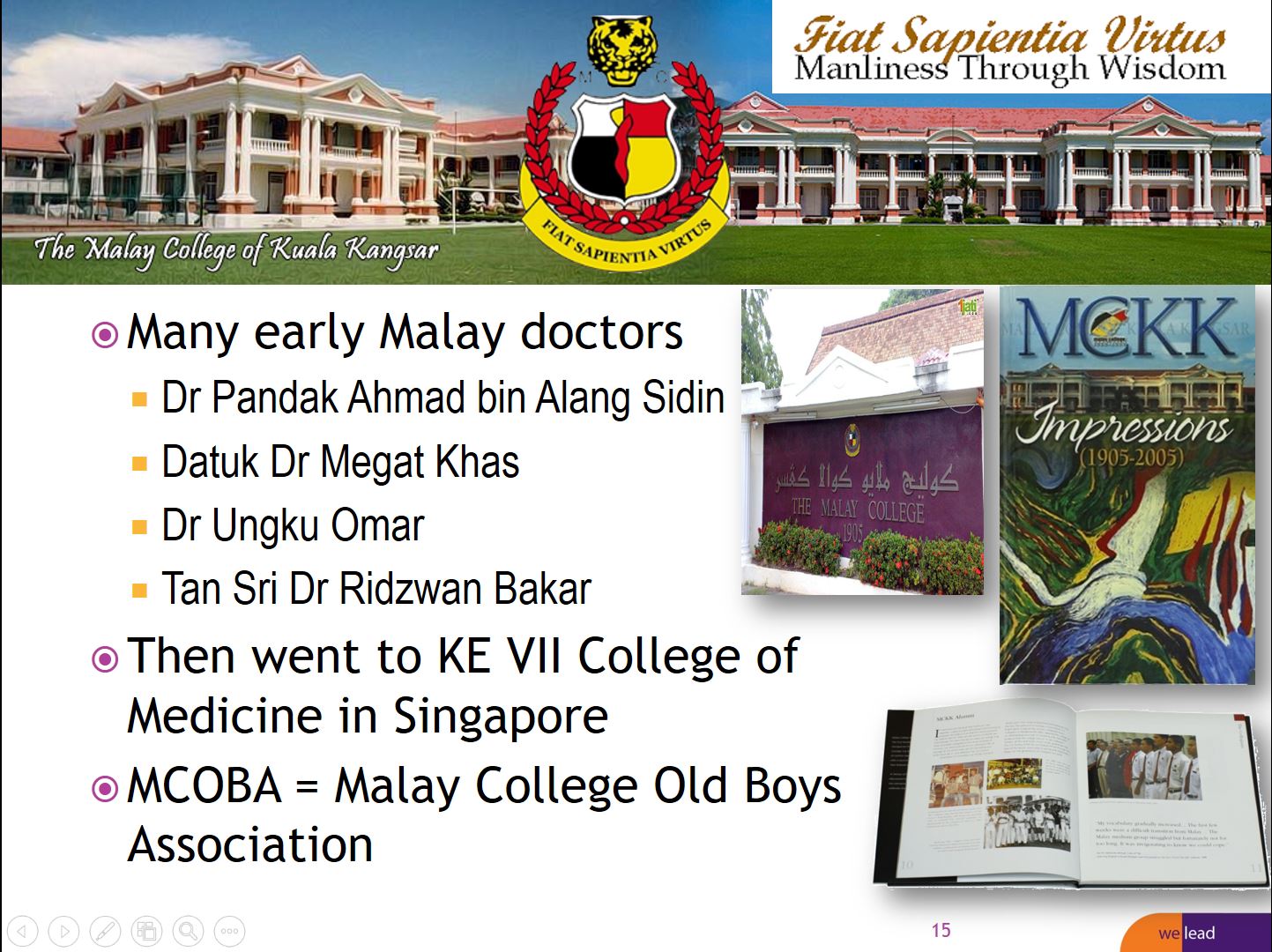
This book was published in 2005 and contains a list of names of all the doctors who graduated from the King Edward VII College of Medicine based in Singapore since 1910. This is useful in checking the date of graduation of each doctor. A slack is the names are short and are listed by the father's name or surname or a single letter instead of fullname. Sometimes the names were wrong and therefore misleading. 


Kelantan Museum had photos of the British doctors in Kelantan.

World War II (WW2) was mentioned by all the doctors' families.

Museums provided a clue about our medical history.

Arkib Negara Malaysia (ANM) was most helpful for my research. Dato' Zakiah Hanum's husband allowed me to use photos from Dato' Zakiah's book, which contained a brief biography of Tan Sri Dr Salmah Ismail.

Tan Sri Dr Abdul Majid advised me to read JM Gullick's book on A History of Kuala Lumpur 1856-1939, in order to understand our history. Some articles were obtained online from J Stor. I also read books on Kelantan history.

Dr Mohd Ismail Merican was then DG Health Malaysia. His staff was most helpful in helping my research and supplied a list of doctors, with date of service. But it was missing information on a few early Malay doctors.

When the British officers left Kelantan in 1914/15, they left 2 photo albums with the Kelantan Sultan. These albums are now with the Kelantan Museum. Nobody at Kelantan Museum knows the British officers who gave away the 2 albums to the Sultan. Nobody knows their families. 

Many early Malay doctors served in Kedah. Some have ties to the Kedah Sultanate.

Tun Mahathir has written many books and many books have been compiled which contain his speeches. His photos are in many galleries across Malaysia. I visited his birth home in Alor Star, Kedah and spoke to the staff in-charge. There was a huge family tree chart being prepared for display. 

There were 2 useful archives - British and Australian archives. Both needed a long time to navigate to find relevant information on the doctors. Some articles had photos. But obtaining the photos was difficult. Dr Ruby Abdul Majeed is in the Australian archives.

These bookshops sold hardcover picture postcard books which were useful to understand history and historical setting to write on The Early Malay Doctors.

USM main library in Penang keeps the series Who's Who. This contains useful information on many early Malay doctors. They contain biodata with/without portraits of the young doctors. The London School of Hygiene and Tropical Medicine (LSHTM) had names of those who took its exams in London. There are no photos of the doctors and the LSHTM at the time.

Those born between 1920s and 1930s were helpful as they had met the doctors either as a patient or seen the doctors, or knew something about the doctors or their clinic practice.

After graduation from the King Edward VII College of Medicine, the doctors either returned to their hometowns to practise medicine or worked outside their hometown. Knowing where they had worked made it easier to find their homes and clinics, or place of work.

Obtaining correct details of each doctor was tedious. Geni was helpful in a few instances, especially when a doctor's name was found. Access was not possible in most cases.

The Early Malay Doctors could be grouped into 2 factions. This research was made difficult as the surviving doctors had not met the earlier senior doctors who had passed on. They only heard about them. It was frustrating as searching for the families and family members of the earlier senior doctors was almost impossible for a researcher who was born after Merdeka. Detailed records of doctors between 1900 and 1957 were nonexistent.

Mr Mohd Fadli Ghani was a strategic and political researcher in KL. He was visiting someone in Hospital USM and visited me to contribute information about 2 doctors - Dr Kamil Ariff and Dr HS Munshi. He gave the fullname for Dr HS Munshi.

Tan Sri Dr Abdul Majid was the second DG Health Malaysia. He provided information on his successor, Tan Sri Dr Raja Ahmad Noordin (3rd DG) and other doctors - Dr Mustapha Osman, Dr SMA Alhady, Dr Latifah Ghows. Tan Sri Dr Raja Ahmad Noordin's wife, Toh Puan Sri Saliah Wahab provided information on Dr Ungku Omar. Toh Puan Sri Saliah and Norman Said assisted with Tan Sri Dr Raja Ahmad Noordin's biography before and after his demise. Relatives, Norman Said and Raja Parish Adley assisted with photos for Tan Sri Dr Raja Ahmad Noordin's biography. Paulinawati contributed a tribute for his biography.

Prof Datuk Dr Mohammed Anwar Fazal provided information on 3 doctors - Dr Kamil Ariff, Dr Ismail Ghows and Dr Latifah Ghows.

Dr Mohamed bin Taib's biography and photos were provided by his youngest daughter Hjh Salmah bt Hj Mohamed and 3 grandsons.

Dr Pandak Ahmad's biography was narrated by his son, Cikgu Mohd Salleh bin Ahmad, many other family members as well as relatives. Both men are deceased.

Visit to PKKN to interview 2 staff. En Azman retired before books on The Early Malay Doctors were published.


First website on The Early Malay Doctors

Second website on The Early Malay Doctors

First search for The Early Malay Doctors was in 2002.

Two early contributors who knew about Dr Ungku Omar.

First person to contact the author/researcher about The Early Malay Doctors. She was the granddaughter of the first Malay doctor.

Outline of the biography of Dr Abdul Latiff in the book, Biography of the Early Malay Doctors 1900-1957 Malaya and Singapore (published in 2012 by Xlibris Corp, USA. Printed in the UK.)

Dr Abdul Latiff bin Abdul Razak was the first Malay doctor


STRENGTHS (S) - no slide


OPPORTUNITIES (O) - no slide


Facebook page for Biography of the Early Malay Doctors

On of the many Internet distributors selling my books

Publisher's website


The End