Wednesday, 28 August 2013

The Merdeka Story

Everyone aged above 55 today knows and remembers Merdeka. We sang the Merdeka songs as kids in the early 1960s and 1970s. We hardly worried about life. We had no worries. We were happy kids.

What was Merdeka about? When did it begin? Where did it happen? What actually happened? Why were we called British Malaya? Why were were called Tanah Melayu? Why were we called Persekutuan Tanah Melayu? What is the Federation of Malaya? Why did we have the Unfederated States? Why are we called Malaysia today? When did we become Malaysia?

Are we patriotic enough? I don't know. We have a national flag (Jalur Gemilang) and a national flower (Hibiscus/bunga raya). We have a national animal (tiger). Do we have a national bird? Do we have a national staple? Do we have a national menu, meal or dish? Do we have a national attire? We have a national language (Bahasa Malaysia/Bahasa Melayu). We have a national logo for our airlines (wau bulan). We have a national airlines (Malaysian Airlines System, MAS). We have our own curreny (Ringgit Malaysia and sen). We have our own banking system, judiciary and education system. We are a fortunate nation.

What does Merdeka mean? It means digging for old photos for me, and trying to understand what happened at Stadium Merdeka that 31 August morning. It means I must revise and read about what Tunku did for our country. It means I must also understand all the people and factions who helped contribute to our independence. 

What is independence? Why do we need independence?

Independence means we get to do things our way, our Malaysian way.

We have much resemblance to the others in this region. We are very similar to the Indonesians who are all around us. We are similar to the Thai Malays who are above us. We are similar to the Filipino Malays who are at 2 o'clock from where we are. We have ties to many Singaporean Malays who are below us on an island. If we combine all the Malays in this region, we are a large mass.

Back to our Merdeka story, what have I got to share in this post? I have some old photos in my harddisk. I probably downloaded them without making note of where I obtained them. I also have a set of photos my late father took at Stadium Merdeka in Kuala Lumpur on 31 August 1957. I wasn't born yet at the time of Merdeka. Merdeka was first proclaimed in Bandar Hilir, Malacca. We have had good prime ministers so far. We had about 55 Malay doctors at Merdeka; my maternal grandfather was one of them. 


Independence documents in London 1953 - 1956:


The first King (Agong) and Prime Minister (Perdana Menteri) 1957:


Malaysia's Prime Ministers 1957 - 2013:

First Prime Minister: Tunku Abdul Rahman Putra Al-Haj
As 1st PM: 31 August 1957 - 22 September 1970.Political party: UMNO. He also created PERKIM.
Born 8 February 1903 - died 6 December 1990 (aged 87).

Second Prime Minister: Tun Abdul Razak bin Hussien
As 2nd PM: 22 September 1970 - 14 January 1976.
Political party: UMNO (1953-1976). He created Buku Hijau.

Born 11 March 1922 - died 14 January 1976 (aged 53)
(suffered from leukaemia)

Third Prime Minister: Tun Hussein Onn
As 3rd PM: 15 January 1976 - 16 July 1981.
Deputy PM: 13 August 1973 - 15 January 1976.
He created the Eye Bank.

Political parties: Independent 1987-1990; UMNO before 1951; 1968-1987; National 1963-1968.
Born 12 February 1922 - died 28 May 1990 (aged 68).


Tun Dr Ismail bin Abdul Rahman
Deputy Prime Minister 22 September 1970 - 2 August 1973.
Political party: UMNO
Born 4 November 1915 - died 2 August 1973 (aged 57).
He was one of the 55 early Malay doctors before Merdeka.
An early Malay doctor from Johor; 3rd Malay doctor from Johor.

Fourth Prime Minister: Tun Dr Mahathir bin Mohamad
As 4th PM: 16 July 1981 - 31 October 2003.
As Deputy PM: 5 March 1976 - 16 July 1981.
Longest term as prime minister in Malaysian history (22 years).
Political party: UMNO
He created Islamic banking, Tabung Haji, the OIC and Putrajaya.
He is one of the 55 early Malay doctors before Merdeka.

Fourth Malay doctor from Kedah.
Born 10 July 1925 (registered date 20 December 1925)

Fifth Prime Minister: Tun Abdullah bin Ahmad Badawi
As 5th PM: 31 October 2003 - 3 April 2009.
As Deputy PM: 29 January 1999 - 31 October 2003.
Political party: UMNO.
He portrayed an Islamic image for Malaysia.

Born 26 November 1939.


Sixth Prime Minister: Dato' Seri Mohammad Najib bin Abdul Razak
As 6th PM: 3 April 2009 - 2 April 2013; 2013-2017.
Deputy PM: 7 January 2004 - 3 April 2009.
Menteri Besar Pahang: 4 May 1982 - 14 August 1986.
Born 23 July 1953.


Proclamation of Independence Memorial in Melaka (Malacca):


MEMORIAL PENGISTIHARAN KEMERDEKAAN

Memorial Pengistiharan Kemerdekaan dinamakan sedemikian kerana pengumuman kemerdekaan Tanah Melayu dilakukan oleh Perdana Menteri Malaysia yang pertama, Al-marhum Tunku Abdul Rahman Putra Al-Haj di Padang Panglima yang terletak di seberang jalan memorial ini. Bangunan usang yang menjadi tarikan ini kini menempatkan butir-butir sejarah perjalanan negara ke arah mencapai kemerdekaan. Peminat sejarah juga boleh menyaksikan tayangan filem rencana mengenai peristiwa-peristiwa penting dalam sejarah kemerdekaan negara di pawagam kecil.

PROCLAMATION OF INDEPENDENCE MEMORIAL

The Proclamation of Independence Memorial is so named because the attainment of Malaya's independence was announced by Malaysia's first Prime Minister, Tunku Abdul Rahman Putra Al-Haj, at Warriors Field just across the road. This quaint old building now houses an exhibition that traces the history of the nation's convoluted journey to independence. History buffs should note that films documenting the highlights of the nation's independence are regularly shown at the theatrette.


(There is a photo of Tunku in a car, being driven around the Malacca Padang. I showed the photo in my class but my medical students did not know nor recognise Tunku at all. I have to search for the photo.)


At Stadium Merdeka, Bukit Petaling in Kuala Lumpur on Saturday, 1 August 1957 (it was drizzling). These photos are from my late father's collection. The original photos were small, dark and vague. I edited the photos using Zoner Photo Studio 15:

That's what my father wrote on the back of each photo below.

There was a post-Merdeka Parade in Bandar Hilir, about a month or so after Merdeka. I have to search for the photos and create another post. 

Tuesday, 27 August 2013

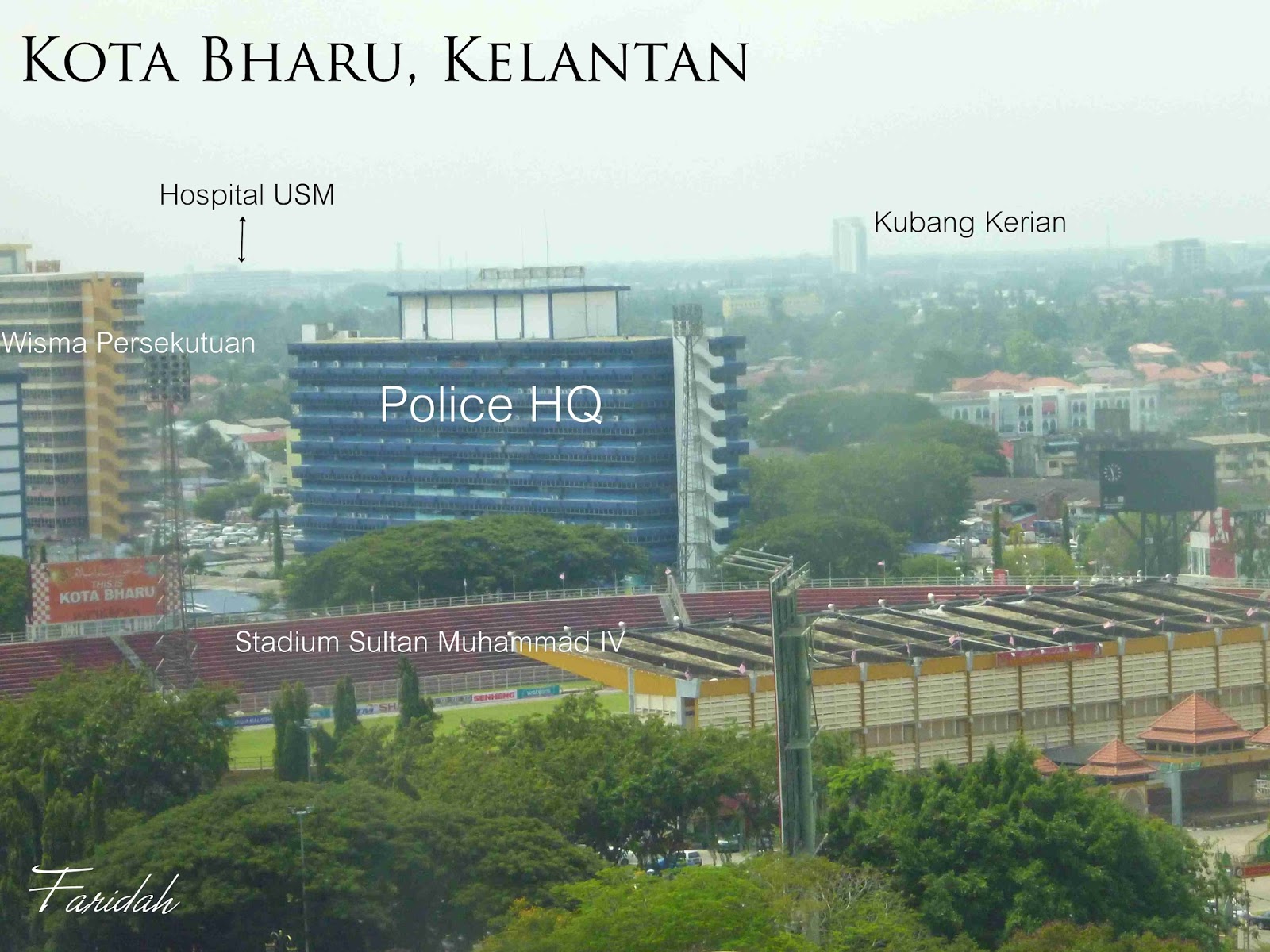
Aerial Views of Kota Bharu, Kelantan

Some of you may want to visit Kelantan. Kelantan is very quiet during school days and very hectic (worse than KL) during school holidays. Don't come to Kelantan during school holidays because the roads are congested and the shops are filled with holiday shoppers. Come during non school holidays and you will be 'King of the Road', and getting around is rapid and shopping is easier. You waste less time on the road and get more things done. You get less headache and normal heartbeat. We have 2 flyovers now to help curb traffic jams. Parking is a problem in Kota Bharu and here the town officers clamp tyres and you have to pay a fine to get your car back. Despite all the unpleasant episodes, Kota Bharu still remains a tourist town. There is a continuous flow of tourists to this unique characteristic old Malay city. It still remains the 'Cradle for Malay Learning' and will always be. Many students come here from Thailand, China, Vietnam, Laos, Cambodia and the Philippines. The teachers comes from Egypt, Saudi Arabia, Jordan, etc. The students mainly study the Quran here at the many Islamic schools and pondoks. Life is very quiet in Kelantan. I have lived here as a little girl, as a teenager, most of my adult teaching life, and now in my middle-age. I have lived in Kelantan for about 33 years. I am not a Kelantanese but I like it here in Kelantan. It is very quiet - I don't hear dogs bark at all. I see only cats, goats and cows. We get soft Australian beef and mutton in Kelantan. We get fresh vegetables and fruits from Thailand and Cameron Highlands. We have a lot of fruit juices, just about every type, including apple juice, soursop juice, mangosteen juice, etc. Internet speed is also faster than in Klang Valley (I think the fastest in Malaysia). That's why I can upload a lot of photos (even though some readers have complained). I will move most of the photos from my blog to my Facebook later.

My husband and I went up to the 11th floor of the Tabung Haji building in Kota Bharu. I took some snapshots of whatever I could see from a tall narrow window that was shut and had an iron grill. My camera is small enough to slip through the grill. But I had difficulty focusing as when the lens tube expanded, there was no room to fit the camera, and it was awkward holding the camera in such a small space and yet try to focus or turn the camera properly. I managed to get some photos. Some shots are not so good. 

We then went to talk to Encik Amri bin Husain in the Tabung Haji office on 9th floor (he will be shifting office soon). He is in charge of the Hajj pilgrimage for Kelantan sector. I informed him that I am only doing Hajj history and I don't belong to the USM Hajj Research Cluster which only does clinical research. He loaned us 2 Tabung Haji reports for my research on the Hajj pilgrimage. He said to make copies and to return them as they are the only originals his office has.

We then headed down to have capati at the nasi biryani shop, our usual hangout when we go to Kota Bharu. The nasi biryani shop is in front of the parking lot in one of the photographs. Nasi biryani is RM7.90 per serve or package. Capati is 80 sen a piece - we shared 3 pieces and each had a tall glass of sweet fresh orange (RM2 per glass). We bought 5 packs nasi biryani for the house and for Affandi's mother at the pondok in Terusan, Pasir Tumboh.


This is the hockey field where I played for my school, Zainab Secondary School. This one is covered with artificial turf; we played on natural grass on hard ground in 1971.


There are 2 bridges on Sg Kelantan, and they lie side by side. The older bridge is nearer the camera. The newer bridge is on the other side (TESCO side).
Kg Gajah Mati is Affandi's village. He was born there. It was a royal Malay village in history. It is just a slum today.
The building with the 3 domes is a shopping arcade. They sell a lot of textiles here.
The few high rises in Kota Bharu. From left: Billion Shopping Centre and Renaissance Hotel, Kelantan Trade Centre, and new Perdana Hotel. I don't know the last high rise but it is in front of the State Secretariat. Looking southwest.
Nasi biryani shop is the one with the red roof and near the trees (parking lot).
Looking northwest.
Looking west
Looking southwest
Looking south-southwest

Penang by Day

Penang is terribly hot during the daytime. I sat in the backseat of my car while my husband drove down the various streets, roads and lanes of George Town, and I took photos of buildings. Sometimes the car swerved and I would fall and roll in the backseat and the photos didn't turn out good. But this is my best effort to obtain some photos and learn what the buildings are about.

Naina Mohamed & Sons (Pg) Sdn Bhd

Naina Mohamed & Sons (Pg) Sdn Bhd shifted from its former location at the Logan Heritage building to Bishop Street. Dr KM Ariff had worked at Naina Mohamed & Sons when it was at Logan Heritage building. I do not know whether Dr KM Ariff also moved when Naina Mohamed & Sons moved to Bishop Street.

Farmasi Naina Mohamed & Sons (Pg) Sdn Bhd
Tel: 04-2610027 / 04-2610082

Bishop Street
Farmasi Naina Mohamed & Sons (Pg) Sdn Bhd
Tel: 04-2610027 / 04-2610082

Cast iron balconies and the original building (as seen in early postcards)
Cast iron balconies from across the road
Close-up of the cast iron balconies.

India House

Whiteways and Laidlaw building

D' Dapor Malay restaurant
D' Dapor
Dewan Perniagaan Melayu PP, JHEI PP, RBS, Tourism Malaysia and AmBank (partial).

Standard and Chartered

Wisma MTT on Weld Quay, near Pengkalan Raja Tun Uda at Penang Port and Rapid bus station

Monday, 26 August 2013

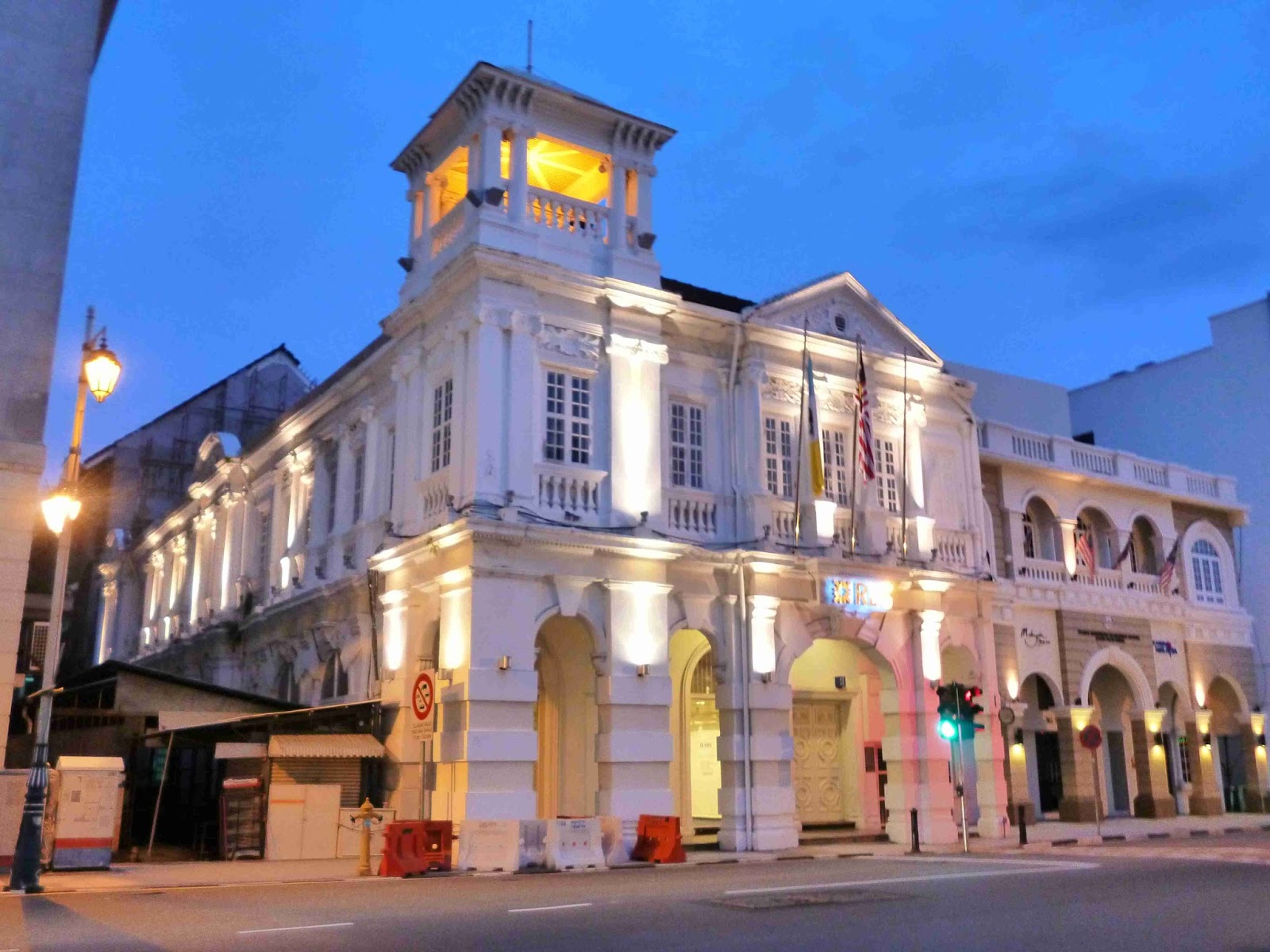
Penang by Night

I went out alone to snap some photos of old buildings in Beach Street, George Town, on one fine night. The night sky was blue. There were a few cars and it felt quite safe. There were a few young boys taking wedding photos of newlyweds at a street corner. I took only a few shots and then ran back to the restaurant (D' Dapor Malay Restaurant) before everyone else arrived for dinner. Beach Street is very beautiful at night, and I never knew.


Standard and Chartered
HSBC
RBS building
Tourism Malaysia office


Whiteways and Laidlaws building
Triple-storey building after Whiteways and Laidlaws. Old photos showed a dispensary was once housed  here in the triple-storey building.


The Logan Heritage building

Saturday, 24 August 2013

Press Release Campaign 2013

This is my Press Release Campaign for September 2013. Please help me to re-post and float it elsewhere. You can post, print or put it at your website. TQ if you are helping me.


501451 FOR IMMEDIATE RELEASE

Book on Malay Medical Pioneers Takes Up Their Role in Shaping National History

Faridah A. Rashid chronicles the few good men who practised medicine in obedience to Islam to reach the “bottom billion” of their suffering masses

KELANTAN, Malaysia – (22 August 2013) – Faridah Abdul Rashid fills in an important gap in Malayan history with her treatise on early Muslim doctors who worked in British Malaya (now Malaysia), Singapore and other parts of Southeast Asia.  In no wise does her book neglect faith in favour of the secular nature of modern medicine.  Thus, while Biography of the Early Malay Doctors 1900-1957 Malaya and Singapore is a chronicle of doctor graduates from King Edward VII College of Medicine in Singapore and the Faculty of Medicine, University of Malaya, it is also a study in the interaction of faith and healing as these doctors practised grassroots rural medicine to reach “the bottom billion.”  

The doctors in this book were the first Malaysians and Singaporeans to practise modern medicine.  Yet there were less than 60 of them from 1911 to 1957 before Merdeka or Malaysian independence.  Their significance lies in their providing the groundwork for the Malaysian health system, which is numbered among the world’s most enlightened and progressive health programmes.  The said doctors built prayer rooms in hospitals for patients as well as immunized patients.  

Another vital part of the history of these medical pioneers was the belief of many people in their capabilities to lead, not just in helping provide good health.  Thus, beyond faith and medicine, they were obliged to lead in the political enlightenment of their people.  Some of them were stalwarts of the Malaysian independence movement.  

The Malaysian health system today operates with a big budget, but it started out with a group of people who became part of the agency of humanitarian change for their suffering masses.  The system still proudly practises this part of their history today.

For more information on this book, interested parties can log on to www.Xlibris.com.au.

About the Author
Faridah Abdul Rashid was born in Malacca, Malaysia.  She grew up and attended schools in Malaysia and completed the Malaysian Certificate of Education (MCE) in 1975.  She attended universities overseas and holds a double BA in Microbiology (with distinction) and Chemical Sciences from California State University (1980), MSc in Biochemistry from the University of California, Riverside (1982) and PhD from the University of Western Australia, Perth (1990).  She has received prestigious financial, academic and merit awards locally and internationally.  She is a lecturer in biochemistry at the School of Medical Sciences, Universiti Sains Malaysia, Health Campus in Kubang Kerian, Kelantan in Malaysia. Her teaching career began in 1982. She has taught medical biochemistry to medical undergraduates and postgraduates in addition to medical laboratory technologists and nurses. Drawing on her passion in local history and zest in computers, she was compelled to teach subjects pertaining to medical bioethics, history of medicine and research on telehealth.  

Biography of the Early Malay Doctors 1900-1957 Malaya and Singapore * by Faridah Abdul Rashid
Publication Date: 21 November 2012
Trade Paperback; $39.99; 982 pages; 978-1-4771-5994-1
Trade Hardback; $59.99; 982 pages; 978-1-4771-5995-8
eBook; $3.99; 978-1-4771-5996-5

To request a complimentary paperback review copy, contact the publisher at 1-800-618-969. To purchase copies of the book for resale, please fax Xlibris at (02) 8282-5055 or call 1-800-618-969.

Xlibris books can be purchased at Xlibris bookstore. For more information, contact Xlibris at 1-800-618-969 or on the web at www.Xlibris.com.au.

Contact:   Marketing Services
                1-800-618-969
                MarketingServices@Xlibris.com.au

Press Release Campaign Post Fulfillment Report


This is my Press Release Campaign Post Fulfillment Report which I received today from my publisher. This is my second Press Release Campaign for my book, Biography of the Early Malay Doctors 1900-1957 Malaya and Singapore. This is in anticipation for the next university session when most world universities open in September. I hope it is clear for especially media people who are interested.


from:      marketingservices@xlibris.com.au
to:       faridahar@gmail.com
date:       24 August 2013 13:22
subject: Xlibris Book ID 501451 - Press Release Campaign Post Fulfillment Report

Dear Faridah Abdul Rashid,

Promotion of your book is now underway.  The enclosed press release has already been sent to newspapers, radio stations, magazines and television stations, which are listed on the attached pages.  Generally, when reviewers are interested in a book, they will contact us requesting for a copy of the book or an interview with the author. Whenever these requests are received, we will contact you so that you can follow-up with the media who requested them, ensuring better coverage.

In addition, please make note of our policies regarding review copies:

If you receive a request from a reviewer, simply advise the requestor to forward their e-mail to (MarketingServices@Xlibris.com.au) or ask the requesting media to notify us of the request via telephone.

Requests must come from members of the working media: either a staff or freelance journalist reporting for a newspaper, radio station, television station, or magazine.

Sometimes a media outlet is not listed on the recipient list because our distribution service was unable to contact them.  We make our best effort to contact all the media outlets in the areas that you chose, however we cannot guarantee that any particular media will be contacted.

If there are other media you believe might be interested in your book, you may send out a copy of your personal press release with your contact information.  Our contact information must not appear on the press release.

Of course, we will be happy to provide free review copies, background info, interviews, etc. to any member of the working press who inquires, whether they respond to releases sent by us or those sent by you. However, please remember, because editors have final say on a book’s coverage, it is impossible for us to know exactly where and when a story will appear.

We are working hard to get the word out about your book and encourage you to do the same.  Experienced authors recognize that promoting books is an on-going process, rather than a one-time event.  The steps outlined above have already proven effective in gaining initial publicity for many of our titles, but they are not a substitute for your own efforts.  Authors who are serious about reaching a broad readership should constantly build their list of contacts and continue to spread information about their books on a regular basis.  Working together, we are confident that we can achieve good results.

If you have other questions or concerns, please feel free to contact me.

Sincerely,

Shiela Millan
Shiela.Millan@Xlibris.com
MARKETING SERVICES REPRESENTATIVE/ ANZ

Xlibris
Suite 1A Level 2
802 Pacific Highway
Gordon NSW 2072
AU Tel: 1-800-455-039 ext. 6195
NZ Tel: 0800-891-366 ext. 6195
AU Fax: (02) 8088 6078
NZ Fax: (09) 353-1455
http://www.xlibris.com.au/
http://www.xlibris.co.nz/

Looking Back

I went to Chowrasta Market (upstairs) in Penang to get some old books on Malaysia's history. I told the eldest-looking Mamu, "Saya mau itu buku sejarah ... History - Malayan independence. You kasi cari, saya mau beli". I'm not a history buff. I only read history to write something on history. Then I forget history altogether until another time I need to write another post on history. That is history to me.

Altogether, I have five books on Malayan & Malaysian history. They are heavy reading stuff for me. I bought them just to read about our Tunku, initially. The Tunku is well-liked by Malaysians.

I heard about Tunku when I was a little girl and when I first entered school in 1965 in Alor Star. Tunku was from Kedah. That time, I only knew his name.

My father told me about Tunku's wife, the Peranakan Arab wife, Sharifah Rodziah. At the time I was a teenager and we were driving home in Malacca. I don't remember much of what my father said but I remember he said the wife is a respectable lady in Malay circle. A newly opened religious school in Malacca was named in her honour. That's all I can remember of our conversation. At the time I had no idea what Tunku was like. He was just a name and a blank figure, but a rather 'nice man'.

I looked at photographs of the Malayan independence, in books and in my parent's collections, including one that had my pregnant mother - she was carrying my elder sister Sharifah at 7 months. It was drizzling during our independence day, and I could see umbrellas at Stadium Merdeka. I listened to cries of "Merdeka, Merdeka, Merdeka" once a while on radio and TV, especially close to our independence day - Merdeka. As schoolchildren, we too shouted "Merdeka, Merdeka, Merdeka" and thought nothing of it afterwards. Merdeka did not sink in at all - it was just a cry, and not more than that. I could not connect to the real meaning of Merdeka even after I was a young adult, enjoying life in Penang. Nobody could teach me what Merdeka really meant. In my middle-age life, I decided to read up on my own, to see what Merdeka was really about and what I must think of it, and what I must pass on to my children and their children.

What is Merdeka to me? I was born a year after Merdeka. I only know hardship and poverty from watching my grandmother, aunts, uncles and parents struggling to eke a living. Life must be very difficult at the time. I never went to kindergarten (kindy) - my mother said she didn't have the money for me to go to school. I never thought much about it as a child except I kept nagging about going to kindy. I never knew the alphabet, nor how to count or even write my own name before I entered Standard 1E at Sultanah Asma Primary School in 1965. I wasn't a dumb child; it is just that I didn't have the opportunity to study any earlier and therefore knew nothing. I ended up as the last student in the last class in the premier school; I cried bitterly and never wanted to ever continue school. It was very painful for a 7-year old, ending up as the last student on my class register. I told my mother I was not ever going back to school. My kind mother must have done something for me at that point. The following year I was placed in Standard 2A - the best class, and miraculously, I did well! I then went to Standard 3A but stopped midway in May 1967. Our family moved to Sabah.

Back to the Merdeka story, I was reading Looking Back by Tunku Abdul Rahman Putra Al-Haj (MPH, 2011), last night and this morning. On page 8, is mentioned who came to the Baling Talks on 19 December 1955. These are the passages:

"In the second truck were Chen Tien and two other Communists ... Abdul Rashid bin Mydin, a man who had escaped from the Malacca Detention Camp in March 1951; the other was a man named Sanip. This was 12.36pm, nearly two hours after Tunku Abdul Rahman, David Marshall and Datuk Sir Cheng-lock Tan had motored in from Kulim."
"As soon as they arrived, Chin Peng and his party moved into their first 'brick home' for seven years and smiled at the cleanliness of everything. At 2.15pm Tunku Abdul Rahman, David Marshall and Cheng-lock Tan entered the Conference Hall."
"From the opposite end of the sealed-off area, Chin Peng, accompanied by Chen Tien, Abdul Rashid Mydin and Mr. J.L.H. Davis, entered the Conference Room by the back door."

There are three important names here - Tunku Abdul Rahman, David Marshall and Datuk Sir Tun Tan Cheng Lock. There is a lot written, spoken and aired about Tunku, but the other two men are hardly mentioned. 

David Marshall was Singapore's first Chief Minister. Tan Cheng Lock was from Malacca. I knew his only son Tan Siew Sin from my mother's stories. Tun Tan Siew Sin's residence was a stone's throw from where we lived in Malacca. His house was sited near ours and was known to us as "the rich man's row". I still remember it as that, "the rich man's row."

David Marshall (from Wikipedia)
Born into an Orthodox Jewish family descended from Indian Baghdadi Jews in Singapore, David Marshall was educated at Saint Joseph's Institution, Saint Andrew's School and then Raffles Institution. He became interested in politics and the independence movement at an early age. After graduating from the University of London, he was called to the Bar at the Middle Temple in 1937. He later became the most successful criminal lawyer in Singapore, with a reputation "Marshall never loses". Known for his sharp eloquence and imposing stances, he claimed that he had secured 99 acquittals out of 100 cases he defended for murder during Singapore's period of using trial by jury. When Singapore's leader (and Marshall's political opponent) Lee Kuan Yew abolished the jury system in 1969, he quoted Marshall's reputation to illustrate its "inadequacy". He was the brother of Joseph Saul Marshall who died under odd circumstances in Sydney in 1945, potentially connected to the Taman Shud Case. David Marshall died in 1995 of lung cancer. Source: http://en.wikipedia.org/wiki/David_Marshall_(Singaporean_politician)


Tan Cheng Lock (from Wikipedia)
Born on April 5, 1883, Tan was the third son of Tan Keong Ann,[1] who had seven sons and daughters, and the fifth-generation Peranakan Chinese Malaysian living at 111, Heeren Street (Malay: Jalan Heeren) in Malacca. His ancestor, Tan Hay Kwan, a junk owner and trader, had migrated to Malacca from Zhangzhou prefecture in Fujian Province, China in 1771.[2] His grandfather, Tan Choon Bok, was very wealthy but he felt his four sons were unworthy to inherit his business empire and wealth and he locked up all his assets in a family trust which ended 84 years after he died, in 1964. By then even Tan Cheng Lock had already been dead for four years.[3] Tan Cheng Lock's father, Tan Keong Ann, was so devastated by his 'disinheritance' that he railed at his father's portrait daily and took to drink.[4] He did not try to earn a living to support his family and instead lived off his annual allowance of $130 (Straits dollars) from the family trust in genteel poverty.[5] Tan Cheng Lock refused to emulate his father.
The young Tan attended Malacca High School and won the Tan Teck Guan Scholarship awarded to top performers in the school. He later continued his education at Raffles Institution in Singapore. He was unable to proceed to England to study law due to his financial situation so he decided to teach instead, and taught at Raffles Institution from 1902 to 1908.[6] He was unhappy with his lot and was too impatient to be a teacher,[7] so his mother, Lee Seck Bin, insisted he return to Malacca to work as an assistant manager of the Bukit Kajang Rubber Estates Ltd.,[8] a company which belonged to his maternal cousin, Lee Chin Tuan.[9] Being a rubber planter suited him and he was a quick learner. Soon he was appointed visiting agent to Nyalas Rubber Estates in Malacca in 1909. In 1910, Tan was involved in the founding of three rubber companies. He started United Malacca Rubber Estate Ltd. himself, and he obtained the assistance of other businessmen to jointly set up Malacca Pinda Rubber Estates Ltd. and Ayer Molek Rubber Company, Ltd.[10]
Three years later in 1912, he was nominated as Malacca Council Commissioner and a Justice of the Peace for Malacca by the British government. Months later, he was also nominated as the Commissioner of the Town Council for the towns and Malacca port as well. In 1914, he resuscitated the Chinese Company of the Malacca Volunteer Corps (later also known as B Company, 4th Battalion, Straits Settlement Volunteer Force) and served as a private for five years until 1919.[11] In 1915, the Straits Chinese British Association (SCBA) was revived by him, electing him as the President of SCBA soon after. In 1923, at the age of 40, he was appointed as a nominated member of the Legislative Council of the Straits Settlements.
In 1926, Tan made history with his monumental speech of ideals of a territorially and politically united Malaya in a speech to the council. Like many Straits-born Chinese of his time, Tan was partial towards Britain but was deeply influenced by ideas of independence which were sweeping across many British colonies. He advocated the concept of a “united self-governing British Malaya”. From 1933 to 1935, he was an unofficial member of the Straits Settlements Executive Council. He championed social causes like opposing opium smoking, promoting Chinese vernacular education, legislating against polygamy and pressing for immigration policy reform. During the Japanese occupation of Malaya, Tan and his family lived in India in exile. They witnessed the struggles of Mahatma Gandhi and Pandit Jawaharlal Nehru for independence during their stay in India, and inspired them to do the same for their motherland Malaya when they returned. Source: http://en.wikipedia.org/wiki/Tan_Cheng_Lock


Merdeka Lessons

What lessons have I learnt about Merdeka? Something. Merdeka was negotiated by Tunku and the delegation that went with him. There are photos of them going and returning. They flew to London. There were reminders of retaining Tanah Melayu for the Malays. The Federation of Malaya (FoM) became a reality on 31 August 1957. My birth certificate also says I was born in the FoM. I grew up in Malayan Malaya for six years.

After the Malayan independence, something else happened. Singapore, Sabah and Sarawak were to join Malaya, and to form Malaysia. [I have not finished reading the necessary pages.] However, after Malaysia was formed, three ugly things happened. First, Singapore created a lot of 'problems' which made the Malaysian leaders unhappy. Tunku was unhappy but assisted all he possibly could to keep Singapore within Malaysia. It was rather heartbreaking for Tunku. The British were rather unhappy about Singapore's Lee Kuan Yu at some point too. Second, with Sukarno as President, Indonesia confronted Malaysia with Konfrantasi. Both ways, Malaysia was really upset and mitigated both aggression. Third, the Philippines wanted Sabah. 

Singapore was asked to leave Malaysia. On 9 August 1965, Lee Kuan Yu signed his Singapore papers as part of the deal. Tunku also prepared our side of the papers. Then Tunku called a meeting in Parliament to inform all of the decision to let go Singapore. Everyone was caught by surprise. But Singapore was free to deal on her own for her own future. Singapore was very brave and Lee Kuan Yu was determined to make good of this granted freedom.

Before Singapore broke away, I remember, our family often visited our relatives in Geylang, Singapore. It was a soy sauce (kicap) village that made kicap HABHAL or kicap kipas udang. That village is no more after Eunos was created as a Malay reservation. We also went shopping in Singapore, after which Padang Besar and Penang each took turns to become good centres for shopping. I remember walking the roads of Singapore and my leg slipped into a small drain by the roadside - it was so painful that I remember the incident to this day, 50 years on.

I remember when we lived in Sabah, there was a lot of commotion about the Philippines wanting to take over Sabah. I was in mid-Primary 3 to mid-Primary 5. My eldest brother Sharif was my latent history teller. Then I also heard about the Vietnam War from him and we sang the jingle, "We won the war in 1964", then later it was "1969". But I wasn't moved by historical events at my age. My heart was on Mt Kinabalu, which created a beautiful scenery that faced our living-room of Flat 1A, Gaya College in Jesselton, Sabah. Life was peaceful in Sabah where we lived. The Kadazan grass-cutters would sing Guantanamera as they cut the grass for our flat. My mother said it is a Spanish song.

My family returned to live in the peninsula after the 13 May 1969 incidences. I didn't get to know about the 13 May incidences till my father mentioned something about it. I couldn't understand nor make out what the 13 May incidences were about when I was in Standard 5A at Zainab Primary School in Telipot, Kelantan. Years later, after I got married, when I was near middle-age, I learned from my husband that people were killed - with black magic and parangs! No wonder my father hardly took us to his village during that time - Kg Baru in Kuala Lumpur - the heart of the killings.

Looking back at our history, I think in our multiracial multiethnic multireligious society, we just have to learn to live together and not make great demands that make it difficult for our leaders. In my family there are Minangs, Arabs, Indians, Chinese, Burghers, Peranakans, and some I don't even know where they fit exactly. But it is best not to demand more than what this country can offer. Malaysia is a small country with limited resources and expertise. There is so much that it can offer and not offer. We must try to understand and make do as best we can and live as one. That is what I think Merdeka means - living together harmoniously as best we can. I don't see why we must out do each other - fight, pull, tug, push, clobber each other. We are Malaysians and that means living together without ill-feelings. We must put aside our differences and live with what we can share with others. We have to be tolerant and think twice because it is easy to hurt and the hurt will last a lifetime. Merdeka will soon come. Let's make the best of it.