Showing posts with label Book - The Golden Chersonese. Show all posts

Monday, 7 November 2011

Indian Convict Labour in Malaya and Singapore


INTRODUCTION

We all know our bitumen roads were not laid down by the locals; they were made by Indians. Who specifically laid down our roads? Indians or Indian convict labour? How did we get that labour to pave our roads? 

The British had taken the natives of India as convicts and brought them to Malaya and Singapore, in a similar manner they brought white British convicts to Australia and New Zealand. Who were these Indian convicts and what happened to them? Were they chained? Did they make the roads while still being chained? When were they freed? What happened to them right after they were freed? What happened to their descendants in the colony? Can we trace them? Are any of them our early Malay doctors? The answer is YES! Isn't that great?!

We know from history that the Indians who arrived in Malaya and Singapore never returned except to visit their families or to bring them here. The Indians stayed on. 

In a newspaper report, it mentioned, as convicts they built the Johore Causeway which was completed in 1924. it also mentioned the Indians were hired, preferentially over the locals as they were honest and worked earnestly.

From Isabella Bird's book, the Golden Chersonese, we know there were mainly 2 European groups - the British and Germans. We are interested in the Germans as they operated steamers (ships) that plied between Singapore and the European ports.


So far on TEMD record, we have only one highly educated Indian who worked his entire life as a free man with the German Embassy which opened in Singapore in 1892. We have difficulties tracing his origin in north India. His original Indian village is unknown.


There are 2 books that mention/illustrate Indians/Indian labourers in Malaya.


MALAYSIA. A Pictorial History 1400-2004.
Wendy Khadijah Moore
2004
ISBN 981-4068-77-2


Of note are pages 45, 56, 103 and 116.


Page 45 - Penang port, showing Fort Cornwallis in the far background; in 1860s. There is an Indian in loin cloth waiting at the water's edge.


Page 56 - The first hospital at Butterworth; circa 1869. There are a few Indians in knee-length cloth standing outside the hospital building.


Page 103 - There is an Indian in ankle-length cloth by the rail crossing near St Mary's church in Kuala Lumpur; circa 1891.


Page 116 - There are 2 Indians in loin cloth working on paving the road at the Esplanade in Penang; circa 1906.


MALAYA. 500 Early Postcards
Cheah Jin Seng
2008
ISBN 978-981-4155-98-4


This is a book of postcards and real photographs with captions. Of note are pages 228, 275 and 279.


Page 228 - Mentions Weld Quay, Penang was built in 1880s (photographed in 1924). Weld Quay housed many European companies: Boustead & Co; Schmidt Kustermann & Co; Behn Meyer & Co Ltd; Shiftman, Heer & Co; Behr & Co.


Page 155 - Before the Johor Causeway was ready in 1924, ferryboats were used to transfer people and food from Johor Bahru to Singapore. Even the train wagons were ferried to Woodlands in Singapore. The photo shows a ferryboat pulling a roll-on railway track. The vicinity was all jungle.

Page 275 - Shows the Johor Causeway in 1925. It was 1,056 metres long and was officially opened on 28 June 1924 by Sir Laurence Guillemard, in the presence of Sultan Ibrahim (Sultan of Johore). The photo was taken from the Johore end of the causeway, facing Singapore.


Page 279 - Mentions Phot Kleingrothe, Deli, Sumatera in a caption. My understanding is "Phot Kleingrothe" is Port Keling Roti in Dutch? Is Kleingrothe, keling roti? Were the Indians baking bread in Sumatera? Did it mean the Indians were already selling the Indian bread, roti chanai (roti canai) in Sumatera as they do all over Malaysia today?

Page ? - There is mention of Norddeutscher Lloyd in 1910 which exported tobacco to Europe. 


The Malays

INTRODUCTION

For my book, The Early Malay Doctors (TEMD), the word "Malay" is all encompassing. It includes all Muslims, regardless of ethnic origin. So, "Malay" would mean: a label to include all who eat mainly rice as their staple (nasi putih, nasi biryani) either with their right hand/fork & spoon/chopsticks, or breads as alternative (roti canai, roti jala, murtabak) and sometimes noodles (mi goreng, mi bandung, spaghetti) and wear clothes according to their various cultures and customs, covering most parts of their torso, that go to show modesty rather than revealing clothes. So a Malay may appear very Chinese, very Indian, very Orang Asli, very Mat Salleh, very Black, very Melayu, to the moderate not so Chinese, not so Indian, not so Orang Asli, not so Mat Salleh, not so Black, not so Melayu, to pan-Asian features.
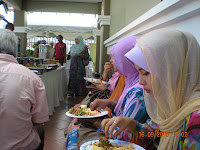
A Malay wedding reception

The JHEOA describes the Orang Asli (Orang Asal) here: Jabatan Hal Ehwal Orang Asli

The book by Isabella Bird, "The Golden Chersonese: Travels in Malaya" in 1879 is available online and is hosted by Digital Library at http://digital.library.upenn.edu/women/bird/chersonese/chersonese.html#IX.

There is mention of the people who make up the population in Malacca, Penang (Pinang) and Singapore at the time of her visit.


The Malays
She described the Malays as follows: "The people lead strange and uneventful lives. [....] They seclude their women to a great extent, and under ordinary circumstances the slightest courtesy shown by a European man to a Malay woman would be a deadly insult; and at the sight of a man in the distance the women hastily cover their faces.


Singapore Census 1881
For the Singapore census of 1881, the people were grouped as: Europeans and Americans, Eurasians, Chinese, Malays and other natives of the Archipelago, Tamils and other natives of India, and Other nationalities. The Arabs were not categorised with the Malays. Among the Europeans, the Germans were next largest after the British. It mentioned Manilamen instead of Filipinos.

Europeans and Americans     823
Eurasians     930
Chinese     32,194
Malays and other natives of the Archipelago     6,954
Tamils and other natives of India     637
Other nationalities     559

The European resident population, exclusive of the soldiers, is only 1,283. The Europeans comprise 19 nationalities, including the British (largest) and Germans (second largest).

The Chinese population is 86,766; the Malay, 22,114; the Tamil, 10,475; the Javanese, 5,881; and the Eurasian, 3,091.

"Malays and other natives of the Archipelago" included, Achinese, Boyanese, Bugis, Dyaks, Jawi-Pekans, and Manilamen.

"Other nationalities" included Arabs.

Settlement of Malacca Census 1881
The total population of the territory is 93,579 (52,059 males and 41,520 females), an increase in ten years of 15,823. The Chinese population has increased by 6,259 or 46.4 per cent., and the Malays by 11,264, or 19.3 per cent.

European 32 (23 males and 9 females)
Eurasian (mainly of Portuguese mixed blood) 2,213
Chinese 19,741 (4,020 being females)
Malay 67,488 (the females being 2,000 in excess of the males)
Tamils or Klings 1,781
Arabs 227
Aborigines of the Peninsula 308
Javanese 399
Boyanese 212
Jawi-Pekans 867
Other 174 (stray Achinese, Africans, Anamese, Bengalis, Bugis, Dyaks, Manilamen, Siamese, and Singhalese)

Natives of India 42%
Other nationalities 48.9%

The town of Malacca contains 5,538 houses, and the country districts 11,177. The area of the settlement is 640 square miles, and the density of the population 146 to the square mile; only twelve of the population are lunatics.

Penang Census
- there is mention -