Wednesday, 18 September 2013

Istana Negara Lama, Kuala Lumpur

2011 marks a turning point in Malaysia's royal records.

On 15 November 2011, the old palace in Kuala Lumpur, Istana Negara, ceased to function as a palace.

On 12 December 2011, the 13th YDP Agong Tuanku Mizan Zainal Abidin Ibni Almarhum Sultan Mahmud Al Muktafi Billah Shah (reigned as Agong 2007-2011) returned to Terengganu.

The Sultan of Kedah, Tuanku Abdul Halim became the 14th YDP Agong, and resided at the new palace from 2011 onward. The new palace is also located in Kuala Lumpur. The new palace was expected to be ready in 2008 (dijangka siap tahun 2008). The date of CF (Certificate of Fitness) of the new palace is unknown.

Source:
Faridah Abdul Rashid. 2012. Biography of the Early Malay Doctors 1900-1957 Malaya and Singapore. Published by Xlibris Corp., Australia. page 93.


HISTORY OF ISTANA NEGARA LAMA

Istana Negara Lama has an interesting history. It was a Chinese family mansion and residence owned by Mr Chan Wing, who hailed from Guangdong Province, China. Mr Chan Wing arrived in Malaya as a poor teenager in 1889. He struck it rich in the tin mining business, which boomed and made Kuala Lumpur and Malaya rich. Mr Chan Wing's business was where The Mines Resort City stands today. His other ventures was the Kwong Yik Bank. Among mega players and occupants of The Mines Resort City built-up area include (I maybe wrong though) Tun Dr Mahathir, Palace of the Golden Horses and the Sapura Group.

I can't recall the story of Mr Chan Wing's wives. Mr Chan Wing had altogether 22 children, the youngest being Dr Mubarak Chan Ching Cheung (79; born 1934) - a graduate from Cambridge University. The Chan Wing children are in fact bright and talented. From 1920 to date, 15 Chan Wing family members attended Cambridge University.

The mansion was built in 1928. The mansion's architect was the Swan and McLaren of Singapore, who also built other superb structures such as the Bok House (Bangunan Kediaman Bok or Le Coq D'or restaurant) in Jalan Ampang in 1929, and the Raffles Hotel in Singapore. Atypical and dissimilar to the Chinese shophouses commonly found in Malayan cities of the time and today, this mansion had a dining hall which could fit 10 tables for diners (if 10 diners sat at a table, the hall could host up to 100 diners at a time). All the Chang Wing family members lived at the family mansion as Mr Chan Wing wanted it his way.

The mansion and grounds are sited on a hillock, on 5.26 hectares of rolling slopes dotted with trees and shrubs, typical of large tracks of hilly terrain in Kuala Lumpur. The grounds is sited near to Sungai Klang. This is most unfortunate as when it poured during the monsoon season, the entire road by the palace grounds would be flooded.
I remember my father driving us in his car through a terrible flood by the palace in KL. I could die seeing the river gushing beside us and our Opel Rekod (old German car) practically floating while trying to drive through the flooded road. - Faridah Abdul Rashid
The rain adds to making the grounds quite interesting. There was a holding pond at the bottom of the grounds but which was filled to make the old palace.

There was an orchard on the grounds, as most Malayan mansions did. Who would't want to grow fruit trees when the grounds are fertile and the rain comes almost daily? Kuala Lumpur is very fertile and fruit trees grow well. I wonder what Mr Chan Wing planted and what happened to the excess fruits harvested. Did they reach the Chow Kit market (which is a bit far, I think).

In 1941, Mr Chan Wing's family had to abandon their mansion. Mr Chan Wing and a son arrived in Perth, Australia. The rest of the family escaped to India. World War II saw the Japanese occupying the mansion from 1942 to 1945 as its officers' mess (mes pegawai tentera Jepun). It is not known if any beheading was done at this mansion during the war. The Japanese Administration added an entrance gate, now the front entrance. The actual gate was at the back of the palace, one that fulfilled the Chinese feng shui for a good life.

After the war ended, the British Military Administration returned to rule Malaya from 1946 to 1951. The British wanted British rule in Malaya for good, called the Malayan Union. The Malayans (mainly the Malays) wanted self rule and the British out. Fighting ensued and Malaya was divided. Things were terrible and Malaya suffered from the Malayan Emergency from 1946 to 1960.
My family and I also went through the intimidating Emergency period and curfew. All walkabout and travelling had to end before dark. It was scary travelling past the rubber trees during that time as an ambush was possible, even in bright daylight. There was a lot of fear when darkness approached and the next town was still far away. Old cars can't travel as fast as today's super cars. I still have butterflies in my tummy when I recall the Malayan Emergency. - Faridah Abdul Rashid
The capital of Selangor was shifted from Kelang (Klang) to Kuala Lumpur. The Sultan Selangor's palace was also shifted to Kuala Lumpur. The old Malay palace remained in Klang. From 1952 to 1956, the Selangor State Government rented the Chinese mansion and it served as Istana Sultan Selangor till Tanah Melayu gained independence on 31 August 1957. In 1957 (Merdeka year), the mansion was sold to the Malayan Government and was upgraded to a palace, suitable for Malaya's first king - YDP Agong. This was our Merdeka palace, a source of 'independence' even though it was originally a Chinese residence. There were many renovations to the old mansion. In the post-Malaysia era, The Balairong Seri Utama (main conference hall) was added in 1980, 17 years after Malaysia was formed in 1963. Humble as the palace was, 13 kings had resided in it; the 14th king was the first to reside in the new palace.

Sources and external links:
  1. Mohd Bakri Jaffar & Dr. Azmy Morsidi. 2007. Untukmu Malaysia Sempena 50 Tahun Merdeka. 25000 km Menjejaki Warisan Kita. Himpunan Gezet Monumen dan Bangunan Bersejarah. pages 1-54 (Kuala Lumpur Ibu Negara).
  2. http://pelancongan-kini.blogspot.com/2013/02/old-istana-negara-opens-to-public-for.html
  3. Google Search results for Istana Negara Lama

ISTANA NEGARA LAMA 2013

Old location & name: Istana Clifford, Jalan Clifford (then renamed Jalan Sultan Salahuddin)
Today's location: Jalan Istana, Bukit Petaling, Kuala Lumpur

Many have not seen the palace up close nor been on its grounds or inside the palace. I have only passed by the main entrance gates twice or so but only saw the iron fence and golden gates, always wondering what's inside and what goes on inside. These photographs were taken by my eldest daughter, Nuraishah Bazilah bt Affandi.


JABATAN WARISAN NEGARA
www.heritage.gov.my

The Malaysian Heritage Department is housed in the old palace in Kuala Lumpur. It works closely with the national archives, Arkib Negara Malaysia.

Datin Paduka Dato' Profesor Emeritus Siti Zuraina bt Abdul Majid
(Pesuruhjaya Warisan)
JABATAN WARISAN NEGARA
Bangunan Pentadbiran
Istana Negara (Lama)
Jalan Istana
50460 Kuala Lumpur

En Amir bin Md Wal
(Pegawai Warisan)
JABATAN WARISAN NEGARA
Bangunan Pentadbiran
Istana Negara (Lama)
Jalan Istana
50460 Kuala Lumpur
Tel: 03-2260 9000
Fax: 03-2272 1392
Hp: 016-286 8586


MUZIUM DIRAJA

2013 marks another point in royal history.

Istana Negara Lama houses a royal museum. Muzium Diraja opened its doors to the public on Friday, 1 February 2013. The museum opens from 9 am to 5 pm daily. Entrance to the royal museum is free. Seven royal guards stand at the entrance gate to relive the atmosphere of a Malay palace.

External link:
http://blog.jmm.gov.my/2013/03/05/istanag-negara-lama-dijadikan-muzium-diraja/


KUALA LUMPUR vs. PUTRAJAYA 2013

The date of opening the royal museum coincides with two important events in Kuala Lumpur's history.   Kuala Lumpur was upgraded from Majlis Perbandaran to Dewan Bandaraya on 1 February 1972. The federal territory, Wilayah Persekutuan Kuala Lumpur, was born on 1 February 1974 - at this point, the federal territory ceased to be a part of Selangor and became an autonomous state (terkeluar dari jajahan taaluk Negeri Selangor). The Government's administrative offices have been relocated to Putrajaya. Kuala Lumpur now serves as a trade and commercial hub for Malaysia and the Southeast Asia (SEA) region.
Many old buildings of Kuala Lumpur are dilapidated. Some old areas of Kuala Lumpur are congested. Kuala Lumpur has lost much of its glamour and appeal. It is not the same Kuala Lumpur I used to like and looked forward to as a kid in the 1960s. Something is lacking in Kuala Lumpur today. Kuala Lumpur feels 'cold' and uninviting to the visitor. I think the 'soul' is missing even though Kuala Lumpur is more developed and looks modern. This is typical of all built-up modern cities I have visited. - Faridah Abdul Rashid

Kuala Lumpur Railway Station

The Kuala Lumpur Railway Station was built in 1910, replacing an older building on site. Above the railway station was the Station Hotel. My family and I happened to stay a few days at the Station Hotel while we were in transit and while we waited for our father to come down to Kuala Lumpur (probably from the north). We had sailed from Port Jesselton to Collyer Quay in Singapore, and taken the train from Singapore to Kuala Lumpur. It must be from the old train station in Singapore, not Woodlands but the other one, Tanjung Pagar, which is now closed down.

I remember the Station Hotel's black and white interior decor and the delicious meals. The place upstairs was spacious, clean, airy and bright, but a bit bare (luas dan kosong). I loved the place as a kid.

I was going though my grandfather's photograph collection and came across a small dirty photograph of the Kuala Lumpur Railway Station. It was probably in 1937, as most of his photographs were from that period, when he worked in Kuala Lumpur. His photograph of the Kuala Lumpur Railway Station is badly stained yellow and I had to clean both the photoprint before scanning. I will need to search for it again.

The Kuala Lumpur Railway Station building today is a bit different and doesn't look as attractive as before. It was the Kuala Lumpur Railway Station that pushed me into liking architecture for life but I never took up architecture as a major at any university. I only kept architecture as a lifetime hobby.

Only five of my relatives have had something to do with the railways:
  1. My granduncle Tan Sri Dr Abdul Majid's father worked in the repair section of the railway yard in Kuala Lumpur. He died of malaria during the war. 
  2. My uncle Pak Saleh worked as Chief Auditor at the railway office across from the Kuala Lumpur Railway Station. He is retired and has just moved to his new house in Sentul. 
  3. My aunt Esther (Jeffrey's mother) worked as an accountant in the railway office. She is retired and has recovered from heart surgery. 
  4. My mother's uncle was a 'train engine driver'; according to my mother, he had blue eyes and a pink face, he was pink. I think he was probably an albino guy. He was named Uncle Osman. 
  5. My maternal grandfather Dr Che Lah bin Md Joonos worked as a doctor at the Malayan Railway Administration after the war.


External links:
http://en.wikipedia.org/wiki/Kuala_Lumpur_Railway_Station
https://www.youtube.com/watch?v=96CUt-_i-kA

Sunday, 8 September 2013

Plague Fighter: Dr Wu Lien Teh


Dr Wu Lien Teh was born in Penang in the Straits Settlement on 10 March 1879. His father was a fresh immigrant from Taishan, China. His mother was a second generation Straits Chinese in Malaya. Her family originated from China. He had four brothers and six sisters.

He attended the Penang Free School in George Town. A high achiever, he won the prestigious Queen Victoria 'Queen's Scholarship' in Singapore, and went to the UK at age 17. He was admitted to Emmanuel College, Cambridge University in 1896. On record, he was the first Straits born Chinese in Malaya to study medicine at the University of Cambridge. He bagged all prizes and scholarships while he was at Cambridge University. He won the Cheadle gold medal for clinical medicine and the Kerslake scholarship in pathology. His undergraduate clinical years (usually years four and five) were spent at St Mary's Hospital in London.

He furthered his postgraduate studies at the School of Tropical Medicine in Germany and the Pasteur Institute in France.

After completing his studies in the UK, he returned to Malaya in 1903. However, the situation in British Malaya could not accommodate him. The British medical system in Malaya at the time could not accept him as he was not a British subject and non-British doctors could not hold any senior or specialist post within that system. Dr Wu Lien Teh instead researched on beri-beri at the newly opened Institute for Medical Research (IMR), Jalan Pahang in Kuala Lumpur, for four years (1903-1907). He finally quit and entered into private practice in 1907.

Opium was traded freely and used widely in Penang. The British provided opium to leper patients and miners. Dr Wu Lien Teh advocated the Chinese males to cut off their Manchu hair queue (long braided hair as pig tail). He opposed gambling and opium activities, including the opium trade. Dr Wu Lien Teh founded and served as President of the Anti-Opium Association in Penang. In his private medical practice, Dr Wu Lien Teh had possessed an ounce of opium tincture for treating his patients. However, when this opium tincture was discovered in Dr Wu Lien Teh's possession, he was charged and found wrong (guilty) which was untrue. His trial attracted worldwide publicity, including the Chinese Government.

He was invited by the Grand Councillor Yuan Shih-kai in Peking to take up the post of Deputy Director of the Imperial Army Medical College in Tientsin (Tianjin) in 1907.

[In 1910, Dr Sun Yat Sen led the revolution of 1910-1911 in China.]

In the severe winter of 1910, Dr Wu Lien Teh (aged 31) was requested by the Foreign Office in Peking to investigate why many patients died in Harbin, Manchuria. They had died of pneumonic plague. This pneumonic plague pandemic killed more than 60,000 victims in Manchuria and Mongolia. Dr Wu Lien Teh worked on the plaque problem in Mongolia and north China, requesting isolation of infected victims, compulsory usage of face masks, and the corpses to be cremated. The area covered 2,000 miles from north-western Siberian border to Peking. Cremation of plague corpses reduced the spread of plague till it was brought under control in 4 months. This was the first instance Chinese corpses were cremated and cremation continued to be a Chinese funeral tradition till today. His new scientific approach greatly prevented the killer disease from spreading.

It was a great success story and progress in Chinese medicine in China. Dr Wu Lien Teh received recognition as a plague fighter who helped saved thousands of lives in northeast China in the early
1910s following a plague outbreak. After the successful control of plague in Harbin, Manchuria and Mongolia, Dr Wu Lien Teh became world famous.

He chaired the International Plague Conference in Mukden (Shenyang) in April 1911. It was a historic event as many scientists from USA, Great Britain, France, Germany, Italy, Austria-Hungary, Netherlands, Russia, Mexico and China attended the conference.

Later in the same year, he presented a research paper on the plague at the International Congress of Medicine in London in August 1911. His paper was published in The Lancet in the same month (August 1911).

Dr Wu Lien Teh contributed significantly to the knowledge on plague and to humanitarian service for his community in China. He established the Manchurian Plague Prevention Service in 1912. With this foundation, he began to introduce major medical reforms, modernising China's medical services and medical education. During his 29 years of service in China (1908-1937), 20 modern hospitals, labs and research institutions were built, including the Peking Central Hospital. He was the first president of the China Medical Association (1916-1920). A medical reformer, he worked with the Russians during an epidemic in 1921. He was the director of the National Quarantine Service (1931-1937) in China.

He worked hard for the League of Nations and became a world authority on the plague.

The Japanese occupied China and the Nationalists retreated. Dr Wu Lien Teh's villa in Shanghai, China was bombed by the Japanese in 1937. Dr Wu Lien Teh left China and returned to the Malay peninsula.

After having worked in China for 30 years, Dr Wu Lien Teh eventually returned to Malaya in 1937. He worked as a General Practitioner (GP) at 12 Brewster Road, Ipoh (now Jalan Sultan Idris Shah). He provided free consultation and treatment for the poor.

With money collected from the public, he helped started the Perak Library (now The Tun Razak Library) in Ipoh to encourage young people to read.

His portrait was taken in Cambridge in 1956 when he was 77. He continued to work as a GP for 22 years till 1959; he was 80 years old. He then retired from medical practice and returned to Penang. He lived in his new Penang retirement home for a week before he died. He died from a stroke on 21 January 1960, aged 81.

Dr Wu Lien Teh was the first person to modernize China's medical services and medical education.
He is remembered for his contributions in promoting China's public health, preventive medicine and medical education. Bronze statues of him appear in departments and hospital buildings in Harbin Medical University and in Beijing. A museum is dedicated to him and contains his bronze bust. A road was named Jalan Wu Lien-Teh after him in Ipoh Garden South, Ipoh. A private housing named Taman Wu Lien Teh near the Penang Free School was named after him.

Until today, Dr Wu Lien Teh's accomplishment is still recognised at the Penang Free School which named one of its school houses after him, and bearing the green colour.

An International Symposium on him was held in Harbin, China on 18-20 January 2013. The symposium was organised by The First Hospital of Harbin Medical University in Heilongjiang, China with the third Boreal Congress of Cardiology. It was attended by delegations from Malaysia, Singapore, members of the Penang State Government, and investPenang, Penang Global Tourism, Penang Medical College, and members of the newly formed Dr Wu Lien-Teh Society, Penang. An 18-member delegation led by Datuk Dr Lee Kah Choon, headed to China to attend the commemorative symposium on the legendary plague fighter Dr Wu Lien-Teh who was born in Penang. Participants were from various organisations, medical professionals, private individuals and members of the Old Frees' Association.

A conference, 'Remember Dr Wu Lien Teh' was held at the Conference Room, Ipoh Specialiist Hospital (5th Floor) on Friday, 22 March 2013 at 8:00 pm to 10:00 pm.

A book authored by Dr Wu Yu-Lin contains 200 photos of his work on the plague and services rendered in China from 1908 to 1937.

His autobiography is entitled Plague Fighter: The Autobiography of a Modern Chinese Physician (Heffner, Cambridge, 1959).

Datuk Dr Anwar Fazal is the president of the Dr Wu Lien-Teh Society of Penang. The Society has proposed Penang as the next venue for the Dr Wu Lien-Teh and Global Health Symposium in 2014.

Dr Wu Lien Teh was nominated for the Nobel Prize in Physiology or Medicine in 1935. However, he did not win a Nobel Prize for the plague that he had battled in Manchuria and Mongolia.

His biography was presented at the Penang Story Lectures on 19 May 2012. Ong Lay Hong presented on "Plague Fighter Dr Wu Lieh-teh. A Penang Hero who modernized medicine in China". Ong Lay Hong is the Managing Director of Singapore Media Academiy, A MediaCorp Enterprise.


References

Quah Seng-Sun. 2012. Anything Goes blogspot. Accessed 6 Sept 2013.
http://ssquah.blogspot.com/2012/05/penang-free-schools-original-crest.html

Dr Wu Yu-Lin. 2013. Memories of Dr Wu Lien-Teh, Plague Fighter. Accessed 6 Sept 2013.
http://www.worldscientific.com/worldscibooks/10.1142/2773

Ipoh News. 2013. Perak Lecture "Remember Dr. Wu Lien Teh". Accessed 6 Sept 2013.
http://ipohnews.com/2013/03/perak-lecture-remember-dr-wu-lien-teh/

Rightways Technologies. 2013. Remembering a plague fighter from Penang, Dr Wu Lien-Teh. Accessed 6 Sept 2013.
http://rightwaysrichard.blogspot.com/2013/01/remembering-plague-fighter-from-penang.html

Wednesday, 4 September 2013

Tan Sri Syed Hassan Aidid (1916-1983)

Senator Syed Hassan Aidid was born on 20 September 1916 in Singapore. He married Sharifah Rahmah Aidid and had nine children. He was educated at Penang Free School in George Town, and at Green Lane. He was a successful diamond merchant and proprietor of the New Gold Co. He was the Chairman of UMNO Penang and Province Wellesley. He was the Director of Sri Negara Ltd. He was the Chairman of Warta Negara Press. He was on the Board of Governors at the St. Xavier's Institution, Jalan Ayer Itam. He was the Manager of the Ayer Itam English School and Sekolah Kebangsaan Ayer Itam (Malay stream). He was the Vice-Patron of the Penang AAA. He was also the Patron of Sepak Raga Association.


His last known home address was 11, Mk. 1A, Ayer Itam Road, Penang. The house is still extant. His last known telephone number in the early 1970s was 23422. His last known office telephone number was 61643.

Source of the above text and portrait: Who's Who is Malaysia 1971-1972.

---
[Update from Nazmi Hassan Razak, 18 Dec 2013: He died on the 28th of February 1983.]
---
Relatives often reminded me that his house was "rumah besar sebelah Shell Air Hitam". He had passed away on 28 February 1983. His youngest daughter and I were working at the USM Medical School in Penang. His eldest daughter was the Chairman of Persatuan Wanita USM and I was the Honorary Treasurer.

I remember entering this house to pay my last respect as they performed mandi jenazah on him before burial. The ladies and I were allowed to view him. I took a long look at his face because I wanted to remember him as I had never met him when he was alive. I still remember his characteristic nose. It was from this memory that I was able to search for his portrait at the USM library in Penang.

His house photos (below) were taken by me when I visited Penang on 6 December 2015

Going towards Bukit Bendera, Jalan Bukit Bendera in Air Hitam (main road).
Shell is the landmark to locate his house.
Approaching his house. View after returning from Bukit Bendera.
There is a junction after Shell and before his house.
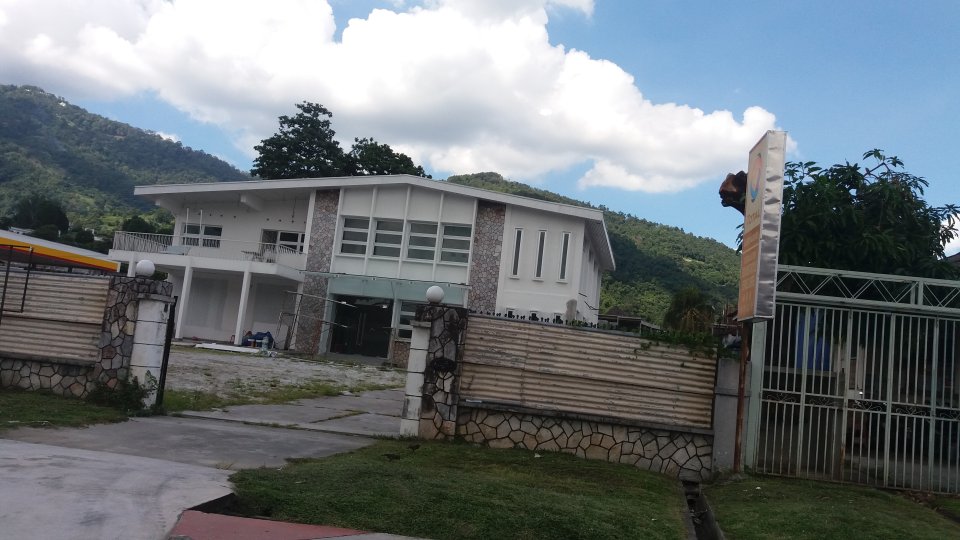
This is his house.  
The house was under renovation when I passed by and took photos of it on 6 December 2015.
---
Update from Syed Alwi Aidid, Singapore 2013:

Puan Sri Datin Sharifah Rahmah Aidid married to Tan Sri Datuk Syed Hassan bin Mohdhar Aidid (deceased 1982/1983). She is the elder sister of Sharifah Mariam bt Syed Alwi Aidid (Prof Syed Mohsin's mother). Puan Sri Datin Sharifah Rahmah Aidid passed away  on 31 May 2012 and is interred on 1 June 2012 at Masjid Perak Road cemetery in Penang. They have 9 daughters.
  1. Datin Dr Sharifah Mariam bte Tan Sri Syed Hassan Aidid married to Datuk Dr Adam Yee Abdullah @ Yee Thiam Sun. Their sons are Isa and Dr Ilias. 
  2. Sharifah Azizah Aidid married to Syed Taha bin Abdullah Sheikh Abubakar
  3. Sharifah Aminah Aidid (Singapore) married to Syed Salim Hassan Alkaff
  4. Sharifah Naemah Aidid married to Abdul Malik. They have 2 sons and a daughter.
  5. Sharifah Shipak Aidid married to Dr Razak Dali. They have 2 daughters and a son, Nazmi Hassan Razak.
  6. Sharifah Sheikhah Aidid married to Syed Ismail Al Wafa
  7. Sharifah Zahrah Aidid married to Roslie
  8. Sharifah Sakinah Aidid married to Dr Syed Mohamad Syed Sahil (Prof Syed Mohsin's brother)
  9. Sharifah Hasnah Aidid married to Prof Abu Hassan bin Abu Bakar. She had worked at the USM Medical School before, 1984-1990.
More at:
http://theearlymalaydoctors.blogspot.com/2013_03_31_archive.html
http://theearlymalaydoctors.blogspot.com/2013/07/dato-dr-yee-thiam-sun.html

---
Update from me, 28 February 2015:

Prof Abu Hassan bin Abu Bakar is at the School of Biology, USM in Penang. He was known as Danker and played the guitar when he attended UC Davis in 1976-1980, along with several others - Prof Musa Abu Hassan (deceased 1954-2015), Prof Mohamed bin Daud (UNISEL), Abdul Rahman, Mohd Shahrin, Harith Harun, Prof Zairi Jaal (Biology, USM; eldest brother of Zaiton Jaal), Prof Khadijah Mohd Salleh (deceased), etc.

---
Update from me, 4 September 2013:

My maternal grandfather's house was at 219 Solok Pemancar. He lived there and I was there for holidays in the early 1960s, before I went to school. Immediately across the road was a big old tree, underneath which some Indian devotees prayed, shook bells and chanted. My grandfather got irritated from the 'noise beneath the big tree' and sold his house, and moved further uphill. But I still like the house, even today. I can't recall what the interior is like anymore but I remember the tiled front entrance, and perimeter walls.
Amendment received from Wan Latifah (10 Sept 2013): I would just like to correct the post regarding 219 Solok Pemancar. This house was bought not by Tan Sri Datuk Syed Hassan Aidid but by his elder brother, my grandfather, Datuk S. M. Aidid. He lived in the house until he passed away in November 2007 at the age of 105.

Tan Sri Syed Hassan Aidid is a relative of my father. They are descended from the Sumatran Achehnese Arab people, Keturunan Aceh Peranakan Arab. They are related to the Sumatran Minangkabau people who opened the earliest Malay settlement in Penang at Kg Batu Uban, some distance from Universiti Sains Malaysia (USM). This settlement was opened by Nakhoda nan Intan @ Muhammad Saleh, an imam and sufi prince from Pagaruyuyng Palace. 

Nakhoda nan Intan's brother, Nakhoda Kecil and his people developed Tanjong Penaga, growing paddy (tanam padi), sugar-cane, coconut among other plants. Nakhoda Kecil went to greet and meet Captain Francis Light on the marshy shores of Tanjong Penaga (Cape Penaigre). Captain Francis Light and his people, and the first batch of Indian convicts developed the paddy fields, etc to become a city that we have today. This area became George Town, named after King George V or VI?

Penang did not lag behind in business and trade as in 1925, there was Dr Ali Othman Merican (Dr A.O. Merican) who helped founded the Penang Malay Association (PMA) which looked into Malay businesses, commerce, trade and industry. Dr A.O. Merican left Penang shortly after, in 1927, to go to Kelantan. He became a successful doctor in Kelantan.

At the time of Merdeka, there were few wealthy Malays in Penang, including those who had businesses going. The Malays were doing well on the island in the 1960s even though many Malays in the villages were poor - they were living at subsistence level (kais pagi makan pagi, kais petang makan petang). It should not surprise us because the Malays preferred a simple life and not run after worldly riches. We must accept this fact and not simply accuse the Malays of being lazy and unable to compete - they are living at their best and they are comfortable with life. It is us who are terrified by their simple way of life and want them to change. In the Malay style of living, rich Malays helped the poor Malays, even among siblings and friends. We actually do not have to change them. What we must worry about is the business-hungry people who want the poor Malays to give up their lands and lives. This we must prevent and put a stop to. Let the poor Penang Malays live as they wish - their landed kampung houses are worth millions today but all they want is a simple life in a wooden house - so just leave them alone, and let them be happy. If we want to help, we can, but by making good roads and drainage where the Malay kampungs are. Just don't force them to change. They are an extinct breed already. Tourists also want to see the real Malays in true Malay settings. Don't change anything but improve on the landscape and facilities.

The PMA is still managing well alongside many other bodies. The Malays must come together and work hard together if they are to remain on Penang island. They cannot just sit back and live. It will be sad if all the Malays on the island have to leave. I will be very sad, just sad as what happened to Singapore where many of my relatives still reside. Singapore is a rather sad story but we must try and save Penang while it is still ours.

The Penang Malays at Kg Sg Gelugor have an active cooperative and the poor villagers in the village get to own houses via this cooperative. So, there are means to help the poor Malays in Penang but the Malays themselves must learn about such existing opportunities and be actively involved in the developmental projects around or near them. They stand to benefit if they do things right and have a positive attitude. My mother benefited from the cooperative at Kg Sg Gelugor - she obtained a double-storey wooden house from the subscription money she paid to the cooperative. I don't know about other cooperatives in Penang. There is also now another active cooperative established by the historic Dato' Jenaton Group - this is a rapidly developing cooperative and worth investing in for the Malays.

---
Update from Nazmi Hassan Razak, 18 Dec 2013:

Nazmi Hassan Razak said...

Just would like to correct the year of death of my grandfather. He died on the 28th of February 1983 iso 1982.

18 December 2013 at 17:47  

---
Update: 28 Feb 2014
King's Birthday Honours for 505

Inche CM Hashim, Penang - Panglima Setia Mahkota
Syed Hassan Aidid, Penang - Johan Mangku Negara
Dr Abu Bakar bin Ibrahim, KL - Johan Setia Mahkota
Dr Ibrahim bin Haji Mohamed Yassin, Ipoh  - Johan Setia Mahkota
Syed Kabeer bin Syed Ahmad, Penang - Ahli Mangku Negara

---
Update from Syed Hazzwarri, 31 Jan 2015:

Syed Hazzwarri has left a new comment on your post "Tan Sri Syed Hassan Aidid":

Hope will have gathering of tok lid generation's a.k.a S.M Aidid. At solok pemancar for this coming aidilfitri. Look like rumah usang ready.. Aunty Latifah hope u can make it become true. Already celebrates 4 year Ami aidid house. This years year we celebrated over there. 

Posted by Syed Hazzwarri to The Early Malay Doctors at 31 January 2015 at 19:25

---
External links:
http://kudaranggi.blogspot.com/2006/12/isu-melayu-pulau-pinang-di-rtm.html

Monday, 2 September 2013

Obituary: Dr Ruby Majeed 1924-2013

I received news from En Amir Mohd Wal (Jabatan Warisan Negara) this morning that Datuk Paduka Dr Ruby Abdul Majeed has passed away. I don't have the details of her demise as yet. We are saddened by her passing. Al-Fatihah.


Datuk Paduka Dr Ruby Abdul Majeed

En Amir has shown my book, Biography of the Early Malay Doctors 1900-1957 Malaya and Singapore, to Dr Ruby's youngest sister, Datin Paduka Profesor Emeritus Zuraina Majid (Pesuruhjaya Warisan), and she is touched.


Dr Ruby bte Abdul Majeed's short biography is on pages 751-754 in my book.

Name: Dr Ruby Abdul Majeed
Date of birth: 6 November 1924
Place of birth: Kuala Lumpur
Medical studies in Australia: http://trove.nla.gov.au - malay girl doctor
Malay Girl Here To Become Doctor. (1948, April 13). The Daily News (Perth, WA : 1882 - 1950), p. 6 Edition: HOME. Retrieved September 6, 2012, from http://nla.gov.au/nla.news-article80799117
Qualification: MBBS 1959 University of Adelaide
Private practice: Clinic Drs Syed Mahmood & Ruby Majeed, Kuala Lumpur


This short (one A4-page or two 9"x6" tradebook-pages) biography below is taken from my other book,  Research on the Early Malay Doctors 1900-1957 Malaya and Singapore (Xlibris, 2012: pages 258-259).

43. Dr Ruby bte Abdul Majid

Dr Ruby is the wife of Dr Syed Mahmood bin Syed Hussain Jamalullail. Prof. Farida Jamal furnished the biographies of both doctors after consulting them.

Ruby was born on 6 November 1924 in Kuala Lumpur. The third of eight siblings, she grew up in the vicinity of the General Hospital Kuala Lumpur, across the road from the Institute for Medical Research (IMR). She watched the activities in her neighbourhood with great interest and dreamed of becoming a doctor, like the ones she saw walking to the hospital. She learnt many skills from her mother and relatives at home. She commenced formal schooling at Kampong Baru Malay School at age five and moved to the Bukit Nenas Convent in Kuala Lumpur at age seven. Upon completing the OSCE (Overseas School Certificate Exam?) in 1948, she proceeded to Australia for further studies. She graduated from the University of Western Australia, majoring in Zoology, and trained in Histology at the University of Melbourne. From 1952 to 1954, she taught Histology at the Faculty of Medicine, University of Malaya, in Singapore.

She married Dr Syed Mahmood in 1956. With the encouragement and support of her professor and head of the department, Ahmed Mohiuddin, she left for Adelaide, Australia, during the same year to study medicine. Her training and work at the University of Malaya was given recognition, and she was exempted from some courses. She graduated from the University of Adelaide as a medical doctor in 1959.

Upon completing her housemanship at the General Hospital, Penang, Dr Ruby Majeed was appointed Medical and Health Officer in Perlis. She founded and chaired the Perlis branch of the Federation of Family Planning Association of Malaysia and the Red Cross Association of Perlis. She also chaired the St John Ambulance, Perlis, and served as patron of the Perlis Girl Guides Association.

Dr Ruby Majeed moved to Kuala Lumpur in 1967 and set up private practice in the MARA building, Jalan Tuanku Abdul Rahman. Dr Syed Mahmood joined her two years later.


She was a Fellow of the Royal Australian College of General Practitioners (FRACGP), which was awarded by the Australian College of General Practitioners. Together with a group of dynamic doctors, she strove to get general practice registered as a medical specialty in Malaysia. The Academy of Family Physicians (formerly known as the College of General Practitioners) was established, and from 1980 to 2002, she served as the president of the College of General Practitioners/Academy of Family Physicians. She was invited to sit on several committees of the Ministry of Health, Malaysia, subcommittees of the Malaysian Medical Association (MMA), and committees of the Private Medical Practitioners Association of Selangor, where she served as president for one year. She also served as the treasurer at MMA Foundation for four years.

Her passion for education resulted in her involvement in teaching and curriculum development in Family Medicine at the University of Malaya and Universiti Kebangsaan Malaysia (UKM). In the 1990s, she also served as an adjunct professor in Family Medicine for four years at the Faculty of Medicine, UKM. Throughout, she worked as a general practitioner. Dato’ Paduka Dr Ruby bte Abdul Majeed is noted for her dedication, determination, sincerity, honesty, and integrity. A good listener, she is much more than a giver of health care to her patients and is always willing to help people in need. She is dearly loved and admired by her large, extended family and her many friends.


From me: It will be great if we can expand and make her biography a more complete one.

Contact for Jabatan Warisan Negara:

Amir Md Wal
016-286 8586

JABATAN WARISAN NEGARA
Bangunan Pentadbiran
Istana Negara (Lama)
Jalan Istana
50460 Kuala Lumpur
www.heritage.gov.my

No. Tel : 03-2260 9000
No. Faks : 03-2272 1392

Wednesday, 28 August 2013

The Merdeka Story

Everyone aged above 55 today knows and remembers Merdeka. We sang the Merdeka songs as kids in the early 1960s and 1970s. We hardly worried about life. We had no worries. We were happy kids.

What was Merdeka about? When did it begin? Where did it happen? What actually happened? Why were we called British Malaya? Why were were called Tanah Melayu? Why were we called Persekutuan Tanah Melayu? What is the Federation of Malaya? Why did we have the Unfederated States? Why are we called Malaysia today? When did we become Malaysia?

Are we patriotic enough? I don't know. We have a national flag (Jalur Gemilang) and a national flower (Hibiscus/bunga raya). We have a national animal (tiger). Do we have a national bird? Do we have a national staple? Do we have a national menu, meal or dish? Do we have a national attire? We have a national language (Bahasa Malaysia/Bahasa Melayu). We have a national logo for our airlines (wau bulan). We have a national airlines (Malaysian Airlines System, MAS). We have our own curreny (Ringgit Malaysia and sen). We have our own banking system, judiciary and education system. We are a fortunate nation.

What does Merdeka mean? It means digging for old photos for me, and trying to understand what happened at Stadium Merdeka that 31 August morning. It means I must revise and read about what Tunku did for our country. It means I must also understand all the people and factions who helped contribute to our independence. 

What is independence? Why do we need independence?

Independence means we get to do things our way, our Malaysian way.

We have much resemblance to the others in this region. We are very similar to the Indonesians who are all around us. We are similar to the Thai Malays who are above us. We are similar to the Filipino Malays who are at 2 o'clock from where we are. We have ties to many Singaporean Malays who are below us on an island. If we combine all the Malays in this region, we are a large mass.

Back to our Merdeka story, what have I got to share in this post? I have some old photos in my harddisk. I probably downloaded them without making note of where I obtained them. I also have a set of photos my late father took at Stadium Merdeka in Kuala Lumpur on 31 August 1957. I wasn't born yet at the time of Merdeka. Merdeka was first proclaimed in Bandar Hilir, Malacca. We have had good prime ministers so far. We had about 55 Malay doctors at Merdeka; my maternal grandfather was one of them. 


Independence documents in London 1953 - 1956:


The first King (Agong) and Prime Minister (Perdana Menteri) 1957:


Malaysia's Prime Ministers 1957 - 2013:

First Prime Minister: Tunku Abdul Rahman Putra Al-Haj
As 1st PM: 31 August 1957 - 22 September 1970.Political party: UMNO. He also created PERKIM.
Born 8 February 1903 - died 6 December 1990 (aged 87).

Second Prime Minister: Tun Abdul Razak bin Hussien
As 2nd PM: 22 September 1970 - 14 January 1976.
Political party: UMNO (1953-1976). He created Buku Hijau.

Born 11 March 1922 - died 14 January 1976 (aged 53)
(suffered from leukaemia)

Third Prime Minister: Tun Hussein Onn
As 3rd PM: 15 January 1976 - 16 July 1981.
Deputy PM: 13 August 1973 - 15 January 1976.
He created the Eye Bank.

Political parties: Independent 1987-1990; UMNO before 1951; 1968-1987; National 1963-1968.
Born 12 February 1922 - died 28 May 1990 (aged 68).


Tun Dr Ismail bin Abdul Rahman
Deputy Prime Minister 22 September 1970 - 2 August 1973.
Political party: UMNO
Born 4 November 1915 - died 2 August 1973 (aged 57).
He was one of the 55 early Malay doctors before Merdeka.
An early Malay doctor from Johor; 3rd Malay doctor from Johor.

Fourth Prime Minister: Tun Dr Mahathir bin Mohamad
As 4th PM: 16 July 1981 - 31 October 2003.
As Deputy PM: 5 March 1976 - 16 July 1981.
Longest term as prime minister in Malaysian history (22 years).
Political party: UMNO
He created Islamic banking, Tabung Haji, the OIC and Putrajaya.
He is one of the 55 early Malay doctors before Merdeka.

Fourth Malay doctor from Kedah.
Born 10 July 1925 (registered date 20 December 1925)

Fifth Prime Minister: Tun Abdullah bin Ahmad Badawi
As 5th PM: 31 October 2003 - 3 April 2009.
As Deputy PM: 29 January 1999 - 31 October 2003.
Political party: UMNO.
He portrayed an Islamic image for Malaysia.

Born 26 November 1939.


Sixth Prime Minister: Dato' Seri Mohammad Najib bin Abdul Razak
As 6th PM: 3 April 2009 - 2 April 2013; 2013-2017.
Deputy PM: 7 January 2004 - 3 April 2009.
Menteri Besar Pahang: 4 May 1982 - 14 August 1986.
Born 23 July 1953.


Proclamation of Independence Memorial in Melaka (Malacca):


MEMORIAL PENGISTIHARAN KEMERDEKAAN

Memorial Pengistiharan Kemerdekaan dinamakan sedemikian kerana pengumuman kemerdekaan Tanah Melayu dilakukan oleh Perdana Menteri Malaysia yang pertama, Al-marhum Tunku Abdul Rahman Putra Al-Haj di Padang Panglima yang terletak di seberang jalan memorial ini. Bangunan usang yang menjadi tarikan ini kini menempatkan butir-butir sejarah perjalanan negara ke arah mencapai kemerdekaan. Peminat sejarah juga boleh menyaksikan tayangan filem rencana mengenai peristiwa-peristiwa penting dalam sejarah kemerdekaan negara di pawagam kecil.

PROCLAMATION OF INDEPENDENCE MEMORIAL

The Proclamation of Independence Memorial is so named because the attainment of Malaya's independence was announced by Malaysia's first Prime Minister, Tunku Abdul Rahman Putra Al-Haj, at Warriors Field just across the road. This quaint old building now houses an exhibition that traces the history of the nation's convoluted journey to independence. History buffs should note that films documenting the highlights of the nation's independence are regularly shown at the theatrette.


(There is a photo of Tunku in a car, being driven around the Malacca Padang. I showed the photo in my class but my medical students did not know nor recognise Tunku at all. I have to search for the photo.)


At Stadium Merdeka, Bukit Petaling in Kuala Lumpur on Saturday, 1 August 1957 (it was drizzling). These photos are from my late father's collection. The original photos were small, dark and vague. I edited the photos using Zoner Photo Studio 15:

That's what my father wrote on the back of each photo below.

There was a post-Merdeka Parade in Bandar Hilir, about a month or so after Merdeka. I have to search for the photos and create another post. 

Tuesday, 27 August 2013

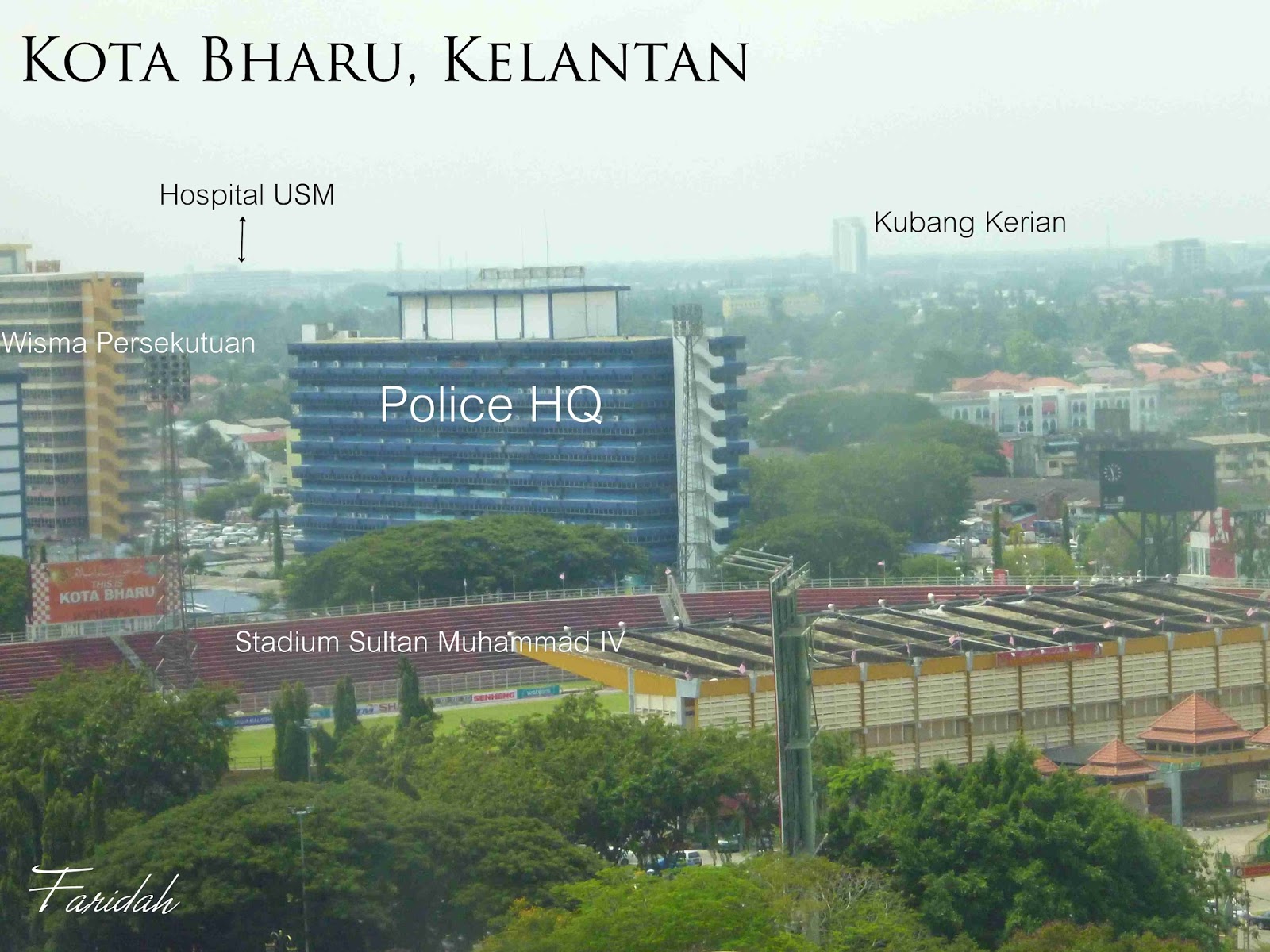
Aerial Views of Kota Bharu, Kelantan

Some of you may want to visit Kelantan. Kelantan is very quiet during school days and very hectic (worse than KL) during school holidays. Don't come to Kelantan during school holidays because the roads are congested and the shops are filled with holiday shoppers. Come during non school holidays and you will be 'King of the Road', and getting around is rapid and shopping is easier. You waste less time on the road and get more things done. You get less headache and normal heartbeat. We have 2 flyovers now to help curb traffic jams. Parking is a problem in Kota Bharu and here the town officers clamp tyres and you have to pay a fine to get your car back. Despite all the unpleasant episodes, Kota Bharu still remains a tourist town. There is a continuous flow of tourists to this unique characteristic old Malay city. It still remains the 'Cradle for Malay Learning' and will always be. Many students come here from Thailand, China, Vietnam, Laos, Cambodia and the Philippines. The teachers comes from Egypt, Saudi Arabia, Jordan, etc. The students mainly study the Quran here at the many Islamic schools and pondoks. Life is very quiet in Kelantan. I have lived here as a little girl, as a teenager, most of my adult teaching life, and now in my middle-age. I have lived in Kelantan for about 33 years. I am not a Kelantanese but I like it here in Kelantan. It is very quiet - I don't hear dogs bark at all. I see only cats, goats and cows. We get soft Australian beef and mutton in Kelantan. We get fresh vegetables and fruits from Thailand and Cameron Highlands. We have a lot of fruit juices, just about every type, including apple juice, soursop juice, mangosteen juice, etc. Internet speed is also faster than in Klang Valley (I think the fastest in Malaysia). That's why I can upload a lot of photos (even though some readers have complained). I will move most of the photos from my blog to my Facebook later.

My husband and I went up to the 11th floor of the Tabung Haji building in Kota Bharu. I took some snapshots of whatever I could see from a tall narrow window that was shut and had an iron grill. My camera is small enough to slip through the grill. But I had difficulty focusing as when the lens tube expanded, there was no room to fit the camera, and it was awkward holding the camera in such a small space and yet try to focus or turn the camera properly. I managed to get some photos. Some shots are not so good. 

We then went to talk to Encik Amri bin Husain in the Tabung Haji office on 9th floor (he will be shifting office soon). He is in charge of the Hajj pilgrimage for Kelantan sector. I informed him that I am only doing Hajj history and I don't belong to the USM Hajj Research Cluster which only does clinical research. He loaned us 2 Tabung Haji reports for my research on the Hajj pilgrimage. He said to make copies and to return them as they are the only originals his office has.

We then headed down to have capati at the nasi biryani shop, our usual hangout when we go to Kota Bharu. The nasi biryani shop is in front of the parking lot in one of the photographs. Nasi biryani is RM7.90 per serve or package. Capati is 80 sen a piece - we shared 3 pieces and each had a tall glass of sweet fresh orange (RM2 per glass). We bought 5 packs nasi biryani for the house and for Affandi's mother at the pondok in Terusan, Pasir Tumboh.


This is the hockey field where I played for my school, Zainab Secondary School. This one is covered with artificial turf; we played on natural grass on hard ground in 1971.


There are 2 bridges on Sg Kelantan, and they lie side by side. The older bridge is nearer the camera. The newer bridge is on the other side (TESCO side).
Kg Gajah Mati is Affandi's village. He was born there. It was a royal Malay village in history. It is just a slum today.
The building with the 3 domes is a shopping arcade. They sell a lot of textiles here.
The few high rises in Kota Bharu. From left: Billion Shopping Centre and Renaissance Hotel, Kelantan Trade Centre, and new Perdana Hotel. I don't know the last high rise but it is in front of the State Secretariat. Looking southwest.
Nasi biryani shop is the one with the red roof and near the trees (parking lot).
Looking northwest.
Looking west
Looking southwest
Looking south-southwest