Saturday, 3 August 2013

Penang

International Conference:

Penang and the Hajj, 17-18 August 2013
The E&O Hotel, George Town, Penang, 9am-5pm
E&O Hotel
Register before 9 August 2013
More at:


Penang Heritage Trust (PHT)

Contact Us:
Penang Heritage Trust
26 Church Street (26 Lebuh Gereja)
George Town
10200 Penang
Malaysia
info@pht.org.my
Tel: +604 264 2631
Fax: +604 262 8421
GPS Coordinates: 5.417915, 100.341557


Good photos of Penang & Miscellaneous:

Photos & text by iGeorgetown

Photos by tourists
http://www.worldisround.com/home/brecky/penang/index.html

Masjid Kapitan Keling
http://www.penang-traveltips.com/kapitan-keling-mosque.htm

Penang hospitals
http://www.penang-traveltips.com/penang-general-hospital.htm

Penang Global City Centre (PGCC)
http://en.wikipedia.org/wiki/Penang_Global_City_Centre

Penang Monthly Archive
http://penangmonthly.com/archive/

Penang foundation stone at Northam Road, George Town. The state name Penang comes from the Malay word buah pinang (refers to the areca nut) but just the word pinang suffice, and becomes Penang. The island once had many areca nut palms which preferred the well-drained hilly and sandy soil and salty sea breeze for optimum growth.
The 1918 influenza, plague and cholera almost decimated the inhabitants of Penang. This scene was along Weld Quay, where junks and medium-small ships came to berth right at the waterfront. The presence of an electric tram indicates 1904 onward. Bullock carts were the main mode of transport.
Batu Ferringhi beach, in North Beach and in north bay ... a place where the Portuguese landed in Penang - could be before 1511, before they attacked Malacca in 1511. The Malacca people called them Orang Peringgit. In Penang, Ferringhi could be an Arab word since there is no letter P in Arabic. Ferringhi could also be derived from the Tamil word Ferringhiar or similar.
Old shophouses and godowns at Ghat Lebuh Aceh in George Town, Penang. These are now dilapidated but some have been restored and are in use.
KOMTAR, once the only landmark of Penang. Now we also have the Penang Bridge. 
KOMTAR occupies the former site of the Chowrasta Malay School (before relocation to Jalan Hatin/Hutton Lane).
Indian cloth shop in Little India, George Town in Penang
Masjid Jamek Melayu Aceh, George Town in Penang
Masjid as above
The Quran School at Masjid Jamek Melayu Aceh, which evolved to become the famous Al-Mashoor School we have today.
Masjid Kapitan Keling, built in 1802 on the land of Kapitan Keling, an Indian Muslim headman and mosque founder Cauder Mohideen (Kader Mydin), who endowed his land (waqf land) for Muslim usage (tanah wakaf).

Fort Cornwallis

George Town as a capital city

The Malays called the city Tanjong Penaga after the large hardwood trees that grew aplenty here. The British called it Cape Penaigre and mapped it as such in early maps of Penang. This was initially renamed after the ruling British monarch and was spelled as George Town, then as Georgetown, and now we are reusing the initial spelling, George Town, and sometimes initialled as G.T.

Fort Cornwallis as a non economical and wasted British fortress

Fort Cornwallis is a British fort in Penang at Tanjong Penaga. It was made partly using the blasted remains of the Malacca fort, A Famosa. The fort is not so high but high enough than the average Malay man. It is not that imposing or scary and does not make the hair stand. It is quite a benign fort, and looks neat in place.

The main entrance to the fort faces the padang. There is an amphitheatre in the centre which was built later, and the walls all round the fort have an earthern platform (ramparts). The convict cells are on ground level and are nearest the clock tower and Light Street. The chapel is at the corner nearest the court building outside. There is an access door at Fort Road, and another small access door facing the Esplanade - they were probably for bringing in convicts or goods, or getting rid of the dead in the secrecy of the night. There are a few wagons and big wagon wheels on display inside the fort.

Francis Light had the fort built without first obtaining consent from Lord Minto in India. Francis Light went ahead to have the fort built by the newly arrival of Indian convicts. He did not wait for Lord Minto's reply to his request. He was impatient and disregarded company rules when he built the fort. Even after the fort was ready and Lord Minto visited to see the fort for himself, he thought is was a waste of money of the East India Company coffers. Lord Minto was displeased with Francis Light and the fortress.

Francis Light and his mistress Martina Rozells lived in a house near Church Street before moving to another house whose grounds are now occupied by the St Xavier's Institution. Suffolk House is further up on Ayer Itam Road, beside the Methodist Boys' School (MBS), and close to the Al-Mashoor Boys' School. Francis Light and Martina Rozells had five children, including William and Mary. William resembled his father; Francis Light's statue is actually that of his son. This was because there was no photo of Francis Light when his statue was to be made, and sculptors had used his son's photo to create the father's statue.

After Francis Light died of malaria on Penang island, Martina Rozells remarried to another English man. The wedding took place in the chapel inside the fort. It was the first marriage there.

Francis Light is interred at the Christian cemetery at Northam Road in George Town, quite close to the sea. There are various graves here. Francis Light's cuboid grave bears his name. Most of the graves here are run down and uncared for.

Seri Rambai the Dutch VOC canon

An elaborate Dutch VOC canon is also present at one corner of the fort, nearest the Esplanade and Town Hall. There are Jawi inscriptions on the Dutch VOC canon. I tried to decipher but can't get the story right. If I understand it right - it seems that the Dutch VOC canon was gifted (menghadiahkan) to the Malay sultan (Maharaja Sri Sultan) and his warriors (panglima). But who was the sultan then in Malacca during Dutch VOC era? Were the Dutch communicating with any of the Malay sultans?

Why was the name Seri Rambai given to the Dutch VOC canon? Buah rambai is a tropical fruit and the fruits appear in clusters. The buah rambai flesh is see-through - like fetus in amniotic fluid! Yes, they look like fetus in amniotic fluid!
Meriam Seri Rambai - a beautiful Malay name for the Dutch VOC canon
The Seri Rambai Dutch VOC canon seated solo, facing North Beach and North Bay, Penang, which opens beyond to the vast Indian Ocean, and Thailand, Burma and northern India.
Affandi tried to decipher the Jawi inscription on Seri Rambai, the Dutch VOC canon
Seri Rambai, the Dutch VOC canon at Fort Cornwallis in Georgetown, Penang; did it come from A Famosa in Malacca?
VOC emblem on the 17th Century canon, Seri Rambai - this is such a beautiful canon.
Mysterious Jawi inscription on the Dutch VOC canon. The bigger story behind the Jawi inscription tells the canon was gifted to the Sultan of Johor and was brought to Batavia in Java. It was to be brought back to Malaya when the Johor ship carrying the canon ran aground in the Straits of Malacca. The canon was later recovered by the British and was laid here at Fort Cornwallis. There maybe other versions of this story.

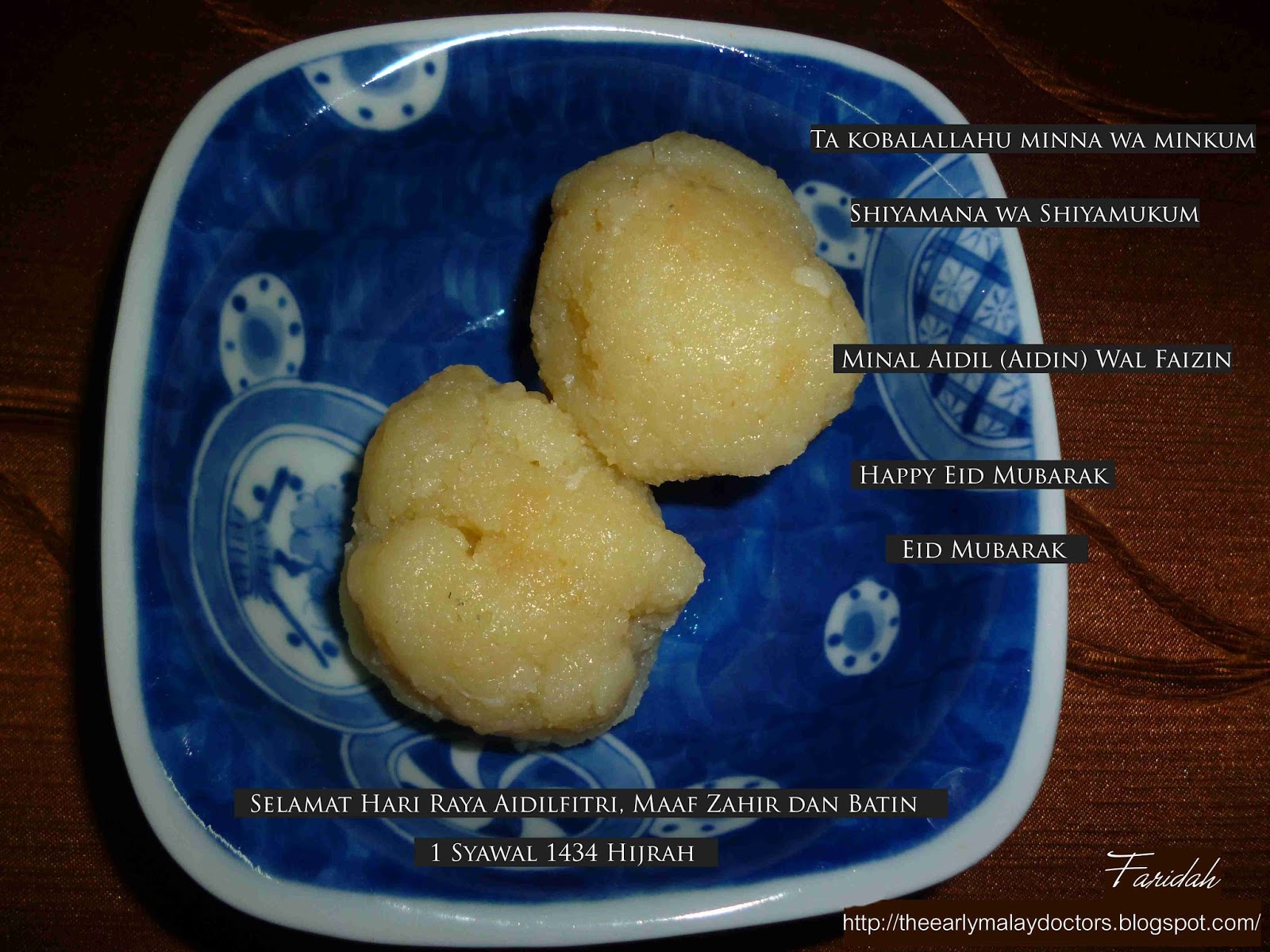
Salam Aidilfitri 1 Syawal 1434 Hijrah


Note:
  1. The greeting "Ta kobalallahu minna wa minkum" was what Nabi Muhammad SAW said.
  2. The greeting "Shiyamana wa Shiyamukum" was a friend's response to what the Prophet said.
  3. The greeting "Minal Aidil (Aidin) Wal Faizin" is commonly heard from the Indonesian Muslims.
  4. The greeting "Happy Eid Mubarak" or "Eid Mubarak" is commonly used in English worldwide.
  5. In Malaysia, we commonly greet with "Selamat Hari Raya Aidilfitri, Maaf Zahir dan Batin". Aidilfitri must be emphasized since it is about being 'born again clean without sins' and it is different from Aidiladha which is about sacrifice. "Maaf Zahir dan Batin" means "Forgive me physically (physical self and actions) and emotionally (soul and actions)". With this greeting, it is thought that the person has asked for total forgiveness and thus purifies himself from all wrongdoings to the person he greeted. 
  6. This is the English version of the Arabic doa, which I learned from Dr Syed at Um Qurra University, Madinah, Saudi Arabia and edited a bit: I would like to wish every Muslim a very warm and happy Eid. May Allah SWT accept all our good deeds performed in the Holy month of Ramadan and continue to bless all of us with His infinite blessings. InsyaAllah. Amin.

All these greetings support peace among the Muslim mass (Ummah).

Friday, 2 August 2013

Floral Tea Mansion

Galeri Warisan Melayu Pulau Pinang
Penang Malay Heritage Gallery
138 Hutton Lane, Penang


I hope to display some of my work on The Early Penang Malay Doctors at this gallery, with the help of Jabatan Warisan Negara. Please come and visit this gallery when it opens.

Update 17 December 2013:
Unfortunately the gallery is still not ready by December 2013 and the roof needs repairs. It is hoped that the gallery will open in March 2014.

Update 2 May 2014:
En Muhammad b Wal wrote that he has moved department in the ministry, and someone else is taking over from him. The new person will let me know when the gallery will open.

Update 9 May 2015:
I still have no update on the display in this gallery.

External links:
http://ryankai1989.blogspot.com/2013_07_01_archive.html
Rumah Teh Bunga

Tuesday, 30 July 2013

Indonesian Independence

Proklamasi

The Proclamation of Indonesian Independence (Indonesian: Proklamasi Kemerdekaan Indonesia, or simply Proklamasi) was read at 10.00 a.m. on Friday, August 17, 1945. The declaration marked the start of the diplomatic and armed-resistance of the Indonesian National Revolution, fighting against the forces of the Netherlands and pro-Dutch civilians, until the latter officially acknowledged Indonesia's independence in 1949. In 2005, the Netherlands declared that they had decided to accept de facto 17 August 1945 as Indonesia's independence date.

The document was signed by Sukarno and Mohammad Hatta, who were appointed President and Vice-president respectively the following day.

Source:
Wikipedia http://en.wikipedia.org/wiki/Proclamation_of_Indonesian_Independence

Logan Heritage

According to retired Professor Suryadi Samin from Riau Province, Indonesia, the name "Indonesia" itself was coined by James Richardson Logan, a British lawyer based in Penang. 

In Penang history, Logan sided with the locals and often assisted them. Once he helped a local win a lawsuit against the East India Company.

A building complex at Beach Street was recently restored and is named Logan Heritage in his honour. Logan Heritage is separated from Standard Chartered building by Union Street. Both open onto Beach Street.

Dato' Dr Yee Thiam Sun

Datin Dr Sharifah Mariam bt Tan Sri Syed Hassan Aidid is married to Dato’ Dr Adam Yee Thiam Sun and their sons are Isa and Dr Ilias. 

Dato' Dr Adam Yee Thiam Sun, the St John Ambulance of Malaysia (SJAM) Penang State Commander, was conferred the Darjah Yang Mulia Pangkuan Negeri (DMPN) by the Penang State Governor in conjunction with TYT Yang di-Pertua Negeri Pulau Pinang 74th birthday on 14 July 2012.[1,2]

Isa Dato’ Adam Yee is the Chief Executive Officer at CRUiSE GPS Systems Sdn. Bhd. 

Dr Ilias Yee is the Clinical Coordinator at the Centre of Excellence for Research in AIDS, University Malaya.

[1] The Council of Dato' Dato' State of Penang (Majlis Dato' Dato' Negeri Pulau Pinang) http://www.datopenang.org/congratulations.php Accessed 30 July 2013

[2] http://www.thestar.com.my/News/Nation/2012/07/14/Chief-Justice-heads-Penang-honours-list-of-1138-people.aspx


From the Sun Yat Sen Museum in Penang:
http://www.sunyatsenpenang.com/?page_id=151
Dr. Sun Yat Sen first arrived in Penang on 19 July 1910. Five days later, on July 24 he wrote to his revolutionary partner Huang Xing mentioning that he will stay in Penang for 3 or more months, and move the Nanyang Tongmenghui Headquarters from Singapore to Penang. As a result of this strategic move, Dr. Sun Yat Sen was able to convene the “Penang Conference” in 1910 and organize the planning of the Canton Uprising and China Revolution.
One hundred years later, our Organizing Committee, chaired by Dr. Yee Thiam Sun (chairman of Min Sin Seah) was able to organize from July 23 to 25 2010, a series of activities at the Sun Yat-sen Memorial Hall, such as the Road To Dawn Charity Premier, Malaysia Cultural & Tourism Promotion, The “Penang Conference” 100 Years Historical Gallery as well as a Cultural Excursion around Taipei. With this, we have kicked off Sun Yat Sen’s “Penang Conference” Centennial Celebration in Taipei. [3]
[3] See more at: http://www.sunyatsenpenang.com/?page_id=151#sthash.bbUGEBkc.dpuf

From Kuda Ranggi blogspot:
There is mention of the Aidid family, Tan Sri Syed Hassan Aidid, and where he had lived, and Isa's marriage held at the LUTH complex in Bayan Lepas, Penang.
http://kudaranggi.blogspot.com/2006_02_01_archive.html

From Pusat Sejahtera USM, Penang:
Pusat Kesihatan di USM dikenali sebagai Pusat Sejahtera USM. Pusat ini diketuai oleh Pengarah pertamanya Dr Azizi Aiyub Ghazali (1973-1989; 16 tahun). Seterusnya diterajui oleh Dr Sharifah Mariam Syed Hassan Aidid (1989-2003; 14 tahun). Kini Pusat ini dipimpin oleh Dr Nurulain Abdullah Bayanuddin (2003-2013; semasa). Pusat ini  telah disambung ke rangkaian E-Klinik pada 1999 dan kini mempunyai seramai 66 orang staf.

Contact Us:
Pusat Sejahtera (Kesihatan & Pergigian)
11800 Universiti Sains Malaysia
Pulau Pinang, Malaysia
T: +604 - 653 3888 ext: 4937 / 4938
F: +604 - 653 4942
E: dir_pk@usm.my

Pusat Sejahtera USM Penang

Monday, 29 July 2013

Mencari Bako

Mencari Bako (1983) is written by Abdul Aziz Ishak. http://id.wikipedia.org/wiki/Aziz_Ishak I bought the book at the 6th family reunion at Vistana Hotel, Penang on 2 June 2013. Mencari Bako explains that Dato' Jenaton and Dato Setia are brothers.


Abdul Aziz bin Ishak, author of Mencari Bako
In a family tree sheet (Silsilah Keluarga) that was given to me by Tok Chu in 2013 (see earlier post on Tok Chu), I understand that Dato' Jenaton married the sister of Dato Setia. If that is true, how can Dato' Jenaton and Dato Setia be brothers?

Dato Setia is Dato Setia Payakumbuh, way back in Pagarruyung in the highlands of West Sumatra. They were cousins, and not brothers. As I understand it, Ismail @ Nakhoda Kecil, Haji Muhammad Saleh @ Nakhoda Nan Intan, Dato'Setia Pagarruyung, and Gadih Suri were siblings. They were cousins of Dato' Jenaton. Dato Jenaton then married Gadih Suri as his first wife. He then married 2 more, one at Batu Bara and another in Penang - Sharifah 'Aini (a Penang-Arab). Sharifah 'Aini had 4 children - Abdullah, Muhammad (died early after marriage), Hamidah and Fatimah. All of Sharifah 'Aini's children married and had children.


KETURUNAN ABDULLAH BIN DATO' JENATON

According to Mencari Bako, Abdullah had a son named Ahmad. Ahmad merajuk (sulked) and went away to live in Terong (Trong) in Perak. He was a good marksman and knew every inch of his farm. He shot deers on his farm (kebun), and then sembelih according to Islamic rites, and had rendang rusa.

Ahmad bin Abdullah bin Dato' Jenaton was Abdul Aziz's paternal grandfather. 

From the book, Dato' Jenaton. Catatan Salasilah Keluarga Melayu di Malaysia dan Indonesia (2013) by (Prof.) Ahmad Murad Merican:

Ahmad bin Abdullah bin Dato' Jenaton had 7 children: 1. Haji Alias 2. Harun (deceased) 3. Mahmud/Mohamad 4. Ishak 5. Kalsom 6. Rapiah, and 7. Sulaiman.

Ishak bin Ahmad bin Abdullah bin Dato' Jenaton married Aishahtun/Aishah Tun bt Haji Aminuddin (Taiping, Perak), and had 9 children: 1. Yusof/Yusoff (first President of Singapore) 2. Laili Zubaidah 3. Abdul Aziz (author of Mencari Bako) 4. Laila Latifah 5. Salbiah 6. Ramli 7. Zohara (author of another family book due out at end of 2013) 8. Abdul Rahim, and 9. Alma Azizah.

Abdul Aziz bin Ishak married Wan Shamsiah bt Pawanteh (Pengurus Utusan Melayu Cawangan Kuala Lumpur), and they had 5 children: 1. Rahmah 2. Zakaria 3. Zabidah 4. Zulkifli, and 5. Zahrah.

Abdul Aziz bin Ishak
Abdul Aziz Ishak's eldest brother, Yusof bin Ishak https://en.wikipedia.org/wiki/Yusof_bin_Ishak was the Managing Director of Utusan Melayu in Singapore, before he (Yusof) became the first President of Singapore. 
Yusof bin Ishak

Tuesday, 23 July 2013

Conference Call and Public Lecture

1. Conference:
CONFERENCE on PENANG AND THE HAJJ, 17 & 18 August (Saturday & Sunday), 9.00am-5.00pm at E & O Hotel.

2. Public lecture:
PENANG STORY LECTURE, Keynote Lecture: The Material World of the Hajj in Colonial-Era Southeast Asia by Eric Tagliacozzo, 18 August (Sunday), 3.30pm-5.00pm at E & O Hotel.
  •  It will be held in conjunction with a two-day conference on “Penang and The Hajj”.
  • The Penang Story Lecture is open to the public and limited to 160 persons.
  • Pre-registration is required for both events.
  • Register for package A or B (see below).
  • Download registration form here.
More at:
http://www.pht.org.my/?page_id=1949

From Berita Harian, 29 July 2013:
(sent by Hjh Sharifah Hj Abdul Rashid, CAP)


Thursday, 18 July 2013

Munshi Abdullah

Munshi Abdullah bin Abdul Kadir (1797-deceased 1800s)
An Indian Muslim translator and chronicler who was born in Kg Pali, Malacca. 
Worked in British Malacca. Worked with Stamford Raffles in Singapore.

Full name: Abdullah bin Abdul Kadir
Call name: Munshi Abdullah, Abdullah Munshi
Born: 1797 Kg Pali, Melaka
Deceased: 1800s
Father: Abdul Kadir
Mother: Unknown
Sibs: All siblings before him died. Only he survived.
Education: Quran, Arabic, Malay and English
Occupation: Translator for the British colonial Government in Malacca and Singapore
Family: Unknown
Wife: Unknown
Children: Unknown


Munshi Abdullah is Abdullah bin Abdul Kadir. He was born in 1797 in Kampung Pali, Malacca. Kg Pali has been renamed Kg Masjid, and now Kg Ketek. His house is not far from Masjid Kampung Kling - about 5 minutes walk from the masjid. Masjid Kampung Kling is an ancient mosque in Malacca. People at the masjid can give the directions to Munshi Abdullah's house. 

Old version of Hikayat Abdullah printed in early 1960s
Two pages of his diary
A decorated page of Hikayat Abdullah
Book cover of the modern version of Munshi Abdullah's book/diary/travelogue, as used in Malaysian schools for Malay literature class
Munshi Abdullah's house in Kg Pali, Malacca

- - - - -

Frank Athelstone Swettenham (British Malaya), a British officer;
his profile resembles that of Munshi Abdullah

There are at least three books on British Malaya and Singapore that discuss Munsyi Abdullah.

  1. One book was written by Frank Swettenham and published in 1907. 
  2. Another book was published in 1948. The contents include accounts of Munsyi Abdullah meeting with Lord Minto. Another account states Munsyi Abdullah with Stamford Raffles and wife Olivia. 
  3. Kesah pÄ•layaran Abdullah (Voyages of Munshi Abdullah), 1907 was written by Sir Richard James Wilkinson (1867-5 December 1941). He was a colonial administrator, a Malay scholar and historian.

There exists an ancient seaside Chinatown in Terengganu, which was visited by Admiral Cheng Ho, and was mentioned by Munshi Abdullah in his book.

External links:
http://www.emily2u.com/munshi-abdullah-house-kg-ketek-melaka/
http://seniwarisanterengganu.blogspot.com/2010/05/kampung-china.html
http://en.wikipedia.org/wiki/Richard_James_Wilkinson
http://eresources.nlb.gov.sg/infopedia/articles/SIP_503_2004-12-27.html
https://arjuna1182.wordpress.com/2008/07/09/abdullah-munsyi-penilaian-negatif-dan-positif/


Frank Swettenham


The Perak XI of 1895
An interesting photograph of a cricket team was
Malaya's champion all-round .... in his day:
The players are: (Left to right)
Back row: J Hughes, ALM Scott
Middle row: AB Stephens, FA Swenttenham CMG, Col RNF Walker CMG,

Capt AL Ingall, AB Noulers
Front row: RM McKenzie, Xavier Marks, FJ Wool and FW Kelly.

Some names maybe incorrect.

This profile looks like Munshi Abdullah
Holding a pole ... for what?
Dark jacket in a climate that is hot and with high humidity?
Was this in the highlands? Fraser's Hill? Cameron Highlands?
Resort? Not Malaya?
With pith hat, indicating a British officer between 1900-1930s
Why the dark shirt?
With hat, indicating a British officer, like a British planter
Looks like going for morning stroll, maybe a Sunday
Swettenham (right) with Sultan Suleiman of Selangor 1936
The Sultan is listening to Frank Swettenham.
Oval portrait, indicates an early era in British Malaya, 1900s
Portrait resembles those of the French kings, possibly same painter, doesn't look like Malaya