Tuesday, 10 May 2011

Cricket in Colonial Malaya

Healthy Bodies, Healthy Minds': Sport and Society in Colonial Malaya
The International Journal of the History of Sport
Volume 19, Issue 2 & 3, 2002, Pages 129 - 156
Author: Janice N. Brownfoot


Source: http://www.informaworld.com/

First DG MOH Malaysia


Living Through Two World Wars, Emergency & Independence

Tan Sri Dato’ Dr Mohd Din lived through two world wars, World War I (1917-18) in his early life and World War II (1941-45), when he was a Medical Officer (MO) in Kuala Kangsar District Hospital, Perak. Following the Japanese Occupation in Malaya (December 1941-45), he then lived during the Malayan Emergency (1948-60) during the British Reoccupation of Malaya until Malaya gained its independence on 31 August 1957.

Director-General, Ministry of Health Malaysia

DIRECTOR-GENERAL OF HEALTH, MINISTRY OF HEALTH MALAYSIA
(Ketua Pengarah Kesihatan, Kementerian Kesihatan Malaysia)

1.      YBhg Tan Sri Datuk Dr Mohamed Din bin Ahmad PMN, SJMK.

2.      YABhg Tan Sri Dato’ Dr Haji Abdul Majid bin Ismail PSM, SSA, SPSK, JMN, PPT.

3.      YM Tan Sri Dato’ Seri Dr Raja Ahmad Noordin bin Raja Shahbuddin AMN, JSM, PSM, SPMP.

4.      YBhg Tan Sri Dato’ Dr RP Pillay PSM, PSD, SPMK, PMT, DPMS, JMN, PJK

5.      YBhg Tan Sri Haji Dato’ Dr Abu Talib bin Abdul Latif DSNS, JMN, PJK.

6.      YBhg Tan Sri Datuk Dr Abdul Khalid bin Sahan PSM, PGDK, ASDK, KMN.

7.      YBhg Tan Sri Dato’ Dr Haji Abdullah bin Abdul Rahman PSM, DIMP, JSM, SMJ, AMP.

8.      YBhg Tan Sri Dato’ Dr Abu Bakar bin Suleiman PSM, DPMJ, JMN, SMJ, AMN.

9.      YBhg Tan Sri Datuk Dr Haji Mohamad Taha bin Arif PSM, DJBS, JMN, KMN, PPT, PPB.

10.  YBhg Tan Sri Datuk Dr Hj Mohd Ismail bin Merican DPMS, SIMP, PJN, DMPN, DSPN, JSM, KMN, PKT, AMP     

11. YBhg Datuk Dr Hasan bin Abdul Rahman 


Acknowledgement of sources
The above information was compiled based on the following:
  1. MOH reply letter to the author, Reference No.: (21) dlm. KKM 61 (2461)/7 JILID 7, dated 7 September 2007, from the Human Resource Division, Ministry of Health Malaysia. Tel: +603-8883-2651. 
  2. Government CXO, Healthcare IT. Malaysia appoints new Director General of Health. By Jianggan Li. 16 March 2011. Accessed on 11 May 2011.


Sunday, 8 May 2011

Islamic Message re Mother's Day

Correct message in Islam re Mother's Day
http://dawahacademy.com/MSM/DawahAcademy.com_Suliman_Mulla-Beloved_Mother.mp3

Dr Abdul Karim bin Nawab Din


--------
HONOURS

dental specialist is honoured
The Singapore Free Press, 18 September 1953, Page 5

---------
POSTS


Dr Abdul Karim bin Nawab Din
Deputy Director of Medical Services (Dental)
Ministry of Health
Kuala Lumpur
Malaysia


---------
PUBLICATIONS
Abdul Karim bin Nawab Din. Malaysia. Wld Hlth Org. techn. Rep. Ser., 1965, 298.pp 34-35. A publication of the Expert Committee on Organization of Dental Public Health Services. Geneva, 13-19 October 1964.


Source: http://whqlibdoc.who.int/trs/WHO_TRS_298.pdf

----------
DENTAL TRAINING SCHOOL
Sepoy Lines, Penang

Dr Abdul Karim was responsible for establishing the Dental Training School in Sepoy Lines, Penang in the 1960s. The facility is near the Penang General Hospital. Many dentists were trained there. 

One old photo showed Dr Che Lah bin Md Joonos, his wife Matron Mariah and daughter Kamariah, at the Dental Training School in Penang. The backdrop showed the words Sekolah Perawatan Pulau Pinang. It was probably the occasion of the opening ceremony of the Dental Training School.

Some of the Universiti Sains Malaysia lecturers were involved with teaching at the Dental Training School in the early 1980s, for example, Dr Noor Hidayah.

Rahman Talib Report

In 1960, the Rahman Talib Report was introduced and incorporated in the Education Act 1961. Among others, it called for:
  • Stress on 3M basic education - Membaca, Menulis, dan Mengira (reading, writing and arithmetic)
  • Stress on a strong spiritual education and the desired elements of discipline
  • Stress on a Malayan curriculum
  • Upper secondary education of two streams, academic and vocational
  • Opportunity to continue education from 9 years to 11 years
  • Facilitation of education management procedures to improve the overall quality of education
Source: http://en.wikipedia.org/wiki/Razak_Report

Razak Report


The Razak Report is a Malayan educational proposal written in the 1956. Named after the then Education Minister, Tun Abdul Razak, its goal was to reform the education system in Malaya. The report was incorporated into the Section 3 of the Education Ordinance of 1957 and served the basis of the educational framework for independent Malaya and eventually Malaysia.
The Razak Report is a compromise between the Barnes Report (favoured by the Malays) and the Fenn-Wu Report (favoured by the Chinese and Indians). The Barnes Report was formerly passed into law as the Education Ordinance of 1952. While the Razak Report forwards the Malay language as the main medium of instruction, it allows the retention of other language medium schools.
The Report provides for Malay, English, Chinese and Tamil schools at the primary school level, and Malay and English schools at the secondary school level. Malay-medium schools are referred to as "national" schools while other schools are referred to as "national-type" schools. All schools are government-funded and use a common national curriculum regardless of school type.
Other provisions include:
  • Formation of a single system of national education
  • Commencement of a Malayan-orientated curriculum
  • Conception of a single system of evaluation for all
  • Recognition of the eventual objective of making Bahasa Melayu the main medium of instruction

Friday, 6 May 2011

Book launch: Straits Muslim

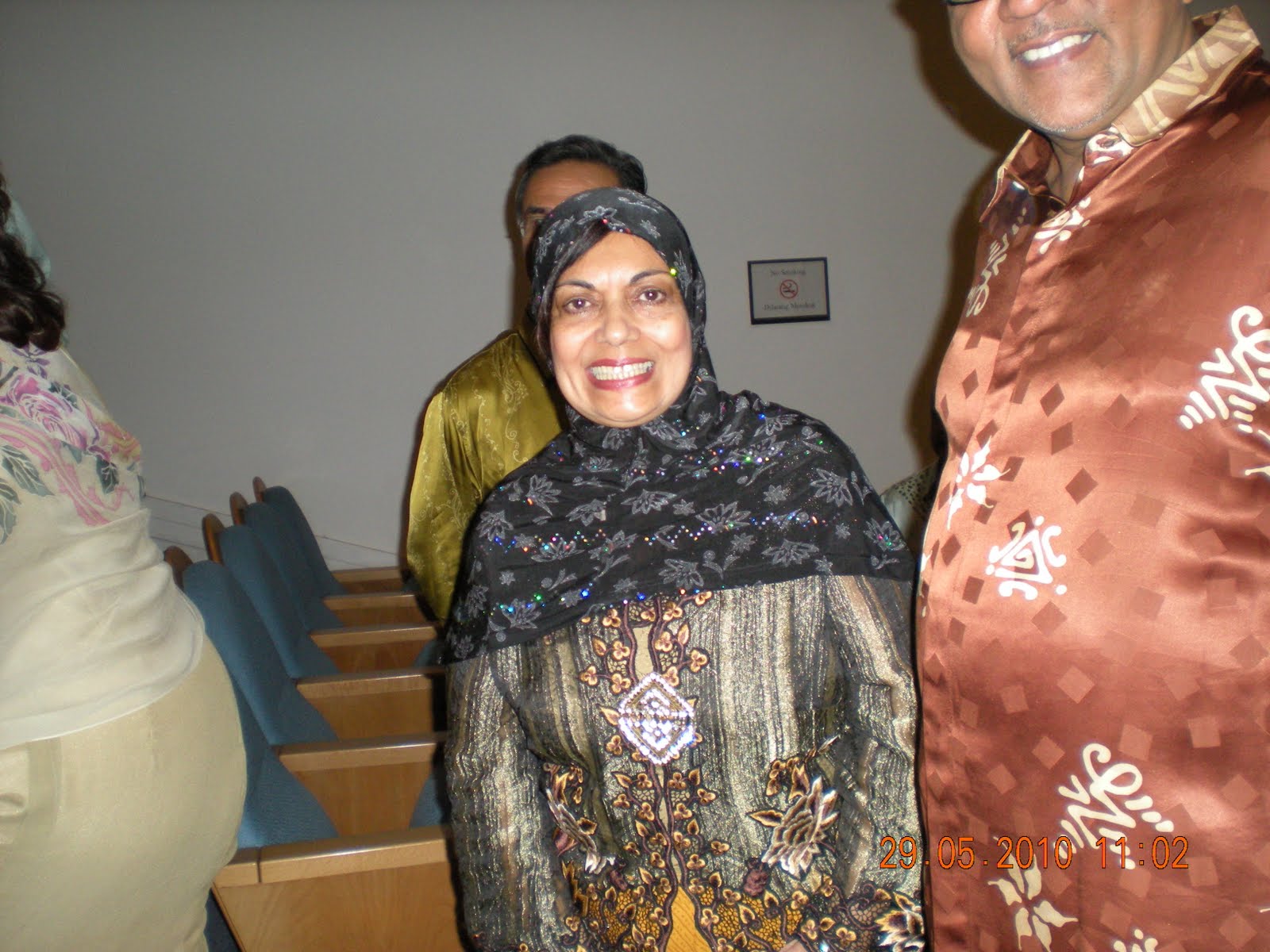
These photos were taken during the launch of the book, Straits Muslims: Diasporas of the northern passage of the Straits of Malacca (2009) at Muzium Islam, Jalan Perdana in Kuala Lumpur on 29 May 2010.


Datin Rosmah Mansur was Guest of Honour who launched the book
Prof Datuk Dr Wazir Jahan Karim, editor of Straits Muslims
Some of the crowd. It was full house
Exit after launch
Great grandchildren of Hafiz Ghulam Sarwar, the man who first translated Quran into English at Oxford University.

Prof Datuk Dr Wazir Jahan Karim

From the book, Straits Muslims: Diasporas of the Northern Passage of the Straits of Malacca, edited by Wazir Jahan Karim (Straits G.T., 2009).


Page 33 shows Dr Abdul Karim's wedding photo (circa 1930s-1940s with a Taj Mahal as prop). The wedding was held at a house in Larut Road (where is this?).

Page 36 shows a photo of Bismillah Begum Munawar.


Prof Datuk Dr Wazir Jahan Karim is the daughter of a famous dentist, Dr Abdul Karim bin Nawab Din.


Dr Abdul Karim married Bismillah Begum bt Munawar, the granddaughter of the famous writer, philosopher and Penang Mufti, Dr Hafiz Ghulam Sarwar. He was also the first person to translate the Quran into English at Oxford University.


Hafiz Ghulam Sarwar (1873-1954)

Biography
He was born in Lahore, India in 1873. Lahore is now in Pakistan. His father was a tailor. He had four siblings - all are brothers. He recited Quran from age three and went to school at age five. By age eleven, he became a hafiz (a person who is able to recite the Quran).

He studied Humanities and Arts in the Government College of Lahore and graduated in 1893. He completed a Masters in Arts at the University of Punjab in 1894. At 21, he studied Philology, Mathematics, and Science (known as Mathematical Tripos) at the St John's College in Cambridge University and completed it in 1896. He studied Advanced Arabic at the Imperial Institute of Modern Languages (1896-1900).

In 1896, after completing his studies at Cambridge University, he was offered two choices - to either serve the British Indian government service in India or the British Colonial Civil Service of the Straits Settlements in Southeast Asia. He chose the latter. In 1896 he was appointed a Cadet of the Malayan Civil Service.

He held several posts in Malaya between 1900 and 1928. Among them were:

Magistrate, Penang Supreme Court
Mufti, Penang
Third Magistrate, Singapore (1920 onward)
Acting Sheriff and Deputy Registrar of the Supreme Court and Assistant Official Assignee, Penang
Acting District Judge, Penang
Acting Censor, Singapore
Acting Registrar of Companies, Penang
Civil District Judge, Singapore (1923 - 30 December 1928)

Hafiz Ghulam Sarwar wrote many books on Islam. He was the first person to translate Quran into English at Oxford University. I have two of his books (photos below). He wrote the following books between 1923 and 1954:

The Word of God and the Wonders of Science (1923-25)
The Translation of the Holy Qur'an (1928)
Philosophy of the Qur'an (1938)
Mohammad the Holy Prophet (1937)

Hafiz Ghulam Sarwar knew many languages including these below:
Qur'anic Arabic
Modern Arabic
English
Urdu
Hindustani
Latin
French
Farsi
Chinese
Burmese
Japanese
Malay

Source: Wazir Jahan Karim. Hafiz Ghulam Sarwar (1873-1954). A Biographical Review. Straits G.T. Intersocietal and Scientific (INAS), George Town, Penang. 2008.

Wazir Jahan Karim. Hafiz Ghulam Sarwar (1873-1954). A Biographical Review. 2008
Hafiz Ghulam Sarwar. Life of Prophet Muhammad (SAW). 2010. ISBN 978-983-44034-2-3
Hafiz Ghulam Sarwar. On God, Creation and Evolution. 2009. ISBN 978-983-44034-1-6

Newspaper reports of Hafiz Ghulam Sarwar (H. G. Sarwar):


Book - Straits Muslims


Page  42 has a photo of a younger Dato' Mushir Ariff with his wife, Dato' Zubaidah Ariff, photographed in Penang in 1956 (courtesy of Dato' Zubaidah Ariff). Dato' Mushir Ariff is the eldest son of Sir Dr Kamil Mohamed Ariff, a famous Penang doctor who was knighted, the only doctor knighted in the history of Penang and Malaysia. Dato' Mushir Ariff also headed the inquiry into the Bank Bumiputra saga in 1974 (I was in Form 4 at TKC).

Page 43 has a family photo of the Ariffs with their children, parents and in-laws (courtesy of Dato' Zubaidah Ariff).

Page 59 shows the 1935 Annual Dinner held at King Edward's College, University of Malaya in Singapore. Present in the photo were dentist Dr Mohamad bin Taib, Khamsiah bt Ali, Latifah Bee Ghows and Dr Mohamed Din. The caption states that Dr Abdul Karim bin Nawab Din was the first Malayan to obtain the F.R.C.D.S. from the University of Manchester.

Page 60 is the same photo used for TEMD. Only three people can be identified - Dr Mohamed Said, Dr Megat Khas and Dr Abdul Karim bin Nawab Din. The others could be our Malay doctors but their names are unknown.

Page 61 shows dental graduates of KE VII College, Singapore in 1936. Present (possibly) were  Dr Nuruddin Salleh and Dr Abdul Karim bin Nawab Din.

Usman Awang's verse on the ethnogenesis of Malays

Melayu di tanah Semenanjung luas maknanya
Jawa itu Melayu, Bugis itu Melayu
Banjar juga disebut Melayu, Minangkabau memang Melayu
Keturunan Aceh adalah Melayu
Jakun dan Sakai asli Melayu
Mamak dan Malbari serap ke Melayu
Malah mu'alaf bertakrif Melayu
(Setelah disunat anunya itu)

Source: Straits Muslims, Wazir Jahan Kairm, Straits GT, 2009. p62 (endnote).

Boria and the Ethnogenesis of the Malays

Have you ever seen or heard of boria? It's not bosia but boria. It's not bo ria. It's boria! What is boria? What do you know about boria? Have you ever performed in a boria? Boria is also spelled as boeria. Boria or boeria could have been derived from 'Boleh Ceria' and then contracted to become boria. So, boria could mean and refer to, 'Let's party and be happy'. So let's be happy with boria.

Place
1. Boria Bal is a village in Balkh Province in northern Afghanistan (Wikipedia).
2. Boria is a village in Poland (Wikipedia).

Caste
Boria is a Hindu caste in north India (Wikipedia).
Boria is a sub-group of the Pasi clan that practices endogamy (Wikipedia).
The Boria and Pasi do not intermarry.
The Boria speak Awadhi dialect. The Pasi speak Hindi.
A part of Pasi embraced Islam and became known as Turuk Pasi.
Turuk Pasi are Muslims.

Transmigration and ethnogenesis
The Indians came to Malaya and with them came a group that continued boria here? Whether boria was borned and propagated by the few Shite Muslims who came to Malaya remain unknown. The Sunni Muslim views of boria are unknown. The ulama' will view boria as haram when it combines men and women together in a staged performance. Whether boria has links to the Jews is also unknown.

Please read about boria in Straits Muslims: Diasporas of the northern passage of the Straits of Malacca by Wazir Jahan Karim, editor (2009), pp9-10; 52-57.

Performance
Boria is a staged dance performance meant for public viewing. It is usually performed in the village or at universities and elsewhere. It is performed for welcoming visitors to a village or part of a stage presentation. The boria (dance) is performed in a large group (10-20 people or more) and led by a leader and singer. The songs are often welcoming songs and now have taken to advisory overtones for civic mindedness.

Boria lyrics

"Boria Anak Tanjung" - Boria Pulau Pinang

Kalimah bismillah bermula kata
Alhamdulillah bersyukur kita
Perihal Pulau Pinang tajuk cerita
Boria Anak Tanjung membawa berita

*
Lainlah buluh lainlah parang
Lain dahulu lain sekarang
Perubahan Pulau Pinang yang cukup terang
Boria Anak Tanjung cuba menerang

Rakyat sekarang pesat pembangunan
Kembang ekonomi mengikut susunan
Bangunan indah kiri dan kanan
Pemimpin berdedikasi memainkan peranan

(Ulang *)

Rakyat hidup berbilang bangsa
Tolong menolong setiap masa
Menabur bakti membuat jasa
Aman damai hidup selesa

(Ulang *)

Akhir karangan menyusun jari
Cerita kami yang tidak terperi
Salah dan silap tanpa disedari
Ampun dan maaf pohon diberi

Lirik Lagu Boria Anak Tanjung @ Lirikami
Read more: http://www.liriklagumuzik.co.cc


Boria today
Whatever the origins of boria we see today, who supported boria in the past, who supports boria today, boria is here to stay and has moved beyond our shores by little student ambassadors. It is a lively performance and a good way to welcome visitors and to make them feel at home. Lyrics for boria dance songs or performances have been greatly subdued from being vulgar  to conform to more acceptable Malay community standards. We will support boria that gives a good message to our young and our visitors alike. Boria was never a Malay creation but came to exist within the Malay society's many traditional performances, after years of multicultural acculturation. Boria came to us and has remained. 


Boria costumes. Photo from Penang Museum.

Boria performances
YouTube - Boria (Universiti Sains Malaysia 2008)
YouTube - Boria (Universiti Malaya 2010)
YouTube - Boria (Pennsylvania State University, USA - Malaysian Night 2010)
YouTube - Boria (Kampung Melayu, Penang)


Thursday, 5 May 2011

Dental Institutions in Singapore and Malaysia

National University of Singapore (NUS)
Faculty of Dentistry
http://www.dentistry.nus.edu.sg/faculty/roll/1936.htm
Accessed on 14 December 2008

Malaysian Dental Association (MDA)

54-2 (2nd Floor) Medan Setia 2
Plaza Damansara, Bukit Damansara
50490 Kuala Lumpur.
Tel: 603-20951532, 20951495
Fax: 603-20944670
Email: mda@streamyx.com
http://www.mda.org.my/00_home.htm
Accessed on 14 Dec 2008

Malaysian Dental Council (MDC)
From MOH Website
MDC website
Contact Us:
The Registrar
Malaysian Dental Council
Level 5, Block E10,
Parcel E, Precinct 1
Federal Government Administration Centre,
62590 Putrajaya.  
Tel : 603-88834217
Fax : 603-88886133
mdc@moh.gov.my

Sekolah Perawatan Pergigian Pulau Pinang
No info yet

Dental Schools in Malaysia
UM University of Malaya Faculty of Dentistry
UKM Universiti Kebangsaan Malaysia Faculty of Dentistry
USM Universiti Sains Malaysia School of Dentistry
AIMST AIMST University School of Dentistry
PIDC Penang International Dental College
IIUM Kulliyah of Dentistry, IIUM Kuantan
UTM Univerisiti Teknologi Mara Dental Faculty
USIM Universiti Sains Islam Malaysia Dental Faculty
MAHSA MAHSA University College School of Dentistry


Early dentists
Dr Abdul Karim bin Nawab Din
Dr Mohamed bin Taib
Dr Nuruddin bin Mohd Salleh

Ministry of Health Malaysia
Oral Health Division
Organisation Chart (20 Jan 2010)
Dental History
- The development of oral healthcare has been greatly facilitated by the establishment of professional organisations, the largest being the Malaysian Dental Association (MDA). The MDA evolved from its precursor, the Malayan Dental Association that was officially inaugurated in 1938. Professor Edgar K. Tratman was its first President. The name change came in 1963 with the official formation of Malaysia.

Health Ministers of Malaysia / Menteri Kesihatan MalaysiaMenteri Kesihatan Malaysia ke empat ialah Y.B. En Abdul Rahman Talib (1962 - 1964).

Photo gallery
Dental photos supplied by the family of Dr Mohamed bin Taib are shown below. The problem is the photos were supplied without captions and I am lost to who are in the photos, what occasion and venue. I've tried contacting a senior family member but I think numerous spams got in the way and I had to block spams. I have tried to reconnect via Facebook but we don't get to access Facebook during office hours and I have to wait till I go home. But when I reached home I forgot to follow up in Facebook and that has gone for many years! I need assistance with the identification of people in the following photos. The photos were probably between 1962 and 1964, judging from the attires and dental equipment, and when YB En Abdul Rahman bin Talib was Health Minister. I have also written to the Nursing Association which also doubles as the nursing alumni but have not got much luck with these photos. Please help if you can.

Man with songkok is YB En Abdul Rahman bin Talib, the 4th Minister of Health Malaysia (1962-1964) (also refer to Rahman Talib Report in Wikipedia re government pensioners' scheme)
Second from right is YB En Abdul Rahman bin Talib (with songkok). Pahang dentist, Dr Mohamed bin Taib is in the middle, facing the camera.
YB En Abdul Rahman bin Talib at centre
YB En Abdul Rahman bin Talib officiating the opening of a new dental clinic. Venue unknown.
YB En Abdul Rahman bin Talib at far right.
Welcoming YB En Abdul Rahman bin Talib for officiating the opening of a new dental clinic. Venue unknown.

Wednesday, 4 May 2011

Parti Islam SeMalaysia (PAS)

These are the addresses for  contacting PAS offices to obtain the biographies of 2 of the early Malay doctors - Dr Haji Abbas bin Haji Alias (also check Wikipedia) and Dr Amir Burhanuddin al-Helmy. The writer for the biographies of these two doctors is YB Tuan Haji Saari bin Sungib, ADUN Hulu Klang. Saari Sungib wrote a very important book which I can't get hold of, Biodata 5 Tokoh PAS. Saari Sungib is also in Facebook and Wikipedia. He has written 30 books.


Monday, 05 November 2007
Pejabat Perhubungan PAS 
Negeri-Negeri & Wilayah Persekutuan
Image 
KELANTAN
Setiausaha Perhubungan PAS Kelantan
Badan Perhubungan PAS Negeri Kelantan
Tingkat 3, Jalan Dato’ Pati
15000 Kota Bharu
Kelantan Darul Naim.
Tel : 09-7481131 / 09-7478815
Fax : 09-7461873 / 09-7431344
kelantan@parti_pas.org
paskelantan@hotmail.com

Image
KEDAH
Setiausaha Perhubungan PAS Kedah
Badan Perhubungan PAS Negeri Kedah
Kompleks PAS Kedah
KM 13, Jalan Alor Setar - Sungai Petani
Simpang Empat
06650 Alor Setar
Kedah Darul Aman.
Tel : 04-7481122
Fax : 04-7481123
Dupn_kedah@yahoo.com

Image
TERENGGANU
Setiausaha Perhubungan PAS Terengganu
Badan Perhubungan PAS Negeri Terengganu
No 33 Taman Sri Intan, Jalan Sultan Omar
20300 Kuala Terengganu
Terengganu Darul Iman.
Tel : 09-6203314
Fax : 09-6203311
pastrg@streamix.com.my

Image
SELANGOR
Setiausaha Perhubungan PAS Selangor
Badan Perhubungan PAS Negeri Selangor
No. 12-C, Tingkat 3, Blok 1
Pusat Perniagaan Worldwide
Jalan Tinju 13/50
40000 Shah Alam
Selangor Darul Ehsan.
Tel : 03-55184530
Fax : 03-55134323
setiausahanegeri@paselangor.com

Source: http://www.pas.org.my/index.php?option=com_content&task=view&id=13&Itemid=28

SlideShare: PAS Dakwah dan Politik

Talks to decide PMIP's new name
New Nation, 16 June 1971, Page 3

Tuesday, 3 May 2011

DOCTORS IN THE EAST : WHERE WEST MEETS EAST

I borrowed this book  from our medical library and read it. I tried writing to the author (Dr Ho Tak Ming) but instead got a Chinese man in my Facebook who only wrote in Chinese script and got lots of porn photos which I don't need!

Who knows the real author? If you are the author, can you please contact me? There is Dr Samsudin Cassim mentioned in the book and I need permission to use some of the contents. I would also like to know how/where to contact the family. His son Tan Sri Osman is/was with Berjaya group but I need his e-mail to contact him if anyone knows the son or any family member.


----- Forwarded Message -----
From: "Nor hairani binti. Abd Rashid" <hairani@kk.usm.my>
To: faridah
Cc: "asmak" <asmak@kb.usm.my>, draman@kk.usm.my
Sent: Wednesday, April 27, 2011 1:11:34 PM GMT +08:00 Beijing / Chongqing / Hong Kong / Urumqi
Subject: ITEM READY FOR BORROWING : DOCTORS IN THE EAST : WHERE WEST MEETS EAST

Assalamualaikum & Good afternoon,

Dear Prof.,

We would like to inform you that your request for the item below is ready for borrowing. 

Title : Doctors in the east: where west meets east
Author: Ho Tak Ming
Publisher: Pelanduk Publication
Year of Publication: 2001
Call Number: WZ56 H678 2001

You can get the item at Customer Relation Department or Circulation Counter. Please contact me if you have any inquiries.

Thank you.


Nor Hairani Ab Rashid
Customer Relation Department
hairani@kk.usm.my
1448

The Civilised Malay

Zimbra Collaboration Suite

The Civilized Malay
1 Messages

The Civilized MalaySaturday, 29 November, 2008 10:37:52 PM
From:
To:
It seems that we are just one race after all...please read from:

Malaya and Its History by Sir Richard Windstedt, London. 1948

THE CIVILIZED MALAY

The migration of the Malays from Yunnan down to the Malay peninsula took place between 2500 and 1500 B.C. Their
quadrangular adze culture, accompanied by unglazed cord­-marked pottery of great variety, has been traced from China
southward, and "the highly specialized pick-adzes of Java and Sumatra from a simple adze type with quadrangular cross­
section and semi-circular edge found in Laos through an inter­mediate type frequent in Malaya indicates the direction and
way of their migration"--namely, down the Malay peninsula. Some may have travelled by land, others across the Gulf of
Siam in craft developed from bamboo outriggers still in use on rivers in Burma and Indo-China. Among the earliest waves may
have been the Jakun. But the most important movement brought the ancestors of the Malays of Kedah, Kelantan and
Patani to become the civilized hinduized subjects of Langka­ suka and Sri Vijaya. The people of Kelantan, who have been
compared to the Polynesians, are bigger than the Malays of the south, perhaps because they represent a different strain,
perhaps on account of a better climate or the better food of an ancient rice area.

For the culture of primitive Malays, language and pre-historic discoveries provide the only evidence. And while
earlier peoples, apparently with an Australo-Melanesoid strain, lived in caves or left gigantic shell-heaps, the debris of
antediluvian meals, to bear witness to their location, the more highly civilized Indonesian and primitive Malay inhabited
villages that are revealed only by some accident like the great flood of 1926, which unearthed one at Tembeling in Pahang.
Yet there is ample evidence that, before these neolithic people left the continent of Asia, they made pottery and built mega­
liths. They were hunters--not only of game but of human heads for the sake of their soul-substance. They were fishermen
acquainted with traps of bamboo and wood, though not, apparently, with the cast-net or other nets of cord. They lived, as villagers still live, in houses built on piles and lashed with rattan, with bamboo flooring and walls. In their gardens they
cultivated sugarcane, bananas, the gourd and the coconut. Their field-crops were millet (still a Sakai crop) and rice, both of
which provided them with food and fermented drink. They had domesticated the pig and the buffalo and perhaps cattle. Their
clothes were of bark. Their numerals went up to a thousand and they possessed some knowledge of the stars.

It must have been long before the Christian that Malay names were given to many parts of Malaya like Kelantan, Muar and Tumasik (which Hindus changed to Singapore). The meaning of Naning, for example, is forgotten today, but we know from the Malay element in the Khasi of Assam that it means "Upriver". Possibly no generic name was adopted by the scattered tribes until Jambi or Melayu succeeded Sri Vijaya in the thirteenth century, after which they called them­selves Malays.

Jambi fell, to be succeeded by inland Minangkabau. But when Malacca was founded with a population largely made up of Malay sea-gipsies, its commerce attracted many Malays from the opposite coast of Sumatra, more especially Hindu Minang­kabaus, who sought the gold districts of Pahang and the valleys of what in the eighteenth century became Negri Sembilan. Bugis, too, from Celebes, in 1700 founded modern Selangor and in 1722 became Underkings of the Johore empire. Most of the Bugis immigrants, at any rate, were men of birth who inter­married with peninsular royalties and dominated their local Malay subjects. And to infer from the legends of the Malay Annals that most of the Malays of the peninsula crossed from Sumatra in mediaeval times is to ignore the evidence of pre-
history and place-names. The Malays have at least as much right to be regarded as the aboriginal people of Malaya as the English have to be called the aborigines of England.

The Malay of today, a broad-headed individual with olive skin, fine eyes, a neat well-proportioned body, lank black hair and almost hairless chin, is the primitive Malay plus many foreign strains derived from marriage with Chinese from Chou times down to the advent of Islam, with Hindus of the Deccan and Bengal, with Muslim Indians, Siamese and Arabs. They have changed little since Magellan's brother-in-law, Duarte Barbosa, described them from his experience in the East between 1500 and 1517: "They are well-set-up men and go bare from the waist up but are clad in cotton garments below. They, the most distinguished among them, wear short coats which come half-way down their thighs, of silk cloth--in grain or brocade--and over this they wear girdles; at their waists they carry daggers in damascene-work which they call creews.

Their women are tawny-coloured, clad in very fine silk garments and short skirts decorated with gold and jewels. They are very
comely, always well-attired and have very fine hair. . . . They live in large houses outside the city with many orchards, gardens and tanks, where they lead a pleasant life. They are polished and well-bred, fond of music and given to love."

To bring the picture up to date: all but the peasant at work in his fields wear coats nowadays: creeses are worn only at court ceremonies, and many Malays have adopted European dress for working hours. Some years ago when a Resident issued a circular in praise of Malay costume and in favour of its retention, the Malay chiefs at the next meeting of the State Council asked him the reason: was he concerned lest they should contract chobi[1]-itch?

It is a pity that modern life and the Malay's own administration for European ways have conspired to make the white man for­
get what Miss Isabella Bird, author of The Golden Chersonese, knew in 1879: "The Malays undoubtedly must be numbered among civilized peoples. . . . They have possessed for centuries systems of government and codes of land and maritime law, which in theory at least show a considerable degree of enlightenment."

The Malay has great pride of race--due, perhaps, as much to his Muhammadan religion as to a past he has forgotten. He has, as Sir Frank Swettenham once wrote, "as good a courage as most men", and a better sense of the values of what life offers than is generally gained from book philosophies. Even the aborigines of Malaya have attractive manners, and the Malay has not only undergone the discipline of Hindu etiquette but has been affected by his Muslim teaching much as an English boy has been affected by the public school, acquiring poise and confidence. Because he is an independent farmer with no need to work for hire, the Malay has got an undeserved reputation for idleness, which his Asiatic competitors take care to foster. In affairs he is not only diplomatic but intelligent and states­manlike, with a natural ability to weigh both sides of a question. His domestic life is happy. He marries young, but in spite of the latitude of Islamic practice the peasant has seldom been a polygamist, though the immemorial need for sons to work his fields makes him prone to repudiate a childless wife.

At the 1947 census, out of 2,395,123 Malays in the Federation, 264,630 were comparatively new-comers from Sumatra and Java, men of the Malay's own racial stock and religion, who alone of the country's immigrants rapidly become absorbed into the Malay community. In the Federation, too, the Malays formed 43·77 per cent of the total population and the Chinese 38·6 per cent. But in Kelantan, for example, the population is almost wholly Malay.
____________________
1 Hindustani for "laundryman".