Thursday, 17 February 2011

History of Darjeeling District, India

Darjeeling in Bhagalpur, Bengal ... is north of Calcutta, near the Himalayas

The name Darjeeling is a composition of 'dorje' meaning 'thunderbolt' and 'ling' meaning 'place' ... 'the Land of Thunderbolt'.

From 1911 Encyclopedia:
DARJEELING, a hill station and district of British India, in the Bhagalpur division of Bengal. The sanatorium is situated 367 m. by rail north of Calcutta. In 1901 it had a population of 16,924. It is the summer quarters of the Bengal government and has a most agreeable climate, which neither exceeds 80° F. in summer, nor falls below 30 in winter. 

The great attraction of Darjeeling is its scenery, which is unspeakably grand. The view across the hills to Kinchinjunga discloses a glittering white wall of perpetual snow, surrounded by towering masses of granite. 

There are several schools of considerable size for European boys and girls, and a government boarding school at Kurseong. 

The buildings and the roads suffered severely from the earthquake of the 12th of June 1897. But a more terrible disaster occurred in October 1899, when a series of landslips carried away houses and broke up the hill railway. The total value of the property destroyed was returned at X160,000.

The district of Darjeeling comprises an area of 1164 sq. m. It consists of two well-defined tracts, viz. the lower Himalayas to the south of Sikkim, and the tarai, or plains, which extend from the south of these ranges as far as the northern borders of Purnea district. The plains from which the hills take their rise are only 300 ft. above sea-level; the mountains ascend abruptly in spurs of 6000 to 10,000 ft. in height. The scenery throughout the hills is picturesque, and in many parts magnificent. The two highest mountains in the world, Kinchinjunga in Sikkim (28,156 ft.) and Everest in Nepal (29,002 ft.), are visible from the town of Darjeeling.


From Encyclopedia Britannica:
Darjiling, also spelled Darjeeling, Tibetan Dorje-ling, city, extreme northern West Bengal state, northeastern India. Darjiling lies about 305 miles (490 km) north of Kolkata (Calcutta). The city is situated on a long, narrow mountain ridge of the Sikkim Himalayas that descends abruptly to the bed of the Great Rangit River. Darjiling lies at an elevation of about 7,000 feet (2,100 metres). On a clear day the city affords a magnificent view of Kanchenjunga (28,169 feet [8,586 metres]), and Mount Everest can be seen from a nearby viewing point. 

The name of the city means “Place of the Thunderbolt.” 

Darjiling was ceded by the raja of Sikkim to the British in 1835 and was developed as a sanatorium for British troops. It was constituted a municipality in 1850. 

The Chaurastha (“Four Roads”) district encompasses the Mall, where the roads converge; it is the city’s main shopping centre and the most attractive promenade.  

Observatory Hill, Darjiling’s highest point (7,137 feet [2,175 metres]), is crowned by Mahakal Temple, which is sacred to both Hindus and Buddhists. 

Birch Hill contains a natural park and the Himalayan Mountaineering Institute. 

The Lloyd Botanic Gardens, well-known for their varieties of Himalayan flora, were laid out in 1865. 

Besides these attractions, Darjiling has a zoo, a natural history museum, and a racecourse. 

It is well-known for its residential schools, and there are several colleges affiliated with the University of North Bengal (founded 1962) in and around the city.

The area in which Darjiling is situated receives plentiful rainfall and has a wide range of climates, from tropical to subalpine, owing to its varying elevations. 

Local coniferous and oak forests yield valuable timber. The local rural economy is based primarily on tea, which is plantation-grown up to elevations of 6,000 feet (1,800 metres). Other crops are rice, corn (maize), cardamom, and wheat. Pop. (2001) 107,197.

Get in
Darjiling is a noted hill resort, and the city’s economy is based largely on tourism; the peak periods for visitors are April to June and September to November. The city has major road, rail, and air connections with Kolkata.  

By plane
The nearest airport is Bagdogra, near Siliguri, 96 km from Darjeeling.
Air India (fomerly Indian Airlines), India's largest airline, has flights from:
  • Delhi - IC 880 (Tu/Th/Sat) and IC 879 (Mon/Fri - via Guwahati)
  • Guwahati - IC 879 (Mon/Fri)
  • Kolkata - IC 721 (Tu/Th/Sat)
Jet Airways, a private airline, has flights from:
  • Delhi - 9W 601 (Mon/Wed/Fri - Via Guwahati) and 9W 602 (Tu/Th/Sat/Sun)
  • Guwahati 9W 601 (Mon/Wed/Fri)
  • Kolkata 9W 617 (Daily)
Spice Jet also operates flights from Kolkata & Delhi.
Air Deccan also known as Kingfisher red, runs budget flights to and from Bagdogra from Delhi, Guwahati and Calcutta.
Indigo has also started direct/indirect flights to & from Delhi and Guwahati since April, 2009 end.
Druk Airways has also commenced direct flights to & from Paro as well as Bangkok, twice a week for both destinations
All other cities major cities can be accessed by taking a flight to Delhi/Kolkata and connecting.

Sources:  

Singapore Arabs

Raffles opened Singapore in 1819 and brought in the Arabs for trade. The Singapore Arabs came mainly from Hadramut in South Yemen (Selatan Yaman) who were already traders in Yemen.

Many Singapore Arabs also came from Indonesia, mainly from Java and Sumatra. Among the famous Indonesian Arabs who migrated to become Singapore Arabs included the Aljunaid, Alsagoff and Alkaff clans. These three clans were rich and famous as they owned businesses and lands in several parts of Singapore.

Beside trading, the Singapore Arabs built mosques and helped spread the teachings of Islam. Singapore has 59 mosques.


Link to YouTube video on The Arabs of Singapore.

The Singapore Arabs were very wealthy. Some were Sheikh Haji. The Singapore Arabs could afford to rent up to four steamships (kapal wap) for the hajj pilgrimages. There was once when the Indonesian pilgrims (jemaah) could not return to Indonesia as the Dutch East India colonial government had prevented their re-entry. The pilgrims were thus retained in Singapore and boarded the homes of the rich Indonesian Singapore Arabs.

Syed Ahmad Alsagoff was the Singapore Ambassador to Turkey. His mansion was named Constantinople Estate.

Syed Ibrahim Alsagoff was the Arab Consular to Singapore. He founded Madrasah Alsagoff.

Syed Ahmad bin Muhammad (of Alsagoff clan) married to Hajjah Fatimah, a rich Bugis princess. They had a son named Muhammad who was nicknamed Nungcik. Syed Muhammad Alsagoff's eldest daughter was Sharifah Badriah who owned the entire row of houses in Arab Street.

Hajjah Fatimah founded Masjid Kampung Glam in Singapore. Kampung Glam developed into a busy trading place. There were people smoking shisha (hookah) which contained aromatic herbs and smoke.

The Alkaff clan owned hundreds of rented houses in Kampung Kwitang in central Jakarta. In Singapore, they owned lands and lavish houses which have been turned into recreational parks, restaurants and botanical gardens.

Muhammad bin Abdurrahman Alkaff was the first Alkaff to arrive in Singapore from Java but he later died. His brother, Shaikh Alkaff succeeded him and managed the Alkaff lands in Indonesia, Singapore and Hadramaut. However, the Alkaff lands in Singapore were forcibly taken away by the Singapore Prime Minister, Lee Kuan You (LKY) at very low price. Their lavish homes were taken over by ABRI at the time of the Konfrontasi between Indonesia and Malaysia. The Alkaff clan founded the Masjid Alkaff in Kampung Melayu in Singpore.

After WWII, the business and economy of the Singapore Arabs declined but their madrasah (religious schools) continued to build up and gained international recognition and fame.

Ali bin Muhammad Jamalullail, dari anak cucunya menurunkan Keturunan leluhur Al-Qadriy, Al-Assry, Al-Baharun, Al-Junaid.

As the Alsagoff and Alkaff had done, the Aljunaid built Madrasah Aljunaid near the Muslim community of Kampung Glam in Singapore.

Lulusan madrasah ini banyak dibiayai oleh Al-Azhar University di Kaherah . Madrasah ini memiliki 1,200 murid dari TK sampai SLTA. Di madrasah ini pemerintah Singapura yang sekular mengizinkan para siswinya untuk berjilbab, dan prianya berkopiah hitam.

Sources:

Wednesday, 16 February 2011

Global Security and the Threats of World Wars

Global Security provides up-to-date US military news online. It is a useful website for studying casualties of past wars and to try and avoid such casualties in future wars (na'u zubillahi min zaalik). The other useful website is the CIA website that has health data and statistics of all the world's communities.

Doctors have served as military personnels in times of war and preparedness for war is something we don't teach at medical schools. For our students who wish to assist in war-torn regions of this globe, I would suggest that you read on the causes of past wars and try to understand how we can possibly avoid conflicts and any sort of war. Any war is likely to cause injury and death,. Death of innocent victims is not an excuse for medical staff to sit back, turn a blind eye, and not express themselves publicly. 

I will honestly say, that we actually don't need any war today. Wars are a thing of the past, avenues of the past, vents for those who never learned and never want to exit the Dark Ages nor leave their dirty actions altogether. Those who committed wars are hyenas and dingos, definitely not humans We are intelligent human beings and we have brains that make our actions humane. We should fully utilise our brains and be able to cap tension from arising, crack conflicts from striking and halt wars from happening. The only avenue to save this world from further rot is to listen to academics, the public at large and the poor masses (the bottom billion have-nots). Communication is a bilateral process; war is single strike.

World War I (WWI) commenced on 6 April 1917 and ended on 11 November 1918. It was localised to Europe. Hence, Malaya was not directly affected but there are evidences from narrations communicated to the author (even though antibiotics were still undiscovered), especially the field of professional medical training.

World War II (WWII) commenced on 7 December 1941 and ended abruptly on 14 August 1945 with the bombing of two Japanese cities, Hiroshima and Nagasaki. This war occurred globally and affected many countries worldwide. Malaya suffered terribly during WWII when it came under the Japanese Occupation. We can still hear many WWII stories from Malayan survivors of that horrific era. The WWII museums also depict the artifacts and happenings of this ugly indescribable war. But we should not forget, that the first antibiotic, penicillin, came into use almost at the close of WWII. 

Since antibiotics only became commonplace after WWII, one should expect stories about infant deaths, childhood deaths, teenage deaths and early deaths of young adults in our medical history, prior to 1945 . The medical situation improved after WWII. WWII was in fact a turning point for medicine. The many drugs we see today are postwar discoveries and have rather short trialling periods. Some drugs are not fully tested for long-term effects and their safety status remain unknown to doctors and patients.

Sources:
http://www.globalsecurity.org/military/index.html
http://www.globalsecurity.org/military/ops/early20cent-ops.htm

Tuesday, 15 February 2011

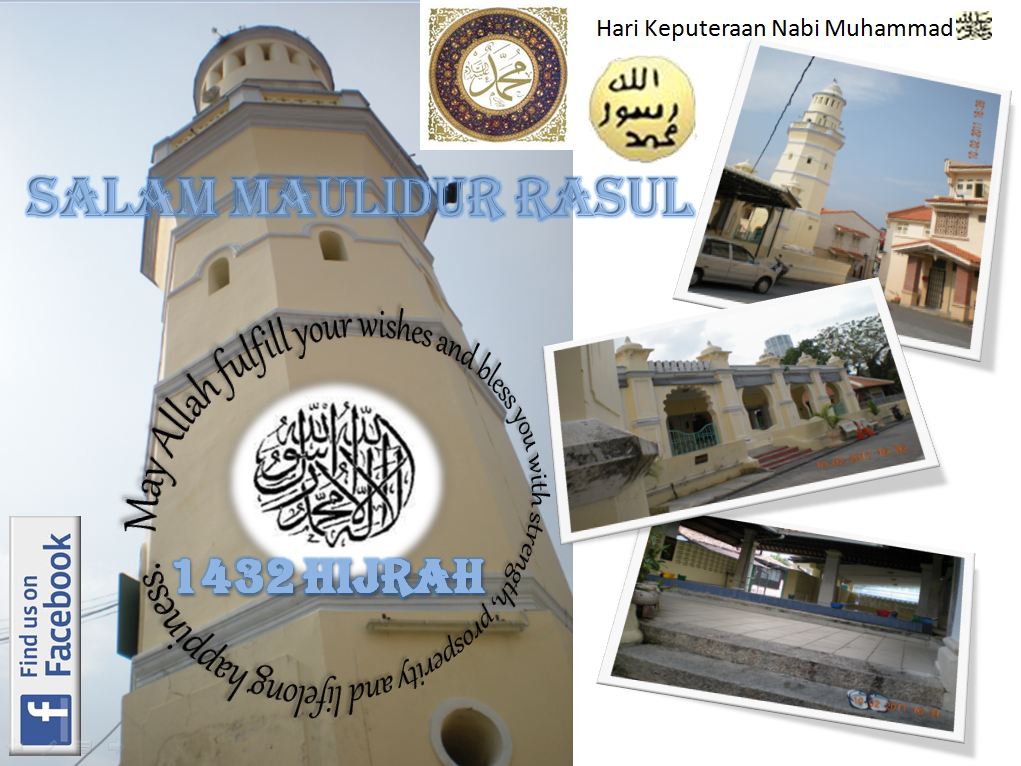
Salam Maulidur Rasul 1432H


To do good is not only our greatest duty, but should be our greatest interest.

Carry a heart that never hates. Carry a smile that never fades. Carry a touch that never hurts.

We do not remember days; we remember moments.

May peace reign in this world, before we shift to the next world.

Salam Maulidur Rasul

Saturday, 12 February 2011

Masjid Melayu (Jamek) Lebuh Acheh, Georgetown, Penang

It is popularly known as Masjid Acheh. It was founded in 1808 (after Masjid Kapitan Keling was built). The philanthropist was Tengku Syed Hussain Idid, who donated his land (wakaf). His grave is at the rear/kiblat side of the masjid. The compound houses Masjid Acheh, 2 big old wooden houses (one is not used), an old kampung house on stilts with ceramic roof tiles & walls painted black. There are a few blocks of modern townhouses which border the front entrance of the grounds. There are two major entrances to the grounds, one on Lebuh Acheh directly faces the minaret, and the other is nearer the ablution venue. There are passages/alleys in between the blocks of townhouses.


More photos of Masjid Acheh in my Facebook album.

Wednesday, 9 February 2011

Masjid Sultan, Singapore

3 Muscat Street, Singapore 198833 +65 6293 4405
1 N Bridge Rd, Singapore +65 6293 4405
http://www.sultanmosque.org.sg/


View Larger Map

Tuesday, 8 February 2011

Masjid Khadijah in Singapore

583 Geylang Road, Singapore 389522
Tel: +65 6747 5607   Fax: 65-6747 5929
http://www.khadijahmosque.org/aboutus/gen2.htm


View Larger Map

Two names are recorded at the Masjid Khadijah website:
1. Dr Hafeezuddin Sirajuddin Moonshi
2. Chishty S.A. Saleem 

Who was "Chishty S.A. Saleem"?
Syed Saleem Chishty and Syed Ahmad Chishty were the grandsons of Dr HS Moonshi.

Syed Saleem Chishty passed away in 2001 and Syed Ahmad Chishty passed away in 2010.


Accessed website: 13 February 2009

Moinudeen Chishty
http://wsany.tripod.com/id11.html

Kapitan

Kapitan = headman (Malay, ketua)

Kapitan Kling refers to Cauder Mohideen / Kader Mydin / Kadir Merican of George Town, Penang.
He was responsible for the construction of Masjid Kapitan Keling.
The hot & spicy Kari Kapitan served in Penang is named in his honour.
His younger brother is Noordin Merican (sometimes written as Merican Noordin)
The Bangunan Noordin within the grounds of Masjid Kapitan Keling is named after Cauder's younger brother, Noordin.

Kapitan China refers to Yap Ah Loy of Kuala Lumpur. He was a mining tawkey and was responsible for the development of early KL.

Kapitan Melayu refers to Tengku Syed Hussain Idid (sometimes spelled as Aidid) of Kampong Melayu, Acheen Street (Lebuh Acheh), Penang, an Acehnese prince who donated (wakaf) his land for the construction of Masjid Melayu (Jamek) at Malay Town in Penang.

Siam/Thai, Malay and Kelantan/Klate

There are many words which the Malay language and Kelantan accent (Klate) share with Siamese or the Thai language. Malay and Siam/Thailand history have a lot of things in common. Thai words are on the left.


Chana
Chana = Chenok

Thepa
Thepa = Tiba

Saba Yoi
Saba Yoi = Sebayu

Nong Chik
Nong Chik = Nong Chik, a male name

Hat Panare
Hat = had, boundary or limit
Panare = Penarik

Sai Buri
Sai Buri = Telube or Selindung Bayu(?)

Yaring
Yaring = Jambu(?); jering or buah jering is a fruit used by the Malay people for controlling diabetes

Kapho
Kapho = Kapur(?)

Hat Talokapur
Hat = had, boundary or limit
Talokapur = Teluk Kapur means chalk cove

Hat Khae Khae
Hat = had, boundary or limit
Khae Khae = gege (Klate) means loud noise or noisy

Palas Market
Palas = palas is a small palm. The young unopened palas fronds (daun palas) are used for making a triangular festive delicacy called ketupat tiga segi

Patatimo Village
Patatimo = Patatimo (Klate) or Pantai Timur means east coast

Yarang Ancient Town 
Yarang Ancient Town is thought to be the ancient kingdom of Lanka Suka
Yarang refers to jambu(?) or jering

Ra-ngae
Ra-ngae = Legeh

Sources:
http://en.wikipedia.org/wiki/Pattani_Province
http://en.wikipedia.org/wiki/Pattani_%28region%29 

Satun and Ku Den Ku Meh

Origin of Satun

Satun or Sentul could have originated from the word sentol, seto (Klate) which refers to the yellow mangosteen-like fruit with thick furry skin which contains a sticky thick white latex. The white flesh (pulp) is eaten fresh or the entire fruit with skin removed is preserved as jeruk seto.

---
History of Satun

Satun is one of the four provinces of Thailand which have a Muslim majority: 67.8% are Muslim and 31.9% are Buddhists. Most of the Muslims have some ethnic-Malay ancestry, though only 9.9% of the population claims to be ethnically Malay. The Malay dialect used in Satun is distinctly different from Pattani Malay and is much closer to the Kedah dialect of Malay, with a significant admixture of Thai influences.

Since Satun had belonged to the Kedah Sultanate, which had a strong relationship with both Ayutthaya and Siam under the Chakri dynasty, its Malay Muslims commonly intermarry with Thai Buddhists without serious religious hesitation. This custom has created a distinct social group known as Samsam, meaning a mixed person. Most Samsams, if not all, are Muslims.

Unlike the other Muslim majority provinces in Thailand, Satun does not have a history of political confrontation with the central power in Bangkok or of tension with the Buddhist population which makes up the majority of Thailand as a country. Malay Muslims in Satun are substantially assimilated and rarely sympathise with separatism from Thailand, in contrast to the Malay Muslims in Pattani, Narathiwat and Yala. 

---
Satun Cuisine

Bunga Kuda - A Malay traditional dessert common in Satun, Thailand and in Perlis, Malaysia. (Wikipedia pic)

---
Governors of Satun
  1. Phya Phuminatphakdi (Kuden bin Kumae) was the Governor of Satun from 1898 to 1916.
  2. Phya Samantaratburin (Tui bin Abdullah) was the Governor of Satun from 1914 to 1932.
---
Kuden bin Kumae
Phya Phuminatphakdi (Kuden bin Kumae) was the Governor of Satun from 1898 to 1916.
Phya Phuminatphakdi (Kuden bin Kumae)?

Phya Phuminatphakdi (Kuden bin Kumae)?

--
Ku Din Ku Meh (from Amir Azahari Al-Saadi in Facebook)

Ku Din Ku Meh was born in 1848 at Anak Bukit. At age 14, he worked as a Prison Warder for Kedah. He was fluent in Malay and Thai. He wrote many books on law circa 1894. His wrote in Jawi. He was the Governor of Satun or High Comissioner of Setul (Satun). His book are kept at the Thai National Archives in Bangkok.


---
Tunku Kudin (from Wan Mohd Nasserudin bin Wan Noordin @ Ayah Wan Merican Noordin on Facebook - deceased 19 Dec 2014)

Tengku Baharuddin @ Tunku Mohd Radin @ Tunku Mat Radin @ Tengku Kudin @ Tunku Kudin @ Kuden, was the Governor of Satun and owned Kuden Mansion in Satun, southern Thailand. 

Tengku Kudin married Siti Kalthum AlHabshee and their daughter was Tunku Rahimah Tunku Mohd Radin @ Tengku Besar Rahmah.


Tengku Baharuddin @ Tunku Kudin.
(Photo from Wan Mohd Nasserudin.)

---
Ku-den Mansion (Satun National Museum)


Ku-den Mansion was the official residence of Phya Phuminatphakdi, the Governor of Satun from 1898 to 1916. It was later used as an official residence for guests, then Japanese army headquarters in the Second World War, a municipal office, the City Hall, the District Office, the school building of Satun Municipality and the Office of the Internal Security Operation Center (ISOC), respectively. The style of the mansion is a combination of European architecture and Islamic art.


The building was originally built to be a royal palace for King Rama V on his visit to the South, and an official reception house for important guests. Its construction was completed in 1902, and commonly called as ''Kuden Mansion", after the name of the ruler of Satun, Kuden bin Kumae (Phraya Phuminatphakdi).The building was used as a provincial hall and an administration centre of Satun during 1947 to 1963.Villagers thus called it 'Sala Klang Kao' (an old provincial hall). The Fine Arts Department registered it as an ancient place, which was gazetted on 14 February 1989.- Tourism Authority of Thailand.

Kuden Mansion or Satun National Museum (Wikipedia pic)
Kuden Mansion or Satun National Museum. (Photo by Muhammad Nizam bin Omar of Serdang, Selangor in Malaysia, 3 Dec 2014) 

---
Segara Ninda


---
Phya Samantaratburin's house

This house was built as the official residence of Phya Samantaratburin (Tui bin Abdullah), the Governor of Satun from 1914 to 1932. The house was built on high wood piles.

Phya Samantaratburi's official residence.

---

Family Relations
From Wan Mohd Nasserudin bin Wan Noordin. (Ayah Wan Merican Noordin on Facebook - deceased 19 Dec 2014)

Wan Mohd Nasserudin bin Wan Noordin @ Abang Chel (1957-2014)


---------------
Siti Kalthum AlHabshee was born to Sheikh Abdul Rahman AlHabshee and Sona Bee. Siti Kalthum was married three times, first to MM Noordin, then her second husband and lastly to Tengku Baharuddin @ Tunku Kudin. Her children with MM Noordin were Che Rajah and Aladin Merican Noordin (Ayah Wan Merican Noordin's grandfather). Her grandchildren were Pak Wan Noordin (Ayan Wan Merican Noordin's father), Noorlaila, Noraini and Khairudin. Noorlaila married to Hamzah and has seven children.

Tunku Rahimah Tunku Mohd Radin @ Tengku Besar Rahmah was born to Siti Kalthum AlHabshee and Tengku Kudin. She married to Dr SM Baboo and had nine children.

Tunku Rahimah bt Tunku Mohd Radin


---
From my book, Biography of the Early Malay Doctors 1900-1957

From TEMD research, Dr SM Baboo was Dr Shaik Mohamad Baboo bin Ahmad Albakish (1894-1964), an early Malay doctor in Penang. Dr SM Baboo married Tunku Rahimah Tunku Mohd Radin and had nine children.


---
External links:
http://en.wikipedia.org/wiki/Satun_Province 
Syed Zainal Abidin
His house in Gelugor, Penang
Tunku Kudin and Klang War / Selangor Civil War

Monday, 7 February 2011

Pattani / Patani Darul Makrif / Patani Darussalam

Pattani
Pattani = Patani (in Malay) or Pattani (derived from Jawi: ڤتنا) is pantai ini or pata ni (Klate) and means 'this beach'. Pattani province was previously the centre of the Malay Sultanate of Patani Darul Makrif that paid tribute to the Siamese kingdoms of Sukhothai and Ayutthaya. The Malay Muslims make up 88% of the population of Pattani and they speak the Patani Malay language which is similar to the Kelantan accent (loghat Kelantan or Klate).

Patani Raya, or "Greater Patani" is a term that has been used to describe a region comprising the southern Thai provinces of Pattani, Yala (Jala), Narathiwat (Menara), and parts of Songkhla (Singgora), together with much of the northern part of modern peninsular Malaysia.

Patani is historically similar to sultanates such as Singgora (Songkhla), Ligor (Nakhon Si Thammarat), and Lingga (near Surat Thani).

Patani came under Thai rule briefly during the Sukhothai period, and more extensively during the later Ayutthaya period.

South Thailand Insurgency

Tengku Mahmud Mahyuddin, a prominent Pattani leader and the son of the last Raja of Pattani, allied with the British and launched guerilla attacks against the Japanese during WWII.

In 1945, a petition by Malay leaders led by Tengku Abdul Jalal demanded that Britain guarantee independence for the southernmost provinces of Thailand. At the war's end, the Greater Malay Pattani State (Negara Melayu Patani Raya) flag did fly briefly in Pattani. However, since the British had no power over Thailand, the Thai continued to rule over Pattani, while the British kept Thailand stable as a counterweight to the communist insurgency in Malaya. This led to the formation of several insurgent groups seeking the independence of Pattani.

During World War II, along with the Greater Patani Malay Movement, led by Tengku Mahmud Mahyuddin, another resistance force under the leadership of Islamic scholar Haji Sulong Tokmina also fought against the Japanese. Their stated goal was to create an Islamic republic in Patani, which frequently put it at odds with Prince Tengku Mahmud who wanted to reestablish the Pattanese Sultanate.

Today, the goals and ideas of Haji Sulong Tokmina are still carried on by minor resistance groups interested in creating an Islamic republic. After the war, though, British and Thai policies essentially removed the possibility of an independent republic in Pattani.

Patani separatist groups, most notably the Patani United Liberation Organization (PULO), began to use violent tactics in 2001. There have been suggestions of links between PULO and foreign Islamist groups, such as al-Qaeda and Jemaah Islamiyah. A number of Pattani Muslims are reported to have received training at al-Qaeda centres in Pakistan, and the Pattani insurgents have forged links with groups such as the Moro Islamic Liberation Front in the Philippines and the Free Aceh Movement (GAM) in Indonesia.

Sources:
http://en.wikipedia.org/wiki/Pattani_Province
http://en.wikipedia.org/wiki/Pattani_%28region%29 

A reader gave this link on Patani History. 

Oath of a Muslim Doctor

The oath of a Muslim doctor is different from that read at most medical schools around the world. The oath is read by final year students prior to graduation. They will swear to do their best as doctors. Below is the oath of a Muslim doctor used at the School of Medical Sciences, Universiti Sains Malaysia.

Oath of a Muslim doctor

Source: Academic Office, School of Medical Sciences, USM

Friday, 4 February 2011

Urdu / Sindhi / Arabic / Malay

I = hum, saya, chek, kawe, ana
you = aap, awak, kamu, demo, anta (lelaki), anti (perempuan)

me = saya, ana / dalam bahasa arab, 'me' yg mana kata ganti nama objek cuma ditambahkan huruf 'ya' yang dibunyikan 'ee'/'ii' . Cth : buku saya = kitabii/kitabee

we (all of us) = kita semua, kami, nahnu
they = dia, dia orang, depa, hom/hum
he = woh, dia, si anu, huwa
she = woh, dia, si anu, hiya

yes = ya, na'am (bahasa fasohah), aiwah (loghat/bahasa pasar)

no = tak, bukan, la'
come = datang, mari, ke sini, ke mari, marilah, ta'al
go = jaao, gi, zahaba
let's go = jom, jom pi, jom gi
walk = chalo, jalan, pergi, masyiya
that way = khuruj or khalaj?, hakaza
eat = khana, makan, makae, soru, akala
drink = piyo, minum, syariba
old = tua, tuha, 'ajuz, qadim


in-laws = mertua , al-hamu abuz zaujah/abuz zauj (father in law) = الحمو : ابو الزوجة او الزوج, hamatun (mother in law)= حماة


great grandfather = datuk moyang, tok moyang, tok yae, abul jaddi
great grandmother = nenek moyang, nek moyang, nek yae, ummul jaddi
grandfather = datuk, tok, tok ayah, to'ayah, jaddun, ....sahib (refers to the grandfather)
big grandfather (big grand dad) = dada sab, jaddun kabirun

grandmother = dadee, ninda, jaddatun

father = bab, walid, abi, bapak, pak, papa, abun, walidun

mother = mami, umi, mak, emak, chek, inche, ibu, bonda, ummun, walidatun
uncle = mamu, ami, pakcik, 'ammun, khalun
elder uncle / big uncle = mamu sab, 'ammun kabirun
aunt (aunty) = khala, makcik, bu, 'ammatun, khalatun

son = bayta, anak lelaki, anak, nak, anakanda, ibnun
daughter = bayti, anak perempuan, nak, anakanda, ibnatun
brother = bhai or bai, abang, abe, bae, akhun kabirun
sister = kakak, kak, sis, ukhtun kabiratun
doctor = doktor, tabib, thobibun
prayer = sembahyang, solat, salat, namaz

Links
http://www.languageshome.com/English-Urdu.htm

Contributor for Arabic words:
Noraida Hassan
Pen. Pustakawan Kanan
Bahagian Perolehan
Perpustakaan Hamdan Tahir
USM Kampus Kesihatan
Tel : 09-7671466
Fax : 09-7651823
E-mail :  aida@kck.usm.my

Please provide more Urdu/Sindhi/Arabic words if you know them. TQ

Also see this website for Arabic terms
http://en.wikipedia.org/wiki/Mawl%C4%81n%C4%81

Tuesday, 25 January 2011

Madras Medical College, Madras, India

Internet photos of Madras Medical College (MMC), Madras, India (1830s-1900s)


Aligarh Muslim University (AMU), New Delhi, India


Aligarh Muslim University (AMU) is a public university, which was originally established by Sir Syed Ahmad Khan as the Muhammadan Anglo-Oriental College in 1875, which then became Aligarh Muslim University in 1920, following the Aligarh Muslim University Act.

The main campus of AMU is located in the city of Aligarh in Delhi, which is spread over 467.6 hectares. Additionally it has three off-campus centres, namely, in Malappuram (Kerala), AMU Murshidabad centre (West Bengal), and Kishanganj Centre (Bihar).
Source: https://en.wikipedia.org/wiki/Aligarh_Muslim_University

https://en.wikipedia.org/wiki/Aligarh_Muslim_University

Entrance gate to campus.
By Hhkhan at English Wikipedia, CC BY-SA 3.0,
Masjid on campus.
By Syed Gibran - Myself Clicked, GFDL 1.2,


External links:
Philosophy and the Founding Father of AMU
Information about AMU and its Historical Milestones

Chistiyia Medical College, Ajmer, India

J.L.N. Medical College, Ajmer

Ismailiyah Medical College, New Delhi, India

Please write about IMC and upload photos here. TQ

The Malay College, Kuala Kangsar, Perak

MCKK in Wikipedia (English)
MCKK dalam Wikipedia (Bahasa Melayu)
MCKK Home
MCKK Facebook
MCKK Old Boys Association (OBA) / MCOBA

MCKK 40
MCKK 50
MCKK 60
MCKK 94

Sembang Kuala (blog)
TiltShift
Perak Tourism

The Victoria Institution, Kuala Lumpur

The Victoria Institution was at High Street before it was relocated to Petaling Hill.

VI @ High Street

  • was a brick and wood building with Malay architecture
  • was on low ground and prone to flooding
  • was flooded in 1926
  • was razed by fire (undated) and was rebuilt (undated)

VI @ Petaling Hill
  • existed in 1937 (without any trees)
  • is near Stadium Merdeka
  • the playing field was a cemetery
  • the bookstore in the school basement was used as a prison cell by the Japanese army in WWII

External links:

St Xavier's Institution

Please write about SXI and upload photos here. TQ