
 |
| HUSM |
Tuesday, 17 July 2012

Development of Hospital USM (HUSM) 2012
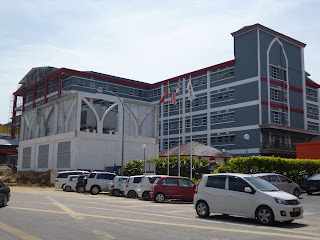
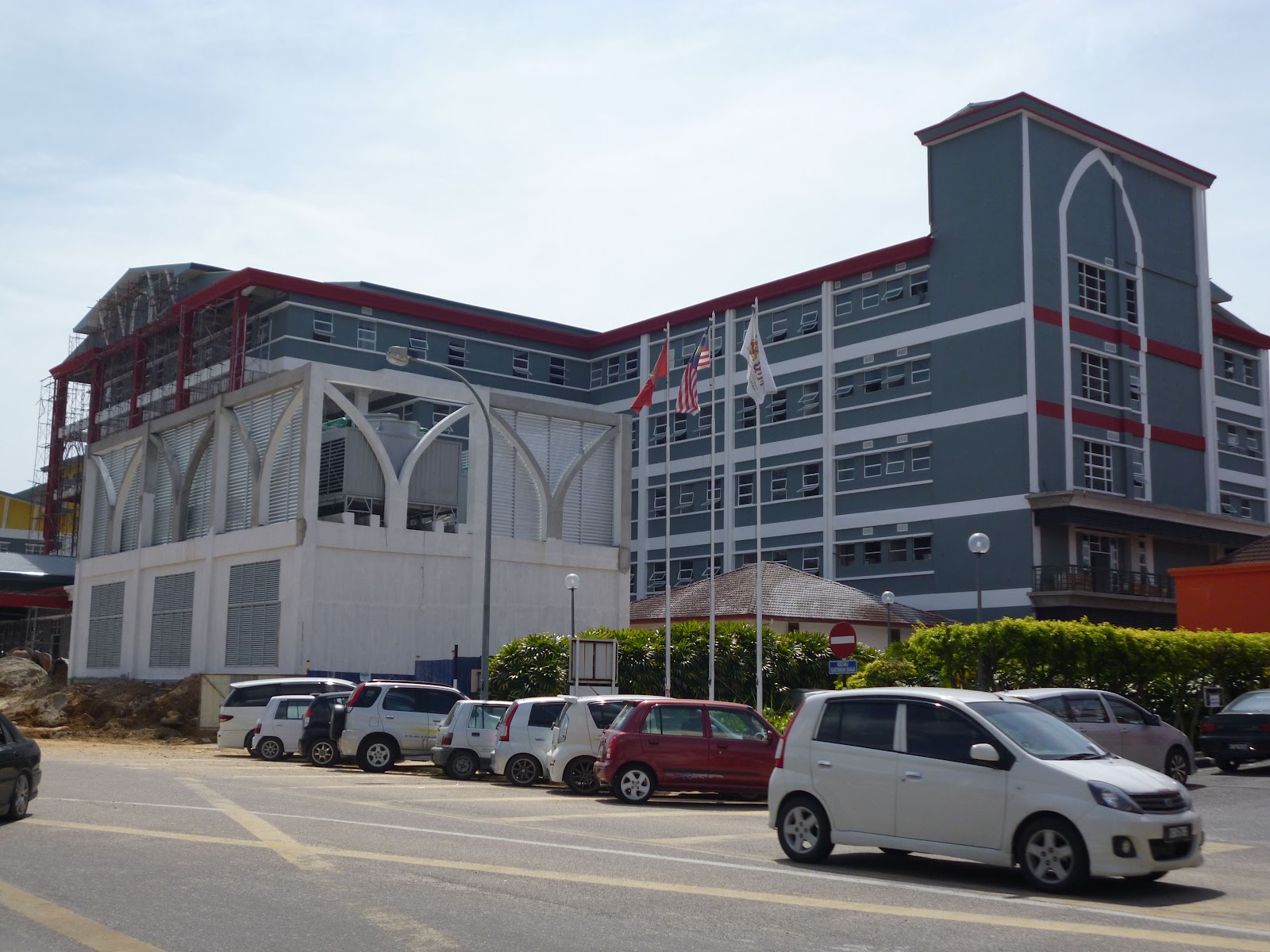
There are 2 new buildings which are almost nearing completion. These are the HUSM administration office and HUSM Accident & Emergency (A&E) Dept. One is the yellow complex, the other is gray & red complex.




 |
| HUSM Admin building |

 |
| HUSM A&E building |
Advanced Medical and Dental Institute (AMDI)
There is the Advanced Medical and Dental Institute (AMDI) in Bertam campus in Penang, and a small AMDI office here in Kelantan. When AMDI was opened in Bertam, staff whose families lived in Bertam moved back to Bertam or Penang island. As the lands in Bertam was cheap, people started buying lands and built affordable homes. Now Bertam is becoming expensive. After some time, a small AMDI office was opened in Kelantan campus. So now there in AMDI in Bertam and AMDI in Kelantan. I don't know what the reasons are. But I have heard news of proposed privatisation of AMDI in Bertam. In years to come, AMDI in Bertam may not be ours anymore. I don't know what the problems affecting it are. As far as I know the place, Bertam is too far away from the airport (Penang International Airport). To go to the airport from Bertam, one has to pay toll RM7.00 at Penang Bridge and then drive to Bayan Lepas where the airport is. This is impractical. I have not been to the place because it is far out from my usual travel routes.


School of Pharmacy (Clinical)
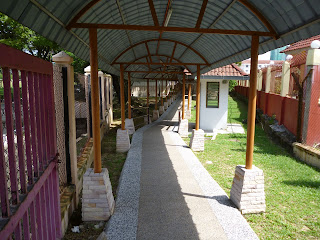
There is a small annex for the School of Pharmacy (Clinical) here in Kelantan campus. It is nearest the old playing field. I have only seen it today while strolling. It seems out of place and resembles the old colonial buildings which are joined by covered corridors. The building is actually a container built on a concrete base and fitted with long windows. Since it is a metal container, it needed air-conditioning. A lot of these units can be seen on the outside. I think this is ecologically-unfriendly as it uses a lot of electricity for cooling the 'metal box' whereas it is already situated under the trees and won't need to depend on air-conditioning so much. I think this place should be turned into a Centre for Child Health and Learning. Pharmacy should return to its initial complex at the medical school, not here.



School of Dentistry, USM
Pusat Pengajian Sains Pergigian (PPSG), Universiti Sains Malaysia (USM), Kubang Kerian, Kelantan, Malaysia.


 |
| Dr Zahar Ahmed is in blue shirt. Beside him is Mr Hazrul Reeza. Both are from UNU-IIGH. |
The Orphans
Far away in the plains of Gua Musang are several acres of oil palm plantations. The groves are named Chiku 1, Chiku 2, and Chiku 3. Chiku 3 is nearest KL. There was once a Malay man who looked after the oil palm plantations of Chiku 3. I called him Pak De. His real name was Ishak bin Hussin. Pake De married Mak De and they had 5 children, 2 boys and 3 girls. Pak De worked hard and saved as much as he could to have his own home. He managed to secure a terrace house in a row in front of a tadika (kindy) and a mosque. He was happy. He retired and had some money so he bought a piece of swampy land to build his second home, which was by the largest Malay graveyard in Tanah Merah. However, when his second home was ready, and it was his daughter's wedding. Pak De passed away at the hospital where my husband works. My husband received the call that Pak De was at out Hospital USM A&E. We went to see him after work. That time his pulse was about to disappear and the resuscitation team came to his rescue. The light blue curtains were drawn on 3 sides and the lifesavers team set to work. After minutes of the best effort to revive him, Pak De passed away at our hospital. Everyone was very sad. I was sad too and I was standing closest to the blue curtains and once in a while I would peek and see what they were doing to Pak De. I saw the worst. I informed Pak De's sons who were also on site. They cried. I had no tears as I was too sad to even cry. The boys wanted to see their father, so the team allowed them. I then left the room, feeling totally lousy. That was February 2012.
Coming back to Mak De, she was the second woman I met who liked my clothes and asked for them. She was a good seamstress and we bonded like sisters. She would take my clothes and re-modelled them into her clothes. That's like turning a size S to a size L but she turned my clothes into lovely pieces that she could wear. There was one instant she wore a brown two piece re-modelled chiffon garment, and she looked really elegant. Mak De was very tall. I think she was almost 6 feet tall. Mak De was 5 years my senior. She was 59 when she passed away. It made me very sad to lose a 'sister'. Now Mak De's 5 kids are orphans. Three of her daughters are still schooling and they are the same age as my last 2 daughters.
Today, 16 July 2012, I was performing Zohor prayers with my husband (solat jemaah). When we completed, he had a message on his mobile and picked up his phone to check if anyone was looking for him. It was a sad message that Mak De passed away at 1 pm at the General Hospital in Kota Bharu (GHKB). My husband understood the message well - we had to go and help. I said to my husband to go back to his workplace first and finish off his job there, then clock out and we'll go to Tanah Merah to attend to Mak De's funeral. When my husband returned at 5pm, I was just through my solat Asar. My husband had light snack and made my evening cup of milk for me. As I was packing to leave home, I gave instructions to my elder daughter to pick up my youngest daughter who was still at school and would only finished school at 6.15pm. Since it would take 1 hour to drive from Kubang Kerian to Tanah Merah, my husband and I had to leave home before 6pm, and reach Tanah Merah before dark. Then we left. I didn't like the idea of leaving home without seeing my youngest daughter who was still in school. We waited for my husband to finish his call to Bank Islam KL and then we had to leave for Tanah Merah. This time the journey was quiet and I was unhappy. I had also forgotten to bring along my prayer mat and clothes. I was totally upset. We usually played a CD for this 1-hour trip but not today. I was not in a mood to listen to any songs. I was saddened by Mak De's sudden demise. Mak De suffered from diabetes and had her left leg amputated below the knee. She was apparently well after that but went to ICU and passed away there. She had complained of difficulty breathing and was put on a respirator but she passed away in the ICU.
When we reached Mak De's house at about 7 pm, she was no longer there as her remains were already transferred to 'masjid besar', the main mosque in Tanah Merah. Affandi talked to Mak De's kids and talked to the eldest son, Badrul. We then left so my husband could drop me at my parent's in-law's place.
At the sound of Azan, my husband, his father, his sister's family all left to go to the main mosque to perform solat Maghrib. Then the men sat down to read the Quran for Mak De. They then performed solat jenazah before her remains were brought to the graveyard near her home. My husband, Mak De's eldest son and another son went down in the grave hole (liang lahad) to receive her remains. Her youngest daughter waited above ground to observe the burial process. That done, my husband returned to his parent's home to pick me up to go home.
I had dinner before my husband returned from the burial ground. When he arrived, there were many people at his parent's house. I was attending to a couple with 5 kids from Padang Tembak. The father of the family, whom I called Li, was telling me stories about his encounter with is classmates, some of whom are doctors where I work. My husband stepped inside the house but he was drenched in his own sweat. He had to take a bath and then we could perform solat Isya' together. My father-in-law joined us and the 3 of us prayed together. He sat on his little portable blue chair while my husband and I stood on our prayer mats. Then my husband had dinner and I accompanied him as I had already eaten. But I had jackfruit (nangka) and durian. Li opened a lot of durians for me to try.
Monday, 16 July 2012
The Malay Printing Press in Penang
INTRODUCTION
There were several newspapers published in the Malay States and outside the Malay States. 29 of these Malay newspapers between 1900 and 1941 were listed in 100 Akhbar Melayu ((2015) by Hamedi Mohd Adnan.
There were at least 8 Malay printing presses in early Penang in the 1900s.
1. Jelutong Press, 555 Jelutong Road in Jelutong
2. Warta Negara Press
3. Sinaran Brothers in Kg Seronok, Bayan Lepas
4. Al-Huda Press
5. C.A. Dabab Company 1925
8. Pustaka Ismail


---
JELUTONG PRESS
Jelutong Press was mentioned in the Encyclopedia Britannica. Jelutong Press was owned by Syed Sheikh.
Dr Syed Mohamed bin Alwi Alhady’s (Dr SMA Alhady) grandfather was Syed Sheikh bin Syed Ahmad Hassan al-Hadi, originally from Kampung Hulu in Malacca. Dr SMA Alhady’s father, Syed Alwi al-Hadi, was the eldest son of Syed Sheikh al-Hadi. Dr SMA Alhady was born in his parent's house at 431 Jalan Jelutong, Penang. This house could be this one, a bit hidden behind zinc fence:

There were several newspapers published in the Malay States and outside the Malay States. 29 of these Malay newspapers between 1900 and 1941 were listed in 100 Akhbar Melayu ((2015) by Hamedi Mohd Adnan.
There were at least 8 Malay printing presses in early Penang in the 1900s.
1. Jelutong Press, 555 Jelutong Road in Jelutong
2. Warta Negara Press
3. Sinaran Brothers in Kg Seronok, Bayan Lepas
4. Al-Huda Press
5. C.A. Dabab Company 1925
6. C. Dabab & Company 1926
7. The United Press 1928 in Dato' Kramat
8. Pustaka Ismail

 |
| Pustaka Ismail |

JELUTONG PRESS
Jelutong Press was mentioned in the Encyclopedia Britannica. Jelutong Press was owned by Syed Sheikh.
Sayid Syeikh Al-Hadi (lists publications of 1927-1933)
Jelutong Press occupied a bungalow in Jelutong, with banana trees in the backyard. The building has been demolished and what is left is a big empty parking lot, awaiting development for high-rise high-density residences.
SYED SHEIKH AL-HADI
SYED SHEIKH AL-HADI

Could this be 431 Jalan Jelutong, Penang?
Jelutong Press was established at 555 Jelutong Road in Jelutong. Syed Sheikh Al-Hady had chanelled much of his assets into setting up Jelutong Press. He even mortgaged his house at 410 Jelutong Road to finance his pet project.
The Jelutong Press was managed by three male staff. They were Encik Ismail - the machinist, Mohd Ariff bin Haji Mohd Shariff - the chief clerk as well as accountant, and Encik Arifin Ishak - the marketing and sales manager.
Arifin Ishak was involved in setting up Sahabat Pena (The Pen Friends), whose members subscribed to Saudara, and helped to keep it going.
Source:
Wazir Jahan Karim. Straits Muslims: Diasporas of the Northern Passage of the Straits of Malacca (2009:178n11).
 |
| Jelutong Press at 555 Jelutong Road in Jelutong, Penang, was owned by Syed Sheikh al-Hadi. Photo shows the composing room where the magazine al-Ikhwan and the weekly newspaper Saudara were printed. Standing: Syed Sheikh al-Hadi (in front in dark coat and white pants) and Mohd Tamim bin Sutan Deman. The compositors are seated at the compositor machines. Photo source: The Real Cry of Syed Shaykh al-Hady (1999: 169) |
There are a few old buildings left in Jelutong as it undergoes rapid development.

House in Jalan Jelutong, in front of Syed Sheikh's house (across the road). This house was demolished.
Source:
Alijah Gordon. The Real Cry of Syed Shaykh al-Hady (1999: 69)
When he died, the Jelutong Press also dwindled and his house at 410 Jelutong Road was repossessed by his debtors. There are no details of his debtors (possibly chetty) and the repossession of the house ended up being a Chinese temple and is looked after by vegetarian nuns.
Source:
My visit to see the house.
Syed Alwi wrote that the Jelutong Press had ceased during the Second World War. This means that the Jelutong Press continued for another 10 years after its founder passed away, before it finally closed down for good before WWII.
Source:
Alijah Gordon. The Real Cry of Syed Shaykh al-Hady (1999: 80n33)
Why did the Jelutong Press shut down?
The actual reasons for the foreclosure of Jelutong Press is unknown. But I have a gut feeling that the global recession that hit the USA in the 1930s also affected the spare parts, inks and newsprint supplies needed to print the magazines and newspaper. Also the debts grew as usury (riba) usually does. So maybe poor sales and supplies plagued, strangled and finally killed the Jelutong Press, bringing it to eternal stop. It could be also because the Japanese refused printed matter other than Japanese propaganda.
MAJALAH AL-IMAM (1906-)
Shaykh Muhammad Tahir Jalaluddin, together with Sheikh Mohamed Salim al-Kalili, Haji Abbas Mohamed Tahar and Syed Shaykh al-Hady, founded the magazine Majalah al-Imam on 23 July 1906. Later, he contributed writings to Syed Shaykh al-Hady’s magazine al-Ikhwan (1926) and the initially weekly, later biweekly newspaper Saudara (29 September 1928).
---
WARTA NEGARA PRESS
The Warta Negara Press HQ was at No 216, Penang Road, Penang.
Warta Negara publisher was Ahmad Jelani.
WARTA (1953-1954) & WARTA NEGARA (1945-1969)
Warta Negara was written in Jawi script and was published by Warta Negara Press in Penang after WW2, beginning 3 September 1945. The newspaper measured 55 cm x 39 cm and had 4-6 printed pages, sometimes more.
http://prpm.dbp.gov.my/Search.aspx?k=warta&d=8
AHMAD JELANI
Ahmad Jelani (Ami Jelani) was Bapak's uncle who lived in Gelugor by Jalan Gelugor (now Jalan Sultan Azlan Shah). Two of Ami Jelani's cousins lived in Banda Hilir, Malacca. Ami Jelani's sister was Hawa Jelani ... she linked to Ami Aziz of Jelutong Timur. Hawa Jelani's daughters are Siti Mariam, Siti Kachik and Siti Hajar bt Mohamad
---
There is a more recent Malay printing press at Kampung Seronok, farther up from USM. Kampung Seronok is a tourist village. It may have the leftover parts of the printing press of the old Jelutong Press. I have to ask there some day.
MANSOR SANUSI
Mansor Sanusi (born 1909, Kg Seronok, Bayan Lepas, Penang-died 1974) was a Malay language teacher, printer and publisher. He wrote and published more than 200 books. He owned the printing and publishing firm, Sinaran Brothers.
Many of USM's high quality books are printed by Sinaran Brothers.
Source:
http://penangmalays.com/2014/03/24/mansor-sanusi/
---
AL-HUDA PRESS
---
(1) C.A. DABAB COMPANY 1925
(2) C. DABAB & COMPANY 1926
(3) THE UNITED PRESS 1928
C.A. Dabab Company was formed by Dabab Haji Muhammad Salleh and Syed Abdul Rahman bin Muhammad al-Habshi in 1925.
http://prpm.dbp.gov.my/Search.aspx?k=warta&d=8
AHMAD JELANI
Ahmad Jelani (Ami Jelani) was Bapak's uncle who lived in Gelugor by Jalan Gelugor (now Jalan Sultan Azlan Shah). Two of Ami Jelani's cousins lived in Banda Hilir, Malacca. Ami Jelani's sister was Hawa Jelani ... she linked to Ami Aziz of Jelutong Timur. Hawa Jelani's daughters are Siti Mariam, Siti Kachik and Siti Hajar bt Mohamad
---
SINARAN BROTHERS
There is a more recent Malay printing press at Kampung Seronok, farther up from USM. Kampung Seronok is a tourist village. It may have the leftover parts of the printing press of the old Jelutong Press. I have to ask there some day.
MANSOR SANUSI
Mansor Sanusi (born 1909, Kg Seronok, Bayan Lepas, Penang-died 1974) was a Malay language teacher, printer and publisher. He wrote and published more than 200 books. He owned the printing and publishing firm, Sinaran Brothers.
Many of USM's high quality books are printed by Sinaran Brothers.
Source:
http://penangmalays.com/2014/03/24/mansor-sanusi/
---
AL-HUDA PRESS
Al-Huda Press owner was Syeikh Abdullah al-Maghribi Al-Ghadamshi, a Libyan.
SYEIKH ABDULLAH AL-MAGHRIBI AL-GHADAMSHI
He was born in 1892 at Ghadamis, Libya.
He died in 1974 in Libya.
He was an influential businessman and educationist in the first decade of the 20th century.
He died in 1974 in Libya.
He was an influential businessman and educationist in the first decade of the 20th century.
He taught Arabic, Arabic literature, Fekah and Balaghah at Madrasah al-Mashoor in Penang.
He was the Headmaster of al-Mashoor in 1919.
He owned the printing company, Al-Huda Press
He published his writings Kitab Munir al-Ifham and Kitab Ilmu Balaghah
He printed religious reading materials and newspaper, Sahabat
He was the Headmaster of al-Mashoor in 1919.
He owned the printing company, Al-Huda Press
He published his writings Kitab Munir al-Ifham and Kitab Ilmu Balaghah
He printed religious reading materials and newspaper, Sahabat
Source:
(1) C.A. DABAB COMPANY 1925
(2) C. DABAB & COMPANY 1926
(3) THE UNITED PRESS 1928
He formed a new company C. Dabab & Company in 1926.
He formed The United Press in Dato’ Kramaat in 1928.
His printing companies published books and magazines.
He printed Warta Malaya
DABAB HAJI MUHAMMAD SALLEH
He was born in the early 1900s.
He was a merchant, printer and publisher.
He wrote his first book, Kitab Taman Pengetahuan dan Perjalanan bagi Orang Ramai.
He was also a distributor of perfumery, toiletries and medicated oil.
He formed United Trading Company, a distributor of general goods
Source:
http://penangmalays.com/2014/03/24/dabab-muhammad-salleh/
---
External links:
http://www.myjurnal.my/filebank/published_article/22939/028_043.PDF
He was born in the early 1900s.
He was a merchant, printer and publisher.
He wrote his first book, Kitab Taman Pengetahuan dan Perjalanan bagi Orang Ramai.
He was also a distributor of perfumery, toiletries and medicated oil.
He formed United Trading Company, a distributor of general goods
Source:
http://penangmalays.com/2014/03/24/dabab-muhammad-salleh/
---
External links:
http://www.myjurnal.my/filebank/published_article/22939/028_043.PDF
The Sultanate of Sulu
Where and what is Sulu? Have you ever heard of Sulu?
Sulu
http://en.wikipedia.org/wiki/Sulu
Sulu is an autonomous island province of the Philippines located in the Autonomous Region in Muslim Mindanao (ARMM). Its capital is Jolo and occupies the middle group of islands of the Sulu Archipelago, between Basilan and Tawi-Tawi. It is home to the historical Sultanate of Sulu.
The peaceful advent of Islam around 1138 through merchants and traders had a distinct influence on Southeast Asia. The coming of Arabs, Persians and other Muslims paved the way for the arrival of religious missionaries, traders, scholars and travelers to Sulu and Mindanao in the 12th century.
A landmark born of the social process was the founding of the principality of Buansa Sumatra, who settled there and married the daughter. A decade earlier (1380), Karim-ul-Mahkdum, an Arab religious missionary and learned judge, reinforced the Islamic foundation of Rajah Baguinda’s polity (1390–1460) and that of the Sultanate of Sayid Abubakar, princely scholar from Arabia who married Paramisuli, the daughter of Rajah Baguinda. Sayid Abubakar eventually inherited the rule of Rajah Baguinda, established the Sultanate and became the first Sultan of Sulu. To consolidate his rule, Sayid Abubakar united the local political units under the umbrella of the Sultanate. He brought Sulu, Zamboanga Peninsula, Palawan and Basilan under its aegis.
The navigational error that landed Ferdinand Magellan to Limasawa brought the Philippines to the awareness of Europe and opened the door to Spanish colonial incursion. The Spaniards introduced Christianity and a political system of church-state dichotomy encountering fierce resistance in the devastating Moro wars from 1578 to 1899.
After Spain ceded the Philippines to the United States, American forces came to Jolo and ended the 23 years of Spanish military occupation (1876 to 1899). On August 20, Sultan Jamalul Kiram II and Brig. Gen John C. Bates signed the Bates Agreement that continued the gradual emasculation of the Sultanate started by Spain (Treaty of 1878) until its final inertia on March 1915 when the Sultan abdicated his temporal powers in the Carpenter Agreement. The Agreement totally vanished opposition against the civilian government of Gov. Clinton Solidum.
The Department of Mindanao and Sulu under Gov. Carpenter was created by Philippine Commission Act 2309 (1914) and ended on February 5, 1920 by Act of Philippine Legislature No. 2878. The Bureau of Non-Christian Tribes was organized and briefly headed by Teofisto Guingona, Sr. With the enactment by the US Congress of the Jones Law (Philippine Autonomy Law) in 1916, ultimate Philippine independence was guaranteed and the Filipinization of public administration began. Sulu, however, had an appointed American governor until 1935 and the Governor General in Manila had a say in Sulu affairs. At any rate, the essence of local governance forged by Rajah Baguinda continued to permeate the ethos of Sulu politics despite centuries of colonial presence. History points to a local government in Sulu that antedates other similar systems in the country.
Today, Sulu has a locally constituted government under the new leadership of Governor Benjamin T. Loong and is part of the Autonomous Region in Muslim Mindanao.
The Tausug dominate the Sulu Archipelago. The Tausug were among the first inhabitants of the Philippines to embrace Islam as a religion and a way of life. Their traditional religio-political structure is the sultanate. The sultan is the head of all ranks. Succession is by election by his staff although patrilineal succession is the ideal.
The Tausug are referred to as ‘people of the current’, reflective of their close ties to the sea. The handicrafts of Sulu mirror Islamic and Malay influences. Skilled artisans make boats, bladed weapons, bronze and brassware, pis cloth, embroidered textiles, shellcraft, traditional house carvings, and carved wooden grave markers.
Fishing is the most important industry since the Sulu Sea is one of the richest fishing grounds in the country. The province also has an extensive pearl industry. Pearls are extensively gathered and a pearl farm is established at Marungas Island. The backs of sea turtles are made into beautiful trays and combs. During breaks from fishing, the people build boats and weave mats. Other industries include coffee processing and fruit preservation. - Wikipedia.
Sultanate of Sulu
Photo 2
Sultanate of Sulu
http://en.wikipedia.org/wiki/Sabah
The Sultanate of Sulu was granted the north-eastern part of the territory as a prize for helping the Sultan of Brunei against his enemies and from then on that part of Borneo was recognised as part of the Sultan of Sulu's sovereignty. In 1878, Baron Von Overbeck, an Austrian partner representing The British North Borneo Company and his British partner Alfred Dent, leased the territory of Sabah. In return, the company was to provide arms to the Sultan to resist the Spaniards and 5,000 Malayan dollars annual rental based on the Mexican dollar's value at that time or its equivalent in gold. This lease was continued until the independence and formation of the Malaysian federation in 1963 together with Singapore, Sarawak and the states of Malaya. As of 2004, the Malaysian Embassy to the Philippines had been paying cession/rental money amounting to US$1,500 per year (about 6,300 Malaysian Ringgits) to the heirs of the Sultanate of Sulu despite Spain and indirectly Sulu renounced all sovereignty according to Article III of Madrid Protocol of 1885.
On 12 September 1962, during President Diosdado Macapagal's administration, the territory of North Borneo, and the full sovereignty, title and dominion over the territory were ceded by the then reigning Sultan of Sulu, HM Sultan Muhammad Esmail E. Kiram I, to the Republic of the Philippines. The cession effectively gave the Philippine government the full authority to pursue their claim in international courts. The Philippines broke diplomatic relations with Malaysia after the federation had included Sabah in 1963 but probably resumed it unofficially through the Manila Accord.
In 1968, Ferdinand Marcos was training a team of saboteurs on Corregidor for infiltration into Sabah but instead Marcos double-crossed the saboteurs. This event is known as the Jabidah massacre. Diplomatic ties resumed in 1989 because succeeding Philippine administrations have placed the claim on the backburner in the interest of pursuing cordial economic and security relations with Kuala Lumpur.- Wikipedia.
Sunday, 15 July 2012
Radio Malaya
Radio Malaya
Radio dan Televishen Malaysia (RTM)
----
Datuk Haji Zainul Alam (5 March 1926-12 December 1991)
Malay radio announcers after WW2:
Mass Media 1900-1936
Radio in Malaya
- radios were not saleable items in British Malaya
- there were no radio broadcasting station in the 2,000-mile radius of Singapore
- Singapore was a dead spot
- Amateur Wireless Society of British Malaya operated an experimental station in Singapore
- Penang had no broadcasting station
- the Malayan Broadcasting Service (Ltd.) had a 5-year licence
- to erect a main radio station in KL immediately, and 2 relay stations later
- Penang was a free port for radio apparatus
- potential radio customers were limited to 4,000 Europeans and 25,000 wealthy Chinese and Eurasians; the population at the time was 1,250,000.
TSFPMA 31Dec1927 p8
----
Send-Off For Malay Announcers
The Straits Times, 3 September 1946, Page 5
Two young Malay radio announcers, Inche Mustapha bin Che Ismail and Inche Idris bin Ahmad Shah, who are going to England early next week to broadcast B.B.C. news in Malay, were given a tea-party by Utusan Melayu at the G. H. Cafe yesterday.
Both Inche Idris and Inche Mustapha are at present Malay announcers with Radio Malaya. They were attached to the R.N.V.R. during the war and broadcast to Malaya over the All-India Radio and also from Ceylon.
Two of their colleagues, Suffian bin Hashim and Ismail bin Ali, who have been with the B.B.C. since the liberation, are returning to Singapore shortly.
----
Radio dan TV Malaysia (RTM) had its beginnings in 1946, before the Malayan Independence. Radio Malaya was a big thing before the TV came to Malaysia. I first watched a B/W TV in 1963.
Radio dan Televishen Malaysia (RTM)
----
Datuk Haji Zainul Alam (5 March 1926-12 December 1991)
- Senior RTM broadcaster in Penang during WW2
- Penang Wireless Party, HQ at Penang Radio Station
- He was a member and the radio announcer for the Malay section, managing the news and song requests.
Malay radio announcers after WW2:
- Suffian bin Hashim
- Ismail bin Ali
- Inche Mustapha bin Che Ismail
- Inche Idris bin Ahmad
Mass Media 1900-1936
Radio in Malaya
- radios were not saleable items in British Malaya
- there were no radio broadcasting station in the 2,000-mile radius of Singapore
- Singapore was a dead spot
- Amateur Wireless Society of British Malaya operated an experimental station in Singapore
- Penang had no broadcasting station
- the Malayan Broadcasting Service (Ltd.) had a 5-year licence
- to erect a main radio station in KL immediately, and 2 relay stations later
- Penang was a free port for radio apparatus
- potential radio customers were limited to 4,000 Europeans and 25,000 wealthy Chinese and Eurasians; the population at the time was 1,250,000.
TSFPMA 31Dec1927 p8
----
Send-Off For Malay Announcers
The Straits Times, 3 September 1946, Page 5
Two young Malay radio announcers, Inche Mustapha bin Che Ismail and Inche Idris bin Ahmad Shah, who are going to England early next week to broadcast B.B.C. news in Malay, were given a tea-party by Utusan Melayu at the G. H. Cafe yesterday.
Both Inche Idris and Inche Mustapha are at present Malay announcers with Radio Malaya. They were attached to the R.N.V.R. during the war and broadcast to Malaya over the All-India Radio and also from Ceylon.
Two of their colleagues, Suffian bin Hashim and Ismail bin Ali, who have been with the B.B.C. since the liberation, are returning to Singapore shortly.
----
Radio dan TV Malaysia (RTM) had its beginnings in 1946, before the Malayan Independence. Radio Malaya was a big thing before the TV came to Malaysia. I first watched a B/W TV in 1963.
There were many great Malaysians at RTM - Gus Steyn, Alfonso Soliano, Datuk Jimmy Boyle, Tan Sri Dol Ramli, Tan Sri Ahmad Merican, Datuk Johari Salleh, etc.
Gus Steyn composed patriotic songs for Malaysia.
Alfonso Soliano composed patriotic songs and Negara Ku, the national anthem.
Datuk Jimmy Boyle @ Penang Boy, introduced jazz to Malaysia.
Tan Sri Dol Ramli was a close friend of Datuk Dr Haji Abbas bin Haji Alias, an early Malay doctor, even in their old age.
Tan Sri Ahmad Merican's name was mentioned by his relatives. He was in radio before the Japanese war.
Datuk Johari Salleh composed some songs. His daughter was in my elder sister's class at Malacca Girls' High School at Durian, Daun in Malacca circa 1972-1974.
----
External links:
----
External links:
RTM History
Regulations in Malaysia vs Canada
Music Authors' Copyright Protection (MACP) Berhad
Music Program offered by UPM in 2008
Sudirman Arshad
Flora Santos
Ooi Eau Jin
----
Photos from Penang Museum
Regulations in Malaysia vs Canada
Music Authors' Copyright Protection (MACP) Berhad
Music Program offered by UPM in 2008
Sudirman Arshad
Flora Santos
Ooi Eau Jin
----
Photos from Penang Museum
 |
| Radio Malaya. Photo from Penang Museum. |
 |
| Radio Malaya. Photo from Penang Museum. |
The Armenians and Jews of Penang
These are from the Penang Museum and my collection.
ARMENIAN
 |
| Photo from Penang Museum. |
JEWS
 |
| A gallery in Penang Museum that displays information about the Jews in Penang |
 |
| Photo from Penang Museum |
 |
| Text for the photo above, from Penang Museum. The text explains the origin of the Jews who came to early Penang. |
E&O Hotel, Georgetown, Penang
 |
| Photo from Penang Museum |
 |
| Close-up of E&O Hotel. Photo from Penang Museum |
 |
| The E&O Hotel, Georgetown, Penang. 2012. Photo by me. |
 |
| The E&O Hotel, Georgetown, Penang. 2012. Photo by me. |
Jewish Graves in Penang
All my professors in California and Perth were either Jews or Christians. It is hard to tell the Jews from the Christians because they can be mistaken for Christians. It is not known whether Jews can become Christians and then become Muslims. Jews, Christians and Muslims have similar names but different spellings. Common names are Abdul Rahman, Yahya, Aaron, Jacob, etc.
From what I understand of history, the Dutch East India Company seamen were Jews. They landed in Ceylon (Sri Lanka) and Malacca. Malacca was Dutch Jew for a long time. Then the British took over from the Dutch and built the churches in Malacca, mostly the Protestant churches. There is no Dutch church as they were Jews. The Dutch Jewish graves should be plenty in Malacca. Today, the mixed Asian Jews are not known as Jews but by another name, some are 'Christians' but have Jewish surnames. However, most of the Jews found in Malaysia are Indians but have Jewish names.
Malaysia forbids Jews from entering into the country as it is an Islamic country. However, the Jews can state 'Christian' for their religion in their passports and visit Malaysia. They can also hold 2 passports - Israel, Iran, USA or UK, and can therefore come to Malaysia.
The Jews consume koshered food. This was aired on Malaysian TV (ASTRO) some time back this year. It was a documentary about the Jews in the Bronx and their livelihood. They wore gloves when handling food at the deli. They worked and owned farms. The one showed was mainly about country life. But we know the Jews are also in academia, banking, military, governments, hoteliers, music industry, etc world wide.
Malaysia hired a very good musician - Gus Steyn, who was a Jew. He worked with Orkestra RTM and composed some of the most beautiful songs played in Malaysia. I remember playing some of his songs on my own piano when I lived in Kelantan between 1969 and 1971. After Gus Steyn (Gustaaf Nicolaas Steyn), we had Alfonso Soliano, who also composed some of the most beautiful songs for Malaysia. In the mid-1970s, there was Irving Berlin in the USA and his beautiful musical scores, which were adapted for the electric organ.
There was still a Jewish community in Penang when I started work at USM in Penang in 1982. When we started the USM medical school in 1979, we had two Jewish lecturers. One was a lecturer in Immunology and the other in Community Medicine. They have both left before the medical school moved to Kelantan in May 1990. The one in Immunology was Prof. Peter Simmons; he already passed away. He was instrumental in setting up the Dept of Immunology for the USM medical school. The other one returned to USA and I don't know whether he is still alive or not. His name is Stephen Wheeler King. Both were very good lecturers.
Gravestone inscriptions point to a lot about our past. Someone wrote on 15 July 2012 to ask about the Jewish graves in Penang. I will help out here at my blog since I have lived in many places including Malacca and Penang. I am familiar with some of the graves but not all the graves.
Jewish Cemetery
Yahudi Road/Jalan Yahudi --> Jalan Zainal Abidin
Georgetwon
Penang
From what I understand of history, the Dutch East India Company seamen were Jews. They landed in Ceylon (Sri Lanka) and Malacca. Malacca was Dutch Jew for a long time. Then the British took over from the Dutch and built the churches in Malacca, mostly the Protestant churches. There is no Dutch church as they were Jews. The Dutch Jewish graves should be plenty in Malacca. Today, the mixed Asian Jews are not known as Jews but by another name, some are 'Christians' but have Jewish surnames. However, most of the Jews found in Malaysia are Indians but have Jewish names.
Malaysia forbids Jews from entering into the country as it is an Islamic country. However, the Jews can state 'Christian' for their religion in their passports and visit Malaysia. They can also hold 2 passports - Israel, Iran, USA or UK, and can therefore come to Malaysia.
The Jews consume koshered food. This was aired on Malaysian TV (ASTRO) some time back this year. It was a documentary about the Jews in the Bronx and their livelihood. They wore gloves when handling food at the deli. They worked and owned farms. The one showed was mainly about country life. But we know the Jews are also in academia, banking, military, governments, hoteliers, music industry, etc world wide.
Malaysia hired a very good musician - Gus Steyn, who was a Jew. He worked with Orkestra RTM and composed some of the most beautiful songs played in Malaysia. I remember playing some of his songs on my own piano when I lived in Kelantan between 1969 and 1971. After Gus Steyn (Gustaaf Nicolaas Steyn), we had Alfonso Soliano, who also composed some of the most beautiful songs for Malaysia. In the mid-1970s, there was Irving Berlin in the USA and his beautiful musical scores, which were adapted for the electric organ.
There was still a Jewish community in Penang when I started work at USM in Penang in 1982. When we started the USM medical school in 1979, we had two Jewish lecturers. One was a lecturer in Immunology and the other in Community Medicine. They have both left before the medical school moved to Kelantan in May 1990. The one in Immunology was Prof. Peter Simmons; he already passed away. He was instrumental in setting up the Dept of Immunology for the USM medical school. The other one returned to USA and I don't know whether he is still alive or not. His name is Stephen Wheeler King. Both were very good lecturers.
Gravestone inscriptions point to a lot about our past. Someone wrote on 15 July 2012 to ask about the Jewish graves in Penang. I will help out here at my blog since I have lived in many places including Malacca and Penang. I am familiar with some of the graves but not all the graves.
Jewish Cemetery
Yahudi Road/Jalan Yahudi --> Jalan Zainal Abidin
Georgetwon
Penang
Jewish Cemetery link 1 (has map)
Jewish Cemetery link 9 (some links did not work)
Jewish Cemetery link 10 (hotels close to the cemetery)
Jewish Cemetery link 10 (hotels close to the cemetery)
Google photos of Jewish Cemetery in Georgetown
Other related articles:
Sejarah Yahudi di Malaysia (Malay article)
Gus Steyn songs
Bohemian dance Nr.2 performed in Australia
Norlaila Ayoub links
RTM Konsert Perdana 1974
RTM Konsert Perdana 1975
Malam Ku Bermimpi
Nona Zaman Sekarang
Other related articles:
Sejarah Yahudi di Malaysia (Malay article)
Gus Steyn songs
Bohemian dance Nr.2 performed in Australia
Norlaila Ayoub links
RTM Konsert Perdana 1974
RTM Konsert Perdana 1975
Malam Ku Bermimpi
Nona Zaman Sekarang
Subscribe to:
Posts (Atom)


