Thursday, 21 June 2012

The Kling People

I wrote 2 posts yesterday and this blog had 222 hits after that. Those were the two 'geram' articles I wrote. Sometimes I get this geram (angered, angry) mood and I write fast and strong, and I breathe like a bull or a bison when I'm just a swan. Sometimes I have no story to write about as my hands won't write even though the story unfolds in my grey matter. Today, I will write for you about the Indians. Everybody calls them 'Kling', a supposedly derogatory word, pointing to a lesser status of the dark skin people. Let me begin this story of the Kling people in my own words and in my own experience, unbiased by what other people have viewed and written about the Kling people.


INTRODUCTION TO THE WORD KLING AND THE KLING PEOPLE

Kling is not killing, keeling or kneeling. Kling is Kling, Keling or Kalinga, but not Klang or Kelang. The word Kling or Keling has many meanings, depending on what the context is. Here are some of the contextual meanings as I understand the word.

Type 1 context:
When someone shouts angrily at you and says 'Awak Keling kah?', then that means 'are you stupid?' or 'are you a fool?'. It implies that one must not act silly and, it is also an indirect order to ask you 'to do something better next time and not act foolishly'.

Type 2 context:
When boys are naughty and they play noisily around the elderly and irritate them, then the elderly will shout to them 'Hei, budak Keling!' which translates to 'hey, you naughty boys!' It does not mean the boys are Indians at all or that all Indian boys are naughty and noisy. It is just an expression.

Type 3 context:
When someone meets you and asks you 'Awak orang Kling kah?' or 'Awak orang India kah?' or 'Awak India mari?', then there are many shades of meanings. (i) Awak orang Kling kah? can be asking whether you are Indian from a Kling settlement (ie, a locality) or the Kalinga group of Indian people (ie, ethnicity). (ii) Awak orang India kah? can be asking whether you are Indian, and therefore assumes you speak and can comprehend the Indian language. (iii) Awak India mari? is directly asking whether you hail from India. It does not ask whether your ancestors were Indians or were from India. It only asks your status.

Type 4 context:
The racial group Kling or Keling refers to the many groups of Indians in Malaya, Malaysia and Singapore. Kling or Keling is an ethnic label for all Indians. Because the unlettered lay Malays do not understand Indian migrations and the geography of the vast Indian sub-continent, they group all the Indians as Kling or Keling. This is the weakness on the part of the Malays. So the educated Indians (Kling or Keling) must enlighten the Malays on this aspect.

If you look back into Malacca history, there is a place in Malacca called Tanjung Keling, supposedly where the Indians came ashore in Malacca during the Portuguese era, and also during the Dutch era. Whether the Indians came as traders or forced labour, I don't know, presumably both. Maybe they came as forced labour (convicts and coolies) first and then as indentured labourers later, and eventually as seekers of fortune. But the phenomenon of the Indians arriving and building an Indian settlement at Tanjung Keling is real, and that has lasted till today. But I don't find many Indians there. There is however, Shah's Village in Tanjung Keling in Malacca. Shah's Village was owned by H.M. Shah, an Indian relative of my father (my father was descended from a clergy Arab-princely Minangkabau lineage). My father recalled his uncle H.M. Shah's wife as 'rich with bangles'. So the Indians (and thus Kling or Keling) of Tanjung Keling, were actually rich and successful traders. If you study the H.M. Shah empire, you will be surprised to find that they own a lot of the assets and some of the prime lands in and around KL, Selangor and Malacca. A lot of hotels and resorts are theirs. So that is how powerfully rich the Kling or Keling can be and are today. So, don't belittle their status if you are not a millionnaire or billionnaire, or earning RM30K per day. The Kling or Keling are richer than all the Malays today, despite their humble origins as Indian migrants from 1511 onward (Portuguese era), 1641 onward (Dutch era), or 1824 onward (British era)) - as convicts, coolies, indentured labourers, fortune seekers, traders, etc. They have successfully found a new home here. The Malays cannot match the hardworking Kling/Keling who are able to persevere everything and make their way out of their misfortunes within 5 generations (if I take 1824 as the index). The Kling/Keling have every right to demand respect for their present status as the rich and powerful among the 28 million Malaysians we have today. So the Malays must use the word Kling or Keling rightfully, and respect the Indians who have made it successfully.

Type 5 context:
The historical word Kling or Keling is just a geo-ethnic label which western authors used for writing about the early Indians who arrived in the British settlements and outposts. We have to deeply think about why the British thought of the Indians as a lowly group of Indians and therefore discriminated them based on skin colour, etc. If we are humans, then we know that it is every human's right to live and be treated as human, as equally as other humans. We cannot treat others as lowly animals or treat them inhumanely. So that brings us to the question of 'why did the British discriminate the Indians?' I don't know. We all know the Indians tend to have dark skin shades while the British have fair skin tones. If you read the Quran, it tells us that the skin and ethnicity do not make us better humans. What makes us better humans is the faith we hold within. So why did the British discriminate and ill-treat the Indians? I guess, the Indians are gentle people and they take anger within, they don't show anger. They practise Yoga and are able to deal with a lot of insults, especially those arising from skin tones. The dark skin tones may make them feel inferior but the Great Creator has given the Indians something that no other ethnic group has. What can that be? The Indians are bestowed with the best brains for mathematics. Their brains are specialised for this very high mental capability. And because there are Indians in this world, we are blessed with things related to numbers. What are things related to numbers? What if I told you these facts: Silicon Valley is dominated by highly educated Indians; NASA is highly dependent on Indian scientists who all have PhDs; France and India have the best mathematicians; and there are many more evidences of the geniuses of the Indians. So, don't belittle the Indians just because they have a darker skin tone compared to you. Remember, you have a lesser brain than any Indian and you cannot see that. This is what I call Rahmatullah (rahmat Allah). So, be thankful that we have Indians in this world and especially a lot of them in Malaysia and Singapore. What would the world be without the Indians? Without the Indians, we won't be counting money, we won't be able to fly to the moon, we won't have holidays, and we won't be enjoying holidays overseas as nobody knows how to even schedule flights. All things dealing with numbers are from the Indians, including the money changer. There was even a big double-storey Indian Mercantile Bank in Kota Bharu before the Japanese invaded Malaya; Kota Bharu only had a small defunct Bank Pitis. So be very thankful that we have the Indians with us today.

The Indian money changer's box. Photo from Penang Museum.

Pre-war Indian Mercantile Bank in Kota Bharu, Kelantan. This is now the WWII Museum (Muzium Perang Dunia Ke-2). I used to follow my mother to this bank - I was 11 years old. The bank officers spoke English.

Go to Little India in Penang and Singapore, and you know what I mean. Even the flower shops near the temples (kuil India) are a delight to visit on weekends. I even bought flowers for my wedding from the flower shops by the Indian kuil in Dato Keramat Road in Penang. 

Indian flower stalls in Penang

And remember the oh-so-good roti canai, capati, murtabak, nasi briyani, kurma, and everything else Indian, the Indians have made this world a more colourful place and added so much variety to Malay cuisine.

Nasi briyani served in Kota Bharu, Kelantan. This plate costs RM8.50.

If you admire Indian materials (kain sari) then you have every reason to thank the Indians for the beautiful sari materials, both the feather-weight and heavy sari materials. They go well with Indian gold accessories. Oh! So wonderful life is with all these sari and gold and perfumes.

A beautiful purple Indian sari material from Bangalore, India, made into a Malay baju kurung for Aidilfitri. This is my daughter's baju kurung. She bought the material in Bangalore for RM80. and had it sewn in Kubang Kerian for RM30. This type of sari baju kurung sells for approx. RM300-RM500 in KL boutiques.

Masjid Kapitan Keling in Penang is a beautiful mosque. When I prayed there I had tears because the mosque is so lovely. It is an Indian mosque and is the cleanest of the many mosques I have been to. The grounds make you feel like you are in the palace when actually you are in the mosque. So please visit Masjid Kapitan Keling next time you visit Penang. Reasonably priced nasi kandar is served outside by the front gates. You can order the rice and that goes down well with air limau ais or teh limau ais. You can eat under the payung and watch the afternoon traffic pass by. Bon appetite!

Masjid Kapitan Keling, Jalan Masjid Kapitan Keling, Penang. This is a beautiful mosque within the World Heritage Cities (of two cities - Penang and Malacca).


I think that settles the long introduction to the Indians whom we call Kling or Keling. Be happy!

Wednesday, 20 June 2012

The Most Difficult Malay Word - Sukachita

Dictionary


When one lives overseas, and before the time of the Internet, there would be 2 ways of looking up a Malay word - ask or look in the dictionary.

I was a MARA scholarship holder for my undergraduate degrees. One day, I received a light blue feather-weight aerogram (air-mail letter) from my future sponsor and employer - Universiti Sains Malaysia (USM). The letter was written entirely in Malay except for my address. I read and read, and read, and read, over and over, over and over... there was one word which I did not know - the word 'Sukachita'.

I knew other words  - suka, chita, chinta, but not this superword - sukachita. I went round to ask the other Malay students for the meaning of the word, 'sukachita'. Nobody knew what that word meant. I called up people to ask what the word 'sukachita' meant but nobody knew. So I was left with a letter with a long Malay word which I did not know what it meant, and nobody knew it either. The haunt went on for the rest of my life overseas - about 10-11 years. 

So, what does 'sukachita' mean to you? It is now spelled as 'sukacita'. What is sukachita or sukacita?

Here are the answers...
  1. There is Jalan Sukachita in Singapore. 
  2. There is an old Malay book involving Hikayat Abdullah that uses the word: http://bl.academia.edu/AnnabelGallop/Papers/1164413/Cerita_kapal_asap
  3. It is a word used in the old Malay language, especially in Malay silat involving Hang Tuah: http://warisansunankalijaga.blogspot.com/2011/01/hang-tuah-bapa-seni-silat-melayu-sejati.html
  4. It is used in a missionary bulletin entitled Messenger/Pesuruh which was written in English and Malay, and used for spreading the Christian mission: http://www.adventistarchives.org/docs/SEAUM/SEAUM19590801-V09-08__C.pdf
  5. Same as above: http://www.adventistarchives.org/docs/SEAUM/SEAUM19581201-V08-12__C.pdf [The word 'dukachita' appears in the case of death or obituary.] A lot of Malays subscribed to its lessons called 'Suloh Hidup', without knowing that is was in fact a Christian mission written in old Malay. 
  6. It is a word cited in Sabri Zain's comments on the genesis of the Malay Annals, which covers the times of Hikayat Munshi Abdullah and also Sultan Mahmud of Malacca: http://www.sabrizain.org/malaya/library/variants.pdf
  7. It is a word that even Sir F. A. Swettenham tried to translate or interpret, along with other common words such as these - pregnant = bun-chit, pot-bellied = bun-tut, the buttocks = bun-toh, and many more Malay words at this link on A Manual of the Malay Language (boleh pecah perut gelak): http://www.archive.org/stream/manualofmalaylan00maxwrich/manualofmalaylan00maxwrich_djvu.txt . Scroll and read all the words there, right till the bottom. 
  8. It is a word in Shellabear's book of English-Malay translation of 1916: http://archive.org/stream/englishmalaydict00shelrich/englishmalaydict00shelrich_djvu.txt
  9. It is a word in Project Gutenberg 2008 which is free for recycle: http://www.gutenberg.org/files/25604/25604-h/25604-h.htm

So, what does 'sukachita' or 'sukacita' mean? It means happy! It is used in the context to convey a happy message, and in doing so, should also make the recipient happy. 

So, why did so many people choose to ignore the most difficult Malay word? The answer is because nobody cares about what Malay words actually mean, especially rare species or words that pop up in unexpected places at unexpected times - eg, overseas and without an English-Malay dictionary, and without Internet or hp, etc (before Internet and mobile technologies). So now you see, technologies we have today, make learning easy, so easy that you can blame your 5 pancaindera if you cannot succeed or fail to learn the meaning of that most difficult Malay word - sukachita or sukacita.

And that was how I learned Malay, by searching how and when people used the words (contextual meanings) and by asking and trying them out myself. Only my Malay teachers knew the Malay words I did not know and you wouldn't believe that I passed MCE Bahasa Malaysia with a Grade 1, just by learning old Malay words my own way, - by searching way back into history. So my level of Malay and practice of Malayness, is very ancient compared to most of you who know modern Malay and practice modern Malayness etiquette. I still prefer the ancient Malay vocabulary as it conveys a better and more flowery message for something as simple as kanchana (gold). There are many levels of the Malay language and it is worth learning them if you have time. When I attended functions at the Istana Balai Besar, a ceremonial palace, a different level of spoken Malay was used for the 2 days. Malay is not difficult but because we choose to ignore it too often, it becomes difficult for us today. But I can pick up the different types of Malay used at palatial functions and Malay conferences. Even Malay weddings have a totally different set of Malay language. Makes Malay language very interesting to learn and re-learn.

I'm keeping all the Malay letters and messages I received. Hopefully, I will be able to compile a second Malay book for myself. I had published a Malay book for teenagers at my cooking blog. It was difficult to write that book in Malay but I managed somehow.

Angkat Tangan! - A Lesson in Democracy

I don't know what democracy means to you. I thought to write about what democracy means to me. 

When I was a small girl of age 3, 4 or 5 (not 6), I recall I answered my dad but he took it wrongly and so I had this chili paste brutally rubbed on my baby soft lips! It stung so badly that I couldn't even cry! I was then made to lie in a dry 'drain' inside our Banda Hilir house and let the sting fade by itself - it took 3 days for the sting to disappear, mind you. That was the democracy I had learned from presumably speaking up. That was democracy learned first-hand. I later learned that that 'mouth torture' was called 'chili mulut'. So I have avoided all chili and hot & spicy for life, just based on that ugly experience. But I grow chili for people, FOC, and minus the chili mulut thingy.

When I went to Standard 1E at Sultanah Asma Primary School in Jalan Langgar, Alor Setar, there was another experience of democracy. This time it involved a teacher reading out our position in class. One by one, she read out our position in class. I waited a long time for my name to be called and to know my position in class. I was the last name called and I was the last girl in my class, which was also the last class in my school! That meant I was an idiot! Of course, I cried when I knew I was the last girl in my class, even though I couldn't even count from 1 to 10 or write my full name. I wasn't ashamed but I was surprised that I was indeed the last girl. If I had my way, then I would have asked the teacher to tell me in private that I was the last girl in the last class and in the entire prestigious girls' school. There was no privacy for girls like me - the 'last of the best'. It is thus very surprising that I have rose against all odds and become a professor in at least 5 fields. Who would ever dream that this little girl who was the 'last of the last of the last' would ever become a world-class professor and much admired? What am I admired for? You can ask all my admirers - there are >600 of them in Facebook alone, and >30,000 who were my students. Ask them. 

So what is democracy? Democracy is looking at how others do things wrong and trying to do things right my own way. Is democracy really democracy today? In politics? At work? At home? Depends on whose side you are and which flag you choose to put on your flagpole. My parents and siblings all chose the blue flag and 'paksa-rela' that I too choose the blue flag. Till today, I don't have a flag. What is a flag for anyway when things are fatally wrong and I can't make them right? I have heard all the propaganda from radio to TV (and on 2 TVs and so many channels). I think I have come to a point of 'burnt out from endless stupid propaganda'. Come to think of it, what are brains for? There are so many problems affecting humans and our lives today and yet we are quarrelling even about the tiny specs of tahi kelawar dust that drift into our houses from our old roofs. Money politics aside, I think we have to use our 250g-brains and start to think. Think hard and see what we want and what we need to do. Think hard to see how we need to do things better for ourselves and others. Much talk leads to more lies and the idle minds wants wine, women and songs, forever. 

I think we are all lazy bumps! We all want an easy life without much brain, effort, ATP and muscle activity. We have become very lazy Malaysians. So lazy that all we want to do is find fault and quarrel, doesn't matter whether it is about the bees being constipated and not producing enough honey or why the pisang tastes like durians, why the world goes round and round, why the moon didn't shine last night, why the world is so hot, etc. We can find endless topics to fight about but how many are thinking and trying to put this world right? What is right and what is wrong? Even my 13-year old daughter can tell you what you think is right is definitely wrong. So why do seemingly mature adult fight? Fight where? Everywhere! In Parliament is the worst I have ever witnessed on TV! Ini kah dikatakan negara aman dan maju? Being the idiot I was in the 'last of the last of the last' .... I think I am not an idoit anymore. The ones who can't make proper use of their brains and fight and bash all the time from morn till dark, they are the actual idiots. They can take my place as 'the last of the last of the last'. I graduated from being an idiot to a professor.

I saw all the green and blue flags and the keris on 2 tones, etc... I think we are wasting a lot of money printing and staging those. Save all your money and don't stage anymore flags anywhere. They make you feel great when you drive past them on country-side drives but the ugly politics don't disappear at all. I have lived so long in this country and outside, I don't like dirty politics and all the propaganda and hitting out at each other. Feels like the cannibals are back for a village fight. Have some sense of responsibility and make our country a truly democratic one. That is my wish for the upcoming 13GE. I don't want to be a politician as it is less glamorous than being a professor, and has nothing to do with self-worth and a worthy brain, unless we all work hard to clean up our politics. I don't like it at all and I'm not going out to vote at the 13GE - I will eat, sleep and read my books at home, forget the stupid people and stupid politics out there. I want to be different as that is what I call 'democracy'.

WASTE THY TIME NOT. THE FIRE BURNS FOR WHOM ARE NITS!

IF YOU CAN'T BEAT THEM, DO IT YOUR SIMPLE WAY!

SUCCESS COMES WITH BEAUTIFUL WORDS AND AN OPEN MIND

A LIFE LIVED EASY IS A MEADOW FOR THE BRAIN TO GROW

Our brain is plastic; use it, nurture it, let it grow and grow and grow....until you die! Then it will stop growing because you are no longer there, and you don't need it anymore.

Never believe what others do are always right. They do wrong rightfully.
Never believe what others say are always from the heart. They lie the very minute their mouths open!

Believe in yourself. That's D * E * M * O * C * R * A * C * Y.
Democracy is the rightful use of your brain willfully, for right things.

Knowing where you stand among 28 million Malaysians is the greatest and happiest feeling a child could ever have at age 53! You read that right!

Dr Nuruddin bin Mohamed Salleh


From RTM TV1: His wife is Datin Seri Noraini Jane bt Kamarul Ariffin. The couple has 3 children - son Datuk Ahmad Nazim Azlan Shah and two daughters, Raja Eminah Alliyah and Raja Bainunisa Safia.
From Arkib Negara: Tan Sri Kamarul Ariffin bin Mohamed Yassin was former Chairman of the National Art Gallery Board of Trustees (1972-2004). His biodata can be read at Arkib Negara website: http://www.arkib.gov.my/en/kamarul_ariffin
From my research on The Early Malay Doctors (TEMD): Mohamed Yassin bin Mohamed Salleh was the eldest of 5 siblings, the youngest being Dr Nuruddin bin Mohamed Salleh, a dental surgeon. Dr Nuruddin's son is Assoc. Prof. Sr Azlan Raofuddin, a lecturer in the School of Housing, Building and Planning (HBP) at Universiti Sains Malaysia (USM) in Penang. Blog on The Early Malay Doctors (TEMD): http://theearlymalaydoctors.blogspot.com/

From my manuscript for publication:
Agenda Daily. 2012. Jenazah Raja Ashman Shah selamat disemadikan di Kuala Kangsar http://www.agendadaily.com/Muka-Hadapan/al-fatihah-raja-kecil-sulung-perak-mangkat.html
Arkib Negara Malaysia. 2012. Arkib Negara Malaysia Resource Centre. Know the Personages – Tan Sri Kamarul Ariffin bin Mohamed Yassin. http://www.arkib.gov.my/en/kamarul_ariffin
Dr Nuruddin’s father converted to Islam upon his marriage to Yang Munah bt Haji Omar, and assumed the name Mohamed Salleh. Dr Nuruddin was the youngest of five siblings namely, Mohamed Yassin, Nong Halijah, Teh and Siti Hajar. Mohamed Yassin was the father of Tan Sri Kamarul Ariffin, a respectable lawyer turned banker and corporate player.

Monday, 18 June 2012

The Civilized Malay

I wrote this message with an excerpt from Sir Richard Windstedt's book, and mailed it to my colleagues on campus many years ago. I will share it with you here.

The Civilized Malay
1 Message

The Civilized Malay Saturday, 29 November, 2008 10:37:52 PM
From: faridah@kb.usm.my
To: akadppsp@warga.kck.usmnet

It seems that we are just one race after all...please read from:
Malaya and Its History by Sir Richard Windstedt, London. 1948

THE CIVILIZED MALAY


The migration of the Malays from Yunnan down to the Malay peninsula took place between 2500 and 1500 B.C. Their quadrangular adze culture, accompanied by unglazed cord-marked pottery of great variety, has been traced from China southward, and "the highly specialized pick-adzes of Java and Sumatra from a simple adze type with quadrangular cross section and semi-circular edge found in Laos through an intermediate type frequent in Malaya indicates the direction and way of their migration"--namely, down the Malay peninsula. Some may have travelled by land, others across the Gulf of Siam in craft developed from bamboo outriggers still in use on rivers in Burma and Indo-China. Among the earliest waves may have been the Jakun. But the most important movement brought the ancestors of the Malays of Kedah, Kelantan and Patani to become the civilized hinduized subjects of Langka suka and Sri Vijaya. The people of Kelantan, who have been compared to the Polynesians, are bigger than the Malays of the south, perhaps because they represent a different strain, perhaps on account of a better climate or the better food of an ancient rice area.

For the culture of primitive Malays, language and pre-historic discoveries provide the only evidence. And while earlier peoples, apparently with an Australo-Melanesoid strain, lived in caves or left gigantic shell-heaps, the debris of antediluvian meals, to bear witness to their location, the more highly civilized Indonesian and primitive Malay inhabited villages that are revealed only by some accident like the great flood of 1926, which unearthed one at Tembeling in Pahang. Yet there is ample evidence that, before these neolithic people left the continent of Asia, they made pottery and built megaliths. They were hunters--not only of game but of human heads for the sake of their soul-substance. They were fishermen acquainted with traps of bamboo and wood, though not, apparently, with the cast-net or other nets of cord. They lived, as villagers still live, in houses built on piles and lashed with rattan, with bamboo flooring and walls. In their gardens they cultivated sugarcane, bananas, the gourd and the coconut. Their field-crops were millet (still a Sakai crop) and rice, both of which provided them with food and fermented drink. They had domesticated the pig and the buffalo and perhaps cattle. Their clothes were of bark. Their numerals went up to a thousand and they possessed some knowledge of the stars.

It must have been long before the Christian that Malay names were given to many parts of Malaya like Kelantan, Muar and Tumasik (which Hindus changed to Singapore). The meaning of Naning, for example, is forgotten today, but we know from the Malay element in the Khasi of Assam that it means "Upriver". Possibly no generic name was adopted by the scattered tribes until Jambi or Melayu succeeded Sri Vijaya in the thirteenth century, after which they called themselves Malays.

Jambi fell, to be succeeded by inland Minangkabau. But when Malacca was founded with a population largely made up of Malay sea-gipsies, its commerce attracted many Malays from the opposite coast of Sumatra, more especially Hindu Minangkabaus, who sought the gold districts of Pahang and the valleys of what in the eighteenth century became Negri Sembilan. Bugis, too, from Celebes, in 1700 founded modern Selangor and in 1722 became underkings of the Johore empire.

Most of the Bugis immigrants, at any rate, were men of birth who intermarried with peninsular royalties and dominated their local Malay subjects. And to infer from the legends of the Malay Annals that most of the Malays of the peninsula crossed from Sumatra in medieval times is to ignore the evidence of prehistory and place-names. The Malays have at least as much right to be regarded as the aboriginal people of Malaya as the English have to be called the aborigines of England.

The Malay of today, a broad-headed individual with olive skin, fine eyes, a neat well-proportioned body, lank black hair and almost hairless chin, is the primitive Malay plus many foreign strains derived from marriage with Chinese from Chou times down to the advent of Islam, with Hindus of the Deccan and Bengal, with Muslim Indians, Siamese and Arabs. They have changed little since Magellan's brother-in-law, Duarte Barbosa, described them from his experience in the East between 1500 and 1517: "They are well-set-up men and go bare from the waist up but are clad in cotton garments below. They, the most distinguished among them, wear short coats which come half-way down their thighs, of silk cloth--in grain or brocade--and over this they wear girdles; at their waists they carry daggers in damascene-work which they call creews.[keris]

Their women are tawny-coloured, clad in very fine silk garments and short skirts decorated with gold and jewels. They are very comely, always well-attired and have very fine hair. . . . They live in large houses outside the city with many orchards, gardens and tanks, where they lead a pleasant life. They are polished and well-bred, fond of music and given to love."

To bring the picture up to date: all but the peasant at work in his fields wear coats nowadays: creeses [keris] are worn only at court ceremonies, and many Malays have adopted European dress for working hours. Some years ago when a Resident issued a circular in praise of Malay costume and in favour of its retention, the Malay chiefs at the next meeting of the State Council asked him the reason: was he concerned lest they should contract chobi[1]-itch?

It is a pity that modern life and the Malay's own administration for European ways have conspired to make the white man forget what Miss Isabella Bird, author of The Golden Chersonese, knew in 1879: "The Malays undoubtedly must be numbered among civilized peoples. . . . They have possessed for centuries systems of government and codes of land and maritime law, which in theory at least show a considerable degree of enlightenment."

The Malay has great pride of race--due, perhaps, as much to his Muhammadan religion as to a past he has forgotten. He has, as Sir Frank Swettenham once wrote, "as good a courage as most men", and a better sense of the values of what life offers than is generally gained from book philosophies.

Even the aborigines of Malaya have attractive manners, and the Malay has not only undergone the discipline of Hindu etiquette but has been affected by his Muslim teaching much as an English boy has been affected by the public school, acquiring poise and confidence. Because he is an independent farmer with no need to work for hire, the Malay has got an undeserved reputation for idleness, which his Asiatic competitors take care to foster.

In affairs he is not only diplomatic but intelligent and statesmanlike, with a natural ability to weigh both sides of a question. His domestic life is happy. He marries young, but in spite of the latitude of Islamic practice the peasant has seldom been a polygamist, though the immemorial need for sons to work his fields makes him prone to repudiate a childless wife.

At the 1947 census, out of 2,395,123 Malays in the Federation, 264,630 were comparatively new-comers from Sumatra and Java, men of the Malay's own racial stock and religion, who alone of the country's immigrants rapidly become absorbed into the Malay community. In the Federation, too, the Malays formed 43—77 per cent of the total population and the Chinese 38—6 per cent. But in Kelantan, for example, the population is almost wholly Malay.

____________________
[1] Hindustani for "laundryman".


Turkish History and Historians

Turkey was once a great nation. The Turkish soldiers contributed a lot to Malay history and victory of Indonesia against the Dutch. The Turkish graves can be found in Aceh, North Sumatra. The Turks also contributed a lot to Australia's history. How did the Turks become great contributors to the development of other nations? The answer is Turkey had brilliant historians!

This is the link for Prof. Halil Inalcik, a Turkish historian: http://www.inalcik.com/indexTr/

Turkish grave:
http://m.wikitravel.org/en/Banda_Aceh

Thursday, 14 June 2012

Archaeology - Bukit Bunuh, Lenggong in Perak


Conference call:
Field: Archaeogeology
Date: 15-18 July 2012
Venue: Eastin Hotel, Penang
Organiser: Global Archaeology Research Centre, USM

Sent: Thursday, June 14, 2012 4:17:34 PM GMT +08:00
Subject: [staf] PERSIDANGAN ANTARABANGSA ARKEOGEOLOGI IMPAK METEORITE DI KAWASAN BUKIT BUNUH, LENGGONG, PERAK

Salam Sejahtera Prof/Prof Madya/Dr/tuan/puan,

Sukacita dimaklumkan Pusat Penyelidikan Arkeologi Global, USM bersama-sama dengan Jabatan Warisan Negara akan menganjurkan satu persidangan antarabangsa seperti berikut:


Tajuk:

PERSIDANGAN ANTARABANGSA ARKEOGELOGI IMPAK METEORIT DI KAWASAN BUKIT BUNUH, LENGGONG, PERAK (BM)

INTERNATIONAL CONFERENCE ON ARCHAEOGEOLOGY OF METEORITE IMPACT AT THE BUKIT BUNUH AREA, LENGGONG, PERAK (BI)

Tarikh: 15-18 JULAI 2012

Tempat: EASTIN HOTEL, PULAU PINANG

Sehubungan itu, pihak PPAG memohon kerjasama pihak Prof/Prof Madya/Dr/tuan/puan untuk menghebahkan persidangan ini kepada staf dan pelajar masing-masing atau sesiapa yang berminat. Maklumat lanjut persidangan dan borang pendaftaran boleh didapati dalam brosur yang dilampirkan.

Sekian, terima kasih.


Goon Kuang Ok
Penolong Pegawai Tadbir Kanan
Pusat Penyelidikan Arkeologi Global
Universiti Sains Malaysia
________________________________________________________________________________
International Conference.pdfInternational Conference.pdf
381K   View   Download  

Sultan of Selangor

From Wikipedia: Sultan of Selangor

The Bugis
The sultans of Selangor are descended from a Bugis dynasty that claim descent from the rulers of Luwu in the southern part of Celebes (today known as Sulawesi). Nobles from this bloodline were involved in the dispute over the Johor-Riau Sultanate in the early 18th century, eventually placing their full support in the cause of Sultan Abdul Jalil of the Bendahara dynasty against the claimant to the Malaccan lineage, Raja Kechil. For this reason, the Bendahara rulers of Johor-Riau established close relations with the Bugis nobles, providing them with titles and control over many areas within the empire, including Selangor. 

Daeng Chelak
The history of the sultans of Selangor begins with Daeng Chelak. Daeng Chelak's prince, Raja Lumu arrived in Selangor and founded a new government at Kuala Selangor in 1766. He was installed by the Sultan of Perak as Sultan Salehuddin Shah and became the first Sultan of Selangor.


1. Sultan Salahuddin Shah (Raja Lumu; 1745-1778)
2. Sultan Ibrahim Shah of Selangor (Raja Ibrahim; 1778-1826)
3. Sultan Muhammad Shah (Raja Muhammad; 1826-1857)
4. Sultan Sir Abdul Samad (Raja Abdul Samad; 1857-1896)
5. Sultan Sir Alaeddin Sulaiman Shah (Tengku Sulaiman Shah; 1896-1937)
6. Sultan Sir Hisamuddin Alam Shah Al-Haj (Tengku Alam Shah; 1937-1942, 1945-1960)
7. Sultan Musa Ghiatuddin Riayat Shah (Tengku Musaeddin; during Japanese occupation 1942-1945)
8. Sultan Salahuddin Abdul Aziz Shah Al-Haj (Tengku Abdul Aziz Shah; 1960-2001)
9. Sultan Sharafuddin Idris Shah Al-Haj (Tengku Idris Shah; 2001-current)


1. Sultan Salahuddin Shah (Raja Lumu bin Daeng Chelak; 1745-1778)
Raja Lumu (Sultan Sallehuddin Shah ibni Almarhum Daeng Chelak; 1705–1778) was the first Sultan of Selangor. He was the son of the famous Bugis warrior prince Daeng Chelak. He took on the title of Sultan Sallehuddin of Selangor in 1742. The Bugis had already begun to settle on the West coast of the Malayan Peninsula towards the end of the 17th century.

Following Raja Lumu, two other Bugis Chiefs settled in the Selangor area: Raja Tua in Klang and Daeng Kemboja in Linggi, south of Lukut. Raja Lumu originally met with opposition from the Sultans of Perak and Johor, as well as from the Dutch, but eventually managed to consolidate his position as sovereign. By 1770, his legitimacy was strengthened by marriage to the niece of the Sultan of Perak.

The latter, Sultan Muhammad "invested Salehuddin with the insignia of Malay royalty and also attended the subsequent installation ceremony in Selangor". To this alliance, he soon added another, by marrying his own daughter to the Sultan of Kedah, the most northerly of the Western Malay Sultanates.


2. Sultan Ibrahim Shah of Selangor (Raja Ibrahim bin Raja Lumu; 1778-1826)
No update


3. Sultan Muhammad Shah (Raja Muhammad bin Raja Ibrahim; 1826-1857)
Sultan Muhammad Shah, (Almarhum Sultan Muhammad Shah ibni Almarhum Sultan Ibrahim Shah; ? - 6 January 1857) was the third Sultan of Selangor. His reign lasted 31 years until his death and saw the opening of tin mines in Ampang and the separation of Selangor into five independent districts.

Muhammad Shah was not the son of his father's first wife, but since he was made the heir presumptive during his father's reign, Selangor dignitaries accepted him as the next Sultan of Selangor. 

Sultan Muhammad Shah was not as competent in governing the state and did not have total control over local rajas, village leaders or their districts. By the end of his rule, Selangor was separated into five individual territories, namely Bernam, Kuala Selangor, Kelang, Langat and Lukut. Each area was governed by different leaders and Muhammad Shah only controlled Kuala Selangor. 

Chinese settlers started mining for tin in the state during his time. The setting up of tin mines in Ampang brought business to the people and this was to be his only recognized success.


4. Sultan Sir Abdul Samad (Raja Abdul Samad bin Raja Abdullah; 1857-1896)
Sultan Abdul Samad, KCMG (Almarhum Sultan Sir Abdul Samad ibni Almarhum Raja Abdullah; 1804 - 6 February 1898) was the fourth Sultan of Selangor.

Abdul Samad was born in 1804 at Bukit Melawati in Selangor to Raja Abdullah ibni Ibrahim Shah, younger brother of Sultan Muhammad Shah. His reign lasted 41 years from 1857 until his death in 1898. His time on the throne saw the only civil war in Selangor, the establishment of Kuala Lumpur, the introduction of the Selangor flag and coat of arms and the start of British involvement in Selangor state affairs.

Before becoming the Sultan of Selangor, Abdul Samad held the title of Tengku Panglima Raja and held authority over Langat. 

The third sultan of Selangor, Sultan Muhammad Shah, died on 6 January 1857 without appointing an heir. This started a dispute between the royal court and dignitaries of Selangor to choose the next sultan. To select the next sultan Malay customs dictate that the son of a royal wife takes precedence over the sons of other wives. This makes Raja Mahmud the next legitimate heir but he was too young and was unable to exert his right. Sultan Muhammad's older and more competent sons, Raja Laut and Raja Sulaiman were sons of concubines, the Sultan's sons-in-law, Raja Jumaat and Raja Abdullah, were from the Riau branch of the family, hence they were all ineligible. This left Raja Abdul Samad, the nephew and son-in-law of the late Sultan, as the candidate with the strongest contention. Raja Jumaat and Raja Abdullah became convinced that they could become the power behind the throne if they supported Raja Abdul Samad to take the throne. With their patronage and the support of four other state dignitaries, a consensus was made to select the nephew of Sultan Muhammad Shah, Raja Abdul Samad Raja Abdullah.

Other sources state that Selangor went on for two years without a sultan until he was favoured and that, unlike his predecessors, he was not formally installed by the Sultan of Perak.

Following the successful establishment of the Ampang tin mines by Muhamad Shah, Sultan Abdul Samad used the tin ore to trade with the states of the Straits Settlements. The mines in turn attracted even more Chinese miners with the help of Raja Abdullah bin Raja Jaafar, one of his son-in-laws and Yap Ah Loy, a Chinese Kapitan.

In 1866, the Sultan gave Raja Abdullah the power and authority over Klang. This fueled the feud between Raja Abdullah and Raja Mahadi, who was the previous administrator of Klang. The dispute led to the Klang War. The Sultan appointed his son-in-law, Tengku Dhiauddin Zainal Rashid (a.k.a. Tengku Kudin), as Vice Yamtuan and arbitrator twice during the war; first on 26 June 1868 and again on 22 July 1871. At the same time he handed over management of the entire state. He also provided Langat to Tengku Kudin to help him fund the handling of the war. Tengku Kudin in turn engaged the help of Pahang, mercenaries and Sir Andrew Clarke of the British Empire. This marked the first British involvement in local politics. The Sultan later handed over the ruling power of Klang to Tungku Kudin after the war was won in 1874. In 1878 Tengku Kudin stood down from this post.

After a number of piracy attacks took place in Selangor, Andrew Clarke assigned Frank Swettenham as a live-in advisor to Sultan Abdul Samad in August 1874. Sultan Abdul Samad accepted James Guthrie Davidson as the first British Resident of Selangor in 1875. In October the same year, Sultan Abdul Samad sent a letter to Andrew Clarke requesting for Selangor to be placed under the British protectorate. During his reign, the areas of Semenyih, Beranang and Broga went under Selangor jurisdiction. Lukut however was handed to Dato' Kelana of Sungai Ujong on 30 July 1880. 

The Sultan was awarded the Order of St Michael and St George (KCMG) conferring the title Sir. Jugra became the royal capital of Selangor when Sultan Abdul Samad built the Jugra Palace and moved there in 1875. The state capital was moved from Klang to Kuala Lumpur in 1880.

In 1893, he helped found one of Malaysia's premier schools, Victoria Institution in Kuala Lumpur along with Kapitan Yap Kwan Seng, K. Thamboosamy and Loke Yew. Sultan Abdul Samad was made one of the first two patrons of the school.

Sultan Abdul Samad was a member of the Council of Rulers for the Federated Malay States, under the British colonial regime. The sultans of the four Federated Malay States of Perak, Selangor, Negeri Sembilan, and Pahang were represented at the first Durbar, which convened in 1897 at Kuala Kangsar, Perak.

Sultan Abdul Samad interacted openly with his people as observers noted that he mingled by chatting in local markets, while taking his daily walks or while watching a cockfight.

Sultan Abdul Samad died on 6 February 1898 at the age of 93 after reigning for 41 years. He was laid to rest in his own mausoleum in Jugra. He had 12 children, 6 princes and 6 princesses from two wives. Raja Muda Musa, the heir apparent, died in 1884. Due to this the next in line is Raja Muda Musa's eldest son, Sulaiman Shah Musa.

The Sultan Abdul Samad Building in Kuala Lumpur, Sultan Abdul Samad Secondary School in Petaling Jaya and the Sultan Abdul Samad Library in Universiti Putra Malaysia are named after him.

Makam Diraja Sultan Abdul Samad, Bukit Jugra:
http://ashgive.blogspot.my/2012/07/makam-diraja-sultan-abdul-samad-bukit.html


Almarhum Sultan Sir Alaeddin Sulaiman Shah ibni Almarhum Raja Muda Musa GCMG, KCVO, (11 September 1863-31 March 1938) was the fifth Sultan of Selangor from 1898 until 1938. He was previously known as Tengku Sulaiman Shah before being crowned Sultan.

Sultan Sulaiman was knighted the Order of St Michael and St George (GCMG) by the United Kingdom in 1912 with the title Sir.

The Sultan's rule was marked by Selangor joining the Federated Malay States, a federation of four protected states in the Malay Peninsula, including Perak, Negeri Sembilan and Pahang, established by the British government in 1895, which lasted until 1946.

It was during Sultan Sulaiman's reign that Istana Alam Shah was built in 1905. The Sultan went on to live in the palace for 35 years until his death in 1938.

Sultan Alaeddin Sulaiman Shah had many children, his first three sons in chronological order being Tengku Musa Eddin, Tengku Badar Shah and Tengku Alam Shah. The first two sons were children by his royal consort, Tengku Ampuan Maharum binti Tengku Dhiauddin of the royal house of Kedah. In 1903, Tunku Musa Eddin had been made Tengku Mahkota and was promoted to Raja Muda or heir apparent in 1920.

However, at the instigation of the British Resident, Theodore Samuel Adams (1885–1961; in office 1935 - 1937), Tengku Musa Eddin was dismissed as Raja Muda in 1934 for alleged "misbehaviour". Adams had accused Tengku Musa Eddin as a spendthrift and wastrel with a penchant for gambling. However, many Malays in Selangor believed the real reason for Tengku Musa Eddin's dismissal was his refusal to follow Adam's orders.

Although Sultan Sulaiman pleaded for the case of Tengku Musa Eddin (even petitioning the Secretary of State for the Colonies and discussing the issue directly with him in London), Tengku Alam Shah was instead proclaimed Raja Muda or heir to the throne over the head of his other half-brother Tengku Badar. The appointment occurred on 20 July 1936.

Tengku Alam Shah was proclaimed Sultan on 4 April 1938, four days after the death of Sultan Sulaiman. On 26 January 1939, he was crowned at Istana Mahkota Puri in Klang. Tengku Musa Eddin, then Tengku Kelana Jaya Putera, presided over the ceremony with no ill feelings.


Sultan Hisamuddin Alam Shah ibni Almarhum Sultan Alaiddin Sulaiman Shah KCMG (13 May 1898 - 1 September 1960) was the second Yang di-Pertuan Agong of Malaysia from 14 April to 1 September 1960, and fifth and seventh Sultan of Selangor between 1938–1942 and again from 1945-1960.

He was the first son of Almarhum Sultan Alaeddin Sulaiman Shah ibni Almarhum Raja Muda Musa (1893–1938) by Cik Puan Hasnah binti Pilong, a commoner wife. Named Tengku Alam Shah at birth, he was not expected to succeed as he had two elder half-brothers.

Educated at the Malay College Kuala Kangsar, he was instrumental in the establishment of the Malay College Old Boys Association(MCOBA) in 1929. In 1931, he was appointed Tengku Laksamana of Selangor, having previously served as Tengku Panglima Raja.

Sultan Alaeddin Sulaiman Shah had many children, his first three sons in chronological order being Tengku Musa Eddin, Tengku Badar Shah and Tengku Alam Shah. The first two sons were children by his royal consort, Tengku Ampuan Maharum binti Tengku Dhiauddin of the royal house of Kedah. In 1903, Tunku Musa Eddin had been made Tengku Mahkota and was promoted to Raja Muda or heir apparent in 1920.

However, at the instigation of the British Resident, Theodore Samuel Adams (1885–1961; in office 1935 - 1937), Tengku Musa Eddin was dismissed as Raja Muda in 1934 for alleged "misbehaviour". Adams had accused Tengku Musa Eddin as a spendthrift and wastrel with a penchant for gambling. However, many Malays in Selangor believed the real reason for Tengku Musa Eddin's dismissal was his refusal to follow Adam's orders.

Although Sultan Sulaiman pleaded for the case of Tengku Musa Eddin (even petitioning the Secretary of State for the Colonies and discussing the issue directly with him in London), Tengku Alam Shah was instead proclaimed Raja Muda or heir to the throne over the head of his other half-brother Tengku Badar. The appointment occurred on 20 July 1936.

Tengku Alam Shah was proclaimed Sultan on 4 April 1938, four days after the death of his father. On 26 January 1939, he was crowned at Istana Mahkota Puri in Klang. Tengku Musa Eddin, then Tengku Kelana Jaya Putera, presided over the ceremony.

On 15 January 1942, Col. Fujiyama, the Japanese Military Governor of Selangor, invited Sultan Hisamuddin Alam Shah to King's House in Kuala Lumpur. In an interview with Major-General Minaki the Sultan confessed that he had made speeches in support of the British war efforts but had been persuaded by the British resident to do so. After being told to surrender the regalia to his older brother, the Japanese removed Sultan Alam Shah and in November 1943, proclaimed Tengku Musa Eddin as the new Sultan Musa Ghiatuddin Riayat Shah of Selangor.

Sultan Hisamuddin Alam Shah declined to work with the Japanese and from 1943, refused their allowance awarded to him and his children.

The return of the British finally brought Sultan Hisamuddin Alam Shah back to the throne, while ex-Sultan Musa was exiled to the Cocos Keeling Islands. Although he had signed the Malayan Union treaty, like all other Malay rulers, he later repudiated it and gave open support to Malay nationalist effort to overthrow the plan.

On 1 March 1946, Sultan Alam Shah officiated the First Malay Unity Congress at the Sultan Sulaiman Club in Kuala Lumpur which was instrumental in creating UMNO. The Congress was organised by the Selangor Malay Society (PMS) which had as its president the scholar Zainal Abidin Ahmad (Za'ba), a critic of British colonial rule.

On 3 August 1957, by eight votes to one, Sultan Alam Shah was elected Deputy Yang di-Pertuan Agong of independent Malaya.

Sultan Alam Shah was elected second Yang di-Pertuan Agong or federal Paramount Ruler of independent Malaya (the present Malaysia before the accession of British North Borneo, Sarawak and Singapore in 1963) on the death of Tuanku Abdul Rahman. His term of office began on 14 April 1960. On 30 July 1960 he proclaimed the end of the Emergency in Malaya.

Sultan Alam Shah died from an unidentified illness at Istana Tetamu in Kuala Lumpur on 1 September 1960, aged 62, the day fixed for his installation. He was interred at the Royal Mausoleum near Sultan Sulaiman Mosque in Klang, Selangor on 3 September 1960.

Sultan Hisamuddin Alam Shah was married at least twice: (i) in 1920 to Raja Jemaah binti Raja Ahmad (1900–1973), a member of a junior branch of the Selangor royal family, who served as Tengku Ampuan of Selangor and Raja Permaisuri Agong; (ii) in 1927 to Kalsom binti Mahmud (1913–1990), who was the mother to Tengku Ampuan Besar Bariah of Terengganu.

He was succeeded by his son by Raja Jemaah, Tengku Abdul Aziz Shah, as Sultan of Selangor, taking the title of Sultan Salahuddin Abdul Aziz Shah. Sultan Salahuddin later became the 11th Yang di-Pertuan Agong and also died while in office like his father.

King George V Silver Jubilee Medal, 1935
King George VI Coronation Medal, 1937
Knight Commander of the Order of St Michael and St George (KCMG), 1938
Queen Elizabeth II Coronation Medal, 1953
Order of the Crown of State (DMN), 1958

Kolej Islam Sultan Alam Shah (previously known as Kolej Islam Kelang), was named after him.
Sekolah Alam Shah (now Sekolah Sultan Alam Shah), first in Cheras and then in Putrajaya, was named after him.
The City of Shah Alam and Istana Alam Shah in Klang was also named in his honour.
Jalan Sultan Hisamuddin (formerly Victory Avenue), Kuala Lumpur was named after him
His reign was the shortest ever for any Yang di-Pertuan Agong, lasting only 139 days. His son's reign, from 21 September 1999 and 21 November 2001 was the second shortest at two years and sixty two days.
He is the only Yang di-Pertuan Agong never to have been officially installed.
He is the only Yang di-Pertuan Agong who never lived at Istana Negara, Kuala Lumpur.
He was the last Yang di-Pertuan Agong to read the Friday sermon himself.


7. Sultan Musa Ghiatuddin Riayat Shah (Tengku Musa Eddin bin Tengku Alaeddin Sulaiman Shah; during Japanese occupation 1942-1945)

Almarhum Sultan Musa Ghiatuddin Riayat Shah ibni Almarhum Sultan Sir Alaeddin Sulaiman Shah (1893–1955) was Sultan of Selangor in Malaysia during the Japanese occupation of that state (1942–1945). He received the Order of the Rising Sun from the Emperor of Japan.

The eldest son of Sultan Alaeddin (1898–1938) by his royal consort Tengku Ampuan Maharum binti Raja Muda Tunku Dziauddin of Kedah, he was born in Jugra, Selangor. His name at birth was Tengku Musa Eddin.

Educated privately, he was made Tengku Mahkota in 1903. He succeeded his father's great-uncle Raja Laut bin Sultan Muhammad as Raja Muda or Crown Prince of Selangor in 1920. An intelligent young man, he represented his father on the State Council established by the British colonial authority.

However, at the instigation of the British Resident, Theodore Samuel Adams (1885–1961; in office 1935 - 1937), Tengku Musa Eddin was dismissed as Raja Muda in 1934 for alleged "misbehaviour". Adams had accused Tengku Musa Eddin as a spendthrift and wastrel with a penchant for gambling. However, many Malays in Selangor believed the real reason for Tengku Musa Eddin's dismissal was his refusal to follow Adam's orders.

Although Sultan Sulaiman pleaded for the case of Tengku Musa Eddin (even petitioning the Secretary of State for the Colonies and discussing the issue directly with him in London), Tengku Alam Shah was instead proclaimed Raja Muda or heir to the throne over the head of his other half-brother Tengku Badar. The appointment occurred on 20 July 1936.

Tengku Musa Eddin was given the title of Tengku Kelana Jaya Putera, ironically the title for the heir-apparent of the Yang di-Pertuan Muda (or Under-King) of Johor and Riau, from which the Sultans of Selangor are descended.

Tengku Alam Shah was proclaimed Sultan on 4 April 1938, four days after the death of his father. On 26 January 1939, he was crowned at Istana Mahkota Puri in Klang. Tengku Musa Eddin presided over the ceremony with no ill feelings.

During the Japanese occupation of Malaya, on 15 January 1942, Col. Fujiyama, the Japanese Military Governor of Selangor, invited Sultan Hisamuddin Alam Shah to King's House in Kuala Lumpur. In an interview with Major-General Minaki the Sultan confessed that he had made speeches in support of the British war efforts but had been persuaded by the British resident to do so.

After being told to surrender the regalia to his older brother, the Japanese removed Sultan Hisamuddin and in November 1943, proclaimed Tengku Musa Eddin as the new Sultan of Selangor, taking the regnal name Sultan Musa Ghiatuddin Riayat Shah.

Sultan Hisamuddin Alam Shah declined to work with the Japanese and from 1943, refused their allowance awarded to him and his children.

After the war, Sultan Musa in turn was dethroned by the British Military Administration under Lord Louis Mountbatten upon the return of the colonial power to Malaya in 1945. Sultan Hisamuddin was installed again as Sultan of Selangor.

Sultan Musa was exiled to the Cocos Keeling Islands. Subsequently, he fell ill and was brought back to Selangor a few months before his death in 1955. Sultan Musa was buried beside his father at the Royal Mausoleum in Klang. His consort, Syarifah Mastura Shahabuddin of Kedah, became Tengku Permaisuri or Queen during his brief reign. She died in 1958. The couple had no children.


8. Sultan Salahuddin Abdul Aziz Shah Al-Haj (Tengku Abdul Aziz Shah bin Sultan Hisamuddin Alam Shah Al-Haj; 1960-2001)

Sultan Salahuddin Abdul Aziz Shah Al-Haj ibni Hisamuddin Alam Shah Al-Haj (8 March 1926 – 21 November 2001) was the eleventh Yang di-Pertuan Agong of Malaysia and eighth Sultan of Selangor.

Born Tengku Abdul Aziz Shah on 8 March 1926 at Istana Bandar Temasya, Kuala Langat, he is the eldest son of Sultan Hisamuddin Alam Shah Al-Haj ibni Almarhum Sultan Alaeddin Sulaiman Shah by his royal consort Tengku Ampuan Raja Jemaah binti Raja Ahmad.

He received his early education at the Pengkalan Batu Malay School in Klang in 1934. In 1936 he furthered his studies at the Malay College Kuala Kangsar until 1941 when World War II began. After World War II, he went to England in 1947 and studied at the School of Oriental and African Studies, University of London for two years.

Upon his return from the United Kingdom, he served with the Civil Service Department as a Trainee Officer with the Selangor Survey Department. He later served as an Inspector of Schools for eight years.
In 1952, he attended a short-term course at the Malay Military Troop in Port Dickson for six months and was commissioned with the Queen Commission in the rank of captain. Thereafter, he was promoted to the rank of major.

Marriages

Sultan Salahuddin Abdul Aziz Shah married at least four wives.

His first wife and cousin, Raja Nur Saidatul Ihsan binti Tengku Bendahara Badar, whom he later divorced, bore:
Tengku Nor Halija
Tengku Idris Shah, later Sultan Sharafuddin Idris Shah
Tengku Puteri Sofiah
Tengku Panglima Diraja Sulaiman Shah
Tengku Puteri Zahariah (Ku Yah)
Tengku Fatimah
Tengku Panglima Besar Abdul Samad
Tengku Puteri Arafiah
Tengku Puteri Aishah

Che Maheram Bt Muhammad Rais, his second wife, bore him:
Tengku Indera Setia Ahmad Shah

His royal consort, Tengku Ampuan Rahimah binti Sultan Abdul Aziz Shah of the Langkat royal family in Sumatra died in 1993 before his election as Yang di-Pertuan Agong. She was the mother of:
Tengku Puteri Nor Marina
Tengku Puteri Nor Zehan

His last wife, commoner Tuanku Siti Aishah binti Abdul Rahman, served as his Raja Permaisuri Agong. Being fifty years younger than him, she was also the youngest ever occupant of that office - only 29 at her succession to the throne.

Hobbies and Interests

Sultan Salahuddin Abdul Aziz Shah was a keen sportsman. His interest in golf is well-known within and outside the country. The Sultan also loved sailing, collecting antique cars, rearing animals and planting orchids. He also likes visiting foreign countries to widen his knowledge and experience.

Sultan

Sultan Salahuddin Abdul Aziz Shah was appointed as the Tengku Laksamana of Selangor on 1 August 1946 and as the Raja Muda (Crown Prince) of Selangor on 13 May 1950.

On the demise of his father, Sultan Hisamuddin Alam Shah Al-Haj ibni Almarhum Sultan Alaeddin Sulaiman Shah, Tengku Abdul Aziz Shah became the eighth Sultan of Selangor with the title Sultan Salahuddin Abdul Aziz Shah on 3 September 1960 and was installed as the 28th Sultan on 28 June 1961.

On 26 April 1984, Sultan Salahuddin Abdul Aziz Shah was appointed as Captain-in-Chief of the Royal Navy by the Malaysian Armed Forces in place of the position of Colonel-in-Chief of the Malaysian Royal Air Force which he held since 1966.

Sultan Salahuddin was the Sultan who signed the cession of Kuala Lumpur from Selangor to the Federal Government to form a Federal Territory on 1 February 1974. The Sultan cried after the signing as he was very fond and proud of the city, but he did it for the greater good of Malaysia. The Kota Darul Ehsan arch was erected along the Federal Highway at the border of Kuala Lumpur and Selangor to commemorate the event in 1981.

Sultan Salahuddin was a founder of Shah Alam, the new Selangor state capital in 1978. He said that for Selangor to become a modern state, it would need a new state capital as Kuala Lumpur had become a Federal Territory. At that time Klang was the state capital after the cession of Kuala Lumpur when the Sultan founded Shah Alam. Many buildings and roads in Shah Alam are named after him.

Yang di-Pertuan Agong

He was the oldest ruler to be elected as the eleventh Yang di-Pertuan Agong on 26 April 1999 and installed on 11 September 1999.

The cession of Putrajaya, which was formerly Selangor territory, to the Federal Government in 2001 to become a Federal Territory occurred during his reign as Yang di-Pertuan Agong. The Persiaran Sultan Salahuddin Abdul Aziz Shah in Putrajaya was named after him.

However, after reigning for two years and 6 months, he died in office on 21 November 2001 at the Gleneagles Intan Medical Centre in Kuala Lumpur. He underwent a heart operation to put a pacemaker two months prior to his death, which he did not fully recover from.

He was buried in the Royal Mausoleum near Sultan Sulaiman Mosque in Klang.

Salahuddin held the rank of Marshal of the Royal Malaysian Air Force as per constitution

Wednesday, 13 June 2012

Syed Sheikh Alhadi - Forum Nusantara

Forum Nusantara
Date: 16 June 2012
Venue: Auditorium MPSB, Bandar PERDA, Bukit Mertajam, Pulau Pinang

This forum is about Syed Sheikh Alhady, the grandfather of Dr SMA Alhady (an early Malay doctor).

Tuesday, 12 June 2012

Violation of Human Rights

This year is what I call 'Sibuk Year'. Why? I call 2012 Sibuk Year because the 13GE is due and this is half the year almost over; we have another 5.5 months left to the year's end. My son asked: "Apa tu 13GE?" And what did I answer? My son is Australian by birth and Malaysian by immigration papers, and French-Arabic is his lingua franca. My husband and I brought him up on air zamzam, fruit juices, al-Quran and halal food. He added olive oil to his diet. He becomes an obedient child and follows the Quran. He'll be 24 on 22 August 2012. So, what to tell him? Paint him an ugly picture of the real Malaysian politics - political strive and upheaval, or tell him the real untruth that life is pretty neat like a picnic? I told him this - I get to 'tick' the 'kertas undi' this year. That's what I told him. I said I get to pick who becomes my PM - not prime minister, but post master. Yes, the post master means a lot to my work, especially this work on The Early Malay Doctors.

The prime minister is whom I see on TV - televised images. I have met Datuk Najib on 2 occasions - one, while studying in UWA for my PhD and we all (Malaysian students) had dinner at Bunga Raya Restaurant in Perth (must have been in 1987-89), and the other was when I was handling computer training/teaching for USM at an IT exhibit when USM launched its IT campaign (1998). The 2 events were 10 years apart.

I was reading on IPPF, ISIS and also SUHAKAM earlier tonight and thought to alert readers to those. SUHAKAM is a great website to visit and read about its activities on the recent Bersih 3.0. Malaysia is not unique to street demonstrations and political rallies, other countries do it more often and they get uglier than ours. I first heard and learnt of demos probably in the early 1970s. I think that time it was from KL area - maybe UM. I could be wrong. I also heard many students were involved. You can ask Dr Mohd Bakri Musa, maybe he can tell you more about those early demos. I once asked Coco Majid about the early 1970s demos but he didn't say much - just smiled, and offered me teh tarik! Of course I didn't accept the teh tarik offer. I actually wanted to know what happened back then. He was DG anyway.

When I grew much older and demos became an ordinary word and event, I didn't pay attention to demos anymore. I almost missed the Bersih 3.0 story, so I read up at SUHAKAM. At first I had thought they were going to clean KL for us! I watched some of the video clips on the wreckage done (not entire length but just glimpses), presumably by Bersih 3.0. My heart sank! 

I remember, back in Penang in the early 1980s, the 'bad boys' would gather at Gurney Drive by New Year's eve, and when the clock struck 12, they would smash windscreens of cars parked at Gurney Drive as well as the Esplanade. Imagine the mess the morning after! Even though I was young and solo then, my father did not allow me to hang out at Gurney Drive nor the Esplanade, even though I just wanted to watch the happenings for real. He made me sit and watch TV at home instead. Way back in the mid-1960s, we didn't have that many cars in Penang, and Gurney Drive as well as the Esplanade, was a beautiful place for evening and night strolls. I thought that would last forever - it didn't, just like the Malay saying, 'Ku sangkakan panas hingga ke petang, rupanya hujan gerimis di tengah hari'. 

I do miss evening and night strolls with my dad. When I first arrived to live in Kelantan in May 1969 (after the 13 May incidences which occurred in KL, mainly), my dad and I strolled the streets of Kota Bharu. What did we find? We strolled the main street (Jalan Hamzah) by the gambling dens - the pit of pits. I was 11 years old. I saw men gambling and drinking, playing billiard all evening and all night long. Some were smoking. Right across the street from the gambling places were wooden shacks where pretty girls waited for the night's fun and merriment. Kelantan was under whom in 1969? I don't know - you can check our political records. Anyway, so bad was the situation in Kota Bharu, that I thought to myself 'negeri ini negeri sampah'. I was right. That was one aspect of life. The other things I hated were the toll on Sultan Yahya bridge (to and fro) and the little shops selling alcoholic beverages, near the old Yaohan. I hated myself for not speaking up against what I believed as morally filthy. It was really bad and I was just a little girl growing up.

Today, we have a new Kelantan. There is no gambling in the former shophouses along Jalan Hamzah. These filthy activities now operate in close quarters with CCTV, etc. Well, there are 1001 ways to do illegal business and 1 right way to clean up that mess - hudud! I heard about hudud on Kelantan FM, I recall late in the evening. There was one authoritative talk on hudud on radio coming from an ustaz. I just listened. Hudud is 'hukum Allah SWT'. That is as far as I understand it. It is for dealing with criminal offenses - stealing, killing, etc.

Coming back to human rights, SUHAKAM's motto is 'Human rights for all', which I think means what it says. Next time we want to organise demos, etc, and not knowing where to bang or hit the gong, go to SUHAKAM first and ask there, then proceed. It would be really unwise to do the reverse. There's a nice lady there at SUHAKAM, whom I have yet to meet - she's Dr Raj Karim, the daughter of Dr Abdul Karim bin Nawab Din, an early Malay dentist. Dr Raj Karim called me once at my office and she just mentioned she's Raj Karim. She is actually Datuk Dr Raj Karim (MBBS). I don't see her name at the website. Maybe she retired? I think SUHAKAM should become an institute of tertiary studies, maybe a hybrid between Humanities, Social Science, Law and Medicine. It will be good to see what happens when SUHAKAM is upgraded to a tertiary learning centre, and with plenty of opportunities for apprenticeship at many trades. The Secretary is JUSA C, which is equivalent to a professor's rank.


Monday, 11 June 2012

Sultan Johor


The first sultan of Johor was Alauddin Riayat Shah II. He was the son of the last sultan of Malacca, Sultan Mahmud Shah. The scion of the Sultanate of Malacca in Johor ended with the death of Sultan Mahmud Shah II in 1699 and throne was taken over by Sultan Abdul Jalil IV. Abdul Jalil IV was a bendahara before the death of the sultan.

Though Johor has been ruled over by at least 20 sultans, the first sultan of modern Johor (Temenggong dynasty) was Sultan Abu Bakar who reigned from 1862 to 1895. He was the first person from the temenggung family to become the sultan in Johor's history. His father, Temenggung Ibrahim (also called Daing Ibrahim) managed to consolidate enough power to disfranchise Sultan Ali who died in 1877. - from Wikipedia

TEMENGGONG DYNASTY
  1. Sultan Abu Bakar Ibni Daing Ibrahim (2 Feb 1862-4 June 1895)
  2. Sultan Ibrahim Ibni Sultan Abu Bakar (4 June 1895-8 May 1959)
  3. Sultan Ismail Ibni Sultan Ibrahim (1959-1981)
  4. Sultan Iskandar Ibni Almarhum Sultan Ismail (1981-2010)
  5. Sultan Ibrahim Ismail Ibni Almarhum Sultan Iskandar
Tengku Mahkota Johor: Tunku Ismail


Sultan Kelantan


The sultans of Kelantan go by 6 names - Ahmad, Muhammad, Mansur, Ismail, Ibrahim, and Yahya.
  1. Sultan Ahmad (1886-1890)
  2. Sultan Muhammad III (1890-1891)
  3. Sultan Mansur (1891-1900)
  4. Sultan Muhammad IV (1900-1920)
  5. Sultan Ismail (1920-1943)
  6. Sultan Ibrahim (1945-1960)
  7. Sultan Yahya Petra (1960-1979) m. Raja Perempuan Zainab II
  8. Sultan Ismail II (1979-2010) m. Tengku Anis bt Abdul Hamid
  9. Sultan Muhammad V (2010-present)

Sultan Muhammad V
Birth name: Tengku Faris Petra
Hari Keputeraan Al-Sultan Kelantan: 12 November 2011


Friday, 8 June 2012

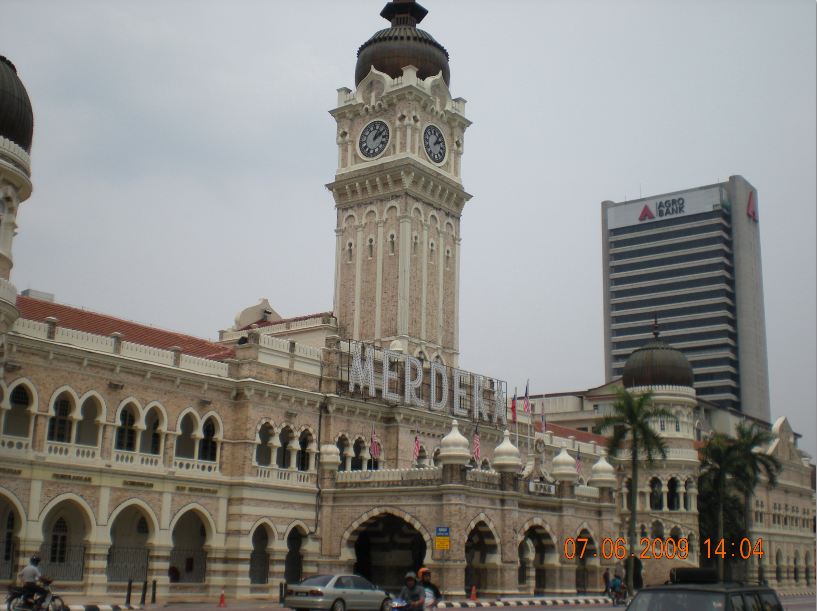
Sultan Abdul Samad Building

Sultan Abdul Samad in Wikipedia

I remember the Sultan Abdul Samad building from 1965 onward. Every time the news hour came on TV, the clock would be shown and its signature tune would play, and then the news was read in English. "Good evening... this is the news from Kuala Lumpur. I am ....."

The Sultan Abdul Samad building of 1897. Sultan Abdul Samad reigned from 1857 to 1898.
The long and symmetrical building has copper domes and a 40-m clock tower.

When I visited the Big Ben in London in 1980, I was a bit confused because our clock tower in KL and the Big Ben in London looked similar. I couldn't tell if the clock tower on TV was coming from KL or London. That confusion lingered for a long time and almost my entire life. Why did they copy the Big Ben and made it an icon in KL? Why? Our local time is GMT +8.00 hours.

The Big Ben in London. Internet pic.

I then went to visit Greenwich, to see for myself, why we must have this 'plus 8 hours' from Greenwich. Is Greenwich the centre of global time setting - the meridian? I doubt it, maybe because time was researched at Greenwich and therefore time was set there. Why Greenwich?

I was reading the ancient calendars and what happened in our history wrt time and how time was timed. There is the Muslim lunar calendar system and the Julian and Gregorian calendar systems. In the latter 2 calendar systems, the time master had to add 9 years every few years, so that time was properly timed.

When we re-study time, times, calendar system, events and history, we will discover that things that happened in history cannot be exact science. Ancient time and dates and times in history, are never accurate and they don't tell the correct time and date. Therefore, which time and date are correct and should be used for reporting events in history?

I have not looked at how well the Chinese calendar system matches whatever we are accustomed to today. It is interesting that we tend to simply accept reported dates in our history without questioning how time actually affected lives and events, and seasons, and how calendaring was actually done.

If I asked you, 'tell me, what season was it on 25 December 1400?', without specifying which calendar system to refer to, what calendar system would you use to give me an answer? How would you go about finding a plausible answer to that rather vague question?

Don't you think that the Muslim lunar calendar is correct and exact? There is no time correct that I know of or have heard of. Time flows and is recorded without a single add/minus to the time. on the clock faces Time is exact. The only thing that changes in the Muslim world is the direction of Qiblat - time does not need re-timing at all. The seasons change but the months don't. So Aidilfitri can be a dry season or a monsoon season, i.e. seasons change with the times. 

We are actually older than we think we are. We are not young. When we sit down and think about it, then I can ask you, 'tell me, how old is a girl aged 9 in our Gregorian calendar'? She is actually 9+9 = 18 years old biologically. Because we are using Gregorian calendar, we are confused about a lot of things in the past. Everything that has to do with time must be backed by the Muslim calendar system which tells exact time, but not the season. That is why when I visited the graves at many locations in Malaysia, I see 2 dates on the headstones - the Muslim date first, followed by the Gregorian date beneath it. I take the Muslim date as the true date of death, not the Gregorian one.

The next time we are asked to reset time, think about this article - think about what time actually means.

Istana Besar Sultan Johor

I have never lived in Johor, so I don't know much about Johor. 

I was browsing old picture postcards (ppc) in the book Malaya, 500 Early Postcards (2008) by Cheah Jin Seng, and came across a ppc that looked familiar. This is the Istana Besar belonging to the Sultan of Johor, which has many tiny steps leading up to the palace. These steps were the same ones where UMNO was photographed after it was formed in 1946. 

The Istana Besar Sultan Johor was built in 1866 by Wong Ah Fook, who was a builder as well as an entrepreneur. He also built the Sultan Abdul Samad building in Kuala Lumpur, which was ready a year before Sultan Abdul Samad passed away. Is there a photo of him? Where is his family today?


Istana Besar Sultan Johor. Internet pic.

Page 145 - Shows a photo of Sultan Ibrahim and Sultanah Helen (Helen Bartholomew Wilson) c 1930.

Tuesday, 5 June 2012

Diaspora Nusantara Project


Sent: Monday, June 4, 2012 10:14:00 AM 
Subject: [staf] JEMPUTAN SEMINAR ANTARABANGSA PERANTAUAN SUMATERA-SEMENANJUNG MALAYSIA, SABAH DAN SARAWAK

YBhg. Prof./Prof. Madya/Dr./Tuan/Puan,

JEMPUTAN SEMINAR ANTARABANGSA PERANTAUAN SUMATERA- SEMENANJUNG MALAYSIA, SABAH DAN SARAWAK

Berhubung perkara di atas, Projek Diaspora Nusantara (Sekretariat) akan menganjurkan seminar tersebut pada:

Tarikh: 6-8 Jun 2012 (Rabu-Jumaat)
Masa: 8.30 Pagi-5.00 Petang (Rabu & Khamis), 8.30 Pagi – 12.00 Tengah hari (Jumaat)
Tempat: C20, Dewan Persidangan, Pusat Pengajian Ilmu Kemanusiaan, USM

Seminar ini mempunyai 9 sesi pembentangan yang merangkumi tema berikut:
1. Perantauan Asal
2. Sejarah Perantauan Awal
3. Jambatan Budaya (Bahasa)
4. Jambatan Budaya (Persaudaraan, Darah dan Keturunan) (3 Sesi)
5. Penghijrahan dan Perantauan Maritim/Rohaniah
6. Jambatan Budaya (Sastera)

Pendaftaran:
8.30 Pagi (Rabu, Khamis, dan Jumaat)
Bayaran Peserta: RM 200.00 berserta Sijil Penyertaan
(Mata CPD)

Sebarang maklumat lanjut sila hubungi:
Sekretariat
04-653 2047
012-9332132 (Jamilah Hani)
017-4605574 (Siti Fatimah)

Sehubungan itu, kami berbesar hati menjemput Tuan/Puan hadir ke seminar ini.

Terima kasih.

Dear Prof./Assoc. Prof/Dr./Sir/Mdm./Ms.,

INVITATION TO 'SEMINAR ANTARABANGSA PERANTAUAN SUMATERA- SEMENANJUNG MALAYSIA, SABAH DAN SARAWAK'

According to the subject above, Diaspora Nusantara Project, Centre for Policy Research and International Studies (CenPRIS), USM will organize an international seminar on:

Date: 6-8 June, 2012 (Wednesday-Friday)
Time: 8.30 am-5.00 pm (Wednesday & Thursday), 8.30 Pagi – 12.00 pm (Friday)
Venue: C20, Conference Hall, School of Humanities, USM

It has 9 sessions to present, the themes include:
1. Perantauan Asal
2. Sejarah Perantauan Awal
3. Jambatan Budaya (Bahasa)
4. Jambatan Budaya (Persaudaraan, Darah dan Keturunan) (3 Sessions)
5. Penghijrahan dan Perantauan Maritim/Rohaniah
6. Jambatan Budaya (Sastera)

Registration:
8.30 am (Wednesday, Thursday and Friday)
Fees: RM 200.00 with certificate
(CPD-requested)

For further information, kindly to contact:
Secretariat
04-653 2047
012-9332132 (Jamilah Hani)
017-4605574 (Siti Fatimah)

It’s a great pleasure to invite you to be a participant in our seminar. Thank you for your attention.

Yang menjalankan tugas,

JAMILAH HANI ESA
Pegawai Penyelidik
Projek Diaspora Nusantara
Pusat Penyelidikan Dasar dan Kajian Antarabangsa (CenPRIS)
Universiti Sains Malaysia
Pulau Pinang.
04-653 2047
012-9332132