Friday, 8 June 2012

Istana Besar Sultan Johor

I have never lived in Johor, so I don't know much about Johor. 

I was browsing old picture postcards (ppc) in the book Malaya, 500 Early Postcards (2008) by Cheah Jin Seng, and came across a ppc that looked familiar. This is the Istana Besar belonging to the Sultan of Johor, which has many tiny steps leading up to the palace. These steps were the same ones where UMNO was photographed after it was formed in 1946. 

The Istana Besar Sultan Johor was built in 1866 by Wong Ah Fook, who was a builder as well as an entrepreneur. He also built the Sultan Abdul Samad building in Kuala Lumpur, which was ready a year before Sultan Abdul Samad passed away. Is there a photo of him? Where is his family today?


Istana Besar Sultan Johor. Internet pic.

Page 145 - Shows a photo of Sultan Ibrahim and Sultanah Helen (Helen Bartholomew Wilson) c 1930.

Tuesday, 5 June 2012

Diaspora Nusantara Project


Sent: Monday, June 4, 2012 10:14:00 AM 
Subject: [staf] JEMPUTAN SEMINAR ANTARABANGSA PERANTAUAN SUMATERA-SEMENANJUNG MALAYSIA, SABAH DAN SARAWAK

YBhg. Prof./Prof. Madya/Dr./Tuan/Puan,

JEMPUTAN SEMINAR ANTARABANGSA PERANTAUAN SUMATERA- SEMENANJUNG MALAYSIA, SABAH DAN SARAWAK

Berhubung perkara di atas, Projek Diaspora Nusantara (Sekretariat) akan menganjurkan seminar tersebut pada:

Tarikh: 6-8 Jun 2012 (Rabu-Jumaat)
Masa: 8.30 Pagi-5.00 Petang (Rabu & Khamis), 8.30 Pagi – 12.00 Tengah hari (Jumaat)
Tempat: C20, Dewan Persidangan, Pusat Pengajian Ilmu Kemanusiaan, USM

Seminar ini mempunyai 9 sesi pembentangan yang merangkumi tema berikut:
1. Perantauan Asal
2. Sejarah Perantauan Awal
3. Jambatan Budaya (Bahasa)
4. Jambatan Budaya (Persaudaraan, Darah dan Keturunan) (3 Sesi)
5. Penghijrahan dan Perantauan Maritim/Rohaniah
6. Jambatan Budaya (Sastera)

Pendaftaran:
8.30 Pagi (Rabu, Khamis, dan Jumaat)
Bayaran Peserta: RM 200.00 berserta Sijil Penyertaan
(Mata CPD)

Sebarang maklumat lanjut sila hubungi:
Sekretariat
04-653 2047
012-9332132 (Jamilah Hani)
017-4605574 (Siti Fatimah)

Sehubungan itu, kami berbesar hati menjemput Tuan/Puan hadir ke seminar ini.

Terima kasih.

Dear Prof./Assoc. Prof/Dr./Sir/Mdm./Ms.,

INVITATION TO 'SEMINAR ANTARABANGSA PERANTAUAN SUMATERA- SEMENANJUNG MALAYSIA, SABAH DAN SARAWAK'

According to the subject above, Diaspora Nusantara Project, Centre for Policy Research and International Studies (CenPRIS), USM will organize an international seminar on:

Date: 6-8 June, 2012 (Wednesday-Friday)
Time: 8.30 am-5.00 pm (Wednesday & Thursday), 8.30 Pagi – 12.00 pm (Friday)
Venue: C20, Conference Hall, School of Humanities, USM

It has 9 sessions to present, the themes include:
1. Perantauan Asal
2. Sejarah Perantauan Awal
3. Jambatan Budaya (Bahasa)
4. Jambatan Budaya (Persaudaraan, Darah dan Keturunan) (3 Sessions)
5. Penghijrahan dan Perantauan Maritim/Rohaniah
6. Jambatan Budaya (Sastera)

Registration:
8.30 am (Wednesday, Thursday and Friday)
Fees: RM 200.00 with certificate
(CPD-requested)

For further information, kindly to contact:
Secretariat
04-653 2047
012-9332132 (Jamilah Hani)
017-4605574 (Siti Fatimah)

It’s a great pleasure to invite you to be a participant in our seminar. Thank you for your attention.

Yang menjalankan tugas,

JAMILAH HANI ESA
Pegawai Penyelidik
Projek Diaspora Nusantara
Pusat Penyelidikan Dasar dan Kajian Antarabangsa (CenPRIS)
Universiti Sains Malaysia
Pulau Pinang.
04-653 2047
012-9332132

Sunday, 3 June 2012

Malay Marriages and Weddings

Now I will do the weddings of the early Malay doctors, their grandparents, parents, children, relatives, peers and friends. The photos were sent to me over many years. Some related stories, some also wrote stories, anecdotes, etc. You can still send your wedding photos and I can upload them here in this blog. If you are sending photos or video links, please provide some details (state your name, whose wedding, date of wedding, wedding venue, etc). In the meantime, take a look at this wedding video taken at the E&O. YouTube wedding video: Wedding of CJ & Steph, Garden Wedding at E&O

TIMELINE

I will need to search for at least 43 wedding photos... need to arrange first...will take some time, as I now have editing to do for about 1 month.

HOW TO CREATE WEDDING PHOTOS WITH PHOTO EFFECTS

Most are composite photos as wedding photos are not available for many of the doctors. I worked in PowerPoint, where I combined 2 photos and used overlay and repeat techniques. I used 2 programs to add the photo effects - MyScrapNook (for frames when necessary), and Pixlr-o-matic (for the film reel effect). I don't have Adobe Photoshop and Aldus Freehand.

WHAT IS KNOWN ABOUT THE EARLY MALAY DOCTORS

Most biographies have no date(s) of marriage(s) stated. They can be approximated from the DOB of the first child. Some of the names of the wives were unknown and only call names were known.
  1. Dr Abdul Aziz married Wan Sharihah bt Haji Ashaari from Kedah and then Zaleha from Singapore.
  2. Nawab Din married Raj Bee; Zainab Bee married Akram; Dr Abdul Karim bin Nawab Din married Bismillah Begum bte Munawar, the eldest daughter of Hafiz Ghulam Sarwar.
  3. Dato' Setia Abdul Razak married Puan Saleha; they were the parents of Dr Abdul Latiff. 
  4. Tan Sri Abdul Majid married Puan Sri To’ Puan Khairany bt Mahyuddin (in early 1950s).
  5. Dr Abdul Wahab Khan bin Muhammad Lal Khan married Fatimah Bee bte Dustagoer Hussain at her residence in 124, Langkawi Road in Kelawei District in Penang, then a British Settlement, on 17 June 1938.

1800
1820
1840
1860
1880
1900
1910
Dr Abdul Latiff bin Abdul Razak married Che Safiah bt Sulong in 1910.
1920
1930
1931
1932
1933
1934
1935
1936
1937
1938
Dr Abdul Wahab Khan bin Muhammad Lal Khan married Fatimah Bee bte Dustagoer Hussain in Penang in 1938.
1939
Dr Haji Abbas married Zawyah bt Ibrahim in 1939; remarried in 1939 to Shareah bt Mohd Taib.
1940
1950
1951
Tan Sri Abdul Majid married Puan Sri To’ Puan Khairany bt Mahyuddin in early 1950s. Their eldest son Aljafri Majid was born at home in 1952.
1952
Dr Abdul Wahab married Datin Intan bte Haji Mustapha @ Tan Kim Poh in 1952.
1953
1954
1955
1956
1957
Dr Haji Abbas married Azizah bt Hassan in 1957.
1958
1959
1960
1970
1971
1972
1973
1974
1975
1976
1977
1978
1979
1980
1981
1982
1983
1984
1985
1986
1987
1988
1989
1990
2000
2010
2011
2012
Professor Dr Nik Abdullah (anaesthesiologist) daughter's wedding in 2012.


Islamic prayer for the newly weds from Surah ar-Rum: 21
Invitation note from a Malay doctor's family
2013
Dr Mustaffa Musa (immunologist) son's wedding reception in 2013.


2014
2015
2016
2017
2018
2019
2020

British East India Company and the Straits Settlements


What was the main interest of the British East India Company? How well did it compete with its competitor and enemy, the Dutch East India Company (VOC)? Why did we have the Straits Settlements? Were they for the interest of the Malays or who? They were for the interests of the British. Why did they set up the 3 settlements? How did they come to be? Are they any good for the Malays? What is the significance of the Straits Settlements in our history? How were the Straits Settlements monitored administratively? Did the development of the first medical school follow the trade progress of the British East India Company? How did the British East India Company become involved in politics when initially it was set up for trade? What were the weaknesses we had that led to the British becoming involved with local politics? What happened in the 1600s, 1700s, 1800s and 1900s? What was Captain Francis Light's purpose in Penang in 1786? What was Stamford Raffles' purpose in Singapore in 1819? Which British man arrived in Malacca in 1795? Do we have the maps and census of the Straits Settlements at these times? Why are early documents and maps of the Straits Settlements important? They are important because they will tell us who were at the 3 settlements during those years. They are also important because a lot of local laws were changed by the British captains and great changes happened to the local communities. I think the British captains had overstepped their limits as trade captains and entered into local politics and changed everything else to their content. Their rules became our rules and we played by their rules. So we came to be under the colonials. Whose fault? We have our own selves to blame for letting go of our homeland, and leaving things to the British captains to do as they pleased. Now we have a lot of problems - land rights is a major problem today - violating local laws and regulations, pressing the Malays to move out where they belong, and taking advantage of their weaknesses, the list is endless while initially there was none. The 3 Straits Settlements are the most worrisome of the Malay lands. We inherit a lot of problems wrt land rights, landing rights and ownership. This is what I see as a result of the trade activities of the British East India Company at the 3 settlements.
Administrative history: The following describes the historical background to the East India Company's factories and their changing function.
1600-1709: The visits to the east of the first Company ships, undertaken in a series of separately funded voyages, were exploratory in nature. Captains were under instructions to seek out those places that offered the best opportunities for trade and to seek permission to trade from local rulers. According to the information received back, Company instructions then became more specific and the captains were advised to visit or revisit particular places to try to establish connections. At these ports. captains tried to obtain permission for a merchant or merchants to settle and, if necessary, to set up factories. A "factory" was a trading post where a number of merchants, or factors, resided. When company ships arrived at the factories, ships' merchants were thus enabled to exchange goods for trading immediately instead of having to wait to make deals with local merchants. Factories were run by a chief factor and a council of factors. In the areas that proved most successful for trading, groups of factories were eventually established. These were known as settlements and were governed by an agent and council. Eventually: certain settlements developed into centres to which all other factories in the region reported. These became known as presidencies and were administered by an agent (first called a president and later a governor) and a large council of senior factors.
Contacts developed only gradually. The Company's first interest lay in the Malay archipelago and the Spice islands, although from the start it faced considerable competition from Dutch merchants. 
In Arabia and the Red Sea, the Company increased its presence as the strategic importance of the region became apparent. The British conflicts with European powers in Africa and the need to protect the route to India were factors in the establishment of political agencies at Bushire (1763) and Bagdhad (1798); the factory at Mocha also took on a new function as a political agency. To the east, the Company's need to protect its trade with China led to the establishment of Penang (1786), Malacca (1795) and Singapore (1819).
Within India, the Company's trading function finally came to an end under the Charter Act of 1813 when its monopoly rights on trade to India were withdrawn. In 1833 the Company's monopoly on the China trade was also abolished. 
Source: http://www.nationalarchives.gov.uk/. Retrieved from The National Archives, UK, 3 June 2012.
Royal Coat of Arms of the British East India Company (Penang Museum)"Honi soit qui mal y pense" is a French phrase meaning: "Shamed be he who thinks evil of it". The royal motto in Norman-French is: "Dieu et mon driot".
Royal motto: Dieu et mon droit has generally been used as the motto of English—and later British (outside of Scotland)—monarchs since being adopted by Edward III. It was first used as a battle cry by King Richard I in 1198 at the Battle of Gisors, when he defeated the forces of Philip II of France and after he made it his motto. The belief in medieval Europe was not that victory automatically went to the side with the better army but that, as with personal trial by combat, to the side that God viewed with favour. Hence Richard wrote after his victory "It is not us who have done it but God and our right through us". So after his victories on the crusades "Richard was speaking what he believed to be the truth when he told the Holy Roman Emperor: 'I am born of a rank which recognises no superior but God'. Source: http://en.wikipedia.org/wiki/Dieu_et_mon_droit

Coat of Arms of the British East India Company and a statue of Captain Francis Light.
Photo from Penang Museum.
British East India Company govt office building, corner of Downing Street and Beach Street, Penang circa 1883. An earlier illustration of the building was hand-drawn circa 1850.


Saturday, 2 June 2012

Prime Minister's Car

What cars did our prime ministers use? What did our first prime minister use? He used a white Rolls Royce. The Rolls Royce was then bought over by Sultan Yahya Petra and it was brought back to Kelantan. Who owned the Rolls Royce in the first place?

I'm looking for a white Rolls Royce that once belonged to Dr Che Lah bin Md Joonos. I believe that he had used it in the post-war, probably from 1945 onwards, mainly for to send his children to school. He had a chauffeur who wore a white suit. I have no other details at this time. Another account I heard was he lived in Sg Buloh.

Rolls Royce was produced in 1920s and ceased in 2002.

I have seen 3 Rolls Royce in Malaysia so far but I have not seen a white Rolls Royce till I saw one today at Muzium Kelantan in Kota Bharu.

The blue painted metal piece in front of the grill reads 'Tengku Mahkota Kelantan', which refers to Tuanku Yahya Petra.
Tengku Mahkota Kelantan royal car plate
This 1947 Rolls Royce Silver Wraith was used by Tunku Abdul Rahman and was then purchased by Tuanku Yahya Petra of Kelantan in the 1960s. This Rolls Royce and the other one next to it were on display at Muzium Kelantan. Photographed by me on 2 June 2012. 
YouTube video: http://www.youtube.com/watch?v=kjPSu1GarVI&feature=related


Spirit of Ecstasy http://en.wikipedia.org/wiki/Rolls-Royce_Limited

More recent photos, 27 December 2012. Man vs car - this Rolls Royce is really big. 
Tuanku Yahya Petra
(portrait from Who's Who in Malaysia 1971-1972)
Tuanku Yahya Petra Ibni Al-Marhum Sultan Ibrahim was born on 10 December 1917 in Kota Bharu, Kelantan. He was educated at Francis Light School in Penang. In 1934 he then went to Britain for further studies for 5 years. He returned to Kelantan in 1939. He was proclaimed Tengku Mahkota of Kelantan on 1 February 1948. He was Regent in 1953 and 1958 when his father Sultan Ibrahim was away. Source: Who's Who in Malaysia 1971-1972.

Friday, 1 June 2012

The Founding of Penang (2)

I returned to Penang Museum for the third time on Sunday, 27 May 2012. This time I focused on a few things - Penang, Francis Light, Nyonya and Japanese war. This third visit was my youngest daughter's first visit to the museum. My husband and I were her tour guides. She liked the displayed items but she did not seem too interested or enthusiastic. At one point, she just sat on the bench with her father, and waited for me. Why wasn't she interested in Penang Museum? I don't know. Maybe she had something else in mind.

There was one instance she asked what the displayed items were, and I told her they were for opium smoking. She asked, 'apa tu'? I said, 'hisap dadah' and she immediately understood. I showed her the large wooden bench by the display where the opium smokers and addicts would sit or lie down to smoke. She found it strange and we moved to the Baba Nyonya section.

The Baba Nyonya section was interesting. I was after the kebaya pendek as I had missed them at the last two visits. This time I needed to see up close what sort of embroidery they did. I saw a familiar kebaya pendek that could have belonged to my mother. It may be that two women bought the same material to make kebaya pendek.

Penang is Pulau Pinang from before the arrival of Francis Light. It is still Pulau Pinang today. Penang referred to the areca fruit and nut, which is the fruit of the pokok pinang (pinang tree).
Majlis Perbandaran Pulau Pinang (MPPP) metal plate for a manhole in the pavement 
Penang inscription stone that describes its name. The MPPP plate can be seen at the  top edge of this pic.
Penang inscription stone and the MPPP metal plate

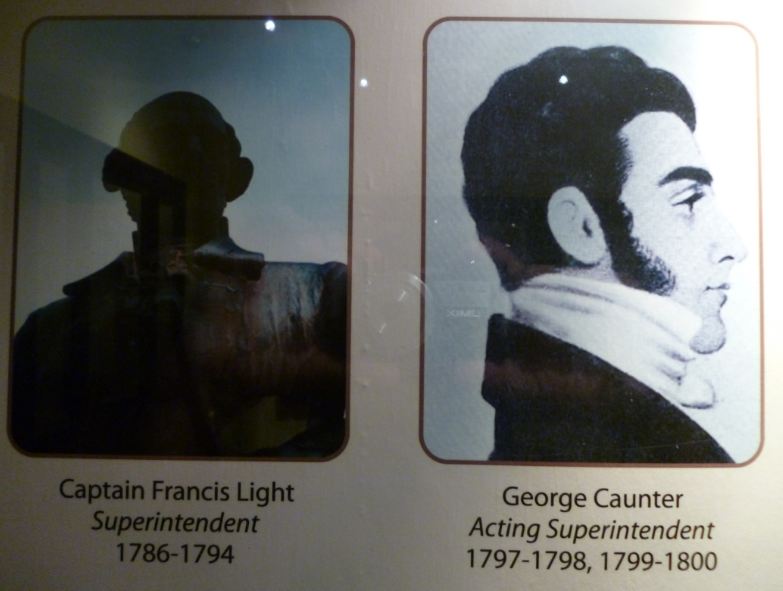
THE GOVERNORS OF PENANG
Images are from Penang Museum
1. Captain Francis Light, Superintendent, 1786 - 1794
2. Philip Manington, Superintendent, 1794 - 1795
3. Thomas Pigou, Acting Superintendent, 1795 - 1796
4. John Beanland, Acting Superintendent, 1796
5. Major Forbes Ross Macdonald, Superintendent, 1796 - 1798
6. George Caunter, Acting Superintendent, 1797 - 1798, 1799 - 1800
7. Sir William Edward Maxwell, Acting Resident Councillor, 1887 - 1889
8. Francis James Anderson, Acting Governor, 1894 - 1895
9. Sir Robert Townsend Farquhar, Lieutenant-Governor, 1804-1805
10. Philip Dundas, Governor, 1805-1807
11. William Petrie, Acting Governor, 1812-1816
12. Robert Fullerton, Governor of the Straits Settlement and Resident Councillors, 1826-1830
13. William Peel, Acting Resident Councillor, 1917-1925
14. Prince Fushimi Hiroyasu, Governor, 1941-1942
15. Col. John Allen Harvey, Governor, 1945
16. Raja Sir Tun Uda Al-Haj bin Raja Muhammad, Governor, 1957-1967


GOVERNORS OF PENANG

1. Raja Sir Tun Uda Al-Haj bin Raja Muhammad, Governor, 1957-1967.
2. Tun Tan Sri Syed Sheh bin Syed Abdullah Shahabudin, Governor, 1967-1969.
3. Tun Tan Sri Syed Sheh Al-Haj bin Syed Hassan Barakbah, Governor, February 1969 – February 1975.
4. Tun Tan Sri Dato' Seri Dato' Haji Sardon bin Haji Jubir, Governor, 5 February 1975-1981
5. Tun Datuk Dr. Haji Awang bin Hassan, Governor, 1 May 1981 - 1989
6. Tun Tan Sri Datuk (Dr.) Haji Hamdan bin Sheikh Tahir, Governor, 1 May 1989-2001
7. Tun Dato' Seri Haji Abdul Rahman bin Haji Abbas, Governor, 1 May 2001-present

Portrait from Penang Museum
Yang Teramat Mulia Raja Tun Uda Al-Haj bin Raja Muhammad was born on 1894, Kuala Langat, Selangor. He was educated in Malay College, Kuala Kangsar in Perak. He joined the Government Service in 1910, and MAS in 1914. He was promoted to Class V, MCS in January 1924. He was appointed in 1939 as Secretary to the British Resident in Selangor, the first Malay to hold such appointment. In the post-war, he became an Officer of Class IB, MCS in April 1946 and Class IA, MCS in February 1948. He was officiated as the Deputy Commissioner (Interior), Selangor before being appointed as the first State Secretary, Selangor on the inauguration of the Federation of Malaya (FoM) Agreement on 1 February 1948. He became the Menteri Besar (MB) of Selangor on 1 July 1949. He relinquished the post on being appointed Commissioner for Malaya in UK in July 1953. He relinquished the appointment in UK in October 1954. On his return to Malaya, he was reappointed MB, Selangor in November 1954. On 24 August 1955, he was appointed as Speaker of Federal Council. He was a Member of the Selangor State Council and Federal Council till the Japanese invasion in 1941. He served in the Federated Malay States Volunteer Force (FMSVF) and others. He was conferred 3 British awards - the CBE in 1947; CMG in 1951; and the KBE in 1953. As the first Governor of Penang, he was also a Member of the Conference of Rulers. His recreational activities included tennis, golf and gardening. Source: Who's Who in Malaysia 1971-1972.


MAPS OF PENANG
GEORGETOWN, BATU UBAN, BUKIT DATUK JENATON, TANJUNG BUNGAH, BUKIT DUMBAR, GELUGOR, JELUTONG

The British arrived in Penang in 1786. The Sumatran Muslim Malays arrived in Penang in the early 1730s. Datuk Jenaton sailed with Nakhoda and they arrived in Kedah, and then made their way to Penang, arriving at Batu Uban. An early British map showed the paddy areas of these Penang Malays..
A large area was paddy
The deepwater harbour was along Beach Street, from Fort Cornwallis right up to the Acheen Street Mosque (Masjid Melayu Aceh), and onward to Jelutong at Masjid Jamek Jelutong. The Indian gold retailers operated not far from the wharf. Masjid Kapitan Keling is very near to the wharf at Beach Street.
The Queen Victoria clock tower is at right in the pic above. The government offices are in the long building in the centre foreground. A few ships can be seen at 10 o'clock.

PEOPLE OF PENANG


Penang Malays cleared lands for cultivation of pepper and areca nut - major cash crops of Pulau Pinang. The British brought in the Chinese and Indians for agricultural purposes and labour. Thus, these 3 communities co-existed in Penang during colonial rule. The Penang Malays existed longest on Penang island. They were originally from West Sumatra, and they came via land and sailed the Straits of Malacca, pushing off from Batu Bara in East Sumatera, and arriving in Kedah, before sailing to Penang - on the sheltered side of the island. The Portuguese had earlier arrived on the unsheltered side of the island - at Ferringhi, the Arab word for Portuguese. The curved coastal stretch from Gurney Drive to the end of Batu Ferrighi forms North Bay. The West Sumatran people were of Minangkabau stock and one great man (Datuk Jenaton) married a lady of Arab-Chinese extract. This marriage started the Minangkabau-Arab-Chinese roots of the Datuk Jenaton clan in Penang, Kedah, Perak, Kuala Lumpur, Kelantan and elsewhere.
Plaque at the cemetery gate on Northam Road (Jalan Jutawan). This plaque is in  4 languages.
Protestant & Catholic graves where famous people in Penang history were laid to rest.
A lot of the graves here were not well-looked after. There were fallen headstones and some graves were in complete ruins. YouTube video: Captain Francis Light's grave.