Tuesday, 8 March 2011

Early Medical Programmes and Degrees Conferred in Singapore and Malaysia 1905-1960


Information to construct the following table on the early medical programmes and degrees conferred by Singapore and Malaysia were obtained by interviewing two KE VII medical graduates, Tan Sri Dr Raja Ahmad Noordin bin Raja Shahbuddin (Class of 1956) and Tan Sri Dr Abdul Majid bin Ismail (Class of 1950). The interviews were held separately in May 2007. Tan Sri Dr Raja Ahmad Noordin was interviewed at home in Petaling Jaya while Tan Sri Dr Abdul Majid was interviewed in his office in Jalan Damai, Kuala Lumpur.

Early Medical Programmes and Degrees Conferred in Singapore and Malaysia 1905-1960
Year
Name of Medical School / Event
Duration of Study
Degree Conferred
1905
Straits Settlement and Federated Malay States Government Medical School
5 years
LMS
1913
King Edward VII Medical School (KE VII Medical School)
5 years
LMS
1921
King Edward VII College of Medicine (KE VII College of Medicine)
5 years
LMS
1923
King Edward VII College of Medicine (KE VII College of Medicine)
6 years
LMS
1939
Merger of King Edward VII College of Medicine with Raffles College of Arts and Science into a university college
6 years
LMS
1942
College of Medicine ceased operation due to Japanese Occupation during WWII
ceased

1943
Marei Ika Daigaku or Syonan Medical College operated in Tan Tock Seng Hospital. Medium of instruction was Japanese.
resumed

1944
Syonan Medical College operated in Malacca General Hospital (ended in 1945). Medium of instruction was Japanese.
shifted

1946
King Edward VII College of Medicine reopened in postwar Singapore
resumed as normal

1949
Faculty of Medicine, University of Malaya was established in Singapore
faculty-based teaching

1950
First batch of postwar graduands attended convocation without their pre-ordered graduation gowns due to late delivery. First batch to receive MBBS instead of LMS. Still in Singapore.
10 years
(lost 5 years to war)
MBBS
UM (S’pore)
1951
Second batch of postwar graduands attended convocation with their graduation gowns,  the first time the gowns were used
5 years
MBBS
UM (S’pore)
1960
Faculty of Medicine, University Malaya operated in KL campus
5 years
MBBS
UM (KL)
 LMS = Licentiate in Medicine and Surgery; KE VII = King Edward VII


Citation: Early Medical Programmes and Degrees Conferred in Singapore and Malaysia 1905-1960. The Early Malay Doctors, 2011, Faridah Abdul Rashid, online blog

Hospital Bangsar / Bangsar Hospital / European Hospital


The European Hospital in Bangsar, Kuala Lumpur was also known as the Bangsar Hospital by the locals. The buildings have been demolished to make way for the Public Health Institute (PHI).

Since two people have asked for photos of "Bangsar Hospital" so far, I have created this post to cater to those needs and for many more who will need the same photos.

I had obtained information about Hospital Bangsar from Tan Sri Dr Abdul Majid bin Ismail, the second Director-General of Health Malaysia when I interviewed him at his office in May 2007. 

The photos of Hospital Bangsar in this post are from Mr Arasu who obtained them recently from Arkib Negara Malaysia (Malaysian National Archives) in Kuala Lumpur. More photos are in his Facebook account. Link to Arasu in Facebook. You may want to get more photos from Arkib Negara. Arasu is planning on a reunion for everyone who had been involved with Hospital Bangsar.

For captions to these photos, please join Arasu's Facebook as he has described them all. He has lived on the grounds of this hospital as his father was once a gardener there.


EUROPEAN HOSPITAL / BANGSAR HOSPITAL in KUALA LUMPUR, MALAYSIA

These photos of the hospital are from the Malaysian National Archives.
I got them from Arasu in Facebook, who obtained them from the Archives.

Photos courtesy of Arkib Negara Malaysia.

Monday, 7 March 2011

The London School of Hygiene and Tropical Medicine (LSHTM)

The London School of Hygiene and Tropical Medicine (LSHTM) is an affiliate of the University of London. It was established in 1899 as the London School of Tropical Medicine. It became a Royal Charter and was renamed the London School of Hygiene and Tropical Medicine in 1924.

1924 - London School of Hygiene and Tropical Medicine established by Royal Charter
1899 - London School of Tropical Medicine


LSHTM main entrance


Most doctors continued to do their postgraduate studies at the LSHTM as Malaya (now Malaysia) is regarded a "tropical" country when it is actually a little north of the equator.

Diseases of the tropics are plenty and these have been studied and continue to be studied at the LSHTM. 

After passing exams conducted by the LSHTM, doctors obtained their first postgraduate degree, i.e., Diploma in Public Health (DPH). The duration of study was approximately two years.


Malaya had sent its students to the LSHTM from 1950 onward. The first student who received the Queens' Scholarship to do postgraduate studies at LSHTM was (Tan Sri) Dr Abdul Majid bin Ismail, who became the second Director-General of Health Malaysia.


LSHTM contact address:
London School of Hygiene & Tropical Medicine, 
Keppel Street, London WC1E 7HT, UK
Tel: +44 (0) 20 7636 8636Location: Bloomsbury, London, WC1, UK


Photo source & credit:
LSHTM
Wikipedia

Other information:
Bloomsbury
Archive: University of London Student Records (1836-1930)

Checking historical data of the University of London Archive

For verification of dates of passing postgraduate exams such as conducted by the London School of Hygiene and Tropical Medicine (LSHTM), I had to e-mail the LSHTM and request assistance since I cannot go to London for many reasons (teaching mostly). 

Now, some of the documents are available online and it is worth sifting through the archived data of the University of London to find if there were those whose names were missed in the December 2010 search.

An advantage for searching is to know how the names of the early Malay doctors were spelled, and the approximate year they were at the LSHTM.

Even though data is accessible online by the public under the Freedom of Information Act, some data sets have an 85-year data protection which means I cannot check these particular data sets online. Some data are only accessible if the student or person involved has died.

I e-mailed the LSHTM for assistance and mentioned the urgency. LSHTM was helpful and had responded positively for a search I requested for all the early Malay doctors who could have done postgraduate studies at the LSHTM between 1950 and 1957. A response to assist was received immediately by e-mail just prior to Christmas 2010. By New Year 2011, I had the list of the early Malay doctors who had done their postgraduate studies at the LSHTM.

The Summary Guide for searching the University of London archives is here:
http://archives.ulrls.lon.ac.uk/resources/Summaryguide.pdf

King Edward VII of England

King Edward VII
King Edward VII College of Medicine building in Singapore

Photo credits, snapshots and links:
http://en.wikipedia.org/
http://www.nus.edu.sg/

Milestones of the Faculty of Medicine, University Malaya 1949-1983

1948
-1960 – Malayan Emergency
1948
Ulu Yam Massacre by the British in Selangor
1949
University Malaya was formed by merger of KE VII College of Medicine and Raffles College.
1949
College of Medicine became the Faculty of Medicine when University Malaya was established in Singapore.
1950
University Malaya confers its first Degrees of Bachelor of Medicine and Bachelor of Surgery (MBBS) on 17 graduates. Dr Abdul Majid bin Ismail @ Coco was in this first batch.
1950
Queen’s Scholarship was introduced for KE VII graduates to pursue postgraduate studies at the London School of Hygiene and Tropical Medicine (LSHTM).
Natrah Incidence (Peristiwa Natrah). Natrah was Maria Hertogh (13), a Dutch girl born in Bandung who married Mansur Adabi (22). Dr Ahmad Ibrahim presided over the heart-breaking case that ensued. He is the son of Dr Mohamed Ibrahim bin Sheikh Ismail, an early Malay doctor (1892-1962).
1952
Construction of a 2-storey building behind the Tan Teck Guan Building for classrooms and labs.
1953
Housemanship was introduced.


1957
Department of Pharmacy, UM Singapore offered its first 3-year course.
1957
31 August – The Federation of Malaya was formed. This was the Malayan Independence or Merdeka. There were 53 Malay doctors with either LMS or MBBS medical degrees. LMS was issued from 1910 to 1949. MBBS was issued from 1950 onward.
1959
University Malaya became 2 autonomous divisions at 2 campuses, one in Singapore and another in Kuala Lumpur. The Faculty of Medicine operated as the Faculty of Medicine of UM in Singapore. An early Malay doctor, Dr Abdul Majid bin Ismail was Council Member of the University Malaya from 1 January 1959-14 May 1987.
1961
Set up of the Postgraduate Medical Studies Committee.
1962
The Singapore division became the University of Singapore and the Kuala Lumpur division became University Malaya. Prof T Danaraj became the first Dean of the medical faculty at University Malaya in KL.
1963
16 September – The Federation of Malaya became a larger country geographically when Malaya, Singapore, Sabah & Sarawak combined to form Malaysia. Malaysia had 2 big sister universities, one in Singapore and the other in KL.
1965
Singapore became an independent Republic of Singapore on 9 August 1965. The Ministry of Foreign Affairs (MFA) Singapore was formed in August 1965. Anwar Ibrahim was the Chief Protocol Officer at MFA Singapore. He was the son of Dr Mohamed Ibrahim bin Sheikh Ismail (1892-1962), an early Malay doctor.
1967
Professor Christiaan Neethling Barnard performed the first human heart transplant on 3 December 1967.
1969
School of Postgraduate Medical Studies was formed.
1969
13 May – riots (also referred to as the 13 May Incidences).  The riots occurred in Kuala Lumpur following the results of the election held then. Though political, the actual trigger of the riots remains unknown. A dark moment in Malaysia's history. The Deputy Prime Minister, also an early Malay doctor, Tun Dr Ismail (1915-1973) delivered his address to calm the nation and halt further bloodshed. The killings stopped and Malaysians continued to live as one.
1983
Hospital Universiti Sains Malaysia (HUSM) was officially opened by KDYMM Al-Sultan Kelantan Sultan Ismail Petra on 26 August 1983.


Citation: Milestones of the Faculty of Medicine - UM 1949-1983, The Early Malay Doctors, 2011, Faridah Abdul Rashid, online blog

Milestones of the King Edward VII College of Medicine in Singapore 1905-1948

1905
The Straits Settlement and Federated Malay States Government Medical School was established at Sepoy Lines in Singapore. It offered a full-time 5-year medical course to train doctors in medicine, surgery and midwifery.
1910
The pioneering class of 7 male doctors graduated from the Medical School with a Licentiate in Medicine and Surgery (LMS).
1911
The Tan Teck Guan Building opened. It housed a lecture theatre, a library and a museum.
1912
The first Professorial Chair of Physiology was established at the Medical School.
1913
The Medical School was renamed King Edward VII Medical School when it received an endowment by the King Edward VII Memorial Foundation.
1913
-1917 WW1
1916
The General Medical Council (GMC) of Great Britain recognizes the LMS and medical graduates were registered in the British Medical Register.
1917
Rumah Sakit Daerah was established in Kuala Krai, Kelantan.
1920
The London School of Tropical Medicine and Hospital for Tropical Diseases moved to Endsleigh Gardens in central London.
1921
The Athlone Committee created and named the London School of Hygiene & Tropical Medicine (LSHTM)
1921
The Medical School in Singapore was renamed King Edward VII College of Medicine as it offered tertiary education.
1923
The KE VII medical course became a 6-year course.
1924
The London School of Hygiene & Tropical Medicine (LSHTM) was made a Royal Charter
1926
The 3-storey College Building with Doric columns opens.
1927
The Dispensary was established in Kota Bharu, Kelantan by Dr Ali Othman Merican & Shaik Hussein Othman Merican (father of veteran athlete Tamin Merican)
1929
/1930 – 7 dental students were accepted by the Department of Dentistry for a 4-year course.
1930
Rumah Sakit Umum was established in Kota Bharu, Kelantan.
1930
The Great Depression in USA.
1939
The McLean Commission on Higher Education proposed the merger of the Medical College with the Raffles College of Arts and Sciences into a university college.
1941
-1945 WW2 (The Japanese Occupation in Malaya)
1942
College of Medicine ceased operation.
1943
The Japanese Military Administration established the Marei Ika Daigaku or Syonan Medical College at Tan Tock Seng Hospital.
1944
Syonan Medical College was shifted to Malacca General Hospital and it ended at the end of WW2. The Japanese used Maktab Perguruan Perempuan Melayu Melaka as their HQ.
1945
WW2 ended; Formation of Malayan Union; British Reoccupation. The Malays opposed the Malayan Union.
1946
College of Medicine reopened in the postwar period and ~200 students resumed medical studies at KE VII.
1948
The Carr-Saunders Commission proposed the formation of a university.
1948
GPMS was formed at KE VII, Singapore.

Citation: Milestones of KE VII, The Early Malay Doctors, Faridah Abdul Rashid, 2011 online blog
-

Sunday, 6 March 2011

Kampong Glam in Singapore

Under the British administration of the Straits Settlements, the community was separated and lived in different regions at each settlement, whether in Penang, Malacca or Singapore. While the Europeans lived in cooler areas such as hills, hillocks and foothills, the rest lived in the hot plains. 

The Muslims lived in their respective areas assigned - Arabs, Bugis, Javanese,  and Malay. The Chinese tended to farming, growing mainly vegetables and rearing pigs. The Indians lived alongside the Muslims, mostly near seaside villages where coconuts grow aplenty. 

The Malays are dependent on the coconut trees for nira (nectar) which is used for making palm sugar, gula Melaka or gulo keret in Kelantan accent. Palm sugar is a main ingredient for making a gooey Malay delicacy, dodol. Palm sugar is a rich source of vitamin B. The Indians need coconuts for coconut milk (santan) for making curry. 

The Malays and Indians use asam Jawa and asam keping to slightly sour their cuisines. Malay and Indian dominated areas are easily discernible to a passing tourist as they have mosques, tamarind trees (pokok asam Jawa) and pokok asam keping. Other trees are pokok cekur & keloh which are a rich source of iron. Keloh beans are used in curries. They are noted to stimulate forceful contractions which are advantageous  in maternal delivery.

While many Penang Muslims lived near Masjid (Melayu) Jamek  Lebuh Aceh in Kampung Melayu, and Kampung Dodol near Masjid Pawanchee along Perak Road, most of the Singapore Muslims live in Kampung Glam and around Masjid Sultan. 

"Gelam"or "Glam" after which Kampong Glam is named could refer to pokok gelam, a mangrove tree whose woods (kayu gelam) are used for firewood and for making charcoal (kayu arang or arang). Pounded charcoal has been used by the Malays for brushing teeth to make them white; this was before the invention of toothpaste.

Istana Kampong Gelam restored to its former grandeur. It now houses the Malay Heritage Centre of Singapore.
85 Sultan Gate (front entrance to Istana Kg Gelam)

The front of the palace with the fountain working. The palm trees look like pokok pinang. Pokok gelam is the one with small leaves.

Affandi at the side entrance to Istana Kampong Gelam
External links:
Kampung Gelam video from Heritage TV Season 2, Singapore
http://yesterday.sg/
http://kudaranggi.blogspot.com/2012/09/istana-kampong-gelam-kini-taman-warisan.html

Saturday, 5 March 2011

Negeri Jauhar @ Johor

How did Johor get its name?

Possibly from the Arabic word "jauhar", meaning gem or precious. What was Johor famous for? Did it have gems, gemstones and precious stones? No. It possibly referred to the strategic location of Johor with regard to sea trade routes frequented by the Arabs. Yes, most possibly. Why the Arabs and not the Indians, Chinese, or Europeans? No idea.

Source: http://johordt.gov.my/jkr/sejarahjohor.htm

In Kelantan, there is Istana Jahar (in local dialect) but it could be Istana Jauhar (in Arabic script).

The Malays also have a proverb, "Jauhari tak kenal manikam". What does it mean?

Transliteration becomes a problem for old Malay documents written in Jawi script as there is ambiguity in the vowels. Jawi has vowels but which can be omitted in normal writing - you read it without the vowels! Jawi also has vowels but with different pronunciation: a (alif as aa, ii, uu), ya (ya as ya, yi, yu), ya (ya as ee),  alif-wau (alif-wau as ou), hamzah (as short aa, ii, uu) and others. When, translating even the script alone, there's ambiguity and variation. For this reason, the proposed book is limited to documents written in romanised Malay and a few documents written in Jawi. The assistance of experts in 3 or 4 languages are needed at times for transliteration purposes, especially when the Jawi scripts are not the usual ones we see today.

Laksamana Bentan dan Puteri Dang Anum

This Sumatran warrior along with his wife forms a classic story in Malay court history.

Laksamana Bentan was a warrior and had served under Sultan Mahmud II of old Johor. He was away on duty (war against straits pirates) when his pregnant wife was murdered for having eaten a slice of jackfruit (seulas buah nangka) from the royal garden belonging to the young sultan (about 24 years). Her womb was cut open to reveal  her unborn child indeed had the jackfruit in its mouth. Of course upon his return from duty, the Laksamana was angry when he found out his pregnant wife (and child?) was murdered and wanted to revenge.

The opportunity to revenge arose when both were on the way to Friday prayers. The sultan was being lifted (dijulang) before his dais was brought down to the ground. The sultan was ambushed and the Laksamana stabbed the sultan while being held high (dijulang). Before the sultan fell he managed to stab the Laksamana, and cursed that the Laksamana's people would vomit blood should they step on Kota Tinggi soil, and that the curse would last for seven generations.

Both Sultan Mahmud II and Laksamana Bentan died but were buried separately in Kota Tinggi. Sultan Mahmud II was buried in a royal mausoleum named Makam Sultan Mahmud II Mangkat Dijulang while Laksamana Bentan and his wife were buried side-by-side in a lesser mausoleum in Kampung Kelantan by Sungai Kemang, Kota Tinggi, Johor. All their tombstones have yellow cloths to mark their royal ancestry.

Sultan Mahmud Shah II or the 10th Sultan Johor (Raja Mahmud; born 1675; reigned 1685-1699), grandson of Sultan Alauddin Riayat Shah II, the first Raja who opened Johor Lama (old Johor) in 1530. Raja Mahmud was only 10 years old when he became Sultan Mahmud. As such the administration was placed under the Bendahara. He died of stab wounds on Friday, August 1699. He was 24 when he died. His name after death was styled Marhum Mangkat Dijulang or Marhum Kota Tinggi. He was buried at Makam Sultan Mahmud Mangkat Dijulang in Kampung Makam, Kota Tinggi, Johor. 
Laksamana Bentan @ Megat Seri Rama also suffered from stab wounds and died. He was buried nearby in Kampung Kelantan, Sungai Kemang in Kota Tinggi. He hailed from Bentan, Sumatra. He had served as an admiral in Sultan Mahmud Shah II's fleet (1685-1699).

Map of locations of the tombs of Sultan Mahmud Mangkat Dijulang, Laksamana Bentan and Dang Anum in Kota Tinggi, Johor: http://goo.gl/maps/X2BUh


Map of locations of Pulau Bintan (Pulau Bentan), Riau Islands, Indonesia and Kota Tinggi, Johor: http://goo.gl/maps/ed8dF


Sources:
http://en.wikipedia.org/wiki/Jackfruit
http://www.youtube.com/watch?v=QK6lamSj39M&feature=related
http://www.youtube.com/watch?v=660Fk0vIFZ8&feature=related

Laksamana Bentan was Megat Seri Rama. Both he and wife were from Pulau Bentan and were of royal Bugis extraction.

A 7th generation male descended from Puteri Dang Anum had recently died outside Johor - he was an early Malay doctor; one is still surviving but not on Malay soil. Puteri Dang Anum is survived by males of her 8th and 9th generations today.

Jungle Trails and Jungle People

Why do the West think we lived on trees? Do they still think so?

The early Western people who came to study Malaya and other countries of southeast Asia were animal hunters - they were zoo keepers and circus owners. In their search of animals, they had come here, to Malaya (now Malaysia). We had tigers (harimau), elephants (gajah), monkeys (monyet), chimpanzees (beruk), snakes (ular), orang utan and gorillas. Some of these animals are arboreal (living in trees). 

Humans were also known to be living up on trees in Malaya but these were jungle tribes, not us. These jungle tribes had to live up high on the trees to avoid being attacked by wild elephants and tigers. Elephants are known to suddenly run amok. Tigers are known to attack humans even in the dark. Living up on trees was a means for safety. Robinson Crusoe also lived in a tree-top house while his Black slave, Man Friday lived below.

Source: http://www.erbzine.com/mag20/2006.html

In the early days where roads and cars were limited to big towns, on the west coast of Malaya, foot trails and elephants trails dominated most parts between these big towns and the hinterland of Malaya. One great elephant trail was the one from Kuala Lumpur to Kota Bharu (KL-KB elephant trail). This elephant trail is difficult to find nowadays since nobody knows of the exact GPS coordinates of that trail.

One account that was related to the author was by Matron Chong Nyet Lin @ Mariah, circa 1965. She had narrated about the KL-KB elephant trail. According to Matron Chong, she had travelled with a Malay doctor (Dr Che Lah bin Mohd Joonos) on elephant backs, carrying medicine for the hospital in Kota Bharu (I gather this would have been the Rumah Sakit Besar Kota Bharu; hospital is 'rumah sakit' in Malay). In retrospect, her story would be after the Japanese occupation, 1948 onward, where she had worked at the Bangsar Hospital in Kuala Lumpur.

Gajah (elephants). Photo from Penang Museum.

Bangsar Hospital was meant for the Europeans according to Coco (Tan Sri Abdul Majid, second Director-General of Health Malaysia). But later, Malay mothers also delivered their babies at Bangsar Hospital. Arasu's father was a gardener at Bangsar Hospital. I will  need more stories about Bangsar Hospital and life that surrounded that hospital before it was demolished. According to (click) Arasu (in his Facebook), only a few buildings of Bangsar Hospital complex remain today. Please contact Arasu in Facebook for pictures of Bangsar Hospital.

Serangoon Road in Singapore

One of the early Malay doctors was Dr Mohamed Ibrahim bin Sheikh Ismail who operated Selamat Clinic in Serangoon Road.
Serangoon Road in Little India, Singapore.
Serangoon Road is situated in Little India in Singapore. It is a main road much like Penang  Road in Georgetown, Penang, Malaysia. It has goldshops, spice shops, a wet market, garland shops, sarees shops,  temples, etc. Sometimes there are Chinese roadside operas. Thaipusm procession also use Serangoon Road.

Keppel Harbour in Singapore

Accounts from at least two early Malay doctors from 1910 to 1957 mentioned Keppel Harbour in Singapore.

Dr Pandak Ahmad had arrived at Keppel Harbour to go to the King Edward College of Medicine.

Keppel Harbour in Singapore

Keppel Harbout was also mentioned in an account of the surrender of the Japanese Army in Singapore in 1945.

Source: www.singas.co.uk

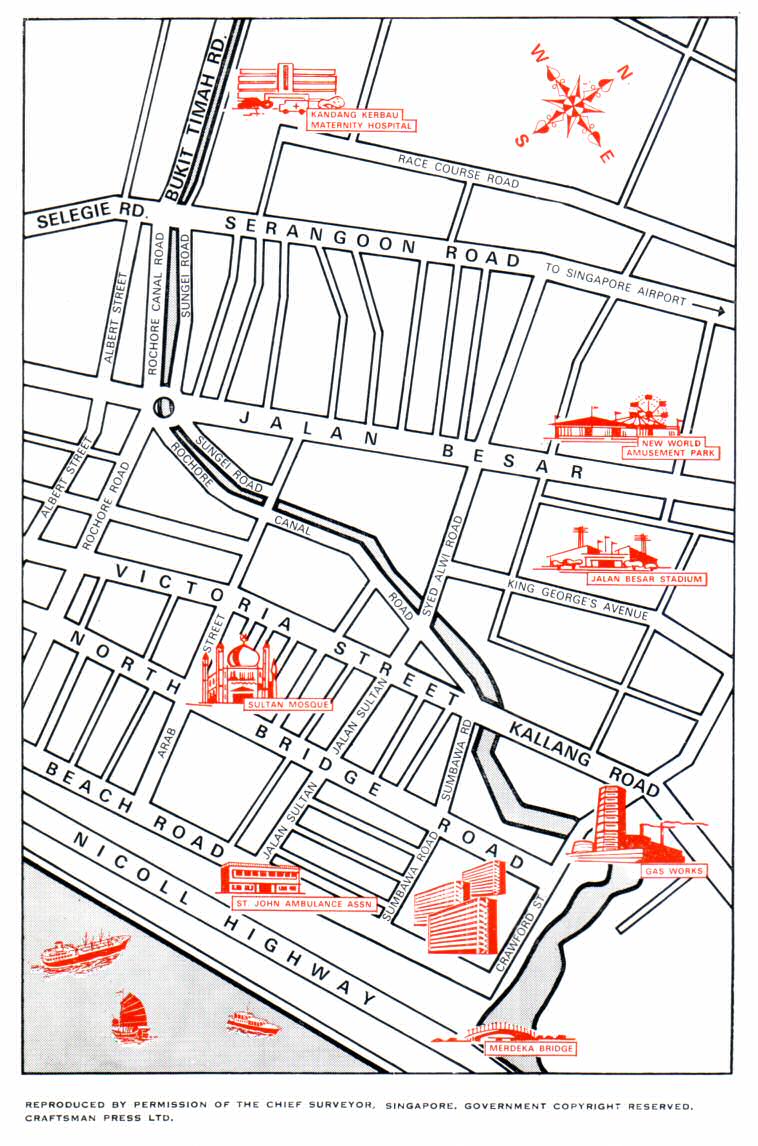
Map of Singapore (1)

This map shows the locations of Masjid Sultan (Sultan's Mosque), Hospital Kandang Kerbau (HKK), Serangoon Road, and North Bridge Road.


Source: http://www.singas.co.uk/sits5/Image6.jpg

Thursday, 3 March 2011

Dr Ahmad Ibrahim and the Natrah Incidence 1950

Dr Ahmad Ibrahim had good parents and grew up in a religious environment, and was involved in the Jamiyah mission in Singapore, with his father (till he died in 1962 during the hajj). He had continued at the Jamiyah and was very active there. When the Natrah incidence occurred  in Singapore on 11-12 December 1950, he was the most capable Muslim attorney to defend the rights of the Muslims involved in the case, even though the case was lost to the Dutch authorities, against the grain of the new religion that Natrah had embraced (Islam). It was this incidence that opened the eyes of the Muslims, both in Singapore and Tanah Melayu, to see how the non-Muslim laws completely ignored the Muslim syariah laws which governed this specific case involving a revert to Islam.

The Natrah case is still relevant today. There are many such cases today as more Muslims get married to non-Muslims and have children. When a divorce occurs, the laws of the country of residence come into play. If the family resides in a non-Muslim country and Muslims laws are not respected, the non-Muslim father/mother takes the children regardless of the religion of the parents and children. In syariah law (Islamic regulations), the children follow the Muslim parent (father or mother), never the non-Muslim parent. This is to avoid the children from being mislead as non-Muslims.

Doctors today also have a big role to play as medical counsellors and they must know the syariah laws governing mixed marriages. Parents of mixed marriages too must try to learn and understand that mixed marriages involving a Muslim and a revert to Islam have to abide by syariah laws when a divorce occurs When we refuse to respect syariah laws, that is when the world turns upside-down and we hear a lot of grief coming from many quarters.

This passage below, written in Malay, is from a blog, and contains the opinions of Datin Seri Fatini Yaacob, author of "Natrah (1937-2009) - Cinta, Rusuhan, Air Mata". The book was published by Universiti Teknologi Malaysia (UTM) in 2010 and is available from Popular for RM75.00 (ISBN 978-983-52-0729-7; paperback)


Kes Natrah cetus semangat patriotik perjuangan martabat undang-undang Islam
6 July 2010
by Roslan88

Usaha Ahmad Ibrahim jadi landasan perundangan syariah diamal Singapura dan Malaysia. SELEPAS 60 tahun kes Natrah: Di mana Kita? adalah persoalan cuba dirungkai pada Muzakarah Pakar anjuran Institut Kefahaman Islam Malaysia (IKIM) bertujuan melihat impak peristiwa menjadi sejarah terus diperkatakan itu kepada perkembangan negara dalam bidang tertentu. 

Sebenarnya, tragedi menimpa anak kelahiran keluarga Belanda yang ditakdirkan menjadi anak angkat keluarga Melayu pada 1947 itu berjaya mengubah kehidupan masyarakat pada masa itu, terutama orang Islam dan membawa kepada kebangkitan perjuangan menentang penjajah. 

Karyawan Tamu Perpustakaan Sultanah Zanariah Universiti Teknologi Malaysia (UTM), Datin Seri Fatini Yaacob, berkata tragedi Natrah perlu dilihat dari perspektif yang luas dan penuh keinsafan kerana membangkitkan kesedaran sebuah negara.

Penulis buku Natrah – Cinta, Rusuhan dan Air Mata itu berkata, selain menyedarkan orang Melayu supaya tidak terus lena ditekan penjajah, peristiwa mengorbankan nyawa itu menjadi pencetus kepada perjuangan memartabatkan undang-undang Islam hingga ke hari ini. 

Bukan itu saja, sejak kes Natrah yang berkahwin dengan Mansor Adabi pada usia 13 tahun mendapat perhatian dan liputan besar, termasuk oleh media Belanda, undang-undang hak penjagaan anak di Britain dan beberapa negara di Eropah serta Amerika berubah secara drastik. 

“Saya selalu katakan tragedi Natrah unik dan istimewa kerana berjaya menimbulkan gelombang kebangkitan luar biasa dalam kalangan rakyat sehingga sanggup berkorban wang, harta benda dan nyawa selain menyatukan orang Melayu yang berpecah kerana fahaman politik. 

“Sementara kes perundangan yang menjadi berita dunia 1950 yang menempelak undang-undang Islam ketika itu membulatkan keazaman jiwa peguam muda, Ahmad Ibrahim memartabatkan undang-undang Islam,” katanya.

Beliau yang membentangkan kertas kerja melihat kesan peristiwa berlaku sebelum merdeka itu dari aspek sosial bagaimanapun mengakui, masih banyak perlu diberi perhatian terutama dalam usaha memastikan kelangsungan Islam.

Fatini berkata, walaupun ada kejayaan memartabatkan undang-undang Islam, tetapi perlu diakui masih banyak yang perlu diperkemaskan tambahan sekarang ini ada saja provokasi menyentuh kedudukan Islam dalam Perlembagaan selain isu menekan orang Islam. 

Justeru katanya, kuasa politik disokong pandangan cendekiawan Islam perlu berperanan menangkis serangan terhadap Islam dan pada masa sama memberi kesedaran serta berusaha membina benteng kekuatan agama bangsa. 

Natrah yang dilahirkan pada 24 Mac 1937 oleh ibunya, Adeline sebagai Hurbedina Maria Hertogh @ Bertha di Bandung sebagai Kristian dan diserahkan kepada Cik Aminah Mohammad yang berasal dari Kemaman, Terengganu, dibesarkan sebagai seorang Islam. 

Tragedi berlaku apabila mahkamah mengarahkan beliau dikembalikan kepada ibu bapa kandungnya dan dipisahkan daripada suaminya, Mansor Adabi, pada 12 Disember 1950. Inilah punca rusuhan Natrah di Singapura yang menyebabkan 18 orang maut dan beratus-ratus lagi cedera. 

Perbincangan mengenai Natrah tidak lengkap jika tidak mengiktiraf jasa peguam Natrah, Allahyarham Tan Sri Prof Ahmad Ibrahim yang menghabiskan banyak masa mengkaji perundangan Islam. 

Usaha kerja beliau mengangkat martabat undang-undang Islam, menyusun silibus pengajian di universiti, memperkemaskan pentadbiran Mahkamah Syariah, meningkatkan kualiti hakim dan pengamal undang-undang syariah serta memantapkan pelaksanaan undang-undang syariah. 

Ketua Pengarah dan Ketua Hakim Syarie, Jabatan Kehakiman Syariah Malaysia (JKSM), Tan Sri Ibrahim Lembut, berkata hasil usaha Ahmad Ibrahim menjadi landasan utama bagi perundangan Islam diamalkan di Singapura dan Malaysia

Katanya, kesedaran ditimbulkan tokoh itu terhadap penindasan dan kesilapan yang dilakukan penjajah kepada bangsa Melayu memungkinkan undang-undang Islam dilaksanakan di negara ini dengan tertubuhnya Mahkamah Syariah. 

“Walaupun masih ada undang-undang yang tidak mengikut nas Islam, kita mampu menjadikan undang-undang Islam sebagai undang-undang utama negara. Apatah lagi, kes seperti yang berlaku kepada Natrah berulang dalam versi berbeza hari ini. 

“Jika kes Natrah membabitkan ibu bapa bukan beragama Islam tetapi kes kali ini berlaku terhadap ibu bapa yang salah seorangnya memeluk Islam. Ada juga kes mereka yang memeluk Islam tetapi akhirnya keputusan menetapkan mereka tidak mengamalkan ajaran Islam,” katanya. 

Beliau yang melihat kes Natrah dari perspektif pelaksanaan undang-undang Islam berkata, sejak negara mencapai kemerdekaan bukan satu jangka masa singkat untuk melihat keadilan dimartabatkan sebagai penyelesaian kepada isu menyelubungi pelbagai lapisan masyarakat. 

Katanya, keadilan bukan menyamaratakan segala tetapi meletakkan yang hak pada tempatnya dan adalah tidak adil adil untuk menidakkan hak umat Islam mempraktikkan syariah seperti mana dituntut agama. 

Ibrahim berkata, situasi kontemporari memperlihatkan perkembangan positif meningkatkan kredibiliti institusi kehakiman termasuk mengharmonikan antara undang-udang sivil dan undang-undang syariah kerana wujud konflik bidang kuasa antara Mahkamah Sivil dan Mahkamah Syariah. 

Namun, beliau mengakui masih ada peruntukan undang-undang perlu diperkemaskan supaya keadilan dapat dilaksanakan bukan saja kepada umat Islam, juga yang bukan Islam menyedari undang-undang syariah turut membela kebajikan mereka. 

Sementara itu, Felo Kehormat Akademik Institut Antarabangsa Pemikiran dan Tamadun Islam (ISTAC), Muhammad Uthman El-Muhammady, berkata selepas 60 tahun kes Natrah, pemikiran umat Islam masih terbelenggu dengan pemikiran penjajah. 

Katanya, ramai orang Islam mempunyai pendidikan tinggi dan kepakaran dalam pelbagai bidang tetapi tidak berkongsi semangat kental Ahmad Ibrahim memperjuangkan kepentingan umat mengatasi keperluan peribadi. 

Malah, perpecahan semasa sendiri kerana kepentingan peribadi dan kelompok secara sempit disebabkan perkelahian serta tohmahan hasil kurang cermat pengamatan ilmu menyebabkan umat Islam rugi. 

“Oleh itu, keperluan kepada elemen mendatangkan pendidikan berkesan diambil daripada pengalaman sejarah terutama terbaik dalam Islam digabungkan dengan sejarah bangsa Melayu yang unggul perlu didedahkan. 

“Begitu juga memupuk pendidikan menguatkan negara dari semua segi termasuk isu baru zaman globalisasi demi kelangsungan ummah,” katanya yang membentangkan pemikiran mengenai kes Natrah daripada sudut pendidikan. 

Hakikatnya, peristiwa Natrah adalah pencetus dan bagaimana umat Islam mengambil iktibar penting kerana jika orang Melayu terus lena, usaha membangkitkan semangat patriotik serta memartabatkan undang-undang Islam tercetus dulu, gagal menghasilkan apa yang sepatutnya. 


Source: http://bit.ly/ge1YH0

Pierre-Alain Weiss & Rabiah's website

Source: http://sites.google.com/site/pierrealainweiss/whatisonthesite

Please be informed that the site no longer exists.