
Who was Habib Noh?
Habib Noh is Al Habib Nuh bin Muhammad Al-Habshi, a Muslim saint of Singapore. His grave (makam) is atop a hillock, and not at the usual Muslim cemetery. There is a history about his unusual burial site and why he is buried there. Makam Habib Noh is a must visit site for many Muslim visitors to Singapore.
External links:
http://aladamyarrantawie.blogspot.com/2012/06/al-habib-nuh-bin-muhammad-al-habsyi.html
Showing posts with label Makam Habib Noh. Show all posts
Showing posts with label Makam Habib Noh. Show all posts
Friday, 11 January 2013

Saturday, 24 December 2011
Moinudeen Chishty
Wahhabi views
The majority of Wahhabis believe that visiting the graves of saints should be classified as shirk and bid'ah except the visiting of the tomb of Nabi Muhammad s.a.w. in Madinah which may be done during Hajj, the Islamic pilgrimage. However, it is not a required. They point out to the following sayings of Muhammad as an evidence for their belief.
Narrated by 'Aisha : Umm Salama told Allah's Apostle about a church which she had seen in Ethiopia and which was called Mariya. She told him about the pictures which she had seen in it. God's Apostle said, "If any righteous pious man dies among them, they would build a place of worship at his grave and make these pictures in it; they are the worst creatures in the sight of God."
The most evil of mankind are those who will be alive when the Last Day arrives and those who take graves as places of worship.”It is also reported in the most authentic books of Sunni Islam that Aa’ishah (wife of Nabi Muhammad s.a.w.) reported:
Had it not been so, his (i.e. the Prophet’s) grave would have been in an open place, but it could not be due to the fear that it could be taken as a mosque.Sunni scholars declare that the purpose of visiting the graves and cemeteries is only to remind people of death and a curse be upon the Jews and Christians for taking the graves of their Prophets as places of worship.
- “...Beware that those before you took the graves of their Prophets as places of worship. Do not take graves as places of worship, for verily I forbid you to do so.”
- “The most evil of mankind are those who will be alive when the Last Day arrives and those who take graves as places of worship.”
Sūnnī or Sufi Views
The purpose of visiting a grave is to gain llim (divine knowledge), tafakkur and to pray for the person in the grave, but if the person in the grave is a Prophet or a Awliya (friend of God), fayd and spiritual benefits can be gained from their souls. The person who is visited, must be thought of as if he is alive and must be visited with the same good manners.| “ | " The event of death is like moving from one house to another for the friends of Allah, the same good manners, respect and high regards must be shown to them, as when they were alive." Abdul Hakim Arvasi, Rabita-i Serife, 23-24; Halidiyye Risalesi, 58-60. | ” |
| “ | " Neither kissing the grave or moving the hands over the face after touching the grave for blessing, is suitable to the good manners (adab)." Gazali, Ihya, IV, 711. | ” |
| “ | " Hz. Rasulullah (s.a.w) has given the good tidings that the Angels say "AMIN" for the prayers which are performed for the brothers and the Awliya and Allahu Taala accepts them (at the exact moment)." Buhari, Edebu'l-Mufred, No:623; Ebu Davud, Vitr, 29. | ” |
| “ | " Visiting the grave is a duty which is performed for Allah's pleasure and visiting the grave of a father and mother on a Friday is appropriate ." Gazali, Ihya, IV, 711. | ” |
- Shrine of Syed Shahul Hamid, George Town, Penang
- Tomb of Ismail Nagore, George Town, Penang
- Tomb of Noordin Sahib, George Town, Penang
- Tomb of Syed Mustapha Idris a.k.a. Dato' Koyah, George Town, Penang
- Tomb of Wali Mohammed Salleh, Batu Uban, Penang - frequented by Naqshabandi Malays
- Tomb of Syed Ibrahim al-Hashimi, Gelugor, Penang
- Darga of Syed Lal Shah Bukhri (Jalan Hang Tua in masjed) Kuala Lumpur
- Darga of Sultan ul Arifeen Syed Ismael Shah Aljillani (Pulau Besar) Melaka
- Darga of Fikir Baba Maulana Miskin (Chulia St, Penang)
- Shrine of Syed Shahul Hamid
- Tomb of Wali Habib Noh - frequented by Malays and Naqshabandis
- Shrine of Hazrath Khwaja Habibullah Shah at Kubur Kassim on Siglap Road near Chai Chee in Singapore.
http://wsany.tripod.com/id11.html
Monday, 7 November 2011
Singapore Mosques
From Woodlands train terminus, take the bus to the nearest MRT station. Ask the officers there for assistance for how to get to Bugis MRT. Take the MRT to Bugis MRT and get off at Bugis MRT. Walk through the Raffles Hospital lobby and exit at the front entrance. Continue walking to Arab St-North Bridge Road junction. The Sultan Mosque is a big mosque but the main entrance is to the left. Cross the street and go round the mosque periphery to the main entrance, which is actually the rear of the mosque (the front is the Qiblat). Enter the mosque ground via Gate 4 (near toilets) or Gate 5 (near shops). The red paved brick street is Bussorah Street.
Ladies prayer space:
The ladies prayer space in on the second floor (go in through the main entrance of the mosque and take the stairs at both sides). Slippers can go on the shoe rack outside the mosque, before the steps.
Friday prayer:
The men pray in the large main prayer hall where the mimbar and mihrab are (that is the direction of Qiblat or front of the mosque). The mosque is packed on Friday. It is better for women to wait till the men have completed Friday prayer before entering the mosque to pray.
 |
| At Bugis MRT, there are no roadsigns that tell which way is to the mosque. We had to ask the people there. Schoolboys showed us the way from Bugis MRT to the Sultan Mosque. This is the front of the Sultan Mosque, it faces North Bridge Road. The main entrance is at the rear (go round to the right in this pic). This junction is at Arab St and North Bridge Rd. Just follow the schoolboys with songkok as they are going for Friday prayer too. |
 |
| Masjid Sultan, main entrance at rear, fronting Bussorah St. Masjid Sultan in Facebook |
 |
| Syed Habib lecturing. Photo from Picasa album of Masjid Abdul Aleem Siddique. |
 |
| Same as above |
 |
| Arches and roof lighted in green. This is the men's prayer hall which is the largest hall. It is a huge hall. The carpet is red and without mosque design. Affandi is performing Solat Dhuha (he blends with the carpet! - camouflage?). |
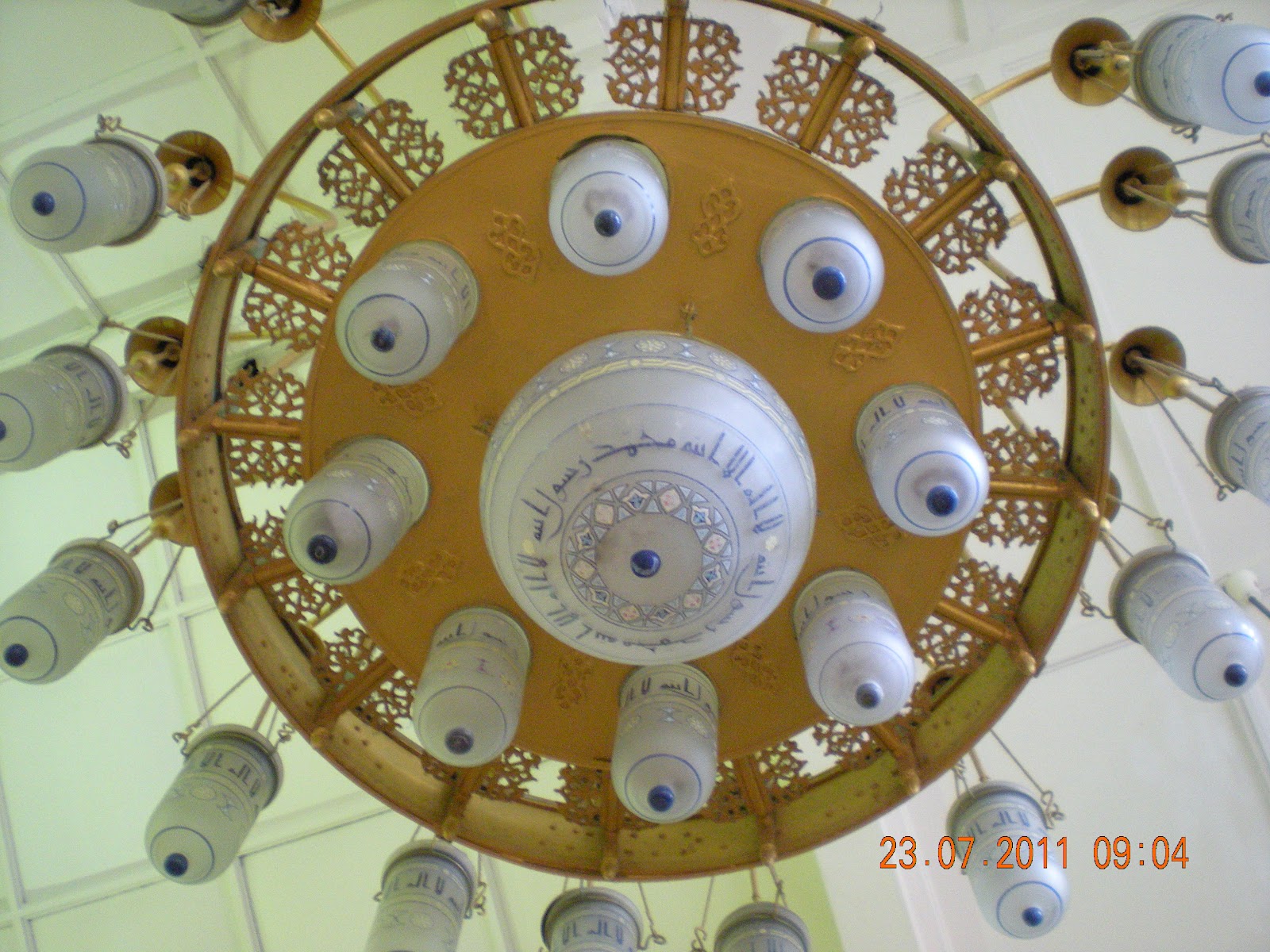 |
| Enormous chandelier in the lobby. The white frosted light bulbs bear light blue Islamic calligraphy, accompanied by light pink floral motifs. This is the cover photo for the book, Biography of the Early Malay Doctors 1900-1957 Malaya and Singapore. |
 |
| Different view of the same chandelier. |
 |
| Front lawn and nursery |
 |
| Map showing all the entrances (gates) of Masjid Sultan and the 4 roads that surround it. The main road where you see buses and traffic lights is North Bridge Road. Kandahar St separates the mosque from Istana Kampong Gelam. Muscat St separates the mosque rear from the shops. Arab St runs parallel to Kandahar St. |
 |
| Entrance to Makam is closed off |

 |
| Makam Sultan in front of Masjid Sultan. The last sultan of Singapore at the time of Raffles, Sultan Hussain, was not buried here. He was buried behind Masjid Tranquera (Masjid Tengkera) in Malacca. There are better photos in the Facebook album of Tengku Aziz, a descendant of the last Singapore Sultan. |
 |
| Masjid Abdul Gaffoor |
 |
| Second generation Ahmad Mohamed Salleh Angullia in The Who's Who in Singapore 1963. (Article was obtained from USM library in Penang.) |
 |
| Second generation AMS Angullia and family as featured in The Straits Times, Friday, 5 August 1988. From humble traders to rich land-owners. (This newspaper article was received from Dr Mohamed Tahir, who in turn received it from AMS Angullia. The article was e-mailed to me on 22 March 2012.) |
 |
| Masjid Angullia (from Google Maps). |
Masjid Abdul Aleem Siddique
 |
| Abdul Aleem Siddique |
 |
| Abdul Aleem Siddique |
 |
| Footprints on the Journey of Human Fellowship, written by Zainudin Mohd Ismail, Jamiyah Singapore. Download from: http://www.jamiyah.org.sg/Arabic/sharing%20file/footprint.pdf
Untitled
His Holiness Hazrath Maulana Shah Mohamed Abdul Aleem Saheb Siddiqui Al'quadri, etc., the well-known qualified theologian of Meerut City, India, addressed a large gathering at the Aljunied Islamic School, Victoria Street, last Sunday on the subject "How to understand the Holy Quran." Among those present were Mr Soon Kim, Syed Abdul Rahman Aljunied, Mr A.M.S. Angullia, Haji Manjoor Saheb, and many other prominent Mohammedans. Dr H.S. Moonshi also addressed the gathering.
|
 |
| Masjid Abdul Aleem Siddique (from Google Maps). |
 |
| Masjid Abdul Aleem Siddique (via StreetView in Google Maps). I was informed by Dr Mohamed Tahir that this mosque now has a beautiful interior. The front wall and the mihrab (prayer pulpit) have a lot of Islamic calligraphy relief and they were made by artisans from Morocco, who were specifically flown in just for the renovation of this mosque in 2005. All photos below are from Masjid Abdul Aleem Siddique gallery which I found in Picasa. |

Interior of dome and spacious prayer hall
 |
| Qiblat, mihrab and front of mosque interior |
 |
| Al-Asma al-Husna calligraphy all over on the walls. Syahadah calligraphy inside the mihrab. Even the mimbar/lecturn has Islamic geometric designs and objects. |
 |
| Beautiful al-Asma al-Husna calligraphic relief on the back wall |
 |
| Spacious prayer hall |
Masjid Kassim
Masjid Ba'alawie
Can be found using Google maps. It is a small old mosque. Tan Sri Prof Ahmad Ibrahim used to come here. The Arabic Al-Attas (Alattas) family used this mosque. The Al-Attas families can be found in Indonesia, Singapore and Malaysia.
Masjid Chander Road
http://pictures.nl.sg/SearchByTag.aspx?tag=Chander%20Road
The location can be found using Google maps - it points to an empty plot, just grassland with a blue zinc fence. This is an old mosque and has been pulled down. A 1984 photo can be found here:
http://pictures.nl.sg/2d8cc929-8e95-4dcd-9bfc-754ea116bdf5.aspx
Among the jemaah here were Ismail Ballah, Dr Mohamed Ibrahim bin Ismail and Tan Sri Prof Ahmad Ibrahim. When the newspapers published Ismail Ballah's demise, it could have pointed to the Muslim community here. "Arab" was used to refer to the Indian Muslims. Today, the Indian Muslims are grouped as Malay. The Chander Road mosque was within Little India.

 |
| Street scene in Little India |
http://www.hjmuhdsalleh.org.sg/Templates/1.html
Nearby is Makam Habib Noh which has an interesting history. The descendants of Habib Noh can be found in Penang and elsewhere. Habib Noh's close friend was Haji Muhammad Salleh @ Nakhoda Nan Intan, whose grave lies at the graveyard adjoining Masjid Batu Uban in Penang. Batu Uban was the first Malay settlement in Penang before Captain Francis Light arrived on the island.
Other mosques:
http://en.wikipedia.org/wiki/List_of_mosques_in_Singapore
Subscribe to:
Posts (Atom)


