
Showing posts with label Datuk Jenaton. Show all posts
Showing posts with label Datuk Jenaton. Show all posts
Wednesday, 17 October 2012
Independence of British, Spanish & Japanese Colonies in SEA
QUESTION 1
It is interesting to reflect on why Malaya achieved its independence 9 years later than nations which achieved their independence in the late 1940s. Have you ever wondered why? Why? Why was Malaya slow in achieving its independence? What actually went on or went wrong?
Philippines' independence: 12 June 1898 (from Spain)
Indonesian independence: 17 August 1945 (from Japan)
India's independence: 15 August 1947 (from Britain)
Malayan independence: 31 August 1957 (from Britain)
Singapore's independence: 31 August 1963 (from Britain); 9 August 1965 (from Malaysia)
QUESTION 2
Who were the people behind Malaya's independence?
1) Mustapha Hussain (second person in KMM; his youngest daughter is Insun Sony Mustapha Fenner. Insun Sony is in Facebook. Insun Sony wrote 5 books about her father.)
2) Yusof bin Ishak (he was the first President of Singapore; a relative of Mustapha Hussain; both were descendants of Datuk Jenaton)
3) Burhanudin Helmy (he was KMM leader; he was an early Malay doctor)
4) Other??
QUESTION 3
What was the origin of the Malay reformers for the Malayan independence?
1) Datuk Jenaton (Datuk Jenaton group is in Facebook. The history of Datuk Jenaton is at a different website given in Insun Sony's Facebook.)
2) Pagarruyung (the Pagarruyung palace was razed to the ground in the battle called Perang Paderi. Many Malay princes escaped to Malaya at that time.)
3) West Sumatra (the Arab descendants of the Minangkabau princes could have come from Aceh. The Arabs of Aceh had significant control over the region before the arrival of the Dutch East India Company.)
4) Other??

Friday, 1 June 2012
The Founding of Penang (2)
I returned to Penang Museum for the third time on Sunday, 27 May 2012. This time I focused on a few things - Penang, Francis Light, Nyonya and Japanese war. This third visit was my youngest daughter's first visit to the museum. My husband and I were her tour guides. She liked the displayed items but she did not seem too interested or enthusiastic. At one point, she just sat on the bench with her father, and waited for me. Why wasn't she interested in Penang Museum? I don't know. Maybe she had something else in mind.


There was one instance she asked what the displayed items were, and I told her they were for opium smoking. She asked, 'apa tu'? I said, 'hisap dadah' and she immediately understood. I showed her the large wooden bench by the display where the opium smokers and addicts would sit or lie down to smoke. She found it strange and we moved to the Baba Nyonya section.
The Baba Nyonya section was interesting. I was after the kebaya pendek as I had missed them at the last two visits. This time I needed to see up close what sort of embroidery they did. I saw a familiar kebaya pendek that could have belonged to my mother. It may be that two women bought the same material to make kebaya pendek.
 |
| Penang is Pulau Pinang from before the arrival of Francis Light. It is still Pulau Pinang today. Penang referred to the areca fruit and nut, which is the fruit of the pokok pinang (pinang tree). |
 |
| Majlis Perbandaran Pulau Pinang (MPPP) metal plate for a manhole in the pavement |
 |
| Penang inscription stone that describes its name. The MPPP plate can be seen at the top edge of this pic. |
 |
| Penang inscription stone and the MPPP metal plate |
THE GOVERNORS OF PENANG
Images are from Penang Museum
 | |
| 1. Captain Francis Light, Superintendent, 1786 - 1794 2. Philip Manington, Superintendent, 1794 - 1795 3. Thomas Pigou, Acting Superintendent, 1795 - 1796 4. John Beanland, Acting Superintendent, 1796 5. Major Forbes Ross Macdonald, Superintendent, 1796 - 1798 6. George Caunter, Acting Superintendent, 1797 - 1798, 1799 - 1800 7. Sir William Edward Maxwell, Acting Resident Councillor, 1887 - 1889 8. Francis James Anderson, Acting Governor, 1894 - 1895 9. Sir Robert Townsend Farquhar, Lieutenant-Governor, 1804-1805 10. Philip Dundas, Governor, 1805-1807 11. William Petrie, Acting Governor, 1812-1816 12. Robert Fullerton, Governor of the Straits Settlement and Resident Councillors, 1826-1830 13. William Peel, Acting Resident Councillor, 1917-1925 14. Prince Fushimi Hiroyasu, Governor, 1941-1942 15. Col. John Allen Harvey, Governor, 1945 16. Raja Sir Tun Uda Al-Haj bin Raja Muhammad, Governor, 1957-1967 | |
 |

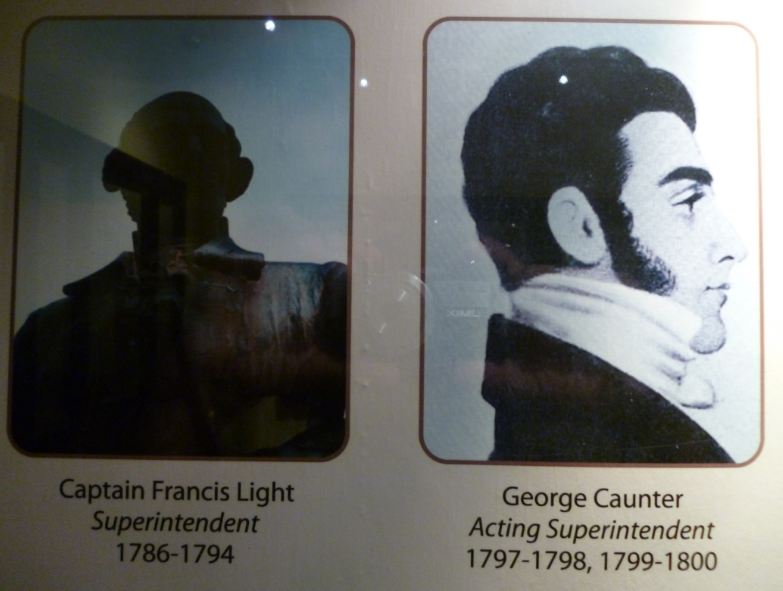


GOVERNORS OF PENANG
1. Raja Sir Tun Uda Al-Haj bin Raja Muhammad, Governor, 1957-1967.
2. Tun Tan Sri Syed Sheh bin Syed Abdullah Shahabudin, Governor, 1967-1969.
3. Tun Tan Sri Syed Sheh Al-Haj bin Syed Hassan Barakbah, Governor, February 1969 – February 1975.
4. Tun Tan Sri Dato' Seri Dato' Haji Sardon bin Haji Jubir, Governor, 5 February 1975-1981
5. Tun Datuk Dr. Haji Awang bin Hassan, Governor, 1 May 1981 - 1989
6. Tun Tan Sri Datuk (Dr.) Haji Hamdan bin Sheikh Tahir, Governor, 1 May 1989-2001
7. Tun Dato' Seri Haji Abdul Rahman bin Haji Abbas, Governor, 1 May 2001-present
 |
| Portrait from Penang Museum |
Yang Teramat Mulia Raja Tun Uda Al-Haj bin Raja Muhammad was born on 1894, Kuala Langat, Selangor. He was educated in Malay College, Kuala Kangsar in Perak. He joined the Government Service in 1910, and MAS in 1914. He was promoted to Class V, MCS in January 1924. He was appointed in 1939 as Secretary to the British Resident in Selangor, the first Malay to hold such appointment. In the post-war, he became an Officer of Class IB, MCS in April 1946 and Class IA, MCS in February 1948. He was officiated as the Deputy Commissioner (Interior), Selangor before being appointed as the first State Secretary, Selangor on the inauguration of the Federation of Malaya (FoM) Agreement on 1 February 1948. He became the Menteri Besar (MB) of Selangor on 1 July 1949. He relinquished the post on being appointed Commissioner for Malaya in UK in July 1953. He relinquished the appointment in UK in October 1954. On his return to Malaya, he was reappointed MB, Selangor in November 1954. On 24 August 1955, he was appointed as Speaker of Federal Council. He was a Member of the Selangor State Council and Federal Council till the Japanese invasion in 1941. He served in the Federated Malay States Volunteer Force (FMSVF) and others. He was conferred 3 British awards - the CBE in 1947; CMG in 1951; and the KBE in 1953. As the first Governor of Penang, he was also a Member of the Conference of Rulers. His recreational activities included tennis, golf and gardening. Source: Who's Who in Malaysia 1971-1972.
MAPS OF PENANG
GEORGETOWN, BATU UBAN, BUKIT DATUK JENATON, TANJUNG BUNGAH, BUKIT DUMBAR, GELUGOR, JELUTONG


 |
| The British arrived in Penang in 1786. The Sumatran Muslim Malays arrived in Penang in the early 1730s. Datuk Jenaton sailed with Nakhoda and they arrived in Kedah, and then made their way to Penang, arriving at Batu Uban. An early British map showed the paddy areas of these Penang Malays.. |
 |
| A large area was paddy |
 |
| The deepwater harbour was along Beach Street, from Fort Cornwallis right up to the Acheen Street Mosque (Masjid Melayu Aceh), and onward to Jelutong at Masjid Jamek Jelutong. The Indian gold retailers operated not far from the wharf. Masjid Kapitan Keling is very near to the wharf at Beach Street. |
 |
| The Queen Victoria clock tower is at right in the pic above. The government offices are in the long building in the centre foreground. A few ships can be seen at 10 o'clock. |
PEOPLE OF PENANG

 |
Penang Malays cleared lands for cultivation of pepper and areca nut - major cash crops of Pulau Pinang. The British brought in the Chinese and Indians for agricultural purposes and labour. Thus, these 3 communities co-existed in Penang during colonial rule. The Penang Malays existed longest on Penang island. They were originally from West Sumatra, and they came via land and sailed the Straits of Malacca, pushing off from Batu Bara in East Sumatera, and arriving in Kedah, before sailing to Penang - on the sheltered side of the island. The Portuguese had earlier arrived on the unsheltered side of the island - at Ferringhi, the Arab word for Portuguese. The curved coastal stretch from Gurney Drive to the end of Batu Ferrighi forms North Bay. The West Sumatran people were of Minangkabau stock and one great man (Datuk Jenaton) married a lady of Arab-Chinese extract. This marriage started the Minangkabau-Arab-Chinese roots of the Datuk Jenaton clan in Penang, Kedah, Perak, Kuala Lumpur, Kelantan and elsewhere.
|
 |
| Plaque at the cemetery gate on Northam Road (Jalan Jutawan). This plaque is in 4 languages. |
 |
| Protestant & Catholic graves where famous people in Penang history were laid to rest. A lot of the graves here were not well-looked after. There were fallen headstones and some graves were in complete ruins. YouTube video: Captain Francis Light's grave. |
Tuesday, 29 May 2012
Tanah Datuk Jenaton
Makam Datuk Jenaton is in Minden Heights, which is beside the Universiti Sains Malaysia (USM) campus in Penang.
Why is Datuk Jenaton important?
From a historical perspective, Datuk Jenaton was awarded a large piece of land on Penang island by a sultan of Kedah, for his deeds, for saving the Kedah Sultanate from Siamese attack. The Kedah Sultanate is probably the second oldest of the Malay sultanates in present-day Malaysia. It was under constant attack by Siamese forces from the north. Datuk Jenaton and his followers helped saved the Kedah Sultanate from the last of the Siamese attacks. In this respect, his deeds to the Kedah Sultanate cannot be simply forgotten in the folds of history. Had he lost that battle with Siam, we would not have old Malaya and modern Malaysia today - we would be part of old Siam and modern Thailand today. We would be speaking and writing Thai. Sawad dee khap?
What land was he awarded? Why is it important to know?
From various accounts written about him and his land, we know he was awarded a large piece of land covering what is today Minden Heights, USM, and maybe Kampung Batu Uban. Kampung Batu Uban is another historical village. We will need all the old maps of Penang and all related documents that have his name written. Places which may still have these old documents would be Penang Town Council and also the construction company that had made Minden Heights. I have not the faintest clue which construction company was involved with building Minden Heights, but I suspect it is a Chinese company and my Chinese grandmother's handsome young Chinese friend named Mr Ang, who also had construction projects (bina masjid) in the Arab states. I don't have any other clues in mind at present.
Was he the original settler?
From a historical perspective, Datuk Jenaton and his elder brother-in-law (abang ipar) Nakhoda Intan, had arrived in Batu Uban and Masjid Batu Uban was constructed in 1734. When he was awarded the land by the sultan of Kedah, he would be the first settler to open the land which was awarded to him (the area was a virgin forest). The British arrived in 1876 when Francis Light dropped anchor in Penang waters. The British developed Tanjung Peniaga/Tanjung Pinang as their administrative stronghold.
How did his land become Minden Heights?
It is a long story. His land was probably taken by force(?) or negotiated to build Minden Barracks, which is now USM main campus in Penang. Then the Minden Heights housing scheme was made in the early 1970s - 1971 to be exact. The housing scheme was designed by my grandfather who is my mother's father. I will tell you a bit about Minden Heights where my late grandfather's and my mother's houses still stand - side by side. My grandfather's house is the oldest house on site, in Minden Heights - it was built around 1970.
History of the Minden Heights housing scheme
In 1958, Dr Che Lah retired from Pahang early and returned to Penang. He had 3 houses built consecutively in Penang, over some 20 years. His first residence was near Dr SMA Alhady's house, along Jalan Sultan Azlan Shah. His second residence was up on Lengkok Pemancar. His third and last residence was built in Minden Height, or rather, Tanah Datuk Jenaton. Dr Che Lah worked in his post-retirement years, as a designer for the Penang Town Council. He worked at various jobs too.
When Dr Che Lah started working on designing the housing scheme for Minden Heights, he first built his wooden bungalow on site, at the corner of Jalan Minden 1 and Jalan Minden 7. His house still stands at the original site - dilapidated with time, and the metal parts rusty from the salty sea breeze nearby. The sea was nearby before Penang bridge was built and land reclamation activities started. USM new campus was just recently constructed in 1969.
In the early 1970s, Minden Heights was virgin forest, really thick jungle - this I saw as I was in Form 1 and I had spent my school holidays with my grandfather and stayed with him. We sat and discussed the design for Minden Heights housing scheme. It was a difficult project. He was at the designing stage and everything else in the area was jungle - very green and very thick! At first I had thought my grandfather was crazy to have abandon his mansion uphill and come to live in a wooden house downhill. Orang Melayu kata buang tebiat. I asked my mother if my grandfather was ok. He was ok. He wanted to sell off his mansion and had his 3rd residence built in Minden Heights.
At the time he (Dr Che Lah) was planning and designing, I had heard the name Datuk Jenaton being mentioned. It was mentioned in almost every conversation and that name left an impression in me. Not knowing the actual problem, I had misconstrued and had thought that Datuk Jenaton himself refused to give up his land and that caused my grandfather to face difficulties proceeding with the housing project he had to do for the Council.
As a young teenager (Form 1), I had no idea of the significance of Datuk Jenaton, but my grandfather and my uncle (Uncle Din) had great respect for him - they spoke of him with great respect. In actual fact, the Minden Heights housing scheme that my grandfather had to do, was actually on Datuk Jenaton's land - this very land we call Minden Heights today (in Malay, we call it Cangkat Minden, which refers to a hillock, not a bukit or hill and certainly not a bukit tinggi or highland). About half of Datuk Jenaton's land is USM and the other half is Minden Heights housing area or scheme.
Minden Heights is a well-planned housing area in this part of Penang island. Some of Penang's super rich tawkays live here. When my grandfather designed Minden Heights, he had allocated a lane and 2 rows of low-cost housing for the poor Indians and Malays. My grandfather's house stands at the start of this 'poor man's row'. I cried when my mother related this to me. It was sheer disbelief on my part that my once super duper rich grandfather wanted to live in a poor man's row. But my grandfather only smiled and never regretted his idea of living on the poor man's row (Minden Jalan 7). My mother had explained to me, my grandfather sold his 2nd residence to help pay for my uncle's education in Australia, and all he was left with was this wooden home in Jalan Minden 7. All his other lands and landed properties in Cherating and KL had been given away too - FOC. My grandfather was preparing for his last farewell, and evidently another life. Minden Heights was the last project he designed for Penang. I don't know what or which model he had used but I suspect he followed an Australian model for the Minden Heights housing scheme.
There are some credibly famous roads in Minden Heights. The main road is Minden Jalan 1. Rich and expensive homes lie along Minden Jalan 1. Houses on this road are in the range of RM3 million and above. Poor man's row is Minden Jalan 7 (even millionaires live here today). My late mother's house is in Minden Jalan 7. Minden Jalan 5 was where USM expatriates once lived when the USM medical school was based at USM in Penang, before it shifted to Kubang Kerian, Kelantan in May 1990.
When Minden Heights was first designed, the roads did not reach far inward. I remember, the perimeter of Minden Heghts was only up to the playground. Later, it expanded to join Minden Heights to Brown Garden (Taman Brown) which is next door, and which also opens into Taman Sardon and the adjacent biggest modern fresh market. Almost everybody in the vicinity of Minden Heights knows the Taman Sardon market. It is the cleanest fresh market in Penang. During my grandfather's time as Penang Health Inspector, the markets must be clean and not sting or smell. But that is old news.
Anyway, coming back to Minden Heights, this area is also famous for another thing - it houses Makam Datuk Jenaton, the Malay hero and warrior who saved Kedah from Siam (more in the next post).
Sunday, 27 May 2012
Tok Chu
I spent the entire day today outside the house. I met with Tok Chu (husband & wife), the parents of Prof. Ahmad Murad Merican. This was the first time we met. We met at his residence in Ayer Itam, and I interviewed both of them. Tok Chu knows a lot about Penang history. He can remember street names, people and events.
See updates on 22 August 2013.
HOW I MET TOK CHU
25 May 2012 - I left a note in the Facebook account of Datuk Jenaton group.
26 May 2012 - I received a hp# of a lady (Kak Yang Kalsom).
26 May 2012 - My husband Affandi called Kak Yang Kalsom as I had the pictures to edit and upload. She SMS and informed of Tok Chu, who would have the key to Datuk Jenaton's graveyard in Minden Heights. Since it was about 1 am, I didn't call the # provided. It was a good thing I did not call.
27 May 2012 - Affandi called Tok Chu and asked about the key to the graveyard. Tok Chu said to come and see him. We went over to Tok Chu's house in Ayer Itam. Earlier after breakfast I checked Google Map for directions to his residence. The landmarks he gave were Kuil India and Kg Melayu.
HOW TO GET TO TOK CHU'S HOUSE
AYER ITAM
Tok Chu lives in Ayer Itam in Penang.
AYER ITAM
Tok Chu lives in Ayer Itam in Penang.
We decided to go down Jalan Masjid Negeri (old street name, Green Lane). We passed by Jalan Thean Teik - a narrow congested road, and the BHP petrol station on the left. We passed by Jalan Satu on the left. We passed by the Indian temple on the right (Affandi recognised the temple first) - I took some photos of the temple. Then we reached the turn-off for Jalan Dua and finally Jalan Kg Melayu on the left.
JALAN KAMPUNG MELAYU
We followed Jalan Kg Melayu to Jalan Ayer Itam and got lost. We U-turned at the school and went back on Jalan Ayer Itam till we reached Jalan Pisang Embun. All the roads here were named after bananas. We turned right into Jalan Pisang Embun and went right till the end. Tok Chu's house is on the right, at the end of the row.
When we arrived, Tok Chu was outside sweeping his porch. We parked in the street (turn right) after his house. Tok Chu met us at his front gate and was happy to see us. He's 83 and still strong. He called out to his wife (also called Tok Chu) and she came to greet us at the door. Tok Chu invited us in and we went inside.
We started with introducing ourselves. I said I am looking for the key to Datuk Jenaton's graveyard and that we had been there yesterday. I introduced myself as the 10th generation of Muhammad Saleh of West Sumatra (who was well-known as Nakhoda). I also introduced myself as a granddaughter of Dr Che Lah. Once Tok Chu knew where I stand, it was easier to talk as relatives, rather than interviewer-interviewee.
WHO IS TOK CHU?
Tok Chu is Mohd Noor Merican bin Ahmad Merican bin Osman Merican. He was born on 13 June 1929 in Penang and grew up in a big bungalow, now lies empty beside the Chinese girls' school in Jalan Dato Keramat. His mother was Zaleha bt Haji Yasin.
Tok Chu worked as an apprentice surveyor in Sungai Petani. He resigned after working less than a year, for some reason he explained but which I couldn't understand. He then returned to Penang and was with the City Council of Georgetown for 25 years, then with LLN and later TNB. He's retired 25 years ago in 1984.
TOK CHU'S FATHER-IN-LAW
Tok Chu's father-in-law was Haji Yasin, who was in charge of Masjid Titi Papan in Georgetown. Masjid Titi Papan is named as such because long ago the parit (drain) was large enough for sampan and tongkang to enter right up to the mosque. A wooden plank was used, and thus the mosque was named after the plank.
Haji Yasin was a goldsmith from Medan in Sumatra. His workplace was at Kinta Lane and later in Burma Road. According to Tok Chu's wife, last time there was no lock and key to keep the gold and gold ornaments safe at home. Haji Yasin had to hide his gold ornaments, stuffing them in between anything - books, clothes, etc. That worked fine.
Tok Chu showed us the Silsilah sheet for Datuk Jenaton and other ascendants. From what I understand Haji Muhammad Saleh (Nakhoda) had 4 siblings - an elder brother, himself, a younger brother and a youngest and only sister. Datuk Jenaton married the youngest and only sister of Muhammad Saleh. Thus, they became related by way of marriage. They were also blood relatives even before marriage as their ancestor cousins married in Sumatra. Datuk Jenaton was the younger brother-in-law of Nakhoda.
PENANG MALAYS
BURMA ROAD
BURMA ROAD
Tok Chu said long ago, Burma Road was a Malay place with many Malay families. Sir KM Ariff's house was opposite the Telekoms (I have not seen this location).
CHOWRASTA SCHOOL
TRANSFER ROAD
TRANSFER ROAD
The Chowrasta School moved at least 2 places - Transfer Road and Jalan Hatin.
JALAN HATIN (old street name was Hutton Road)
The present Chowrasta School is at Jalan Hatin.
THE EARLY MALAY DOCTORS
Tok Chu knew Dr Che Lah bin Md Joonos.
PENANG ARABS
Tok Chu's wife said a lot of Arabs reside in Batu Uban and their graves are at the cemetery attached to Masjid Batu Uban. There are also a large number of them in Jalan Kelawei (Kampung Syed).
Tok Chu also knew Aziz Yamani (my paternal granduncle) who was popularly known as Abdul Aziz Al-Yamani. Aziz was an anglophile. He was of short stature and wore shorts and shirt with short sleeves. He did not come from Yemen (Yaman) but from Malacca. Aziz Yamani had a garage at the corner of Anson Road and Dato' Keramat Road. The British gave him the European car business. (I remember being at his garage in the early 1960s.) They also gave him a double-storey bungalow behind Masjid Jalan Hatin - the bungalow still stands today - it is a bright yellow building (photographed 9 Oct 2011 and 27 May 2012). According to Tok Chu, the house is before '7 hotel'. Aziz Yamani married Nenek Jepun. The mother and child (Mazalifah) often returned to Tokyo.
 |
| Front gate of Ami Aziz's residence. His house is the yellow bungalow behind the mosque (at far left, and partly hidden by the mosque in this pic). |
SMELTING WORKS
Eastern Smelting was initially at ______________? It is now just flats.
See updates on 22 August 2013.
TOK CHU's WIFE
Tok Chu's wife is Hendon bt Ahmad bin Abdullah. She was born on 2 August 1932. She has 5 elder brothers - Zainol Abidin, Zainudin, Mohamad Tahir, Ibrahim and Abdul Halim. Hendon is descended from Datuk Jenaton.
Subscribe to:
Posts (Atom)


